A strain is not a set of fish. It is a record of decisions. Breeders who hold a line for ten years are not lucky with genetics; they run a system that keeps enough variation alive to keep selecting, while holding the traits they care about steady. Breeders who lose a line usually lose it the same way: a few fish, a few generations of brother-sister pairings, then smaller fry, fewer females, curved spines, and a tank of fish that look right and produce nothing.
This guide is about the maintenance side of line breeding: how many founders you need, how to split a line into sub-lines and rotate between them, what the inbreeding numbers actually mean, when to cull, and when to bring in outside blood. It applies to guppies, platies, swordtails, and mollies alike. If you are still choosing a goal and building the first generations, start with our Selective Breeding Guppies Guide. For how traits are inherited, see Livebearer Genetics 101 and the Guppy Color Genetics Guide. This page picks up after both.
Line Breeding vs. Inbreeding vs. Outcrossing
The terms get used loosely, so here is how we use them:
- Inbreeding: mating close relatives (siblings, parent to offspring) repeatedly, with little control over which relatives.
- Line breeding: mating relatives on purpose to concentrate the traits of a specific outstanding ancestor, while tracking the pedigree so you know how related each pair is.
- Outcrossing: mating to an unrelated fish, usually of the same strain, to bring in fresh genetic variation.
The difference between inbreeding and line breeding is the notebook. Line breeding is controlled inbreeding with a plan, a pedigree, and an exit strategy.
Understand the Inbreeding Numbers
Geneticists measure relatedness with the inbreeding coefficient (F), the probability that two copies of a gene in an offspring are identical by descent. Standard textbook values for the offspring of common pairings:
| Pairing | Offspring F |
|---|---|
| Full siblings | 0.25 |
| Parent x offspring | 0.25 |
| Half siblings | 0.125 |
| Grandparent x grandchild | 0.125 |
| First cousins | 0.0625 |
| Unrelated | 0 |
A single generation of sibling mating at F = 0.25 means about a quarter of the offspring’s gene pairs are identical copies. That is how you lock in a trait, and also how you lock in hidden harmful recessives. Repeated sibling mating pushes F toward 1 within a handful of generations.
Livebearers carry an extra wrinkle: females store sperm, so a female that has been with several males can deliver a brood with more than one father. If a pairing matters, use a virgin female or isolate her for the full storage window before you trust the parentage. Hobbyists commonly report that stored sperm can fertilize broods for months, so a conservative approach is to treat a female as unreliable for pedigree work until she has dropped a few broods in isolation.
The practical goal is not zero inbreeding. It is keeping F moving slowly. Pairing half siblings or cousins instead of full siblings roughly halves or quarters the rate at which relatedness climbs, and that slower climb is what buys you more generations of selection.
Start With Enough Founders
A line begun from one pair has already hit its first bottleneck: at most four alleles at any gene, two from each parent. Everything the strain will ever express must come from those four copies. Hobbyist practice, echoed in most strain-keeper advice, is to start with several unrelated or distantly related pairs of the same strain and to keep as many distinct families going as space allows.
A workable rule of thumb for a small home line:
- Founding stock: at least 3 to 4 unrelated females and 2 to 3 males, from different breeders if you can.
- Working population per sub-line: a minimum of roughly 10 to 12 breeding adults, with more females than males.
- Unwanted narrowing: if a strain drops below about half a dozen females across all sub-lines, treat it as at risk and plan an outcross.
These are practical hobby guidelines rather than scientific thresholds, but they line up with the conservation-genetics principle that small populations lose variation quickly.
The Sub-Line Rotation System
This is the single most useful structure for holding a strain long term. Instead of one big tank of the strain, you keep the line as three or four separate sub-lines, labeled A, B, C, and D, each descended from a different founding family.
- Keep each sub-line in its own tank or fully divided section. Physical separation is the whole point, so nothing crosses by accident.
- Breed within each sub-line for one or two generations, selecting the best fish from the best broods.
- Rotate males between sub-lines. Move a top-grade male from line A to line B, and a top male from B to C, and so on, in a circle. Females stay put.
- Record every move. The offspring of an A male and a B female are tagged as such, so you always know their parentage.
Rotating males works because males are the easier sex to move and each one can sire many broods, so one good male does the work of several. It keeps every sub-line connected to the others without ever mixing the whole population into one tank. If one sub-line goes bad, the others carry the strain.
For tank setups that host multiple sub-lines on one rack, see our Best Breeding Rack Setup roundup and Colony Management for Livebearers.
Keep Records That Actually Work
A pedigree only helps if you can read it a year later. Assign every sub-line a letter and every generation a number, then tag each brood with both plus a date. A brood labeled B3-0412 tells you the sub-line, the generation, and the pairing date at a glance.
For each brood, write down:
- sire and dam (by brood code)
- number born, number surviving to 8 weeks
- number kept, number culled, and why
- notes on any deformity, small size, or low fertility
The survival numbers are your early-warning system for inbreeding trouble. A weaker brood on its own means nothing, but a slow downward trend across several generations in one sub-line is the signal to outcross that line.

Rite in the Rain Weatherproof Side Spiral Notebook
Best for Pedigree Records- ✓ Survives wet hands and splashes on a fishroom shelf
- ✓ Spiral binding lays flat while you sort and count fry
- ✓ One notebook per strain keeps pedigree history together for years
- ✗ Handwritten records are not searchable, so back them up in a spreadsheet
- ✗ Only useful if you log at the moment of observation
Our Best Breeding Log Templates roundup covers printable and spreadsheet options if you would rather keep digital records alongside the notebook.
Cull on a Schedule, Not on a Feeling
Selection only works if you actually remove fish that do not belong. Hobbyists who maintain strains successfully cull in stages:
- At birth to 2 weeks: remove obvious deformities (twisted spines, missing fins, fused gill plates).
- At 6 to 8 weeks: cull the slowest-growing third of each brood. Growth rate is a cheap, visible stand-in for overall vigor.
- At first color-up: keep only fish that show the strain’s core traits clearly. Be strict about the trait you chose as the standard and flexible about the rest.
- Adults: retire breeders that produce small broods or weak fry, regardless of how good they look.
The tough rule is to cull for vigor first and appearance second. A gorgeous male that sires weak fry damages the line faster than a plain male that sires strong ones. Whatever you do with culls (rehoming, feeding out, humane euthanasia) should be decided before you need it. Our Livebearer Fry Survival Guide covers the early-stage care that keeps the numbers honest.
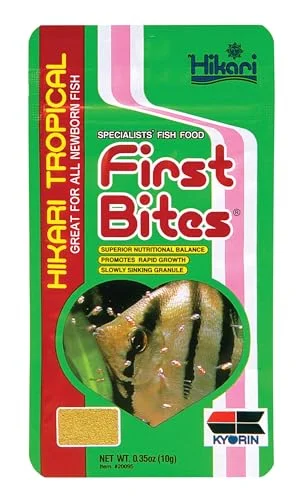
Hikari First Bites Slow-Sinking Granule
Best Fry Food for Even Growth- ✓ Fry-sized granules let every sub-line start on the same diet
- ✓ Even feeding makes growth-rate differences easier to read as genetics, not nutrition
- ✓ Low cost per feeding across several grow-out tanks
- ✗ Small container runs out quickly with several grow-outs
- ✗ Older juveniles need a larger pellet
Feeding every grow-out on the same diet at the same schedule matters here. If one tank grows faster because it was fed more, you will keep the wrong fish.
Equipment: Keeping Lines Physically Separate
The most common line-breeding failure is not genetics, it is a fry that crossed a divider. Plan the physical separation as carefully as the pairings.
Filters
Each sub-line should have its own filter so a disease or water problem in one cannot travel to the others. Air-driven sponge filters are the standard choice because they cannot trap fry and cost little when you need several.
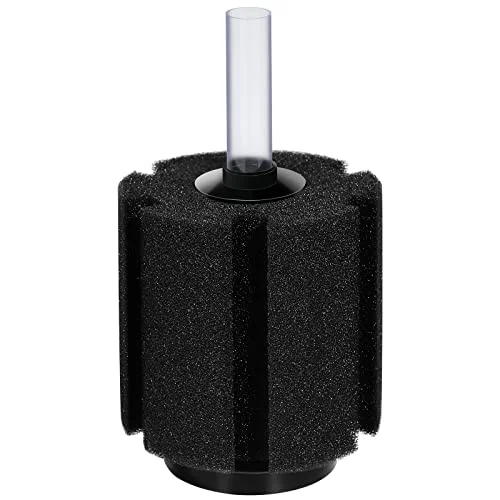
AQUANEAT Aquarium Bio Sponge Filter
Best Filter for Line Tanks- ✓ Sponge surface cannot suction fry, so it is safe in every line tank
- ✓ Cheap enough to give each sub-line its own filter instead of sharing water
- ✓ Seeded sponges can be swapped between tanks to start new lines already cycled
- ✗ Needs a separate air pump and airline tubing
- ✗ Bulky in very small tanks
Dividers
For adults, a perforated grid panel lets one tank host multiple sub-lines on identical water. Because newborn fry can slip through grid holes, treat grid panels as adult-only barriers and never rely on them to hold fry.
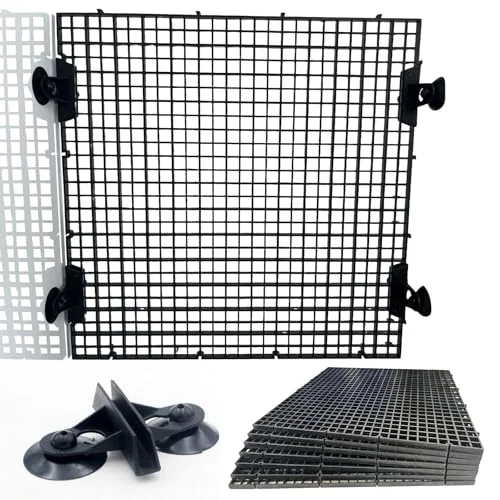
TQDXZA Aquarium Divider Panel (8-Pack Grid)
Best for Splitting One Tank into Sub-Lines- ✓ Lets one tank host two or three sub-lines on identical water
- ✓ Combinable panels fit most standard tank footprints
- ✓ No drilling or permanent modification
- ✗ Holes are wide enough for newborn fry to cross, so use it for adults only
- ✗ Suction cups need reseating from time to time
When you need true fry-tight separation within a single tank, a solid clear divider is the safer pick. Give each side its own sponge filter, since water will not pass through.
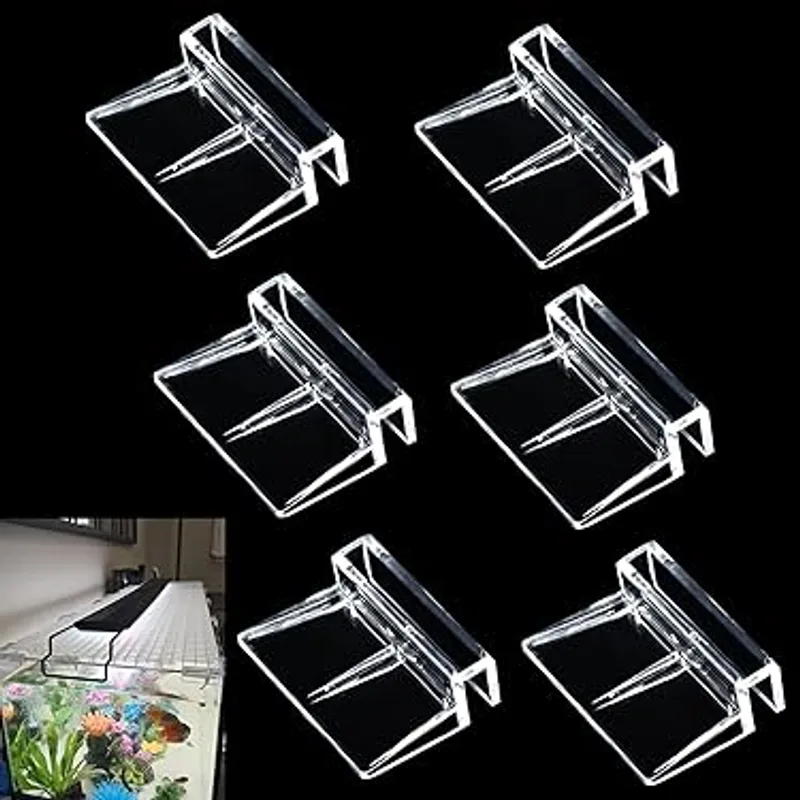
CVUTOVO Clear Tank Divider
Best for Fry-Tight Separation- ✓ Solid panel keeps fry and adults of different lines physically apart
- ✓ Clear material makes side-by-side comparison of two lines easy
- ✓ Cheaper than adding a second tank and heater
- ✗ Water does not circulate through the panel, so each side needs its own filter
- ✗ Fit depends on the tank, so measure the interior width first
Our Best Breeding Dividers roundup compares more options.
Breeder Boxes for Controlled Pairings
When a pairing matters, isolate the female and collect the brood in a box so the fry are unmistakably hers.
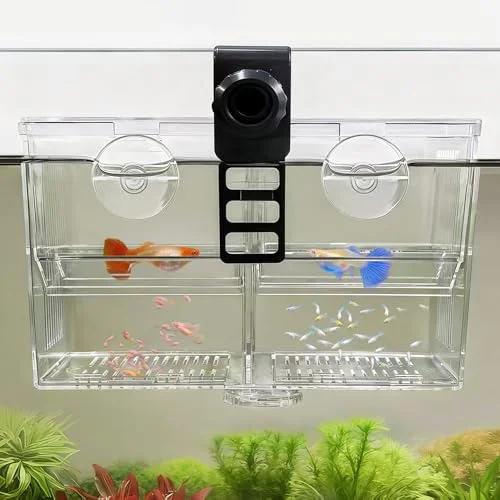
BaoZqua Dual-Chamber Fish Breeder Box
Best for Controlled Pairings- ✓ Isolates a specific female so every fry can be assigned to a known pairing
- ✓ Two chambers protect fry from the mother after birth
- ✓ Inexpensive enough to run one per planned pairing
- ✗ Small volume stresses larger swordtail and molly females
- ✗ A temporary holder only, since fry need a grow-out tank within days
See Best Breeder Boxes for alternatives, including larger boxes better suited to swordtails and mollies.
When to Outcross
Line breeding has a ceiling. Plan the outcross before you need it, not after the line collapses. Signs it is time:
- Brood sizes and survival rates trending down across several generations in a sub-line
- Rising rates of deformities, curved spines, or poor fin growth
- Male fertility problems, or females failing to produce after good conditioning
- Sub-lines starting to look identical, which can mean variation is running out
When you do outcross, use an unrelated fish of the same strain whenever possible, so you refresh variation without importing a different pattern. Breed the outcross fish into only one sub-line at first. Pick the best offspring of that cross and keep them as a new family, rather than blending them into everything at once. That way, if the outcross brings an unwanted trait, you have not contaminated the entire strain. Keep one sub-line completely untouched as a backup. The Selective Breeding Guppies Guide goes deeper on outcross timing and backup lines for guppies in particular.
Species Notes
- Guppies: Many traits are Y-linked, so the male line carries the pattern. Rotating males is especially effective, and the Guppy Strains and Color Guide is worth reading alongside this one.
- Platies and swordtails: Strains often carry mixed ancestry between the two species, so record the source of each founder. Mixed-species lines can show unexpected traits when relatedness climbs.
- Mollies: Larger and slower-maturing, so generations take longer and each sub-line needs more tank volume. Plan fewer sub-lines and more space per line.
Across all four, warm, stable water and consistent feeding keep growth comparable between lines, so differences you see are more likely to be genetic. Outdoor setups in warm southern climates can run from about March through October in USDA Zones 7-9, and guppies need water at 65°F or above, so move outdoor sub-lines indoors before the first cold nights.
Frequently Asked Questions
How many generations of line breeding can a strain take?
There is no fixed number. Strains stay healthy for years when they are split into sub-lines, rotated, culled for vigor, and outcrossed when survival numbers dip. Strains kept as one tank of siblings often show problems within a few generations.
Is sibling mating always bad?
No. A single sibling cross is a common tool for fixing a trait, and many strains were built that way. The trouble comes from repeating it without records or without selecting for vigor. Mix in half-sibling and cousin pairings to slow the climb.
How do I know if my line is inbred too far?
Watch survival to 8 weeks, brood size, and deformity rate across generations. A steady decline in one sub-line is the clearest warning. Hobbyists also report smaller adult size and lower male fertility as late signs.
Can I line breed with only one tank?
You can, but you give up most of the safety net. A solid divider with a filter on each side lets one tank hold two sub-lines, which is far better than a single mixed group.
Should I outcross to a different strain or the same strain?
Prefer the same strain from an unrelated breeder. That refreshes variation while keeping the traits you want. A different strain is a new project, not a refresh, and it typically takes several generations to clean up.
Do I need to track every fish?
No. Track every brood. Brood-level codes tell you parentage, generation, and sub-line without tagging individual fish.
Conclusion
Line breeding works when it is treated as a system. Start with enough founders, split the line into three or four sub-lines, rotate males between them, cull for vigor before looks, and write everything down. Slow the inbreeding climb with half-sibling and cousin pairings, and outcross to the same strain from an unrelated breeder when survival numbers slip.
If you are buying gear first, our top pick is the sponge filter and a solid divider so each sub-line has its own clean water, followed closely by the pedigree notebook, which costs the least and prevents the most mistakes. The runner-up spend is the grid divider panel for adult sub-lines. The notebook habit matters more than any single piece of equipment.