AquaRanked is reader-supported. When you buy through links on our site, we may earn an affiliate commission.
The sponge filter vs. HOB filter debate is one of the first decisions new fishkeepers face — and experienced breeders revisit it every time they set up a new tank. Both filter types are legitimate, widely used, and capable of keeping fish alive and water clean. But they have very different strengths, and picking the wrong one for your specific situation costs money and causes headaches.
Sponge filters are cheap, silent, and completely safe for shrimp and fry. HOB filters move more water, handle heavier bioloads, and are easier to swap media in and out. Neither is universally better. What matters is matching the filter type to the tank’s inhabitants, size, and purpose.
This comparison breaks down both filter types with real product examples from each side, so you can make the right call for your setup.
| Aquarium Co-Op Sponge Filter Best Sponge Filter | Hikari Bacto-Surge Foam Filter Best Dense Foam | AquaClear 20 Power Filter Best HOB Filter | Seachem Tidal 35 Power Filter Best HOB Premium | |
|---|---|---|---|---|
| Rating | 9.3/10 | 8.9/10 | 9.4/10 | 9.1/10 |
| Price | $8-$13 | $9.27as of Sep 27, 2026 | $41.99as of Sep 27, 2026 | $46.37as of Sep 27, 2026 |
| Sizes | Nano, Small, Medium, Large | Mini, Small, Large, XL | — | — |
| Tank Range | 2-100+ gal | 5-125 gal | — | — |
| Drive | Air pump required | Air pump required | — | — |
| Shrimp Safe | Yes — 100% | Yes — 100% | With prefilter sponge | With prefilter sponge |
| Tank Size | — | — | 5-20 gal | Up to 35 gal |
| Flow Rate | — | — | 100 GPH | 130 GPH |
| Adjustable Flow | — | — | Yes | — |
| Media | — | — | Open basket — customizable | Open basket — customizable |
| Self-Priming | — | — | — | Yes |
| Surface Skimmer | — | — | — | Yes |
| Check Price → | Check Price → | Check Price → | Check Price → |
Prices change daily — tap Check Price for the current Amazon price. Numbers shown were verified on the "as of" date.
How Each Filter Works
Sponge Filters
A sponge filter is a foam block connected to a lift tube. An air pump pushes bubbles up the tube, creating a gentle upward current that draws water through the sponge. Mechanical filtration happens as debris gets trapped in the foam pores. Biological filtration happens as beneficial bacteria colonize the enormous surface area inside the sponge.
That is the entire system. No moving parts in the water, no impeller, no exposed intake slots. This simplicity is both the sponge filter’s greatest strength and its main limitation.
What they do well: Shrimp safety, fry safety, aquarium cycling, and biological filtration for lightly stocked tanks. A sponge filter can run indefinitely without replacement — you never throw it away, just rinse it in old tank water.
Where they fall short: Flow rate. A sponge filter driven by a standard air pump moves maybe 30-80 GPH depending on size. For a heavily stocked 20-gallon community tank, that might not be enough. Sponge filters also do not offer chemical filtration (activated carbon) unless you buy a dual-chamber model.
HOB (Hang-On-Back) Filters
A HOB filter clips onto the tank rim, pulls water up through a submerged intake tube, runs it through a media basket inside the filter body, and returns it through an overflow cascade back into the tank. The impeller-driven pump moves significantly more water than a sponge filter — a compact unit like the AquaClear 20 moves 100 GPH, and larger models move 200 GPH or more.
The media basket can hold mechanical foam, biological ceramic rings, and activated carbon simultaneously. This gives HOB filters more versatile filtration options than a basic sponge filter.
What they do well: Handling heavier fish loads, providing chemical filtration (carbon, Purigen), and oxygenating water through the waterfall return. They are also easier to maintain because the media is directly accessible — no air lines, no disconnecting anything.
Where they fall short: The intake tube. Without a prefilter sponge attached to the intake, a HOB will trap or injure baby shrimp and small fry. HOBs also produce waterfall noise and increase evaporation through surface agitation.
Detailed Reviews
Aquarium Co-Op Sponge Filter
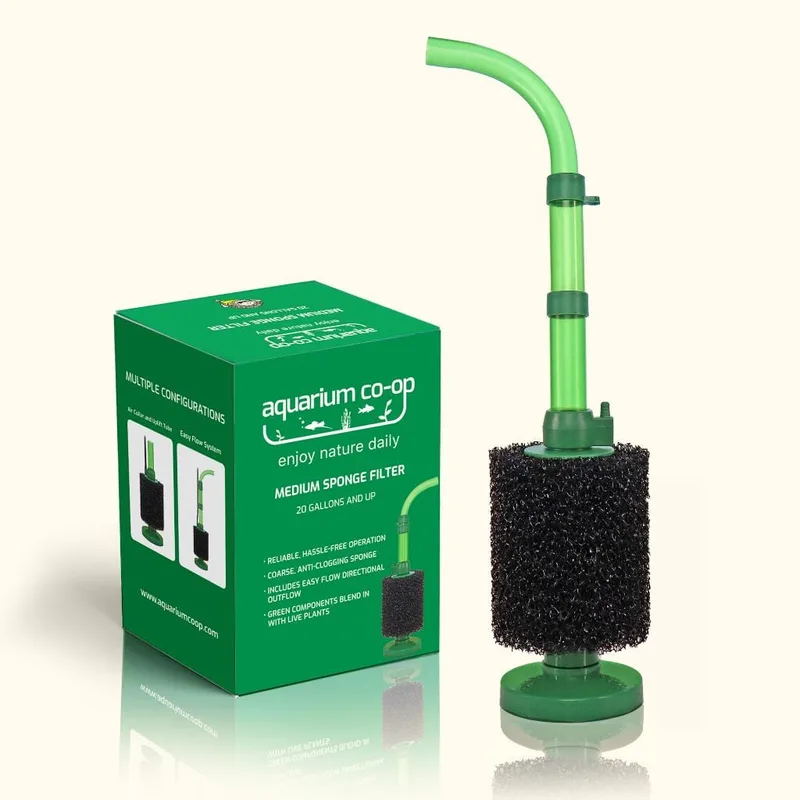
Aquarium Co-Op Sponge Filter
Best Sponge Filter- ✓ Coarse pore foam resists clogging — longer intervals between cleanings
- ✓ Weighted base stays put without suction cups
- ✓ Four sizes cover nano to large tanks
- ✓ Zero exposed intake — safest option for shrimp and fry
- ✗ Only sold direct — not available on Amazon
- ✗ Requires an air pump and tubing to run
The Aquarium Co-Op sponge filter is the standard against which other sponge filters are measured in the freshwater hobby. The coarse foam — coarser than most competitors — has a counterintuitive advantage: it clogs slower. Dense foam produces better mechanical filtration initially but needs rinsing every week or two. The Co-Op’s coarser foam traps debris without clogging, giving you 2-4 week intervals between cleanings in most setups.
The weighted base is a small but meaningful design improvement. Most sponge filters rely on suction cups that eventually fail and let the filter float. The Co-Op filter sits on a stable weighted base that holds position in gravel or bare-bottom tanks. In a shrimp colony tank, you do not want to be chasing a floating filter around.
For running a breeding rack with 10-20 tanks, the economics are hard to beat. A small Co-Op sponge filter runs about $8. Run them off a central air manifold with a single large pump and your cost per tank is minimal. This is the operational model used in most serious livebearer and shrimp breeding rooms.
Best for: Shrimp tanks, fry grow-out tanks, breeding rack setups, and any situation where cost-per-tank matters.
Hikari Bacto-Surge Foam Filter
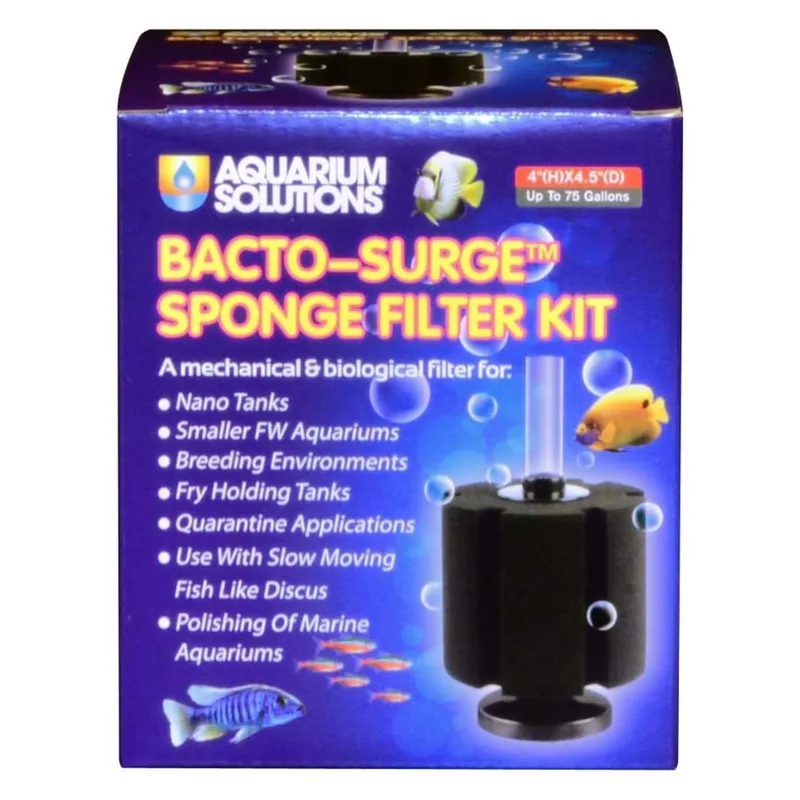
Hikari Bacto-Surge Foam Filter
Best Dense Foam- ✓ Dense foam catches very fine particles — better mechanical filtration
- ✓ Wide size range from mini nano to 125-gallon tanks
- ✓ Large biological surface area colonizes quickly
- ✓ Established brand with a long track record in the hobby
- ✗ Dense foam clogs faster — needs rinsing every 10-14 days
- ✗ Lighter base requires suction cup or gravel anchoring
The Hikari Bacto-Surge uses denser foam than the Co-Op filter, which produces noticeably better mechanical filtration — it polishes water more visibly in the first few weeks of use. The tradeoff is more frequent cleaning, but for tanks where water clarity matters (display tanks, breeding tanks where you photograph fish), the Bacto-Surge earns its keep.
The size range is broader than most sponge filters. The Mini handles tanks as small as 5 gallons, while the XL is rated for tanks up to 125 gallons — large enough to be a serious option for species tanks or large breeding setups. Most sponge filter lines top out at 50-75 gallons, so the XL option gives hobbyists running larger tanks an alternative to adding a second filter.
For shrimp tanks specifically, any sponge filter is the safe choice, and the Bacto-Surge is a solid pick for setups where you want better particle capture. Cherry shrimp, Crystal Red, and Neocaridina colonies all benefit from the sponge’s complete lack of exposed intake risk.
Best for: Display tanks where water clarity matters, larger tanks (up to 125 gal), and shrimp colonies where fine particle capture is a priority.
AquaClear 20 Power Filter
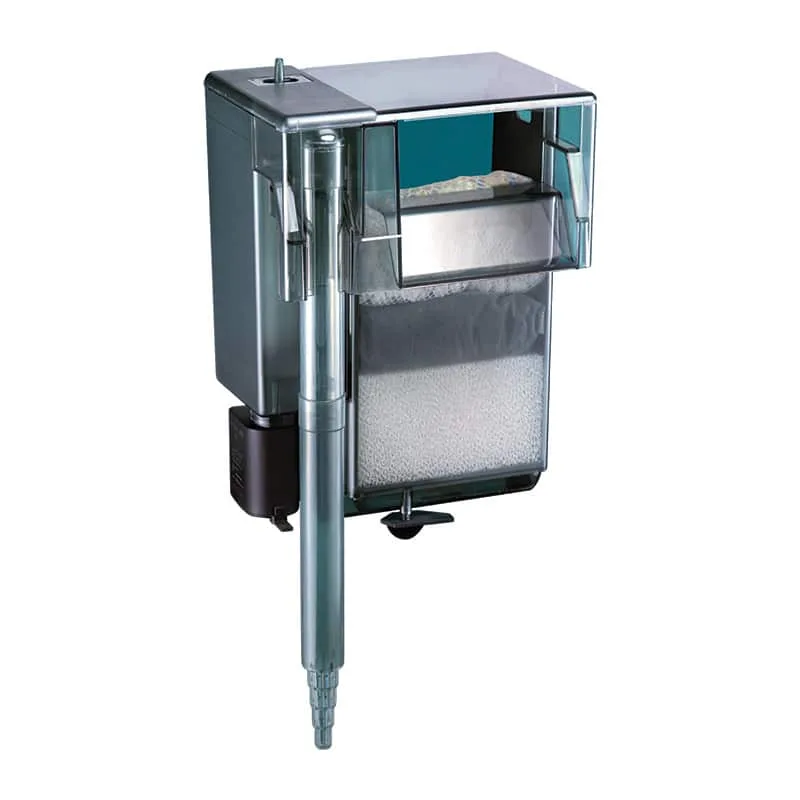
AquaClear 20 Power Filter
Best HOB Filter- ✓ Large open media basket — no proprietary cartridges required
- ✓ Adjustable flow dial reduces current for shrimp and nano fish
- ✓ Decades of proven reliability across breeding rooms
- ✓ Easy maintenance — pop the lid, rinse the media, done
- ✗ Intake tube needs a prefilter sponge for shrimp and fry tanks
- ✗ Waterfall noise increases when water level drops
The AquaClear 20 is the most-recommended HOB filter for small tanks in the freshwater hobby, and it has earned that position by being genuinely better than competitors in the ways that matter. The open media basket — not locked into proprietary cartridges — means you can fill it with any media you choose: sponge, ceramic rings, Seachem Purigen, activated carbon, or a combination. When the carbon is exhausted, you replace just the carbon. Your biological media (sponge and ceramic) stays in place, so your bacterial colony is not disrupted.
The adjustable flow control is more useful than it sounds. At full power, the AquaClear 20 moves 100 GPH through a 10-gallon tank — enough current to stress a betta or a group of shrimp. Dial it back to 30-50% and the flow becomes gentle enough for sensitive species while still providing adequate filtration.
Shrimp safety note: The AquaClear’s intake tube has slots large enough to trap baby shrimp. Attach an intake sponge prefilter (widely available for a few dollars) before running this filter in a shrimp tank. With the prefilter, the AquaClear is safe for shrimp. Without it, it is not.
Best for: Nano to 20-gallon community tanks, livebearer growout tanks, and setups where easy media customization matters.
Seachem Tidal 35 Power Filter
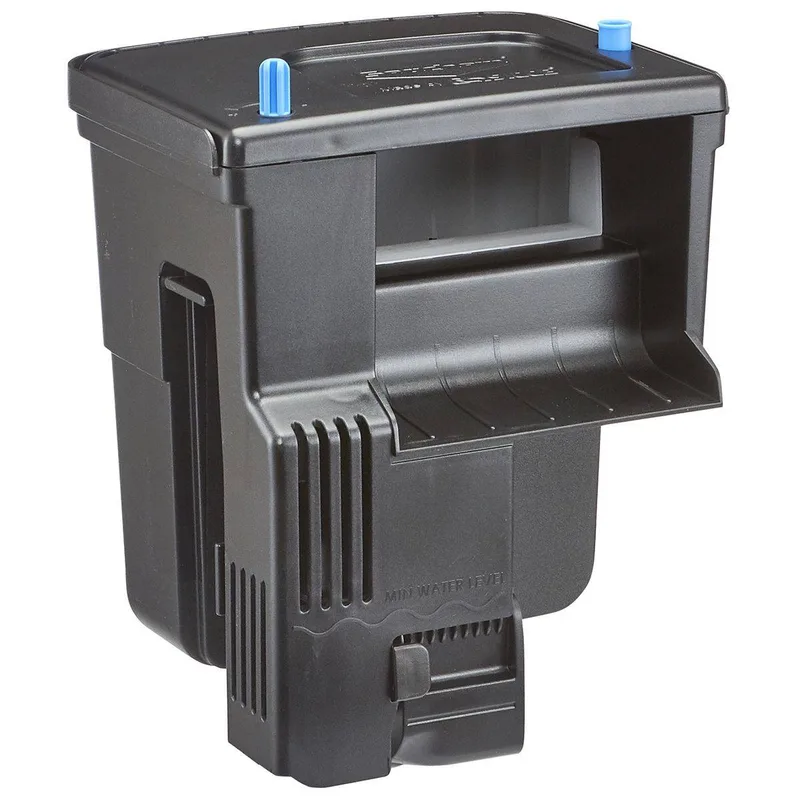
Seachem Tidal 35 Power Filter
Best HOB Premium- ✓ Self-priming pump restarts automatically after power outages
- ✓ Built-in surface skimmer clears protein film
- ✓ Maintenance monitor tells you exactly when to clean
- ✓ Large media basket with no cartridge lock-in
- ✗ Costs more than the AquaClear for similar tank sizes
- ✗ Dual intake requires a prefilter sponge for shrimp tanks
The Seachem Tidal 35 addresses two real pain points with standard HOB filters. The self-priming pump restarts automatically after a power outage — you do not come home to a silent, dead filter. This matters in areas with frequent storms or power fluctuations, and it matters even more in a breeding room where a filter going hours without running can spike ammonia fast.
The built-in surface skimmer is the other standout feature. A standard HOB has a single submerged intake tube. The Tidal adds a second intake at the water surface, which continuously removes the thin protein film that forms in most tanks. This film blocks gas exchange and reduces oxygen transfer. The surface skimmer solves the problem passively, without an additional pump or powerhead.
At $44.99, it costs more than the AquaClear 20 for tanks of similar size. That premium is justified if you value the self-priming restart and surface skimmer. For a basic grow-out tank or quarantine setup, the AquaClear is the better value.
Best for: Planted tanks, setups with surface film problems, and breeding rooms where automatic restart after power loss is critical.
Decision Framework
Choose a Sponge Filter When:
- You keep shrimp — any species, any age. No intake = no risk.
- You are running fry or grow-out tanks where small juveniles could be sucked into a HOB intake.
- You are building a breeding rack with multiple tanks. The economics heavily favor sponge filters at scale.
- You want backup filtration alongside an existing filter. A seeded sponge filter is the fastest way to cycle a new tank.
- Budget is the primary constraint. A sponge filter plus an air pump covers a tank permanently at a fraction of the cost of a HOB.
Choose a HOB Filter When:
- Your tank is 10 gallons or larger with a moderate-to-heavy fish load.
- You want chemical filtration options — activated carbon for medication removal, Purigen for tannin control.
- Surface film or low oxygen is a concern — the waterfall return aerates and agitates the surface.
- You want easy media access without removing equipment from the tank.
- You do not keep shrimp or are willing to add an intake prefilter sponge.
When to Run Both:
Running a sponge filter alongside a HOB is common in breeding setups. The sponge provides safe biological filtration and doubles as a seeded backup. The HOB handles mechanical and chemical filtration. This combination covers all three filtration types without risking shrimp or fry.
Shrimp Safety — Mandatory Reading for Shrimp Keepers
Sponge filters are inherently shrimp-safe. There is no exposed intake, no impeller, and no suction. Baby shrimp can walk directly on a running sponge filter without risk. For Cherry Shrimp, Crystal Red, Neocaridina, and Caridina tanks, a sponge filter is the default recommendation.
HOB filters are not inherently shrimp-safe. The intake tube draws water with enough force to trap or injure juvenile shrimp, shrimplets, and fry. To make a HOB shrimp-safe, you must cover the intake tube with a prefilter sponge — a cylinder of foam that fits over the intake and blocks anything larger than a few millimeters from entering. This accessory costs $3-6 and is non-negotiable for shrimp tanks.
For Caridina shrimp — Crystal Red, Taiwan Bee, Tiger Shrimp — which require very soft, acidic water and are more fragile than Neocaridina, the sponge filter is the better long-term choice. The gentle flow is less stressful and there is zero risk of shrimplet loss.
Frequently Asked Questions
Can I use a sponge filter in a 20-gallon community tank?
Yes, but use an appropriately sized sponge. A medium or large sponge filter driven by a decent air pump can handle 20 gallons with a light to moderate fish load. For a heavily stocked community tank with fast-swimming species, a HOB will do a better job managing waste and oxygenating water.
Do sponge filters actually filter water well?
Yes. Sponge filters excel at biological filtration — the sponge surface area colonizes with beneficial bacteria that process ammonia and nitrite. They do adequate mechanical filtration, though they do not polish water to the same clarity as a HOB with fine mechanical media. They do not offer chemical filtration unless you use a dual-chamber model with an activated carbon chamber.
Do I need an air pump to run a sponge filter?
Yes, always. A sponge filter requires an air pump, airline tubing, and a check valve (to prevent back-siphon if power cuts). Budget for a quality quiet pump like the Aquarium Co-Op Nano Air Pump. For a rack with multiple tanks, a single larger pump fed through a manifold is more cost-effective.
How often should I clean a sponge filter?
Every 2-4 weeks depending on stocking density and foam type. Always rinse in used tank water — never tap water, which kills beneficial bacteria. Squeeze until the brown water runs cleaner, then return the filter to the tank. Do not scrub it clean; you want to preserve the bacterial colony, not destroy it.
Is a HOB filter too strong for a 10-gallon tank?
It can be if not managed. A standard 10-gallon HOB moves 100-130 GPH, which is 10-13 tank turnovers per hour — on the higher end for delicate species. The fix is simple: choose an HOB with adjustable flow (AquaClear, Seachem Tidal) and dial it down. Alternatively, baffle the output with a small sponge or deflect it against the tank wall to reduce current.
Can I move a sponge filter to cycle a new tank?
Yes, and this is one of the most practical uses for a sponge filter. A sponge that has been running in an established tank is fully seeded with beneficial bacteria. Move it to a new tank and the new tank is effectively cycled immediately. This is the standard method used in breeding operations when setting up new grow-out tanks quickly.
Which filter type uses less electricity?
Sponge filters, by a wide margin. A typical HOB filter motor draws 3-8 watts. A sponge filter draws zero electricity directly — it runs off an air pump that draws 1-4 watts and can power multiple filters simultaneously. At rack scale, running 20 sponge filters off one pump draws less electricity than running 5 HOBs.
Conclusion
For shrimp tanks, fry tanks, and breeding racks, the sponge filter wins every time. The safety profile is unmatched, the cost at scale is hard to beat, and the biological filtration is genuinely effective. The Aquarium Co-Op Sponge Filter is the top pick for most freshwater breeding and shrimp setups — coarse foam, stable base, and four sizes.
For community tanks with a moderate to heavy fish load — especially tanks where you want easy media access and the option to run activated carbon or specialty media — a HOB is the better tool. The AquaClear 20 is the default recommendation for tanks under 20 gallons: open media basket, adjustable flow, and decades of proven reliability. Step up to the Seachem Tidal 35 if you want self-priming restart and built-in surface skimming.
If you are just getting started, run the sponge filter. If you outgrow it — more fish, heavier stocking, more complex needs — add a HOB. The two filter types complement each other well, and running both in the same tank is a common and effective approach in serious freshwater setups.
Our Top Pick