Every filter does the same three jobs: trap debris, host the bacteria that process ammonia and nitrite, and keep water moving. Sponge, hang-on-back (HOB), canister and internal filters just do those jobs in very different packages, and the wrong package costs you money, noise or baby shrimp. This comparison is for anyone choosing a filter for a new tank or replacing one that has stopped keeping up.
We run breeding racks and shrimp tanks, so the lens here is practical: what each type does well, where it fails, and which tank it belongs on. If you only need a head-to-head of two types, we also have sponge vs HOB and canister vs HOB. This page is the four-way decision guide, with one representative pick per type so you can see real specs and prices.
| Aquarium Co-Op Sponge Filter Best Sponge Filter | Hikari Bacto-Surge Foam Filter Dense Foam Alternative | Tetra Whisper IQ 20 Power Filter Best Budget HOB | Seachem Tidal 35 Power Filter Best HOB | Fluval 107 Performance Canister Filter Best Canister for Small Tanks | Fluval 207 Performance Canister Filter Best Canister Overall | Fluval U2 Underwater Filter Best Internal Filter | |
|---|---|---|---|---|---|---|---|
| Rating | 9.3/10 | 8.9/10 | 8.6/10 | 9.1/10 | 9/10 | 9.3/10 | 8.4/10 |
| Price | $8-$13 | $9.45as of Nov 16, 2026 | $19.19-$23.17as of Nov 16, 2026 | $39.04as of Nov 16, 2026 | $134.57-$152.99as of Nov 16, 2026 | $146.24-$153.94as of Nov 16, 2026 | $47.99as of Nov 16, 2026 |
| Type | Sponge (air driven) | Sponge (air driven) | Hang-on-back | Hang-on-back | Canister (external) | Canister (external) | Internal (submersible) |
| Tank Range | 2-100+ gal | Small kit rated up to 40 gal | Up to 20 gal | Up to 35 gal | Up to 30 gal | Up to 45 gal | Up to 30 gal |
| Drive | Air pump required | Air pump required | — | — | — | — | — |
| Shrimp Safe | Yes, no intake slots | Yes, no intake slots | With a prefilter sponge on the intake | With a prefilter sponge on the intake | With a prefilter sponge on the intake | With a prefilter sponge on the intake | With a prefilter sponge on the intake |
| Flow Rate | — | — | 130 GPH | — | — | — | — |
| Self Priming | — | — | — | Yes | — | — | — |
| Media Space | — | — | — | — | Multi-stage trays | Multi-stage trays | — |
| Placement | — | — | — | — | — | — | Horizontal or vertical |
| Check Price → | Check Price → | Check Price → | Check Price → | Check Price → | Check Price → | Check Price → |
Prices change daily — tap Check Price for the current Amazon price. Numbers shown were verified on the "as of" date.
The Four Filter Types at a Glance
Sponge Filters
An air pump pushes bubbles up a lift tube, which pulls water through a foam block. Debris collects in the foam and bacteria colonize it. There is no impeller and no intake slot, so shrimplets and fry cannot be sucked in.
Best at: shrimp tanks, fry and grow-out tanks, hospital tanks, and breeding racks where you need many cheap filters. Weak at: heavy bioloads in large tanks, and any need for chemical media.
HOB (Hang-On-Back) Filters
A HOB clips to the rim, lifts water through an intake tube, passes it through a media basket and returns it over a small waterfall. It moves far more water than a sponge filter and lets you swap or add media in seconds.
Best at: 10 to 40 gallon community tanks, easy maintenance, and running carbon or specialty media. Weak at: shrimp and fry safety without a prefilter sponge, and waterfall noise.
Canister Filters
A sealed external canister sits in the stand and pushes water through stacked media trays via hoses. Media volume is the big advantage: more mechanical, biological and chemical capacity than any HOB.
Best at: large or heavily stocked tanks, planted tanks where a clean look matters, and keepers who want to clean a filter every month or two rather than every few weeks. Weak at: upfront cost, and a messier, hose-disconnecting cleaning routine.
Internal Filters
A submersible pump and cartridge sit inside the tank. They are compact, cheap and quiet, and they can be mounted horizontally or vertically to shape current.
Best at: small tanks, turtle and low-water setups, and as a supplemental filter for added flow. Weak at: visible bulk inside the tank and limited media space.
How They Compare
Flow and Capacity
Sponge filters have the gentlest flow, which is exactly what shrimp, bettas and fry want, but flow depends on the air pump and the sponge size. HOBs and internals sit in the middle: the Tetra Whisper IQ 20 is listed at 130 GPH for tanks up to 20 gallons. Canisters offer the most headroom per tank rating because the pump sits behind a large media volume.
Media Space
This is where the types separate. A sponge is one block of foam. An internal holds a small cartridge. A HOB gives you a basket you can fill with your own foam, ceramic and carbon. A canister gives you multiple trays. If you want to stack mechanical, biological and chemical stages, go HOB or canister.
Noise
Sponge filters are quiet apart from the air pump, which you can place away from the tank. Canisters are generally the quietest once running and primed. HOBs add waterfall splash, especially when the water level drops. Internals are usually quiet but can hum if the pump is not fully submerged.
Maintenance
Sponge filters need a rinse in old tank water every few weeks. HOBs take a few minutes to rinse. Canisters need hose disconnection but run longer between cleanings. Internals are quick but their small cartridges clog sooner on messy tanks. Never rinse any biological media in tap water, because chlorine and chloramine harm the bacteria.
Cost
Sponge filters are the cheapest to buy and run, especially across a rack. HOBs and internals sit in the middle. Canisters cost several times more upfront. Use the prices in the table above as a guide, and check the live price on the button before you buy.
Detailed Reviews
Aquarium Co-Op Sponge Filter
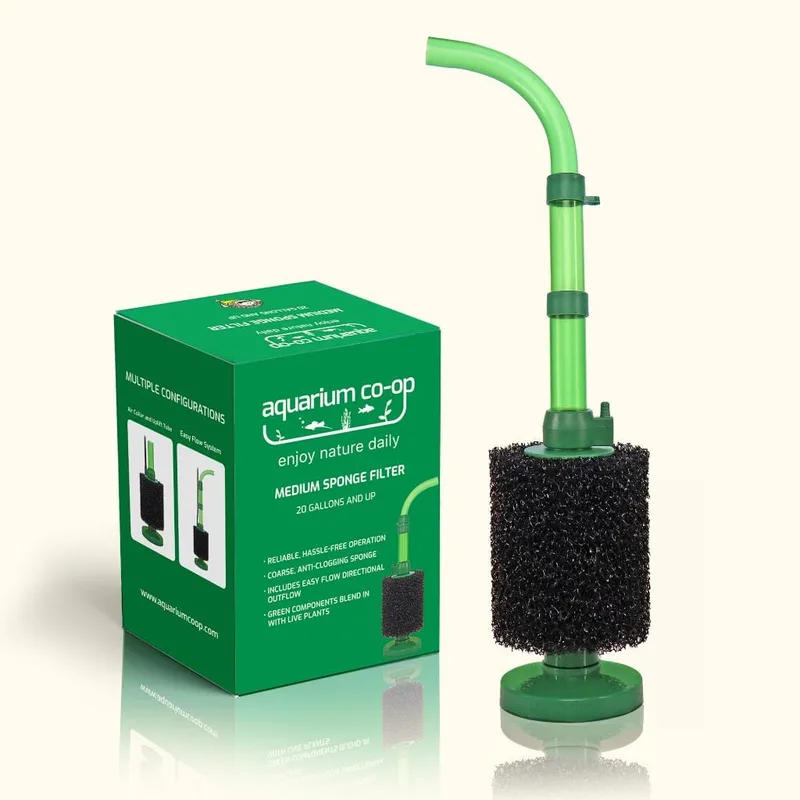
Aquarium Co-Op Sponge Filter
Best Sponge Filter- ✓ Coarse foam resists clogging between rinses
- ✓ Weighted base stays put without suction cups
- ✓ Four sizes from nano to large tanks
- ✓ Cheapest per tank when you run many tanks off one air pump
- ✗ Sold direct only, not on Amazon
- ✗ Needs an air pump, airline and check valve
The default for shrimp, fry and breeding racks. Coarse foam clogs slower than dense foam, and the weighted base means it stays where you put it. If you are filtering ten tanks, nothing else comes close on cost per tank. Pair it with a quality air pump from our air pump roundup. For rack-specific options see breeding rack filters.
Best for: shrimp colonies, fry tanks, cycling new tanks, and any tank under about 20 gallons with a light fish load.
Hikari Bacto-Surge Foam Filter

Hikari Bacto-Surge Foam Filter
Dense Foam Alternative- ✓ Dense foam catches fine particles
- ✓ Large surface area for beneficial bacteria
- ✓ Easy to find on Amazon
- ✗ Dense foam clogs faster and needs more frequent rinsing
- ✗ Lighter base may need anchoring
The dense-foam alternative if you want an Amazon-available sponge. Dense foam traps finer particles but needs rinsing more often, so it suits tanks with lower waste output. The listing rates the small kit up to 40 gallons, but a sponge driven by an air pump is best treated as a primary filter on lightly stocked tanks.
Best for: nano and shrimp tanks, and quarantine tanks where you want fine mechanical filtration.
Tetra Whisper IQ 20 Power Filter

Tetra Whisper IQ 20 Power Filter
Best Budget HOB- ✓ Self-priming, so it restarts after a power cut
- ✓ Sound shield rated under 40 dB by the manufacturer
- ✓ Low upfront cost
- ✗ Cartridge based, refills are an ongoing cost
- ✗ No flow adjustment listed, so it can be strong for shrimp tanks
A budget HOB for tanks up to 20 gallons. It is self-priming and Tetra rates it under 40 dB. The trade-off is cartridge dependence: you keep buying refills unless you adapt the basket with your own media. If you plan to keep shrimp, add a prefilter sponge over the intake.
Best for: a first community tank where low upfront cost matters.
Seachem Tidal 35 Power Filter
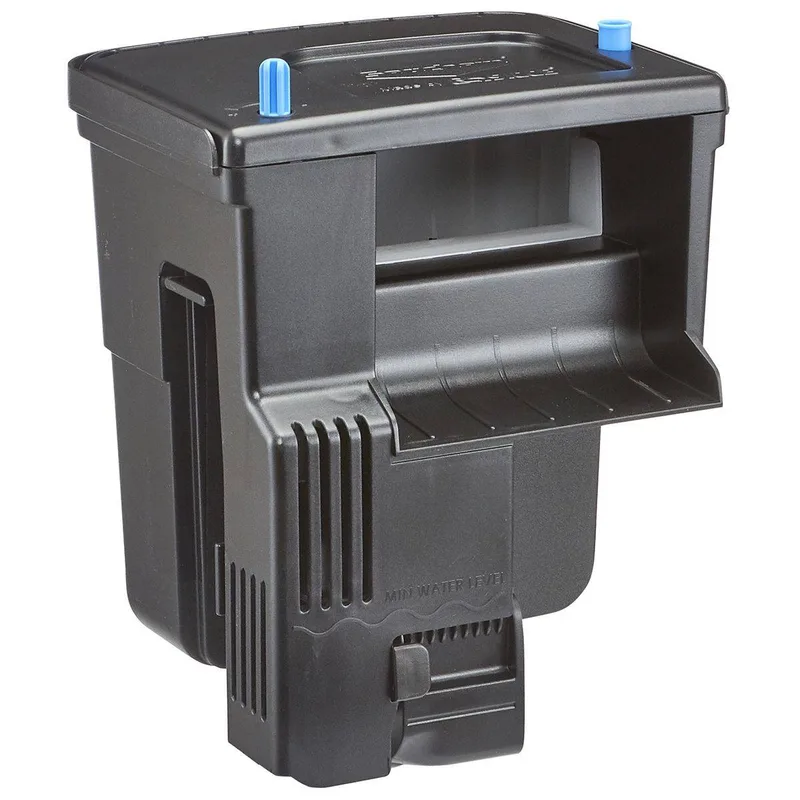
Seachem Tidal 35 Power Filter
Best HOB- ✓ Self-priming pump with a self-cleaning impeller
- ✓ Room for your own media instead of proprietary cartridges
- ✓ Handles a heavier fish load than an air-driven sponge
- ✗ Intake needs a prefilter sponge for shrimp and fry
- ✗ Waterfall return adds some noise
The better HOB if you can spend about twice as much. The self-priming pump and self-cleaning impeller reduce the headaches that HOBs are known for, and the open basket lets you build your own media stack. For help choosing what goes in it, see our filter media guide, and for more HOB options, our HOB roundup.
Best for: 20 to 35 gallon community tanks and keepers who want to customize media.
Fluval 107 Performance Canister Filter

Fluval 107 Performance Canister Filter
Best Canister for Small Tanks- ✓ Manufacturer describes it as ultra-quiet in operation
- ✓ Far more media volume than a HOB of the same tank rating
- ✓ Nothing but intake and output tubes inside the tank
- ✗ Costs several times what a HOB costs
- ✗ Cleaning means disconnecting hoses and carrying the canister
The smallest canister that still gives you a real multi-stage media setup. It makes sense when you want a clean aquascape with only hoses visible, or when a HOB would be marginal for the stocking level. For a wider canister comparison, see best canister filters.
Best for: planted tanks up to 30 gallons and heavier bioloads where a HOB feels undersized.
Fluval 207 Performance Canister Filter

Fluval 207 Performance Canister Filter
Best Canister Overall- ✓ Extra headroom for heavily stocked mid-size tanks
- ✓ Same quiet eTEC pump design as the 107
- ✓ Media can be rearranged to fit your setup
- ✗ Overkill for tanks under 20 gallons
- ✗ Higher price for what is still a single-tank filter
The 207 is our overall canister pick. It shares the design of the 107 with more capacity for tanks up to 45 gallons, and the extra media volume gives you margin when a tank is heavily stocked or when you go a few extra weeks between cleanings.
Best for: 30 to 45 gallon tanks, cichlid and larger community setups, and anyone who wants set-and-forget filtration.
Fluval U2 Underwater Filter

Fluval U2 Underwater Filter
Best Internal Filter- ✓ Sits inside the tank, so there is no waterfall noise or overflow
- ✓ Can run horizontally in shallow tanks or vertically to shape current
- ✓ Flip-top lid gives quick access to the cartridge
- ✗ Takes up visible space inside the tank
- ✗ Small cartridge means less media than a HOB or canister
An internal filter that does its job inside the tank. The U2 can run vertically or horizontally, which makes it handy for shallow tanks and for shaping current. It is also a useful add-on to a sponge-filtered tank when you want extra flow. For more internals, see best internal filters.
Best for: small to mid-size tanks up to 30 gallons, low water levels, and supplemental flow.
Which Filter Should You Choose?
Choose a Sponge Filter If
- You keep shrimp, fry or other small, fragile animals.
- You run multiple tanks and want the lowest cost per tank.
- You need a filter that survives a power cut and restarts without priming, once the air pump runs again.
Choose a HOB If
- You have a 10 to 40 gallon community tank and want easy media access.
- You want a custom media stack without paying canister prices.
- You are comfortable adding a prefilter sponge if you keep shrimp.
Choose a Canister If
- Your tank is large, heavily stocked or planted.
- You want maximum media volume and longer gaps between cleanings.
- You can spend more upfront and do not mind a more involved cleaning.
Choose an Internal Filter If
- Your tank is small or shallow.
- You want a compact second filter for extra flow.
- You would rather not hang anything on the back of the tank.
Shrimp-Safe Notes
Sponge filters are the shrimp-safe baseline. There is no intake for shrimplets to enter.
HOB, canister and internal filters all need a prefilter sponge on the intake if you keep shrimp or breed livebearers. Without one, the intake can trap or injure baby shrimp and fry. A foam sleeve over the intake is inexpensive and takes seconds to fit.
Watch the media, not just the filter. Some medications and a few additives contain copper, which is toxic to shrimp and other invertebrates. Media such as carbon can absorb medications, but never assume a product is shrimp-safe without reading the ingredient list on the label. Neocaridina tolerate pH 6.5-8.0 and Caridina need softer, more acidic water, so flow and filtration choices should also match the species, as covered in our shrimp water parameters guide.
Frequently Asked Questions
What is the best type of filter for a beginner?
For a first community tank of 10 to 40 gallons, a HOB is the easiest to set up, maintain and customize. For a first shrimp tank or a tank with fry, a sponge filter is the safer choice.
Can I run two different filter types on one tank?
Yes, and it is common. A sponge filter alongside a HOB or canister adds redundancy: if one fails, the other keeps bacteria alive, and the sponge also acts as a shrimp-safe backup. It is also the standard way to seed a new tank with established bacteria.
Are canister filters worth the extra money?
They are worth it when media volume matters: large tanks, heavy stocking, planted tanks where you want hardware out of sight. For tanks under 20 gallons, a HOB or sponge filter usually does the job for far less.
Is an internal filter better than a HOB?
Neither is better overall. An internal is quieter at the tank rim and works in shallow water, but it has less media space and takes up room inside the tank. A HOB offers more media and easier access.
Which filter type is quietest?
A sponge filter makes almost no noise, though the air pump can buzz. Canisters are typically very quiet when running properly. HOBs produce a waterfall sound, and the level matters: a low water level makes it louder.
Do I need a prefilter sponge on every filter?
Only if you keep shrimp, fry or other animals small enough to be pulled in. Sponge filters do not need one. HOB, canister and internal intakes all benefit from one in those tanks.
How often should I replace filter media?
Rarely. Rinse mechanical foam in old tank water instead of replacing it, and replace chemical media such as carbon on the manufacturer schedule. Swapping all media at once removes the bacteria colony, so replace it in stages.
Conclusion
There is no single best filter type, but the decision is simpler than it looks. Shrimp, fry and breeding racks: sponge filter, with the Aquarium Co-Op Sponge Filter as our top pick. A standard community tank up to 35 gallons: a HOB, with the Seachem Tidal 35 as the better-featured choice and the Tetra Whisper IQ 20 as the budget option.
Bigger, busier or planted tanks: step up to a canister, and the Fluval 207 is our overall winner for the combination of media space, quiet operation and capacity. The Fluval 107 is the runner-up for smaller tanks. Internal filters earn their place on small and shallow tanks and as a supplement to a sponge filter.
If you are unsure, start with a sponge filter. It is cheap, safe for every animal in the hobby, and it keeps its bacteria colony even if you later upgrade to a HOB or canister.
Our Top Pick