AquaRanked is reader-supported. When you buy through links on our site, we may earn an affiliate commission.
Ricefish and guppies get compared constantly because they solve overlapping problems — both are small, peaceful, easy to feed, and popular in nano and community setups. But they are not interchangeable. One is a livebearer that needs warm, stable water to breed well. The other is an egg-scattering coldwater species that thrives without a heater at all. Picking the wrong one for your setup means fighting your equipment instead of your fish.
This comparison breaks down the real differences — temperature needs, reproduction, tank mates, and the gear each one actually requires — so you can decide which fits the tank, climate, and goals you already have instead of retrofitting your setup around a fish that doesn’t match it.
| Hikari Tropical Fancy Guppy Fish Food Best Shared Staple Food | Eheim Jager 50W TruTemp Heater Best Guppy Heater | Fluval Multi-Chamber Holding and Breeding Box Best Guppy Fry Nursery | Ziss ZET-65 Egg Tumbler Best Ricefish Egg Incubator | VIVOSUN LCD Digital Aquarium Thermometer Best Ricefish Temp Monitor | |
|---|---|---|---|---|---|
| Rating | 9/10 | 9.2/10 | 8.8/10 | 9/10 | 8.7/10 |
| Price | $6.36-$6.71as of Sep 27, 2026 | $31.99as of Sep 27, 2026 | $23.99as of Sep 27, 2026 | $59.85-$66.50as of Sep 27, 2026 | $7.99as of Sep 27, 2026 |
| Type | Slow-sinking micro pellet | — | Hang-on external, up to 3 chambers | In-tank egg tumbler / incubator | Digital with suction cup probe |
| Protein | 50% | — | — | — | — |
| Size | 0.77 oz (22g) | — | — | — | — |
| Best For | Guppies, ricefish, and other small surface feeders | — | — | Ricefish, killifish, and other egg scatterers | — |
| Wattage | — | 50W | — | — | — |
| Tank Size | — | 7-16 gal | — | — | — |
| Temp Range | — | 65-93°F | — | — | — |
| Accuracy | — | ±0.5°C (calibratable) | — | — | +/- 1°C |
| Design | — | Shatter-resistant laboratory glass | — | — | — |
| Dimensions | — | — | 10.25in L x 5.5in W x 4.75in H | 2.95in x 2.76in x 8.66in | — |
| Capacity | — | — | 0.5 gal (1.9L) | — | — |
| Flow | — | — | Air-pump driven (pump sold separately) | Air-driven gentle tumbling | — |
| Display | — | — | — | — | LCD |
| Power | — | — | — | — | LR44 battery |
| Check Price → | Check Price → | Check Price → | Check Price → | Check Price → |
Prices change daily — tap Check Price for the current Amazon price. Numbers shown were verified on the "as of" date.
Temperature and Heating Requirements
This is the single biggest difference between the two, and it should drive most of the decision.
Guppies (Poecilia reticulata) are tropical livebearers. They hold color, breed, and stay healthy in the 72-82°F range, and they need a heater to maintain that consistently in anything but a warm room. Drop a guppy tank into the low 60s for an extended period and you’ll see slowed metabolism, suppressed breeding, and increased susceptibility to ich and fin rot.
Ricefish (Oryzias latipes, commonly sold as medaka) are coldwater fish by aquarium standards. They do well in the 61-75°F range and need no heater in most indoor rooms or in outdoor containers through the warmer months. Some hardy strains tolerate brief dips into the 50s without issue, which is why ricefish get called “tomorrow’s guppies” in parts of the hobby — an unheated tank that would stress a guppy colony is a ricefish colony’s normal environment.
If your goal is a low-power, unheated setup — a windowsill tank, an office desk tank, or a patio tub that only needs to run March through October in USDA Zones 7-9 — ricefish are the better starting point. If you’re running a heated fish room already, guppies fit right into that infrastructure without any adjustment.
Reproduction: Livebearers vs Egg Scatterers
Guppies and ricefish reproduce in completely different ways, and this changes what breeding equipment you actually need.
Guppies give live birth. A pregnant female carries fry internally for roughly 26-31 days and drops 20-50 free-swimming fry that need to be separated from adult tankmates immediately or they get eaten. This is why breeder boxes and breeder nets exist — they isolate a visibly pregnant female until she gives birth, then hold the fry until they’re large enough to rejoin the main tank.
Ricefish scatter eggs. A female carries a cluster of eggs on her belly for a day or two before brushing them off onto floating plants, moss, or a spawning mop. The eggs need to be moved to a separate incubation container — an egg tumbler or a simple net-and-mop setup — away from adult fish, which will eat their own eggs given the chance. Hatching takes one to two weeks depending on temperature.
Neither method is harder than the other, but they require different gear. A breeder box is wasted money on a ricefish tank, and an egg tumbler does nothing for a guppy colony. Match the equipment to the species you’re actually keeping.
Tank Size and Stocking
Both species work well in nano setups, but the numbers differ slightly. A group of 5-6 ricefish is comfortable in a 10-gallon long tank, and their calm, shoaling behavior means they look better in larger groups viewed from above or the side in a shallow tank. Guppies do fine in similar volumes but benefit from a male-to-female ratio of roughly 1:2 or 1:3 to spread out male breeding attention, since a single female harassed by multiple males shows visible stress.
Both are prolific enough that population control matters. A guppy colony left unchecked in a 10-gallon tank will overrun it within a few months. Ricefish reproduce more slowly and are easier to keep from overpopulating a tank of the same size, which makes them a lower-maintenance option for anyone who doesn’t want to run a constant rehoming pipeline.
Temperament and Tank Mates
Ricefish are shoaling fish that do best in groups of six or more and rarely show aggression toward tankmates. They’re a genuinely good addition to a peaceful community tank and are often kept alongside shrimp without issue, since they largely ignore anything that isn’t matching their own size and shape.
Guppies are generally peaceful too, though fancy strains with long, flowing fins can draw fin-nipping from more boisterous tankmates, and male guppies will chase females persistently when the ratio skews too male-heavy. Both species coexist well with cherry shrimp and other Neocaridina, and hobbyists commonly report guppies and ricefish sharing the same unheated-to-lightly-heated community tank without conflict — they occupy slightly different zones in the water column and don’t compete heavily for food.
Outdoor and Seasonal Keeping
For outdoor patio ponds and tubs in USDA Zones 7-9, ricefish are the more forgiving choice. Their cold tolerance lets them stay outside longer into the fall and go back out earlier in the spring than guppies, which need water reliably above 65°F to avoid stress. Guppies can absolutely run in an outdoor container through the warm months, but they need to come inside — or into a heated setup — well before nighttime lows threaten to drop the water out of their comfort range.
Neither species should be treated as truly cold-hardy like koi or goldfish. A hard freeze kills both. The difference is the margin: ricefish give you more weeks on either end of the season before that margin runs out.
Recommended Gear for Each Setup
Hikari Tropical Fancy Guppy Fish Food
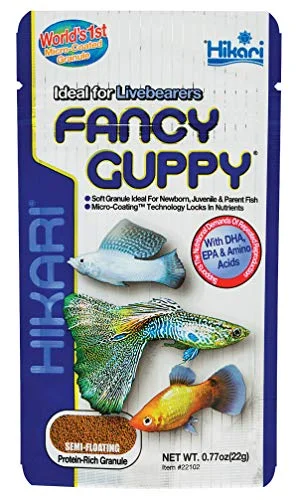
Hikari Tropical Fancy Guppy Fish Food
Best Shared Staple Food- ✓ Micro pellet size suits both guppy and ricefish mouths
- ✓ High protein and krill content supports breeding condition
- ✓ Spirulina content enhances natural coloration
- ✓ One food covers a mixed guppy-and-ricefish fish room
- ✗ Small container empties fast across multiple tanks
- ✗ Not species-specific — no ricefish or guppy formula tweaks
This micro pellet is small enough for both guppy and ricefish mouths and works as the single staple food for a mixed fish room. The 50% protein content and krill inclusion support breeding condition in both species, and the spirulina helps guppies especially hold color. Keep a can of this on hand regardless of which species — or both — you end up keeping.
Eheim Jager 50W TruTemp Heater
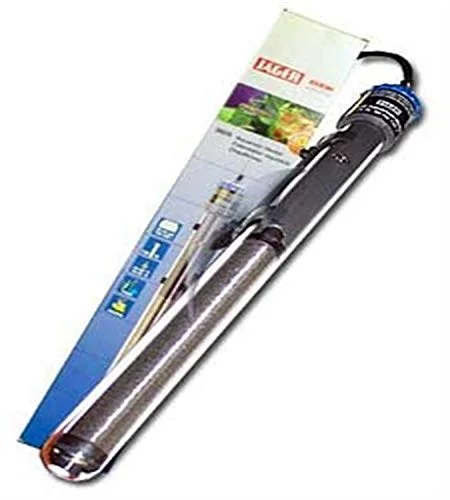
Eheim Jager 50W TruTemp Heater
Best Guppy Heater- ✓ TruTemp dial lets you calibrate against a trusted thermometer
- ✓ Holds a stable 72-82°F for guppy breeding condition
- ✓ Run-dry safety shutoff protects against water level drops
- ✓ Decades-long reference standard in the freshwater hobby
- ✗ Glass construction needs careful placement around active fish
- ✗ Not needed at all for a ricefish-only tank
If you’re setting up a dedicated guppy tank, this is the heater to buy. The calibration dial lets you align the reading to a separate thermometer, which matters when you’re trying to hold a specific breeding temperature rather than a rough range. Skip this entirely for a ricefish-only setup — it’s an unnecessary expense and one more piece of equipment that can fail.
Fluval Multi-Chamber Holding and Breeding Box
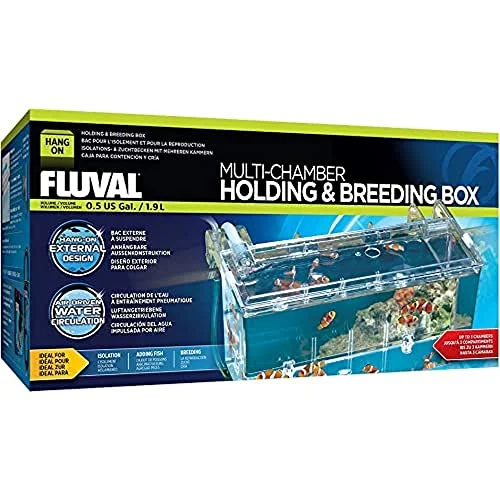
Fluval Multi-Chamber Holding and Breeding Box
Best Guppy Fry Nursery- ✓ External mount keeps the box out of the main tank's footprint
- ✓ Separate chambers isolate a pregnant female from newborn fry
- ✓ Pump-driven flow keeps the nursery water oxygenated
- ✓ Clear walls make checking on fry easy without disturbing them
- ✗ Built for livebearer fry, not for incubating scattered eggs
- ✗ Needs a spare air pump and airline to run
The external hang-on design keeps this out of the tank’s usable swimming space while giving a pregnant guppy female a safe place to give birth. Multiple chambers let you separate the female from the newborn fry once she’s delivered, which prevents her from eating her own brood — a real risk with livebearers left in the main tank.
Ziss ZET-65 Egg Tumbler
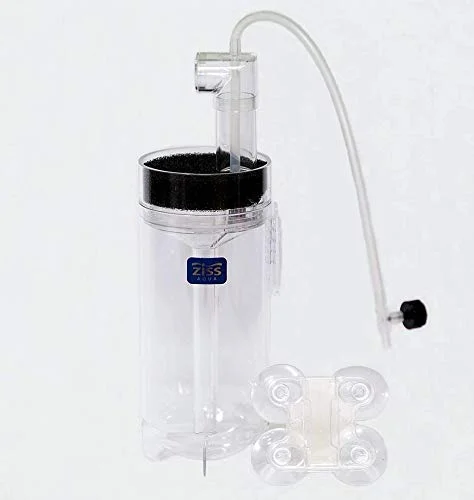
Ziss ZET-65 Egg Tumbler
Best Ricefish Egg Incubator- ✓ Gentle tumbling action prevents fungus growth on ricefish eggs
- ✓ Stainless mesh keeps snails and debris away from developing eggs
- ✓ Air-driven design has no motor to fail
- ✓ Compact enough for a dedicated 5-gallon ricefish grow-out tank
- ✗ No use for guppies — livebearers don't lay externally fertilized eggs
- ✗ Small chamber means batching for very productive colonies
For ricefish breeders, this is the equivalent tool to the breeder box above — except it’s built for eggs, not live fry. The gentle air-driven tumbling keeps fungus from taking hold on the eggs while they incubate, and the stainless mesh keeps opportunistic snails away from the clutch. This has no application in a guppy-only tank.
VIVOSUN LCD Digital Aquarium Thermometer
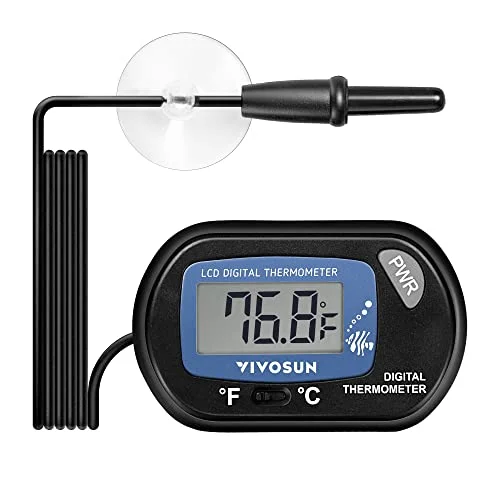
VIVOSUN LCD Digital Aquarium Thermometer
Best Ricefish Temp Monitor- ✓ Confirms an unheated ricefish tank is staying in the 61-75°F range
- ✓ Under $10 and widely available for every tank in a fish room
- ✓ Large LCD display is easy to read at a glance
- ✓ Suction cup mount keeps the probe submerged and stable
- ✗ Suction cup grip weakens over time and needs occasional resets
- ✗ No alerts or logging if the room temperature swings overnight
- ✗ Reads in whole degrees, not decimal precision
Running an unheated ricefish tank doesn’t mean ignoring temperature — it means confirming the room is actually holding the range you’re assuming. This thermometer is cheap enough to put on every tank in the house, but it earns its keep specifically on unheated setups where there’s no equipment actively enforcing a target number.
Which Should You Choose?
Choose ricefish when:
- You want an unheated tank or a seasonal outdoor container.
- You’re keeping a planted, shallow tank where their shoaling behavior shows off well.
- You want a species that’s less likely to overpopulate a tank on its own.
- You live somewhere with cooler indoor temperatures and don’t want to run a heater.
Choose guppies when:
- You already run a heated fish room and want a colorful, prolific livebearer.
- You want fast, hands-off reproduction without managing an egg incubator.
- You’re after specific fancy strains and color patterns — the guppy hobby has far more strain variety than ricefish.
- You want a fish that’s been bred in captivity for generations and is forgiving of beginner mistakes.
Keep both when:
You have the room for two setups, or you want to try a mixed community tank. Guppies and ricefish don’t compete aggressively and occupy the water column differently enough to coexist, provided the shared tank stays warm enough for the guppies without exceeding the upper end of what ricefish tolerate comfortably — 78-80°F is a reasonable shared target.
Frequently Asked Questions
Can ricefish and guppies live in the same tank?
Yes. They’re peaceful toward each other and occupy slightly different zones in the water column. The main constraint is temperature — pick a shared range in the high 70s that works for both rather than optimizing purely for one species.
Do ricefish really not need a heater?
Correct, in most indoor rooms that stay above roughly 60°F. Ricefish are comfortable in the 61-75°F range. If your home runs colder than that in winter, a low-wattage heater set conservatively is a reasonable safety net, but it’s not required the way it is for guppies.
Which species breeds faster, ricefish or guppies?
Guppies. A single pregnant female can produce a new brood roughly every 26-31 days with 20-50 fry per batch. Ricefish lay a smaller number of eggs daily, and not every clutch gets successfully collected and hatched, so overall population growth is slower and easier to manage.
Are ricefish or guppies better for a beginner?
Guppies are more forgiving of beginner tank management since fry that get missed in a community tank are simply lost, with no ongoing egg-collection routine required. Ricefish require slightly more attention if you want to actually raise fry, since eggs need to be moved and incubated separately.
Can guppies survive outdoors year-round in warm climates?
Not reliably, even in USDA Zones 7-9. Guppies need water above roughly 65°F, and winter lows in those zones drop well below that. Ricefish tolerate the shoulder seasons better, but neither species should be left outdoors through a hard freeze.
Do ricefish and guppies eat the same food?
Yes, largely. Both do well on a small-particle staple like a micro pellet or crushed flake, since both are surface- and mid-water feeders with small mouths. Neither needs a species-specific formula.
Which fish is more colorful?
Guppies, by a wide margin, thanks to decades of selective breeding for fin shape and color pattern. Ricefish strains do include striking colors — platinum, orange, and glowing varieties — but the range of available patterns is narrower than what the guppy hobby has produced.
Conclusion
The decision comes down to your setup, not which fish is objectively “better.” If you’re running a heated fish room already, want fast livebearer reproduction, and care about strain variety and color, guppies are the stronger fit — the Eheim Jager 50W and a Fluval breeding box cover the gear you need. If you want an unheated tank, a seasonal outdoor container, or a shoaling fish that won’t overrun its own tank, ricefish are the better call — pair them with a Ziss egg tumbler for breeding and a cheap digital thermometer to confirm the unheated range is holding.
Both are good fish. The mistake is picking one without checking whether your existing setup — heated or not, indoor or seasonal outdoor — actually matches what it needs.
Our Top Pick