AquaRanked is reader-supported. When you buy through links on our site, we may earn an affiliate commission.
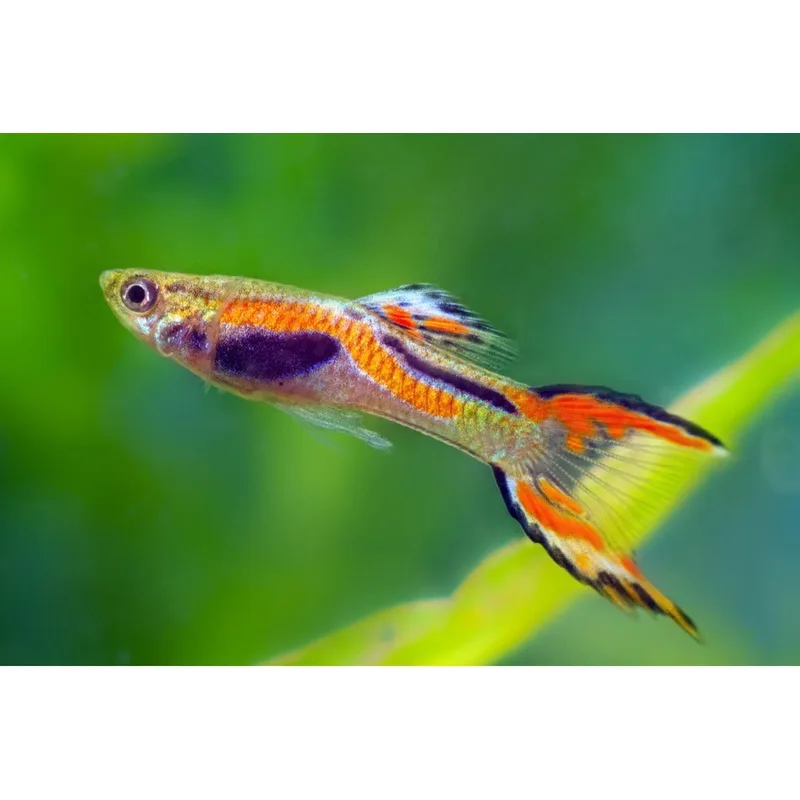
Endler’s livebearers (Poecilia wingei) are one of the most visually striking small fish available to freshwater hobbyists, and one of the most misunderstood. Males max out under 1 inch and carry colors — electric greens, deep blacks, iridescent blues, vivid oranges — that compete with any dwarf cichlid or killifish twice their size. Females stay peaceful, fecund, and hardy. The fish breed readily, coexist with shrimp, and work in tanks as small as 5 gallons.
What sets Endler’s apart from guppies — and what creates most of the confusion around them — is a formal classification system built by the hobbyist community to protect wild-type strains. N-Class, P-Class, and K-Class designations track genetic purity, and they matter more in Endler’s keeping than in almost any other hobby fish. Getting this wrong costs you the traits that make Endler’s worth keeping in the first place.
As of 2024, Poecilia wingei was added to the IUCN Red List as Endangered. Pollution, habitat loss at the Paria Peninsula collection sites in Venezuela, and hybridization with introduced common guppies have put wild populations under serious pressure. The strain purity work done by dedicated hobbyists is now genuinely conservation-relevant, not just a preference.
Tank Setup
Tank Size
A 10-gallon tank is the practical minimum for a productive Endler’s colony. A 5-gallon works for a breeding trio, but fry survival improves significantly with more water volume and more surface area for the biofilm and algae that fry graze on in the first weeks of life.
For anyone running multiple strains — which is most serious Endler’s keepers — a row of 10-gallon tanks on a dedicated breeding rack is standard practice. Keeping each strain in a separate tank is non-negotiable if you want to maintain pure N-Class fish.
Filtration
Sponge filters are the right choice for Endler’s tanks. The low, gentle flow suits these small fish and eliminates the intake hazard that kills Endler’s fry in tanks with HOB filters or bare powerheads.
Aquarium Co-Op makes the most reliable sponge filters available, and at under $10 each they are affordable enough to put in every tank on a rack without overthinking it. The sponge surface also develops into a biofilm feeding station that Endler’s fry and small shrimp graze on continuously — a meaningful food source in breeding setups.
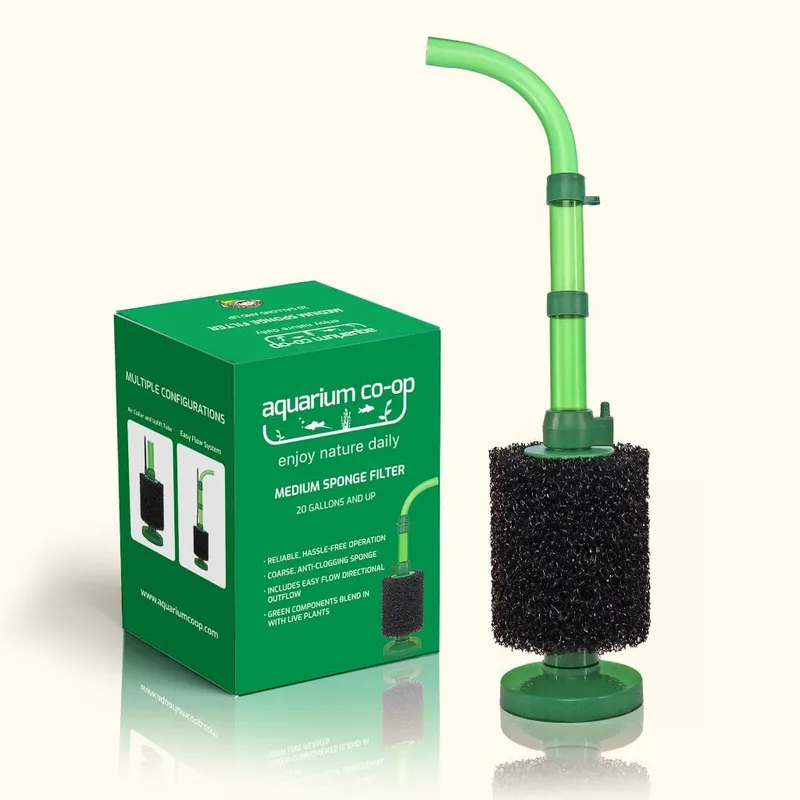
Aquarium Co-Op Small Sponge Filter
Best Filter for Endler's- ✓ Gentle flow rate won't stress Endler's or pull fry into intake
- ✓ Sponge surface doubles as feeding ground for fry and shrimp
- ✓ Reliable biological filtration for breeding colonies
- ✓ Inexpensive enough to run in every tank on a breeding rack
- ✗ Requires separate air pump and airline tubing
- ✗ Sponge needs regular rinsing in tank water to maintain flow
For a broader comparison, our Best Sponge Filters roundup covers options across tank sizes. For larger display tanks over 20 gallons, a HOB with a foam prefilter over the intake is workable — but sponge filters are better in any setup where fry survival matters.
Hardscape and Plants
Dense planting serves two purposes in Endler’s tanks: it gives fry cover immediately after birth, and it reduces male aggression by breaking line of sight. Java moss, hornwort, and water sprite are practical choices — fast-growing, hardy, and they create the dense surface cover that fry use from day one.
Floating plants help further. Frogbit and salvinia shade the tank, reduce surface agitation, and provide natural grazing material. In outdoor setups, floating plants manage heat and provide natural food through insect fall-in.
Avoid aggressive water flow. Endler’s are not current-tolerant fish, and males spend energy fighting current instead of displaying.
Water Parameters
Endler’s are among the most adaptable freshwater fish available. Their wild habitat — the Campoma and Cumaná lagoons on Venezuela’s Paria Peninsula — is warm, hard, and stable. This origin produces a fish with genuine tolerance for variable conditions.
| Parameter | Target Range |
|---|---|
| Temperature | 72–82°F (22–28°C) |
| pH | 6.5–8.5 |
| GH | 8–35 dGH |
| KH | 4–12 dKH |
| Ammonia | 0 ppm |
| Nitrite | 0 ppm |
| Nitrate | <30 ppm |
Temperature
76–78°F is the sweet spot for color and breeding activity. Males show their best coloration at this range, and females produce and carry fry reliably. Endler’s tolerate temperatures from the low 60s through the mid-80s, but sustained heat above 82°F increases stress and disease risk.
A heater is usually necessary unless your room stays consistently above 72°F year-round. Unlike medaka, Endler’s require stable warmth for consistent breeding.
pH and Hardness
Hard, alkaline water matches their wild conditions. Most municipal tap water in the US falls well within the acceptable range without adjustment. GH from 8 to 35 dGH is a wide band — Endler’s are the opposite of caridina shrimp in hardness sensitivity, and harder tap water actually produces better color in many strains.
If your tap water runs very soft (below 5 dGH), adding crushed coral or aragonite to the filter improves coloration and breeding success over time.
Before adding Endler’s to a new tank, the nitrogen cycle must be fully established. Our Nitrogen Cycle Guide covers both fishless and fish-in cycling methods.
The Class System: N-Class, P-Class, and K-Class
This classification system is the most important thing to understand before buying Endler’s. It was developed by the hobbyist community precisely because guppies and Endler’s interbreed freely and produce fertile offspring — meaning a single mistake permanently contaminates a strain.
N-Class (Natural Class)
N-Class Endler’s are pure Poecilia wingei with documented lineage from verified wild-type populations — primarily the Campoma and Cumaná lagoons on the Paria Peninsula. These fish have never been crossed with common guppies.
N-Class fish breed true: males from an N-Class Black Bar colony look like Black Bar males generation after generation, with no guppy-type fins or color drift. This predictability is what strain-focused breeders and conservation-minded keepers are after.
Acquiring genuine N-Class fish requires sourcing from dedicated breeders who maintain documentation. Flip Aquatics is one of the few commercial sources with reliably documented N-Class strains. Chain stores almost never carry verified N-Class fish.
P-Class (Possibly Hybrid)
P-Class covers fish sold as “Endler’s” with unclear or undocumented lineage. The fish may look like Endler’s and may carry predominantly Endler’s genetics, but their background cannot be verified. Most fish sold under the Endler’s name at pet stores fall here.
P-Class fish are not necessarily inferior pets — they are often attractive, healthy, and display Endler-type patterns. But they cannot be used in N-Class breeding programs, and their offspring may drift toward guppy-type traits over generations.
K-Class (Known Hybrid)
K-Class fish are documented intentional crosses between N-Class Endler’s and common guppies (Poecilia reticulata). Sold and kept transparently as Endler-guppy hybrids, they carry the label intentionally, not as a mistake.
K-Class hybrids often show unusual color combinations that neither pure parent produces. Some hobbyists specifically work with K-Class fish for the expanded color range. There is nothing wrong with keeping K-Class fish, as long as they are never mixed with N-Class stock.
Common Strains
Named Endler’s strains refer to wild-type collection variants and selectively developed lines, all maintained in N-Class populations by dedicated breeders.
Black Bar Endler: The reference strain, closest to wild-type fish from the Campoma lagoon. Males show a bold black vertical bar across an orange and metallic green body. The most widely available N-Class strain and the best starting point for new Endler’s keepers.
Tiger Endler (El Tigre): Orange and black banding pattern with variable metallic sheen. Males are more active displayers than Black Bar fish.
Peacock Endler: Round dorsal spots and tail patterning that resembles peacock feather eyes under good lighting. A display-tank favorite.
El Silverado: Metallic silver base with iridescent overlay and minimal black. Named for the Venezuelan collection site.
Japan Blue: Iridescent blue with yellow and orange accents. Developed in Japan from collected wild stock and re-exported to the hobby.
Lime Green: Neon green iridescence with blue highlights. One of the most visually striking strains under good lighting, though slightly less common than Black Bar.
Why Strain Purity Matters
Beyond the conservation argument — and the IUCN Endangered listing makes that argument genuinely urgent — strain purity matters practically because Endler’s traits are fragile under hybridization.
A single male common guppy in a tank with N-Class Endler females produces offspring that look like Endler’s in F1 but show increasing guppy characteristics through F2 and F3. By the third generation, males may display guppy-type large dorsal fins, flowing tails, and body proportions that no longer resemble wild Endler’s. The small, intensely colored male body type that distinguishes Endler’s disappears.
This is not recoverable without back-crossing to verified N-Class stock — a process requiring multiple generations and access to documented fish to begin with.
The practical rule: house Endler’s and guppies separately, permanently. Never share equipment between tanks without thorough rinsing, and remove any male that shows guppy-type elongated finnage from an N-Class colony immediately.
Feeding
Endler’s are micro-predators. In their wild lagoon habitat, they feed on small insects, algae, biofilm, and zooplankton at the water surface. Their small mouths — barely 2mm across in adult males — require appropriately sized prepared food.
Hikari Fancy Guppy is the most reliable daily food for Endler’s. The micro pellet size fits their mouths correctly, the 50% protein content supports breeding condition in both sexes, and spirulina contributes to the blue-green iridescence visible in many strains. It performs identically in Endler’s tanks as in guppy and ricefish setups.
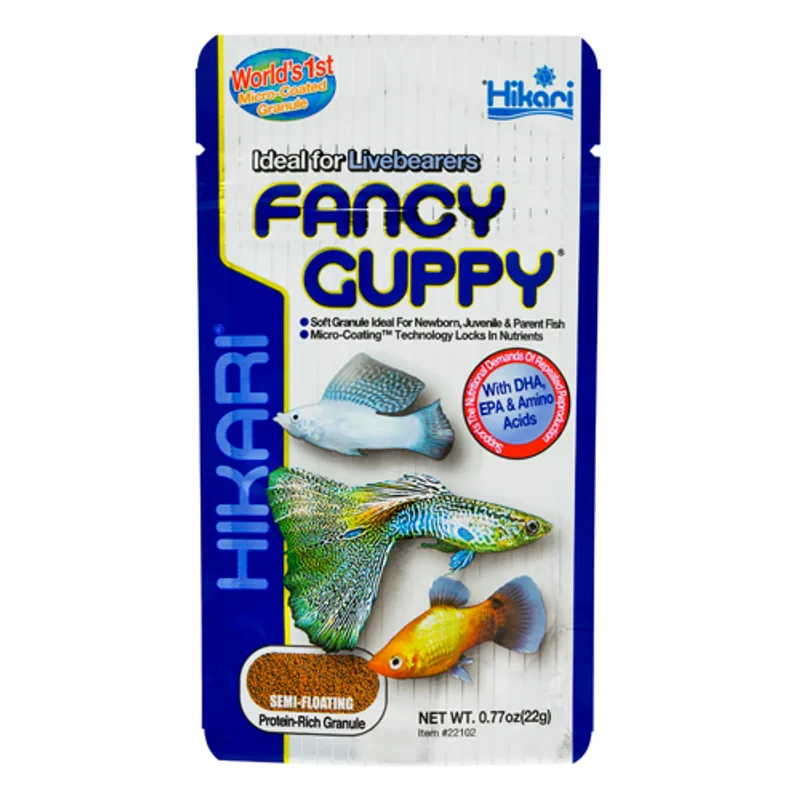
Hikari Tropical Fancy Guppy Fish Food
Best Daily Food- ✓ Micro pellet size fits Endler's small mouths perfectly
- ✓ High protein and krill support color and breeding condition
- ✓ Spirulina enhances the reds and greens in male Endler's
- ✓ Works across all livebearer tanks — guppies, platies, ricefish
- ✗ Small container runs out fast when feeding multiple breeding tanks
- ✗ Not Endler's-specific; general small-fish formula
Live and Supplemental Foods
Live food drives breeding activity more effectively than any dry food. Baby brine shrimp nauplii offered 3–4 times per week visibly increase spawning frequency in Endler’s colonies. Daphnia, vinegar eels, and microworms are excellent alternatives when brine shrimp culture is not practical.
For fry, vinegar eels and microworms are the most practical first food — they stay alive in the water column longer than powdered foods and are small enough for fry from day one. Baby brine shrimp work starting at about 5–7 days as fry grow.
Rotating between food types produces better color, faster growth, and more consistent breeding than feeding a single food source.
Feeding Schedule
Feed adults 2–3 times daily, only as much as the colony consumes in 1–2 minutes per feeding. Endler’s have small stomachs, and overfeeding fouls water faster in small tanks. Fry benefit from four small feedings daily for fastest growth through the first 4–6 weeks.
Breeding
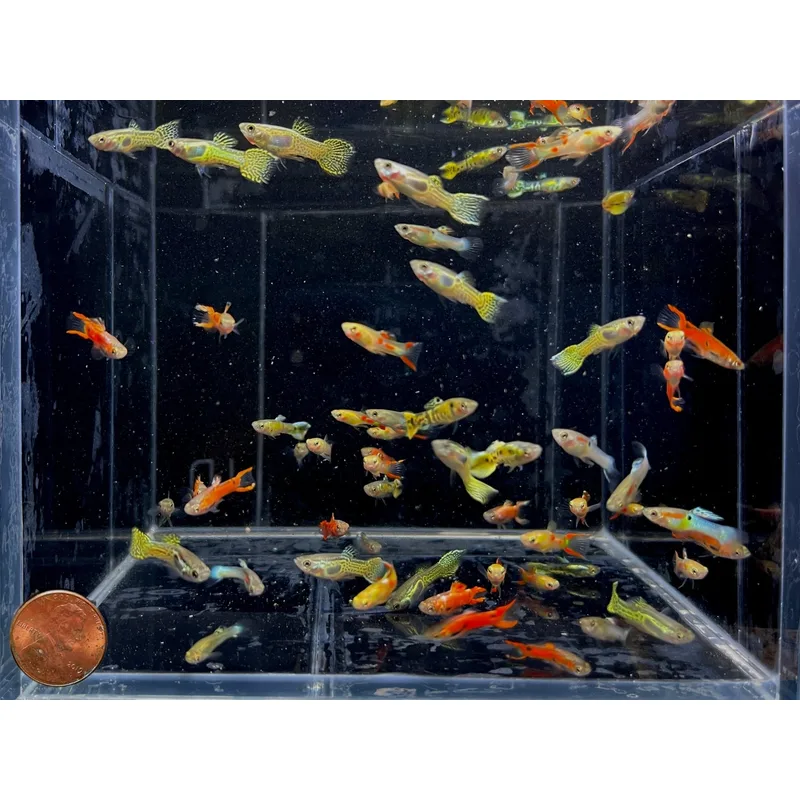
Endler’s breed without any special intervention in a properly maintained tank with both sexes present. Females give birth to live fry after a gestation period of 23–28 days. Brood size ranges from 10–30 fry in young females to 40 or more in mature fish.
Colony Ratio
Maintain a ratio of at least 2 females per male, ideally 3:1. Males pursue females relentlessly, and undersized female-to-male ratios produce stressed, worn-out females with reduced lifespan and inconsistent fry production. With more females available, males distribute attention and females recover between births.
Fry Survival
Endler’s adults eat newborn fry if given the opportunity. In a heavily planted tank with dense java moss or floating plants, some fry survive without intervention. In a bare or sparsely planted tank, survival rates drop sharply.
For reliable production, remove the female to a separate breeder box just before birth, or transfer fry to a dedicated grow-out tank as soon as they appear. The Ziss BL-2 is the most practical in-tank solution — its slotted acrylic construction allows water circulation from the main tank while keeping fry separated from adults. The built-in drop-through divider means newborn fry fall automatically into the lower chamber, away from the mother.
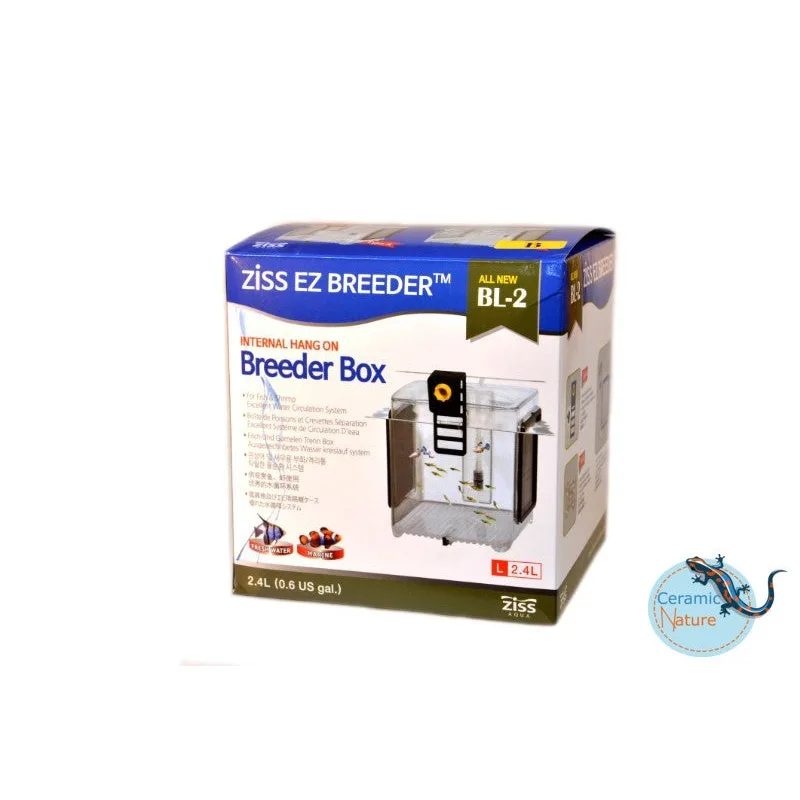
Ziss BL-2 EZ Breeder Box
Best Fry Separator- ✓ Slotted walls allow water circulation without exposing fry to main tank
- ✓ Fry divider drops newborns into lower chamber away from the mother
- ✓ Clear acrylic gives full visibility for monitoring
- ✓ Sturdy build that doesn't flex in warm water like cheaper plastic
- ✗ Larger footprint than mesh-style boxes
- ✗ Slots can occasionally trap very small fry tails
For more options, our Best Breeder Boxes roundup covers the full range from mesh-style nets to rigid acrylic designs.
Fry Development
Endler’s fry are born free-swimming and feeding immediately — no yolk sac dependence. Start with vinegar eels or microworms for the first week, then transition to baby brine shrimp nauplii at 5–7 days. Finely crushed pellets can supplement starting at 2–3 weeks.
Males begin showing color at 3–5 weeks. Full coloration and sexual maturity arrive at 6–8 weeks in well-fed, warm conditions. Males are identifiable by developing gonopodium around 4 weeks of age.
Outdoor Keeping in Warm Climates
Endler’s make excellent outdoor container pond fish in warm climates. They tolerate the heat of southern US summers, breed actively in warm conditions, and their small size suits container ponds from 15 gallons upward.
In USDA Zones 7-9, outdoor pond season typically runs March through October. Endler’s require water above 68°F to breed reliably — the outdoor growing season in warm southern climates aligns almost perfectly with their productive temperature window.
Set containers in morning sun with afternoon shade. Peak summer afternoon temperatures in small, sun-exposed containers can exceed 90°F — more than Endler’s tolerate comfortably. Larger containers (30+ gallons) buffer temperature swings better than smaller ones. Add shade cloth over containers that get direct afternoon sun in the hottest months.
For container options, our Best Patio Pond Kits guide covers suitable setups from 15 to 100 gallons. Add predator netting over any outdoor container — cats, birds, and raccoons locate fish containers quickly.
Bring Endler’s indoors before water temperatures drop below 65°F consistently. They lack the cold tolerance of medaka and will not survive outdoor overwintering in most climates.
Keeping Endler’s with Shrimp
Endler’s are genuinely compatible with neocaridina shrimp. Their small mouths cannot harm adult shrimp, and they coexist peacefully in planted tanks. Shrimplets face some predation risk, but in a densely planted setup, shrimp colonies establish and reproduce alongside Endler’s without population collapse.
This compatibility makes Endler’s one of the better options for planted shrimp tank inhabitants — more display behavior than snails, far less threat than most other fish. For neocaridina parameters and full setup guidance, our Neocaridina Shrimp Care Guide covers everything you need.
Do not house Endler’s with caridina shrimp in the same tank. Caridina parameters (pH 5.4–6.2, very soft water) sit at the lower edge of Endler’s tolerance and significantly reduce breeding activity. Keep those setups separate.
Common Health Issues
Fin Rot and Bacterial Infections
Ragged fins, body sores, or cotton-like growths indicate bacterial or fungal infection, usually secondary to poor water quality or stress. Improve conditions with partial water changes, remove affected fish to a hospital tank, and increase aeration. Most mild bacterial infections in healthy fish resolve with improved conditions without medication.
Wasting Disease
Fish losing weight despite eating — becoming hollow-bellied while still feeding actively — is a warning sign for mycobacterial infections. These are common in livebearers and resistant to treatment. Remove and humanely euthanize visibly infected fish to prevent spread. Focus on water quality and hygiene rather than treatment; there is no reliable home cure.
Ich
White salt-grain spots on body and fins indicate ich. Raise temperature gradually to 82°F over 48 hours, increase aeration (warm water holds less dissolved oxygen), and treat with ich medication per package directions. Endler’s tolerate heat treatments well. Treat all fish in the affected tank regardless of visible symptoms.
Male Aggression and Stress
In colonies with too many males relative to females, males harass each other and females relentlessly. Stressed males show faded coloration — a reliable early indicator that something is wrong with the tank ratio. The solution is reducing male density or increasing females. Removing surplus males to a male-only display tank is a good solution once the breeding colony is producing regularly.
Frequently Asked Questions
What is the difference between N-Class and P-Class Endler’s?
N-Class Endler’s have documented lineage from verified wild populations and have never been crossed with common guppies. P-Class fish are sold as Endler’s but lack documentation — their genetics may include some guppy ancestry. For pure strain work and conservation-oriented breeding, only N-Class fish are acceptable. P-Class fish are fine pets but cannot be used in documented breeding programs.
Can Endler’s live with guppies?
No — not if you care about maintaining Endler’s traits. The two species interbreed freely, and the resulting hybrids lose the compact male body type and intense wild-type colors that distinguish Endler’s within 2–3 generations. House them permanently in separate tanks with separate equipment.
Are Endler’s good for beginners?
Yes. They are hardier and more forgiving of water quality fluctuations than fancy guppies, easier to breed consistently, and require no precise parameter management. The main learning curve is understanding the class system and sourcing genuine N-Class fish if strain purity matters to you. For general keeping, they are among the easiest livebearers available.
How many Endler’s can I keep in a 10-gallon tank?
A colony of 8–12 fish at a 3:1 female-to-male ratio is comfortable in a 10-gallon with a sponge filter and live plants. Population grows quickly — females give birth every 23–28 days and colonies can double within two months. Plan to move grow-out fish regularly or keep a male-only display tank for surplus males.
Where can I buy genuine N-Class Endler’s?
Dedicated livebearer breeders documented on hobbyist forums and Facebook groups focused on Endler’s are the most reliable sources. Flip Aquatics maintains documented N-Class strains commercially and ships nationwide. Pet store fish are almost always P-Class at best, and often hybrid stock without any documentation.
Do Endler’s need a heater?
Yes, in most setups. Unlike medaka, Endler’s require water above 68°F to breed reliably and perform best at 76–78°F. Unless your home stays consistently warm year-round, a small adjustable heater is necessary. This matters especially for rack breeding setups where temperatures in a fish room can vary considerably between tanks at different heights.
Can I keep a male-only Endler’s tank?
Yes, and it produces a spectacular display tank. Males kept without females display constantly to each other — showing off full coloration, spreading fins, performing rapid lateral displays. No breeding to manage and no population growth to control. This is an underrated approach for anyone who wants the color without the colony management.
Conclusion
Endler’s livebearers deliver more visual payoff per tank size than almost any other freshwater fish. A pair of N-Class Black Bar males in a 10-gallon planted tank under decent lighting — displaying to each other, chasing females, constantly flashing those electric color patterns — outperforms most community fish three times their size.
The strain purity question is not a hobbyist technicality. With Poecilia wingei now IUCN Endangered and wild population habitat under ongoing pressure, maintaining genetically documented N-Class strains in captivity has real conservation value. The class system is worth understanding and respecting.
Start with a documented N-Class strain — Black Bar is the most widely available and forgiving for new Endler’s keepers. Sponge filter, planted 10-gallon, quality micro pellet plus live food rotation, 3:1 female-to-male ratio. Breeding follows automatically. Once you have a productive colony, expanding to a second strain in a second tank is the natural progression — just keep the tanks separate and label everything from day one.