Going on vacation should not mean coming home to a tank full of dead fish. But the fear of starving your fish while away leads hobbyists to make worse decisions than the problem they are trying to solve — dumping food blocks that foul the water, having well-meaning friends overfeed, or jury-rigging unreliable feeding solutions.
Here is the reality: healthy adult fish can go 7-10 days without food and be completely fine. Fry and juvenile fish need more frequent feeding, but even they can manage 3-4 days with a well-planted tank providing biofilm and microorganisms. Your biggest vacation risk is not starvation — it is water quality problems caused by overfeeding or equipment failure.
Quick Picks
| Need | Our Pick |
|---|---|
| Best overall | Eheim Everyday Fish Feeder |
| Best value automatic | Zacro Automatic Fish Feeder |
| Emergency block | API Vacation Pyramid Feeder |
| Budget block | Penn-Plax Pro Balance Feeder |
Before You Leave: Pre-Vacation Checklist
The most important vacation prep happens before you walk out the door:
- Large water change (30-40%) the day before you leave. Start with the cleanest water possible.
- Clean your filter if it is due. Do not clean it the same day as the water change — stagger by 2-3 days.
- Check equipment. Verify your heater, filter, and lights are all functioning. A stuck heater or failed filter is more dangerous than missing a few feedings.
- Set lights on a timer. This should already be standard practice, but if not, set a timer for 7-8 hours daily. Lights running 24/7 while you are away guarantees an algae bloom.
- Test water parameters. Verify ammonia and nitrite are at zero. If they are not, fix the problem before leaving.
- Remove any dead plant matter or debris. Rotting material consumes oxygen and produces ammonia.
- Feed normally on the day you leave. Do not double-feed “to hold them over” — this just fouls the water.
The Case Against Vacation Feeder Blocks
Vacation feeder blocks — those white plaster pyramids and gel cubes — are the most popular solution and arguably the worst. Here is why:
They dissolve unevenly. Some blocks break down too fast, releasing food and plaster simultaneously. Others dissolve so slowly that fish barely get anything.
The plaster material is the real problem. As calcium-based blocks dissolve, they raise pH and introduce minerals that your tank may not need. In soft-water setups or shrimp tanks, this pH spike can be dangerous.
Fish often ignore the released food. The food particles embedded in feeder blocks are low-quality and unfamiliar to your fish. Many fish will swim past the slowly dissolving block without eating from it.
Ammonia spikes. A large block dissolving over 7-14 days adds organic matter to the water whether fish eat it or not. In a tank without a well-established biological filter, this can trigger an ammonia or nitrite spike.
For shrimp tanks specifically: Do not use feeder blocks. The pH swing and dissolved mineral spike can cause molting failures and deaths. Shrimp tanks have biofilm, algae, and plant matter that sustain shrimp naturally for 1-2 weeks without any supplemental feeding.
Detailed Reviews
1. Eheim Everyday Fish Feeder
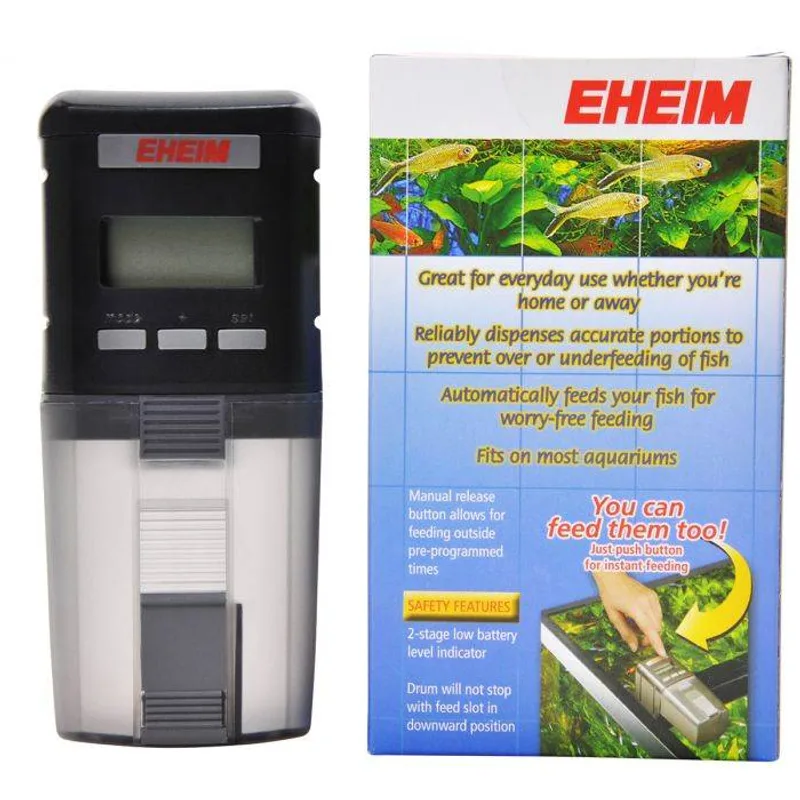
Eheim Everyday Fish Feeder
Best Overall- ✓ Programmable feeding times with adjustable portion sizes
- ✓ Drum design keeps food dry and fresh
- ✓ Fan system prevents moisture from clumping food
- ✓ Reliable battery life lasts months
- ✗ Requires calibration to get portion sizes right
- ✗ Clamp mount does not fit all tank rim types
- ✗ Only works with dry food (flakes, pellets, granules)
The Eheim is the most reliable automatic feeder on the market and has been for years. The programmable timer lets you set 1-8 feedings per day at specific times, with a rotating drum that dispenses a consistent portion each time.
The built-in fan activates before each feeding to push moisture away from the food, which prevents the clumping that plagues cheaper automatic feeders. This is important — if your food clumps, the feeder either dispenses nothing or dumps an oversized portion, and both outcomes are bad for your tank.
For vacation use, program one feeding per day (half your normal daily amount) and test the portion size for several days before you leave. This ensures the feeder dispenses the right amount without your intervention.
The Eheim works with flakes, small pellets, and granules. It does not work with wet food, frozen food, or large pellets that do not fit through the adjustable opening.
Who it is for: Any hobbyist taking vacations longer than 3-4 days who wants reliable, portion-controlled feeding.
2. Zacro Automatic Fish Feeder
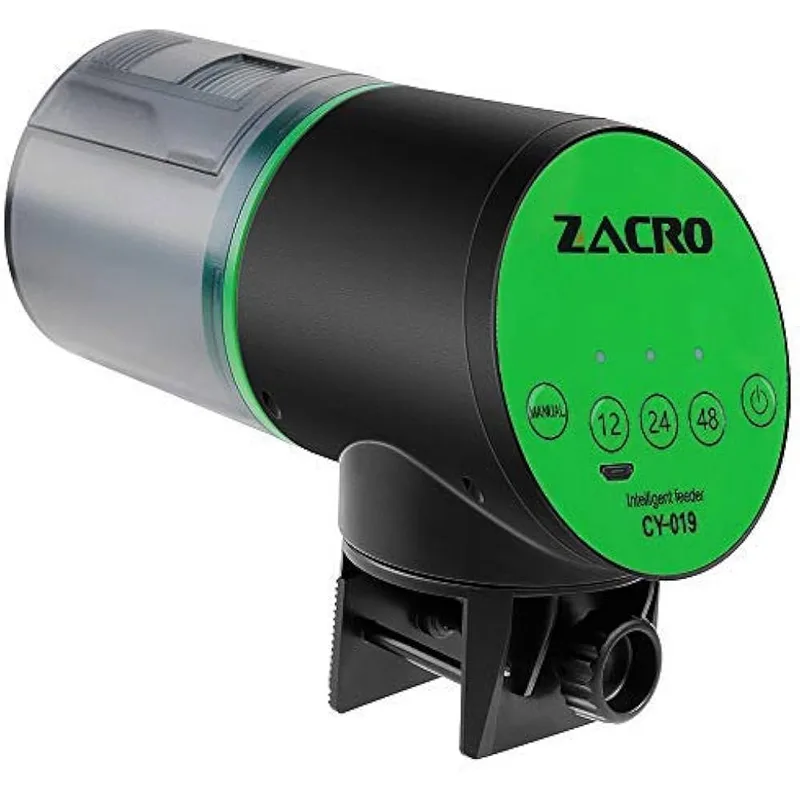
Zacro Automatic Fish Feeder
Best Value- ✓ Larger drum capacity than most competitors
- ✓ Simple programming with LCD display
- ✓ Adjustable portion slider
- ✓ Affordable price point
- ✗ Moisture can enter drum in humid environments
- ✗ Portion consistency can vary with pellet sizes
- ✗ Mount is bulky on smaller tanks
The Zacro offers similar functionality to the Eheim at nearly half the price. The 200ml drum is actually larger, holding more food for extended trips. Programming is straightforward with the LCD display — set up to 4 daily feedings and adjust the portion size with a sliding control.
The main tradeoff is moisture management. The Zacro lacks the Eheim’s fan system, which means food in the drum can absorb moisture in humid environments (common near aquariums). To mitigate this, fill the drum with food the day you leave rather than days in advance, and add a small silica gel packet to the drum alongside the food.
Portion consistency is also slightly less reliable than the Eheim, especially with irregularly shaped pellets. Stick with uniform-sized granules or small pellets for best results.
Who it is for: Budget-conscious hobbyists who want automatic feeding without the Eheim price tag.
3. API Vacation Pyramid Feeder
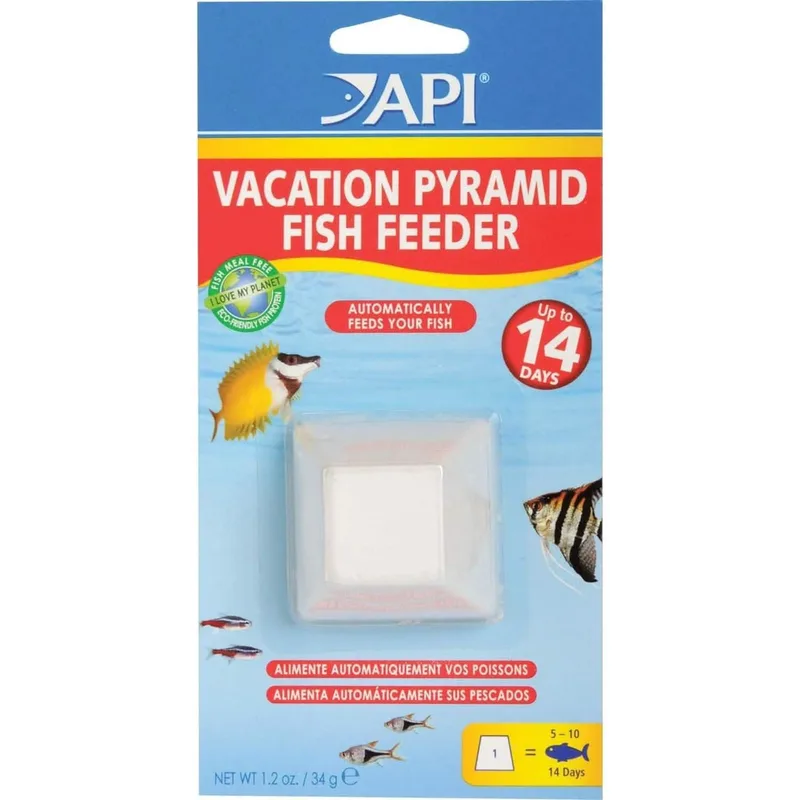
API Vacation Pyramid Feeder
Best Emergency- ✓ No setup required — drop and go
- ✓ Costs almost nothing
- ✓ Available at every pet store
- ✗ Dissolves unevenly and can spike ammonia
- ✗ Fish often ignore the food released
- ✗ Can cloud water and drop pH
- ✗ Not recommended for shrimp tanks
The API pyramid is the original vacation feeder and the most widely available. Drop it in, leave, and it slowly dissolves over 14 days. In theory.
In practice, results are inconsistent. Some pyramids dissolve in 4-5 days. Others barely break down at all. The calcium-based plaster material raises pH and GH, which is a problem in soft-water tanks and a serious problem in shrimp tanks.
If you use a pyramid feeder, use it only for short trips (3-5 days) in a well-established tank with robust biological filtration. Remove any undissolved remnant immediately upon returning and do a water change.
Who it is for: Emergency-only situations where an automatic feeder is not available and the trip is short.
4. Penn-Plax Pro Balance Vacation Feeder
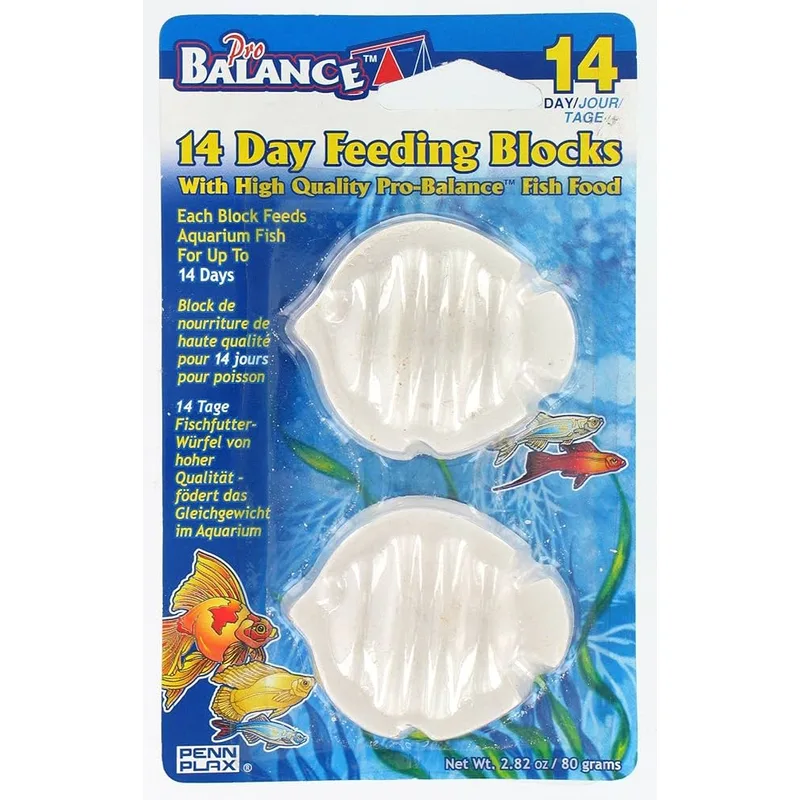
Penn-Plax Pro Balance Vacation Feeder
Budget Block- ✓ Gel formula dissolves more evenly than plaster blocks
- ✓ Extremely affordable
- ✓ Simple — no equipment needed
- ✗ Still risks water quality issues from dissolving material
- ✗ Limited nutrition compared to regular food
- ✗ Not suitable for shrimp-safe setups
The Penn-Plax gel block is a modest improvement over plaster-based feeders. The gel formula dissolves more evenly and introduces less calcium carbonate to the water. However, it still carries the fundamental risks of all dissolving feeders — uncontrolled food release, potential water quality issues, and inconsistent consumption by fish.
At $3, it is cheap enough to use as a supplement alongside an automatic feeder (one block in the tank plus daily automatic feedings) for extra-long vacations. But as a sole feeding solution, it has the same limitations as the API pyramid.
Who it is for: A cheap supplemental feeding option, not a primary solution.
Comparison Table
| Eheim Everyday Fish Feeder Best Overall | Zacro Automatic Fish Feeder Best Value | API Vacation Pyramid Feeder Best Emergency | Penn-Plax Pro Balance Vacation Feeder Budget Block | |
|---|---|---|---|---|
| Rating | 9.2/10 | 8.5/10 | 6.5/10 | 7/10 |
| Price | $50.59-$54.99as of Sep 27, 2026 | Unavailable | Unavailable | Unavailable |
| Type | Automatic programmable | Automatic programmable | Dissolving block | Dissolving gel block |
| Capacity | 100ml drum | 200ml drum | — | — |
| Feedings | Up to 8 per day | Up to 4 per day | — | — |
| Power | 2x AA batteries | USB Rechargeable | — | — |
| Duration | — | — | Up to 14 days | 7-14 days |
| Pack | — | — | 1 pyramid | 1 block |
| Use | — | — | Drop in tank | Drop in tank |
| Check Price → | Check Price → | Check Price → | Check Price → |
Prices change daily — tap Check Price for the current Amazon price. Numbers shown were verified on the "as of" date.
Better Alternatives to Feeder Blocks
Option 1: Just Skip Feeding
For trips of 1-7 days, the best vacation feeder is no feeder at all. Healthy adult fish handle a week without food easily. They will not starve. They may look a little thinner when you return, but a few days of normal feeding brings them right back.
This does not apply to fry. If you have active fry grow-out tanks, you need either an automatic feeder or a trusted person feeding them.
Option 2: Automatic Feeder
For trips longer than 7 days, invest in an automatic feeder. The Eheim or Zacro will cost you $16-28 and serve you for years of vacations. Set it up, test it, and leave with confidence.
Option 3: Trusted Fish Sitter
If you have a fellow hobbyist who can check on your tank, this is the gold standard. A knowledgeable person can feed appropriately, check equipment, and respond to problems.
If your fish sitter is not an aquarium hobbyist, pre-portion the food. Put individual daily portions in labeled bags or a weekly pill organizer. This prevents the most common sitter mistake: massive overfeeding.
Vacation Tips by Tank Type
Community Tanks
Skip feeding for trips under 5 days. Use an automatic feeder for longer trips. Do a water change before leaving.
Shrimp Tanks
Shrimp tanks are the easiest to leave unattended. Shrimp graze on biofilm, algae, and plant matter continuously. A healthy shrimp tank can go 2-3 weeks without supplemental feeding. Just make sure parameters are stable before leaving.
Planted Tanks
Turn your light timer down to 6 hours daily while away to reduce algae growth without supplemental maintenance. If you dose CO2, consider turning it off — slightly slower plant growth is preferable to an algae bloom you cannot manage.
Fry Tanks
Fry need food. Use an automatic feeder set for 2-3 small daily feedings. Alternatively, add a healthy culture of live microworms or banana worms to the tank before leaving — they survive in the water and provide a continuous food source.
Frequently Asked Questions
How long can fish go without food?
Healthy adult tropical fish can go 7-14 days without food. Some species (plecos, larger cichlids) can go even longer. Fry and juvenile fish should not go more than 2-3 days without feeding.
Will my fish eat plants while I am away?
Some herbivorous species (mollies, some plecos) will graze on soft plants. Most community fish will not damage plants. Shrimp will increase their grazing on biofilm and algae when supplemental food is absent.
Should I leave the lights on while on vacation?
Set lights on an automatic timer for 6-8 hours daily. Never leave lights on 24/7 — this guarantees algae problems. Never leave lights off for the entire trip either — plants need light to survive and produce oxygen.
Can I ask my neighbor to feed my fish?
You can, but pre-portion the food. Non-hobbyists almost always overfeed, and a week of overfeeding does more damage than a week of no feeding. Put daily portions in a pill organizer and leave clear instructions: “one compartment per day, no more.”