AquaRanked is reader-supported. When you buy through links on our site, we may earn an affiliate commission.
Getting fry through the first two weeks is the hardest part of freshwater breeding. The problem is not the fish — it is finding food small enough to fit in their mouths and nutritious enough to fuel the rapid development they need during that window. Most losses happen because keepers feed fry the same food they use for adult fish, which fry cannot eat, or they pick the wrong food for the species and growth stage.
Fry food falls into three categories: dry powders, liquid suspensions, and live cultures. Each has a different use case. Powders are the workhorse for most breeders — affordable, shelf-stable, and effective across species. Liquids are convenient for small clutches. Live cultures trigger feeding responses that nothing else can match, especially in predatory or finicky species.
The five picks below cover all three formats and span from newly hatched larvae to mid-stage juveniles that are starting to take larger food. Pair the right food to the right growth stage and your survival rates will improve.
| Hikari First Bites (10g) Best Overall | Sera Micron Nature (50ml) Best for Smallest Fry | Aquatic Foods Inc. Golden Pearls 5-50 Microns (2oz) Best for Newly Hatched | JADINGSFARM Liquid Daphnia Fry Food (2-Pack, 120ml) Best Liquid Option | TruBlu Supply 4oz Live Microworm Culture Best Live Culture | |
|---|---|---|---|---|---|
| Rating | 9/10 | 8.7/10 | 8.5/10 | 8/10 | 8.8/10 |
| Price | $4.54-$4.78as of Sep 27, 2026 | Unavailable | $13.99as of Sep 27, 2026 | $13.49-$14.99as of Sep 27, 2026 | Unavailable |
| Protein | 48% | ~50% | 57% | — | — |
| Particle Size | ~50-100 microns | < 50 microns | 5-50 microns | — | — |
| Form | Semi-floating powder | Ultra-fine suspension powder | Micro-encapsulated dry powder | Ready-to-feed liquid suspension | Live self-propagating culture |
| Volume | 10g (0.35 oz) | 50ml (0.8 oz) | 2oz | 120ml total (2 x 60ml) | 4oz starter culture |
| Species | All freshwater fry | Larvae, amphibian fry, artemia nauplii | Newly hatched fry, shrimp larvae, nano fish | Betta fry, guppy fry, nano fish | Panagrellus redivivus |
| Base | — | — | — | Daphnia suspension | — |
| Prep | — | — | — | None — shake and pour | — |
| Worm Size | — | — | — | — | 1-2mm |
| Propagation | — | — | — | — | Doubles every 3-5 days |
| Check Price → | Check Price → | Check Price → | Check Price → | Check Price → |
Prices change daily — tap Check Price for the current Amazon price. Numbers shown were verified on the "as of" date.
Quick Picks
- Best Overall: Hikari First Bites — high-protein semi-floating powder that works for virtually every freshwater species from day one
- Best for Smallest Fry: Sera Micron Nature — sub-50 micron suspension powder for newly hatched larvae with tiny mouths
- Best for Newly Hatched: Golden Pearls 5-50 Microns — micro-encapsulated neutrally buoyant particles with 57% protein, proven in commercial hatcheries
- Best Liquid: JADINGSFARM Liquid Daphnia — ready-to-pour daphnia suspension with no measuring or prep required
- Best Live Culture: TruBlu Supply Microworm Culture — self-propagating live worms that trigger feeding in the most resistant fry species
Detailed Reviews
1. Hikari First Bites (10g)
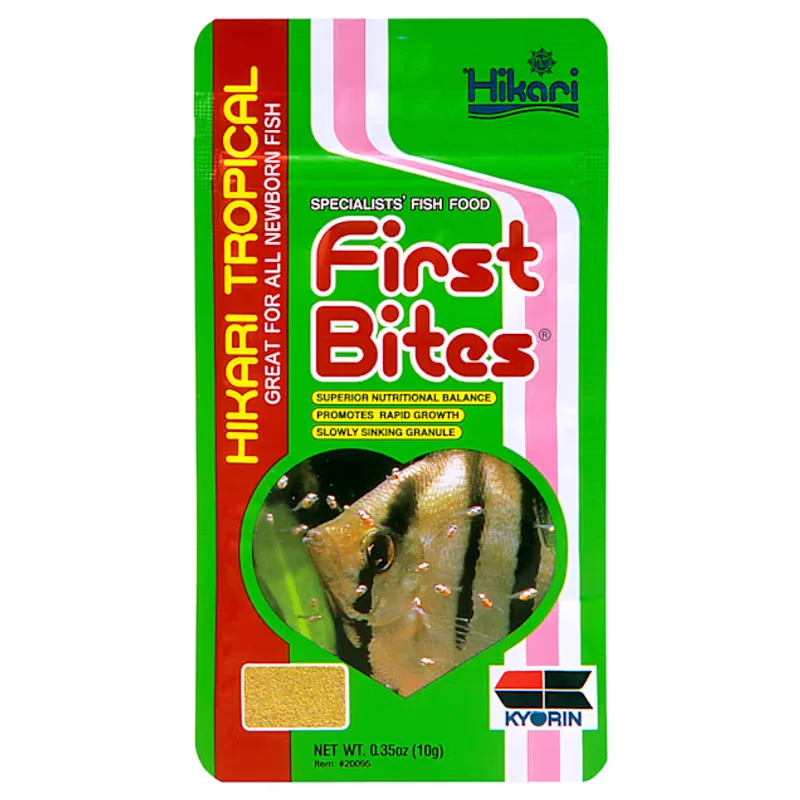
Hikari First Bites (10g)
Best Overall- ✓ Semi-floating particles stay in the water column where most fry feed — reduces uneaten food
- ✓ High 48% protein content supports rapid growth during the critical early weeks
- ✓ Works for virtually every freshwater species including livebearers, egg scatterers, and mouthbrooders
- ✓ Affordable price makes it practical for breeders running multiple tanks
- ✗ Particle size is not fine enough for the very smallest larvae — killifish and betta fry under 3 days old may need something finer
- ✗ Small package (10g) disappears fast when feeding large clutches daily
Hikari First Bites has been the default recommendation for freshwater fry for years, and it earned that position through consistent performance. The semi-floating particle size hits the middle range that covers most species — small enough for guppy, molly, platy, and tetra fry from day one, and visible enough that the fish can locate and engulf particles rather than swimming through an invisible cloud of dust.
The 48% protein content supports rapid growth during early development, when muscle and organ formation demands constant nutrition. The semi-floating behavior is the underrated feature here — particles do not all sink immediately, which means fry feeding at mid-water and near the surface have access without having to dive for food they may not spot.
On a breeding rack with 10-15 growout tanks, Hikari First Bites is the standard daily rotation food. Feed two to three times per day with a pinch that disappears in 2-3 minutes. That is the portion guideline regardless of which fry food you are using — overfeeding crashes water quality fast in small fry tanks.
The 10g package is small relative to what a serious operation goes through, so buying several packs at a time makes sense. The cost per feeding remains low enough that it does not register as a meaningful expense per tank.
Best for: Guppy, molly, platy, tetra, corydoras, and most livebearer fry from first feeding through 4-5 weeks old.
2. Sera Micron Nature (50ml)
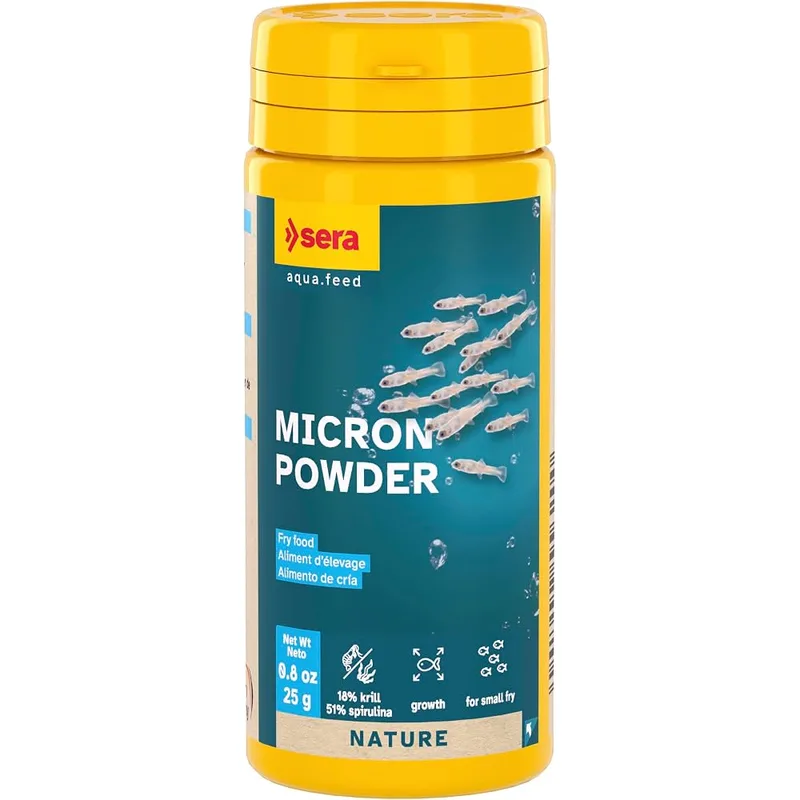
Sera Micron Nature (50ml)
Best for Smallest Fry- ✓ Particles under 50 microns fit mouths that standard powders cannot — right choice for newly hatched larvae
- ✓ Contains both zooplankton (18% krill) and phytoplankton (51% spirulina) for broad nutritional coverage
- ✓ Free from artificial dyes and preservatives — matters for sensitive larvae
- ✓ Stays in suspension longer than heavier powders, giving slow-feeding larvae more time to access it
- ✗ 50ml volume goes quickly in a multi-tank breeding operation
- ✗ Higher cost per gram than Hikari First Bites
Some fry are genuinely tiny. Betta fry at day one, killifish larvae, ricefish fry — their mouths are smaller than what standard fry powders target. Sera Micron Nature addresses this with particles under 50 microns, fine enough that even newly hatched larvae with near-microscopic mouths can ingest it.
The nutritional composition is balanced across both animal and plant sources. Sera uses 18% krill alongside 51% spirulina, which covers the high-protein base that fry need for rapid growth and the carotenoid pigments that support coloration from the earliest weeks. No artificial dyes and no preservatives keeps the formula clean for sensitive larvae that respond poorly to additives.
The suspension behavior is excellent. Fine particles stay in the water column significantly longer than heavier powders, giving slow-moving or newly hatched fry more time to reach the food. In tanks with minimal flow — the environment most newly hatched larvae need — this is meaningful.
The 50ml volume goes fast across multiple fry tanks. Use Sera Micron for the critical 7-14 day window after hatch when larvae are at their smallest, then transition to Hikari First Bites as mouths grow. It is not a cost-effective bulk food — it is a specialist tool for the most delicate developmental window.
Best for: Betta larvae, killifish fry, ricefish fry, and any species with newly hatched larvae under 5mm total length.
3. Aquatic Foods Inc. Golden Pearls 5-50 Microns (2oz)
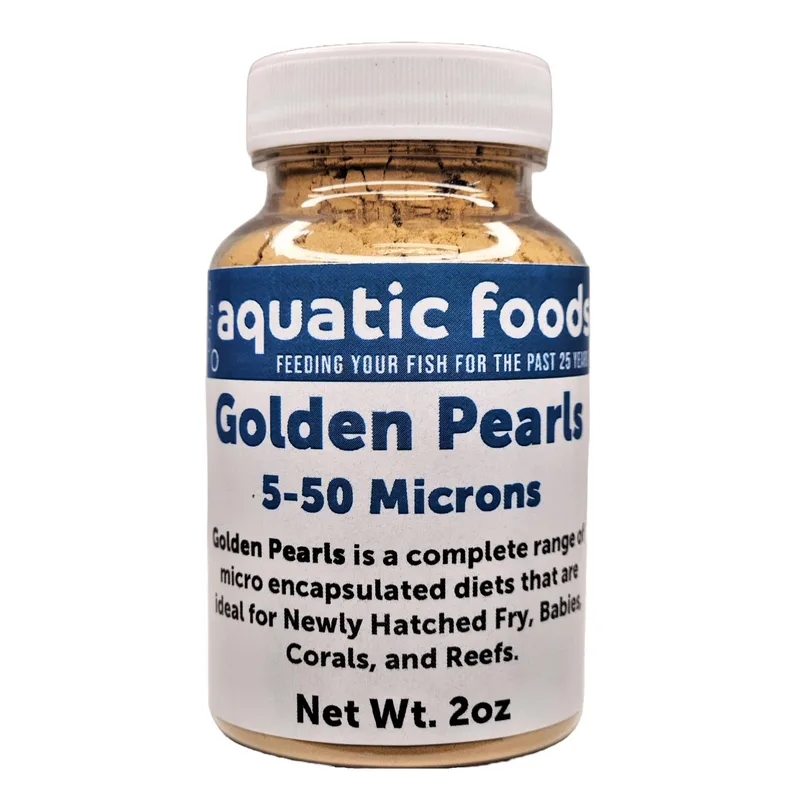
Aquatic Foods Inc. Golden Pearls 5-50 Microns (2oz)
Best for Newly Hatched- ✓ Micro-encapsulated particles trap tiny air pockets, keeping food neutrally buoyant throughout the water column
- ✓ 57% protein is among the highest of any dry fry food — supports fast early development
- ✓ Effective for shrimp shrimplets, which are notoriously difficult to feed at the newly-hatched stage
- ✓ Used in commercial marine hatcheries with proven nutritional profiles for delicate larvae
- ✗ Higher price point than basic powders
- ✗ Very fine dust — use sparingly to avoid fouling water in small fry tanks
Golden Pearls started as a commercial marine hatchery product and crossed over to freshwater because the nutritional profile and suspension behavior are both superior to most consumer-grade powders. The micro-encapsulation process gives each particle a trapped air pocket, which keeps the food neutrally buoyant in the water column — not concentrated on the surface and not sinking to the bottom.
At 57% protein, Golden Pearls is the highest-protein dry food on this list. That density supports the fastest growth rates in the first week, when developmental speed determines long-term health outcomes. Commercial hatcheries use it specifically for species that are historically difficult to raise through the larval stage.
For freshwater shrimp breeders, Golden Pearls earns its place specifically for shrimplets — baby cherry shrimp and caridina shrimp at the newly-hatched stage. Standard fry powders are often too large or too dense for shrimplets to capture efficiently. The 5-50 micron range includes particles small enough for shrimplets from day one.
The 2oz bottle is a sensible size because the food is so fine that a little goes a long way. Overdose and you fog the water in a small tank fast. Add less than you think you need, wait 15 minutes, and assess before adding more.
Best for: First-week larvae, shrimp shrimplets, discus fry, and breeders who want the highest available protein density in a dry food.
4. JADINGSFARM Liquid Daphnia Fry Food (2-Pack, 120ml)
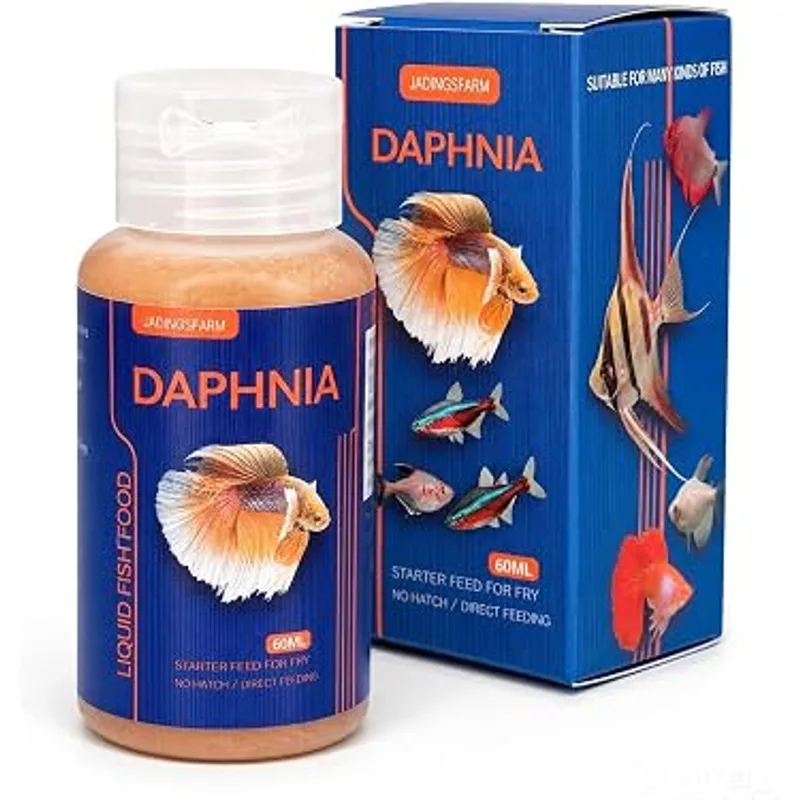
JADINGSFARM Liquid Daphnia Fry Food (2-Pack, 120ml)
Best Liquid Option- ✓ Ready-to-pour with no mixing, no measuring powder, and no mess
- ✓ Daphnia-based formula is naturally palatable to most freshwater fry
- ✓ Convenient for small clutches where a breeders wants a quick daily dose
- ✓ Two-bottle pack keeps one fresh in the refrigerator while the other is in active use
- ✗ Shorter shelf life than dry foods once opened — refrigerate and use within stated window
- ✗ More expensive per feeding than comparable dry foods
- ✗ Not a substitute for live food in species that require moving prey to trigger feeding responses
Liquid fry foods occupy a niche between dry powders and live cultures. They are more convenient than maintaining live cultures and more palatable to some fry than dry powders. The JADINGSFARM Liquid Daphnia delivers a ready-to-use daphnia suspension — open the bottle, squeeze a small amount into the tank, done.
Daphnia is a natural prey item for most freshwater fish. Fry recognize it readily, and the liquid suspension makes particles accessible immediately without the brief hydration period that some dry powders require to fully disperse. For breeders who want a low-maintenance daily feeding option for smaller clutches, this format removes friction from the routine.
The two-bottle packaging is practical. Keep one at room temperature for active use and store the second refrigerated to extend shelf life. Liquid fry foods are more perishable than dry options once opened, and the two-bottle format prevents cracking open a large container before you have a clutch ready to eat through it.
Liquid daphnia is not going to replace a live culture for serious fry-rearing operations. It is a convenient option for hobbyists who want a step above standard powder without the ongoing maintenance of live worms or brine shrimp.
Best for: Betta fry, guppy fry, and small clutches where convenience matters more than cost per feeding.
5. TruBlu Supply 4oz Live Microworm Culture
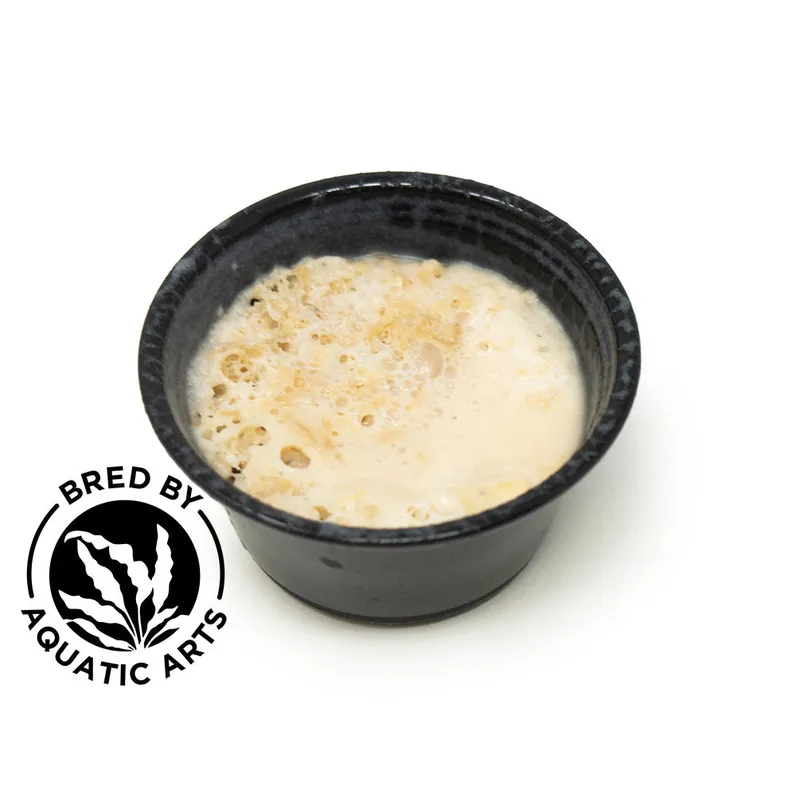
TruBlu Supply 4oz Live Microworm Culture
Best Live Culture- ✓ Live worms trigger feeding responses that powders and liquids cannot match in finicky or predatory fry
- ✓ Self-propagating culture means one starter produces unlimited food — ongoing cost approaches zero
- ✓ 1-2mm size is ideal for mid-stage fry that have outgrown ultra-fine powders but are too small for baby brine shrimp
- ✓ Easy to maintain at room temperature on an oatmeal-based medium
- ✗ Requires ongoing maintenance — must subculture every 1-2 weeks or the colony crashes
- ✗ Microworms are high in protein but not nutritionally complete on their own — rotate with a dry food
Nothing replaces live food for fry that refuse to eat. The movement of live microworms — Panagrellus redivivus, tiny nematodes about 1-2mm long — triggers feeding responses in species that completely ignore powders and liquids. Predatory fry like betta and killifish want moving prey, and no suspension or powder replicates that stimulus.
A 4oz starter culture arrives with established worms on an oatmeal-based medium. Within 3-5 days, the culture doubles. After the first week, you have more worms than a small breeding operation can use. Harvest by running a wet finger along the inside glass of the container — worms climb the walls — and rinse them into the fry tank with a small amount of old tank water.
Subcultured properly, one starter kit produces unlimited food for the life of the operation. Transfer a portion of an active culture to a new container of oatmeal every 1-2 weeks before the old culture crashes. Running two or three staggered cultures means you always have a fresh batch producing at peak output.
Microworms are not nutritionally complete on their own — they are high in protein but lack the full micronutrient profile that quality powders provide. Rotate microworms with Hikari First Bites or Sera Micron rather than using them as the sole food source.
Best for: Betta fry, killifish fry, and any species that ignores dry food and requires the trigger of live prey movement to initiate eating.
Buying Guide: Choosing the Right Fry Food
Match Food Size to Fry Mouth Size
The most important variable is particle size relative to the fry’s mouth opening. A fry can only eat what physically fits. As a practical guide:
- Newly hatched larvae (under 5mm total length): Sub-50 micron suspension powders — Sera Micron Nature, Golden Pearls 5-50 Microns
- Early fry (5-10mm): Standard fry powders — Hikari First Bites, Golden Pearls
- Mid-stage fry (10-20mm): Microworms, crushed flakes, micro-pellets
- Juvenile (20mm+): Small pellets, baby brine shrimp, crushed adult food
Guppy fry are born large relative to most species and can eat Hikari First Bites from day one. Betta larvae at hatch are tiny and need Sera Micron or Golden Pearls for the first several days before transitioning to larger particles.
Feeding Frequency Matters More Than Quantity
Fry have small stomachs and fast metabolisms. Feed small amounts 3-5 times daily rather than one large feeding. Each feeding should be consumed within 2-3 minutes — if food remains after 5 minutes, you fed too much. Uneaten food in a fry tank decomposes rapidly and crashes water quality.
Live Cultures for Fry That Refuse Dry Food
If fry are not eating within 48-72 hours of first feeding attempts, switch to live microworms before assuming a health problem. Some species respond only to moving prey in early development. Once feeding behavior is established on live food, transitioning to dry powders is usually straightforward.
Shrimp Shrimplets Are Different
Shrimplets graze continuously on biofilm and fine particles rather than hunting visible food. Golden Pearls 5-50 Microns works well because the neutrally buoyant particles integrate into the water column where shrimplets forage. Standard powders that sink quickly are less effective. Heavy biofilm growth in shrimp breeding tanks is the primary nutrition source for shrimplets in the first week — prioritize that alongside supplemental powder feeding.
The Main Mistake in Fry Raising: Overfeeding
Overfeeding kills more fry than underfeeding. Excess food decomposes, drives ammonia and nitrite spikes, and creates bacterial blooms that are fatal to fragile larvae. In a 5-10 gallon fry tank with minimal filtration, this happens fast. Use a sponge filter for biological filtration without the risk of sucking up fry, change 20-25% of water every 2-3 days, and feed only what fry can consume in 2-3 minutes per feeding.
Frequently Asked Questions
When should I start feeding fry after they hatch?
Most fry absorb their yolk sac for 24-72 hours after hatch before becoming free-swimming. Start feeding when fry are actively swimming horizontally rather than hanging near the substrate. For livebearers (guppies, mollies, platies), fry are born free-swimming and can eat immediately. Do not feed non-swimming larvae — they cannot yet feed and any food will only foul the water.
Can I feed fry the same food as adult fish?
No. Adult flakes and pellets are too large for fry mouths and will go uneaten, rotting in the tank. Even crushed adult food is often too coarse for newly hatched fry. Purpose-built fry powders with verified particle sizes are the correct starting point, transitioning to crushed adult food only once fry reach juvenile size around 4-5 weeks for most species.
How long should I use fry food before switching to regular food?
Most species transition to small adult food at 4-6 weeks old, when they reach 15-20mm in length. The visual indicator is mouth size — when fry are visibly catching and swallowing mini pellets reliably, they are ready to transition. Keep offering fry powder as a supplemental feed until you are confident all fish in the group are eating the larger food consistently.
Do microworms survive in the tank and breed in the aquarium?
No. Microworms cannot reproduce in aquarium water and will not become an infestation. Any worms that fry do not eat within a few hours will die and settle to the substrate. This is why small, frequent additions are better than large doses — add only what fry will consume in 30-60 minutes to keep the tank clean.
Are fry foods shrimp-safe?
Most dry fry powders are shrimp-safe — Hikari First Bites, Sera Micron Nature, and Golden Pearls contain no copper or compounds toxic to invertebrates. Shrimplets will actually benefit from the fine particles in these foods. The JADINGSFARM Liquid Daphnia is shrimp-safe based on its daphnia-and-water formula. Live microworms are also safe for shrimp. Never use copper-based medications or algaecides in any tank housing shrimp at any life stage.
What is the best fry food for guppies specifically?
Hikari First Bites is the reliable standard for guppy fry. Guppies are born large for livebearers and can eat First Bites from day one. Supplement with microworms for faster growth rates. Guppy fry grow fast — by three weeks they can often start eating crushed Hikari Fancy Guppy flakes alongside the fry powder, which accelerates the transition to adult food.
Can I make my own fry food at home?
Egg yolk paste — hard-boiled egg yolk mixed with tank water to a suspension — is a traditional homemade fry food that works for many species. It fouls water quickly and must be used in extremely small amounts. Commercial powders are cleaner and more consistent for a breeding operation. Microworm cultures are the best DIY live food option and cost effectively nothing to maintain after the initial starter purchase.
Conclusion
For most freshwater breeders, Hikari First Bites handles the majority of fry feeding across species. It is affordable, effective, and well-suited to guppies, tetras, corydoras, livebearers, and most other commonly bred freshwater fish. Keep several packs on hand and feed small amounts 3-4 times daily.
For newly hatched larvae with the smallest mouths — betta, killifish, ricefish — add Sera Micron Nature or Golden Pearls 5-50 Microns for the first 1-2 weeks before transitioning to Hikari First Bites as mouths grow. Golden Pearls earns its spot especially if you are also breeding shrimp, since the neutrally buoyant particles are well-matched to how shrimplets forage.
Every serious breeding operation benefits from maintaining a microworm culture. The startup cost is under $10 and the ongoing cost is effectively zero. Live worms trigger feeding in species that ignore dry food and accelerate growth in species that would eat powders anyway. Start a culture before you need it — TruBlu Supply ships established cultures that are actively producing within days of arrival.