AquaRanked is reader-supported. When you buy through links on our site, we may earn an affiliate commission.
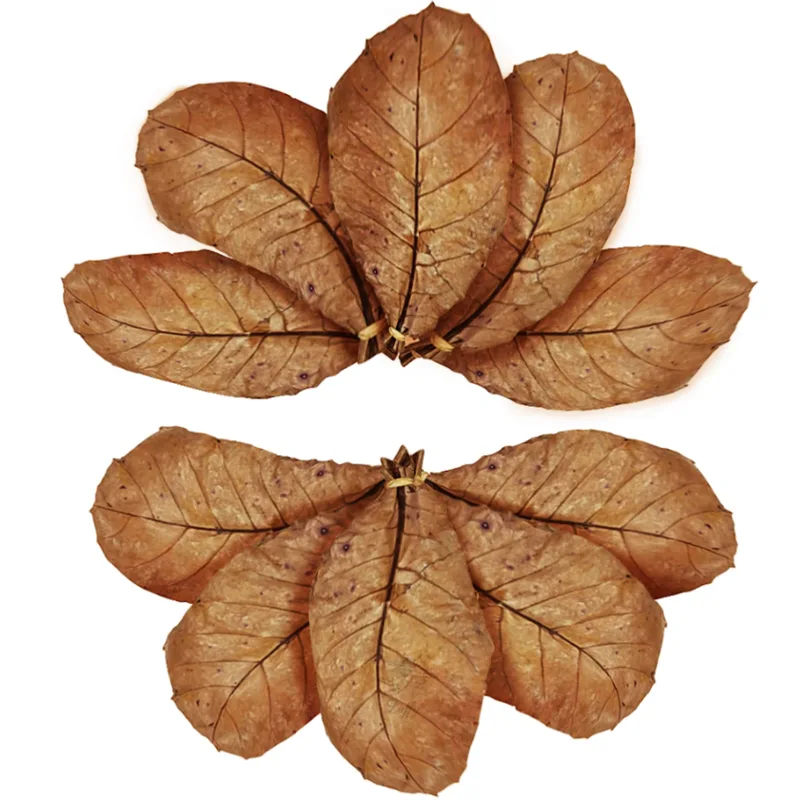
Indian almond leaves — catappa leaves, derived from Terminalia catappa trees native to tropical Southeast Asia — are one of the most effective and affordable additions you can make to a shrimp or betta tank. Drop one in and it starts releasing tannins, humic acids, and flavonoids that soften water, nudge pH downward, and create the blackwater chemistry that bettas, shrimp, and most Southeast Asian fish evolved in. As the leaf decomposes, it grows biofilm — the primary food source for baby shrimp and newly hatched fry.
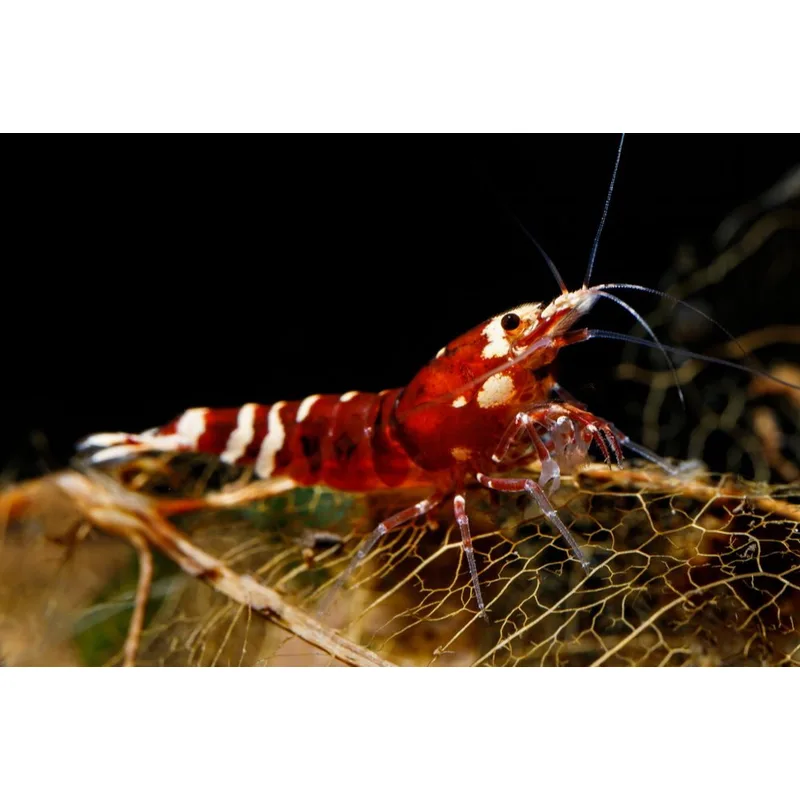
Shrimp-safe status: Fully safe for all shrimp species. Indian almond leaves contain no copper, no synthetic additives, and no preservatives. They actively benefit shrimp tanks — both Neocaridina (Cherry, Blue Dream) and Caridina (Crystal Red, Taiwan Bee) shrimp colonies respond with increased grazing activity and improved breeding rates. This is one of the few shrimp tank additions with no downside risk.
The market is full of options from no-name importers to established hobby brands. Leaf size, preparation quality, and consistent tannin output are what separate the good products from bags of random dried leaves. This roundup covers five options that cover different use cases — from the best all-around medium-leaf pack to the cheapest bulk option for multi-tank breeders.
| Dr. Moss Catappa Leaves Medium (50-pack) Best Overall | Aquarium Co-Op Catappa Leaves (20-pack) Best for Shrimp | LeonBach 100-Pack Catappa Leaves 5-8" 250g Best Bulk Value | SunGrow Giant Catappa Indian Almond Leaves 7-8" Best for Betta | Sukh 30-Pack Indian Almond Leaves Large Catappa Budget Pick | |
|---|---|---|---|---|---|
| Rating | 9/10 | 9.2/10 | 8/10 | 8.5/10 | 7.5/10 |
| Price | Unavailable | $12.99 | $15.95as of Sep 27, 2026 | $6.58-$6.93as of Sep 27, 2026 | $5.99as of Sep 27, 2026 |
| Size | 10-15cm (4-6") | 4-7" | 5-8" | 7-8" | Mixed large |
| Count | 50 leaves | 20 leaves | 100 leaves | 10 leaves | 30 leaves |
| Type | Medium | Medium | — | Large | Large |
| Best For | Shrimp and betta tanks | Neocaridina and Caridina shrimp colonies | Breeders, multi-tank fish rooms | Betta tanks, 10-20 gallon community tanks | First-time buyers, casual betta keepers |
| Weight | — | — | 250g | — | — |
| Check Price → | Check Price → | Check Price → | Check Price → | Check Price → |
Prices change daily — tap Check Price for the current Amazon price. Numbers shown were verified on the "as of" date.
Quick Picks
Buying Guide: What to Look for in Indian Almond Leaves
Leaf Size Dictates Use Case
Size is the most important variable to get right before buying.
Small (under 4”): Best for nano tanks under 5 gallons, breeding jars, and betta cups. These break down fast — faster biofilm development but more frequent replacement. Hard to find in the US market; most sellers work in medium to large sizes.
Medium (4-7”): The sweet spot for most tanks. Works in 5-20 gallon shrimp colonies and standard betta setups. One medium leaf per 10 gallons is a solid starting point.
Large (7”+): Best for standard 10-gallon and up betta tanks and community tanks. Higher tannin output per leaf and longer lifespan before decomposition. Less practical for nano shrimp setups where one leaf can take up significant floor space.
For shrimp tanks running Neocaridina colonies in 10-20 gallons, medium 4-7” leaves are the standard recommendation. For Caridina tanks where you’re maintaining low pH, slightly more leaves or larger format leaves help maintain consistent tannin levels between changes.
Tannin Output and Water Color
All catappa leaves release tannins, but potency varies by source, harvest age, and drying method. Well-cured leaves produce a steady, gradual release that turns water a light amber over 1-2 weeks. Poorly processed leaves may dump tannins quickly, turn water dark brown within 24 hours, then stop producing after a few days.
The hobbyist goal is a light tea color — not black water. To control intensity:
- Use fewer leaves per gallon
- Pre-soak in dechlorinated water for 24 hours before adding (reduces initial burst, creates steadier release)
- Remove leaves at 50-60% decomposition rather than letting them fully dissolve
Cost Per Leaf: The Multi-Tank Math
For breeders running 10+ tanks, per-leaf cost matters more than pack price:
| Product | Count | Price | Cost Per Leaf |
|---|---|---|---|
| LeonBach 100-pack | 100 | $15.95 as of Sep 27, 2026 | $0.16 |
| Dr. Moss 50-pack | 50 | Unavailable | $0.26 |
| Sukh 30-pack | 30 | $5.99 as of Sep 27, 2026 | $0.30 |
| Aquarium Co-Op 20-pack | 20 | $12.99 | $0.65 |
| SunGrow Giant 10-pack | 10 | $7.99 | $0.80 |
Running 10 tanks at 2 leaves per tank every two weeks means 40 leaves per month. At LeonBach pricing, that’s $6.40 per month. At Aquarium Co-Op pricing, that’s $26.00 per month. For single-tank betta keepers going through maybe 2 leaves per month, the premium Aquarium Co-Op pack makes sense. For a fish room, bulk is the only rational choice.
Preparation: Drop-In or Pre-Soak?
Drop-in (most common): Rinse briefly under tap water, let sit 10-15 minutes, add to tank. Leaf floats for 24-48 hours then sinks as it waterloggs. Simple and effective.
Pre-soak: Place leaves in a separate container of dechlorinated water for 24 hours before adding. This reduces the initial tannin burst, making the release more gradual and controlled. Recommended for Caridina tanks where pH stability is non-negotiable. Also useful when adding multiple leaves at once to avoid a sudden color or pH shift.
Do not boil catappa leaves. Boiling extracts tannins into the water you then discard — you’re cooking out exactly what you want to preserve. A brief rinse is all the preparation needed.
Caridina vs. Neocaridina: Does Catappa Matter More for One?
Both benefit, but Caridina keepers rely on catappa more heavily.
Caridina (Crystal Red, Taiwan Bee, Tiger Bee) need pH 5.4-6.2 with near-zero KH and GH of 3-6. Catappa tannins work alongside active buffering substrates (ADA Amazonia, SL-Aqua) to maintain the soft, acidic blackwater chemistry Caridina require. In a properly set up Caridina tank, catappa leaves are a standard maintenance tool, not optional.
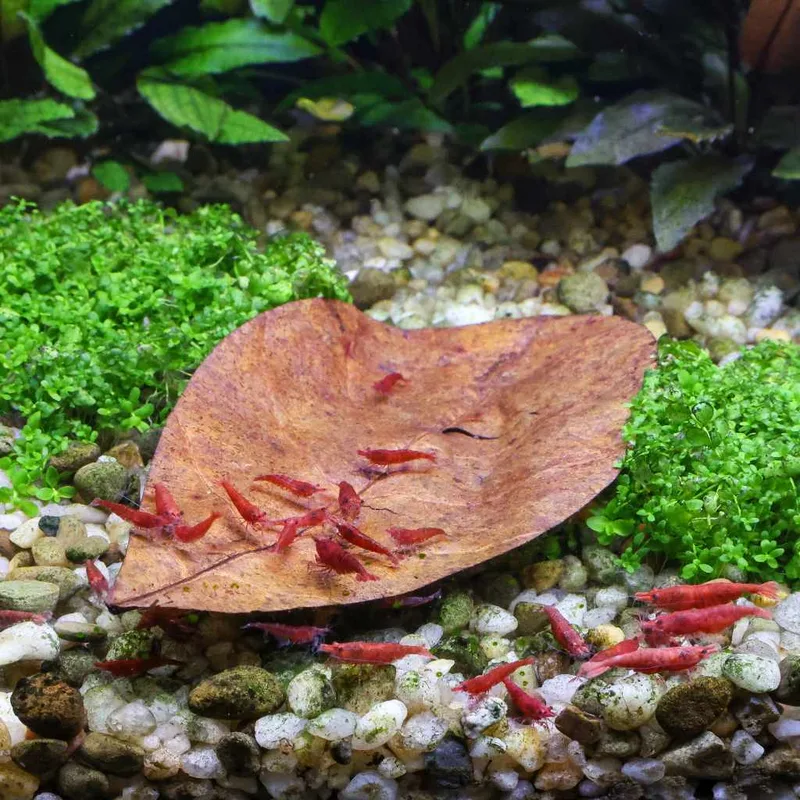
Neocaridina (Cherry Shrimp, Blue Dream, Snowball) tolerate pH 6.5-8.0 and GH of 6-12. Catappa still provides biofilm and mild pH support, but the water chemistry benefit is less critical. The biofilm grazing benefit is equally relevant — Neocaridina colonies visibly increase activity when leaves are added, clustering on the leaf surface within hours.
Detailed Reviews
Dr. Moss Catappa Leaves Medium (50-pack)
Dr. Moss Catappa Leaves Medium (50-pack)
Best Overall- ✓ Medium size works in nano shrimp tanks and betta setups alike
- ✓ 50-pack covers multiple tanks for several months
- ✓ Consistent tannin release without excessive water darkening
- ✓ Long-established product with reliable batch-to-batch quality
- ✗ Individual leaf sizes vary slightly within each pack
- ✗ No small or large variants under the same brand
Dr. Moss is one of the longest-standing catappa brands in the US hobby. The 50-pack of medium 10-15cm (4-6”) leaves has been a consistent recommendation in shrimp keeping communities for years, and the batch-to-batch quality holds up in a way that generic sellers often don’t.
Medium sizing is the reason this is the top pick for most hobbyists. At 4-6 inches, these leaves work in 5-gallon shrimp nano tanks without covering the entire floor, fit comfortably in a 10-gallon betta setup, and scale up to 20-40 gallon community tanks with 2-3 leaves. You don’t need multiple pack sizes for different tanks.
Fifty leaves at $12.99 gives you $0.26 per leaf and enough supply to run through 2-3 months across 5-8 tanks at standard dosing. Shrimp start grazing within hours of the leaf sinking. Tannin release produces a light amber tint that stays manageable rather than going deeply brown, which matters in planted tanks where light penetration is important.
The one critique is slight size variation between leaves in the pack. You’ll occasionally pull out a 3.5-inch leaf when you expected 5 inches. For most purposes this doesn’t matter, but if you’re dosing precisely by size, the inconsistency is worth knowing about.
Verdict: The right first-buy for most freshwater hobbyists. Covers shrimp tanks, betta setups, and community tanks with one 50-pack. Established quality, fair price, medium-format versatility.
Aquarium Co-Op Catappa Leaves (20-pack)
Aquarium Co-Op Catappa Leaves (20-pack)
Best for Shrimp- ✓ Hand-curated for shrimp and planted tank keepers
- ✓ Consistently sized leaves — predictable dosing
- ✓ Sourced through Aquarium Co-Op's vetted supply chain
- ✓ Works equally well in betta tanks and shrimp colonies
- ✗ Available direct only — no Prime shipping
- ✗ 20-pack runs out faster than bulk Amazon options
Aquarium Co-Op’s catappa leaves carry the highest per-leaf cost on this list and still earn the “Best for Shrimp” designation. The reason is sourcing confidence.
When you buy catappa leaves from a no-name Amazon seller, you’re trusting that the leaves were properly dried, stored in dry conditions, and haven’t picked up contaminants in a humid warehouse. Aquarium Co-Op curates their botanicals specifically for planted tank and shrimp hobby use. The 4-7” medium leaves arrive consistently sized, with no moisture retention issues or surface mold.
For Caridina keepers where a single parameter swing can stress or kill an expensive colony, sourcing traceability matters. You want catappa leaves from a supplier who understands the hobby, not a bulk agricultural import. The 20-pack at $12.99 costs $0.65 per leaf — a premium you’re paying for quality assurance, not prestige.
The direct-only availability is the main friction. No Amazon Prime means planning your restock before you run out. Order 2-3 packs at a time if you’re a regular buyer to offset shipping costs.
Verdict: The top pick for serious Caridina keepers and anyone running a shrimp breeding operation where consistency is non-negotiable. Higher cost-per-leaf is justified by quality control that bulk Amazon options can’t match.
LeonBach 100-Pack Catappa Leaves 5-8” 250g
LeonBach 100-Pack Catappa Leaves 5-8" 250g
Best Bulk Value- ✓ Best cost-per-leaf ratio on Amazon at roughly $0.16 per leaf
- ✓ 100 leaves stocks a breeding rack for 2-3 months
- ✓ Properly dried — minimal mold issues on arrival
- ✓ 5-8" range useful across most standard tank sizes
- ✗ Leaf sizes vary more than curated smaller packs
- ✗ Occasional broken or torn leaves in bulk shipments
For multi-tank breeders, the LeonBach 100-pack is the obvious choice. At $15.95 for 100 leaves, you’re at $0.16 per leaf — the lowest cost-per-leaf available from an established Amazon seller with a real product track record.
The 5-8 inch size range is practical for most tanks. You’ll get some leaves that run closer to 5” and some closer to 8” — more variation than a curated pack, but workable if you have a mix of tank sizes. Spend 5 minutes sorting a new shipment and you’ll have a stack of smaller leaves for nano tanks and larger ones for 10-20 gallon setups.
Leaf quality is adequate for the price. User reviews consistently note proper drying — no mold on arrival, leaves hold together well during handling. The occasional broken leaf in a 100-pack is expected and doesn’t affect overall value given the count.
For a breeding rack with 10 Neocaridina colony tanks running 2 leaves per tank every two weeks, the LeonBach 100-pack lasts approximately 2.5 months. That’s roughly $6 per month in catappa leaves across the entire rack.
Verdict: The rational choice for anyone running 5+ tanks. The per-leaf economics are compelling, quality is adequate, and 100 leaves keeps you stocked for months. Not the right pick if you want precisely sized, premium-quality leaves — that’s what Aquarium Co-Op is for.
SunGrow Giant Catappa Indian Almond Leaves 7-8”
SunGrow Giant Catappa Indian Almond Leaves 7-8"
Best for Betta- ✓ Large format gives bettas real cover and resting surface
- ✓ Strong tannin output per leaf for true blackwater conditioning
- ✓ Established SunGrow brand with over a decade of positive reviews
- ✓ Affordable entry price for betta keepers who don't need bulk
- ✗ Only 10 leaves per pack — high cost-per-leaf for shrimp rooms
- ✗ Too large for nano tanks under 5 gallons
The SunGrow Giant Catappa has been on the market since at least 2014. These 7-8 inch large-format leaves are designed primarily for betta tanks where leaf size translates directly to functional cover and resting space.
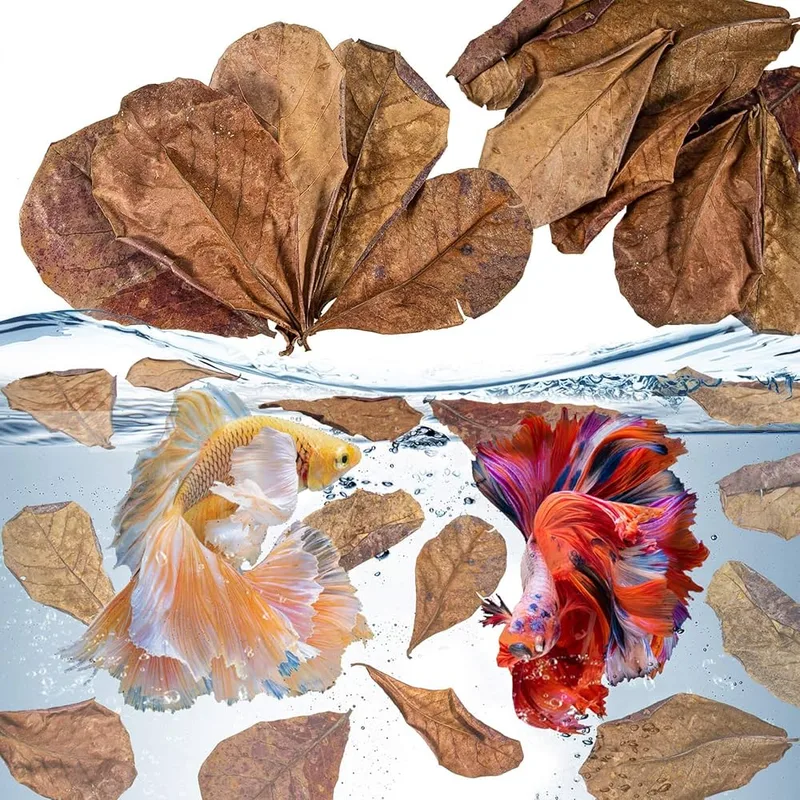
A betta in a 10-gallon tank with two large catappa leaves on the bottom behaves differently than a betta in a bare setup. User reports across forums consistently describe reduced aggression toward tank walls, more time spent near the bottom and mid-level exploring the leaf surface, and calmer color display. The large surface area also provides meaningful tannin output — one 7-8 inch leaf can condition 10 gallons to a noticeable amber tint within 48 hours.
The 10-pack format makes sense for single betta setups where you’re going through 2 leaves per month. For a shrimp room, the $0.80 per leaf cost and limited count make this impractical. There are better large-leaf options for bulk purchase, but for a single betta keeper who wants a premium leaf, SunGrow’s long track record and consistent reviews make this the safe choice.
Verdict: The right pick for betta keepers who want large-format catappa leaves and aren’t concerned with multi-pack economics. One of the most reviewed catappa products on Amazon for good reason.
Sukh 30-Pack Indian Almond Leaves Large Catappa
Sukh 30-Pack Indian Almond Leaves Large Catappa
Budget Pick- ✓ Low entry price for trying catappa leaves without commitment
- ✓ 30 leaves lasts 2-3 months in a single-tank setup
- ✓ Mixed sizing lets you pick the right leaf per tank
- ✗ Inconsistent quality control — occasional torn or undersized leaves
- ✗ Tannin output less reliable than established brands
- ✗ Mixed sizing makes consistent dosing harder to predict
The Sukh 30-pack is a reasonable entry point for someone who hasn’t used catappa leaves before and doesn’t want to commit to a 50- or 100-pack before knowing they’ll stick with it.
At $8.99 for 30 leaves, you’re paying $0.30 per leaf — middle of the range on this list. The “large catappa” designation means mixed large sizing, which in practice spans from barely-medium to genuinely large. You’ll need to look at each leaf and decide where it fits.
Quality control is the main concern. Occasional broken leaves, uneven sizing, and less consistent tannin output compared to Dr. Moss or Aquarium Co-Op are recurring themes in user reviews. For a casual betta keeper or someone experimenting with adding tannins, these limitations don’t matter much. For a shrimp breeding operation where you’re dosing 20 tanks on a schedule, the inconsistency becomes a real friction point.
Verdict: A sensible trial purchase for first-time catappa users. Once you confirm you’ll use them regularly, the Dr. Moss 50-pack or LeonBach 100-pack offer better value and consistency.
Frequently Asked Questions
How many Indian almond leaves should I use per gallon?
Start with one medium leaf (4-6”) per 10 gallons. For a stronger blackwater effect, go up to one per 5 gallons. For light tinting, one per 15-20 gallons is sufficient. Shrimp tanks can run slightly heavier since shrimp benefit from the decomposing biofilm. For Caridina tanks where you want consistent tannin levels, 1-2 medium leaves per 10 gallons replaced every 2-3 weeks is the standard approach.
Are Indian almond leaves safe for all shrimp?
Completely safe for all freshwater shrimp species, including sensitive Caridina. No copper, no synthetics, no preservatives. They’re actively beneficial — decomposing catappa leaves grow biofilm that newly hatched shrimp and juveniles feed on. Catappa tannins also support the soft, acidic water chemistry that Caridina require and mildly benefit Neocaridina colonies.
How long do catappa leaves last in an aquarium?
Medium leaves (4-6”) typically last 2-4 weeks before decomposing fully. Large leaves (7”+) last 4-6 weeks. The leaf passes through stages: floating (days 1-2), sinking and softening (days 3-7), active biofilm colonization (days 7-21), skeletal decomposition (days 21+). Shrimp are most active on leaves in the middle stages. Most keepers replace at 50-60% decomposition and drop in a fresh leaf — you can leave the skeletal remainder for shrimp to finish off.
Will catappa leaves drop my pH dangerously?
No, not in typical tanks. In tanks with KH of 2 or higher, pH reduction from catappa leaves is 0.1-0.3 units over 2 weeks — gradual and safe. In soft-water Caridina setups with near-zero KH and active buffering substrate, catappa tannins contribute to the overall acidic environment without shocking parameters. The pH change is a slow drift, not a spike. The only scenario where catappa becomes a problem is in an already-unbuffered tank near pH 6.0 where you add a large quantity all at once — pre-soak and add leaves gradually if you’re in that situation.
Can I use catappa leaves in a planted tank?
Yes. They’re compatible with planted tanks and don’t interfere with most aquatic plants. The amber tint reduces light penetration slightly at depth, which matters in high-light setups with demanding carpeting plants. In low-tech and natural-style planted tanks, catappa leaves are a standard addition. The decomposing leaf matter also adds trace organics that plants can access through substrate roots.
Do Indian almond leaves help with betta fin rot?
The tannins have documented mild antibacterial and antifungal properties that provide a supportive effect for early-stage fin rot. They’re not a substitute for clean water and proper water change schedules, and they won’t resolve moderate or severe fin rot without addressing the root cause. But in a tank maintained at proper parameters, catappa leaves contribute to the environment that prevents fin rot from developing in the first place.
How should I store unused catappa leaves?
In a sealed paper bag or breathable container in a cool, dry location. Avoid sealed plastic bags, which trap moisture and can cause mold during long storage. Properly dried catappa leaves stored in dry conditions last 12-24 months without quality degradation. Order in bulk and store in a cabinet away from humidity.
Conclusion
Indian almond leaves cost almost nothing and make a real difference in shrimp survival rates, breeding success, and betta behavior. The tannin release creates favorable water chemistry, the decomposing leaf surface feeds shrimp colonies, and the cover gives bettas a more functional environment.
Our Top Pick
Dr. Moss 50-pack is the all-around winner for most hobbyists — medium sizing, solid count, established quality. It’s the right first buy and the pack most hobbyists return to for ongoing use.
For dedicated shrimp keepers where water parameter consistency matters most, Aquarium Co-Op’s curated 20-pack is worth the higher per-leaf cost. For multi-tank fish rooms and breeding operations, LeonBach’s 100-pack at $0.16 per leaf is the only rational choice.
Single betta keepers who want the classic large-leaf blackwater experience: SunGrow Giant has been the reliable standard in this format for over a decade.
For more on setting up a complete shrimp environment, see the Best Shrimp Substrate in 2026 guide and the Neocaridina Shrimp Care Guide for full parameter and colony management recommendations.