The canister vs. HOB debate has been running in the freshwater hobby for decades, and the answer is still the same: it depends on your tank, your budget, and how much maintenance you are willing to do.
Neither type is objectively superior. Canister filters excel at biological filtration capacity and silence. HOB filters win on ease of maintenance and cost. Understanding where each shines helps you make the right choice for your specific setup.
The Core Differences
How They Work
Canister filters sit below or beside the tank in a cabinet. Water is pulled from the tank through an intake tube, pushed through a sealed canister packed with filtration media, and returned through a spray bar or outlet. The entire system is sealed and pressurized.
HOB (Hang-On-Back) filters clip onto the back rim of the tank. Water is pulled up through an intake tube, flows through a media basket inside the filter body, and waterfalls back into the tank over an overflow lip.
Media Capacity
Canisters win here definitively. A Fluval 207 has a 3.1-liter total filtration chamber packed with customizable media. The AquaClear 50, one of the most spacious HOBs, holds roughly 1.5 liters. More media means more surface area for beneficial bacteria, more room for chemical filtration, and more flexibility in customizing your filtration stack.
Maintenance Effort
HOBs win here just as definitively. Pop the lid, pull out the media, rinse in old tank water, replace. The whole process takes 5 minutes. A canister requires disconnecting hoses, carrying the canister to a sink, opening it (which can be stubborn), cleaning multiple baskets, reassembling, reconnecting, and priming. Budget 20-30 minutes.
Noise Level
Canisters are nearly silent when properly sealed and primed. The motor is submerged in water inside the canister, which dampens vibration. HOBs produce waterfall noise from the overflow — some people find it pleasant, others find it distracting. The noise increases as water level drops from evaporation.
Cost
A canister filter for a 40-gallon tank runs $100-200. A comparable HOB runs $30-60. Over time, canisters also cost less in replacement media because you are using bulk sponge, ceramic rings, and activated carbon rather than proprietary cartridges — but the upfront gap is significant.
Detailed Reviews
Fluval 207 Canister Filter
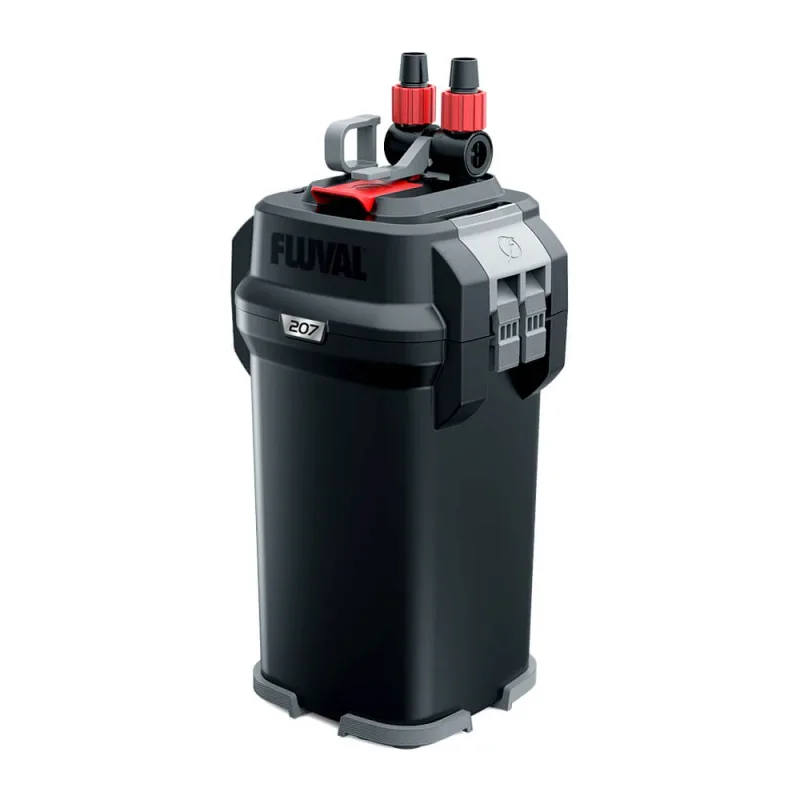
Fluval 207 Canister Filter
Best Canister- ✓ Large media capacity for superior biological filtration
- ✓ Quiet operation — barely audible from 3 feet away
- ✓ Customizable media baskets for tailored filtration
- ✓ No evaporation increase — sealed system
- ✗ Expensive compared to HOB filters
- ✗ Maintenance requires disconnecting hoses and carrying to a sink
- ✗ Potential for leaks at connections
- ✗ Bulky — needs cabinet or stand space
The Fluval 207 is the go-to canister for tanks in the 20-45 gallon range. Four media baskets let you customize a filtration stack — coarse sponge on the bottom, ceramic bio rings in the middle, fine polish pad and activated carbon on top. This flexibility means you can optimize for biological filtration in a planted tank (skip carbon, maximize bio media) or heavy mechanical filtration in a fish-heavy tank (more sponge, polishing pads).
The quick-disconnect valves make maintenance less painful than older canister designs. You can shut off flow, disconnect the hoses, and carry the canister to a sink without draining hoses or making a mess. Fluval’s Aqua-Stop valves are the reason their canisters dominate the hobby market.
For shrimp tanks, pair the intake with a prefilter sponge. The stock intake strainer has gaps large enough to trap juvenile shrimp.
Best for: Planted tanks 20-45 gallons, shrimp breeding setups (with prefilter), and situations where noise must be minimal.
AquaClear 50 HOB Filter
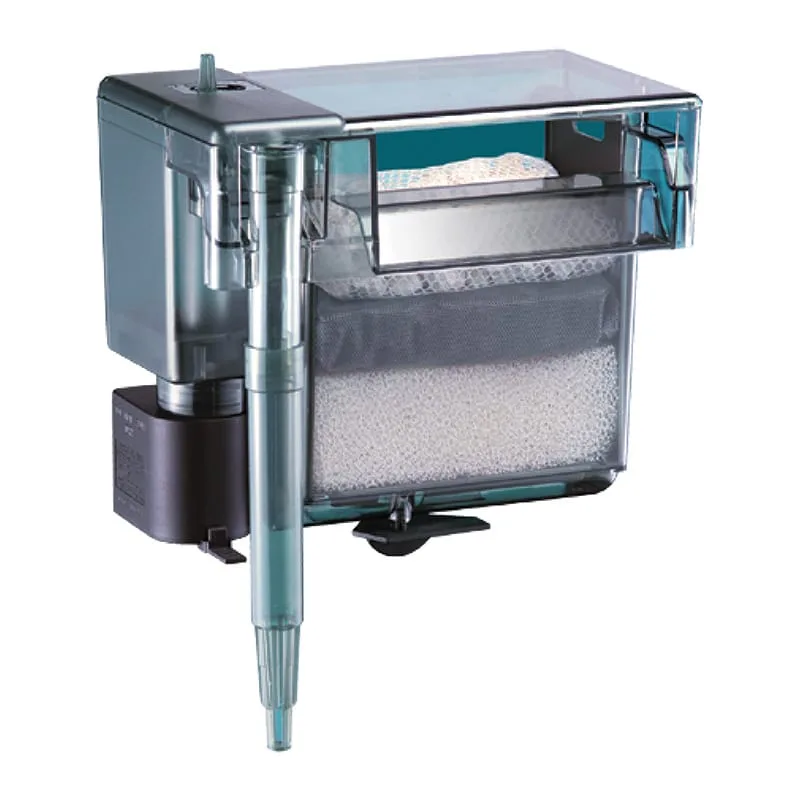
AquaClear 50 HOB Filter
Best HOB- ✓ Excellent value — premium filtration under $50
- ✓ Easy media access without disconnecting anything
- ✓ Customizable media basket (not locked into cartridges)
- ✓ Adjustable flow control
- ✗ Creates surface agitation that increases evaporation
- ✗ Waterfall noise can be noticeable in quiet rooms
- ✗ Takes up space on the tank rim
- ✗ Intake tube can trap shrimp without a prefilter sponge
The AquaClear is not like other HOBs. Where most hang-on-back filters lock you into buying proprietary cartridges that combine all media into a single disposable unit, the AquaClear uses a customizable basket system. You get a foam block, activated carbon bag, and BioMax ceramic media — but you can replace any component individually without disrupting the others.
This means you never have to throw away your biological media just because the carbon is exhausted. Swap the carbon bag, leave the sponge and ceramic rings untouched. Your bacterial colony stays intact.
The adjustable flow control is another standout feature. Dial it down for shrimp tanks or betta setups where strong flow is stressful. Crank it up for flow-loving species like danios and loaches. This adjustability makes the AquaClear appropriate for a wider range of tank inhabitants than fixed-flow HOBs.
Shrimp safety note: The intake tube needs a sponge prefilter cover to prevent baby shrimp from being sucked into the impeller chamber. This is a $3 accessory that should be considered mandatory for any shrimp tank.
Best for: Most freshwater tanks under 50 gallons where ease of maintenance is a priority and some noise is acceptable.
Seachem Tidal 55 HOB Filter
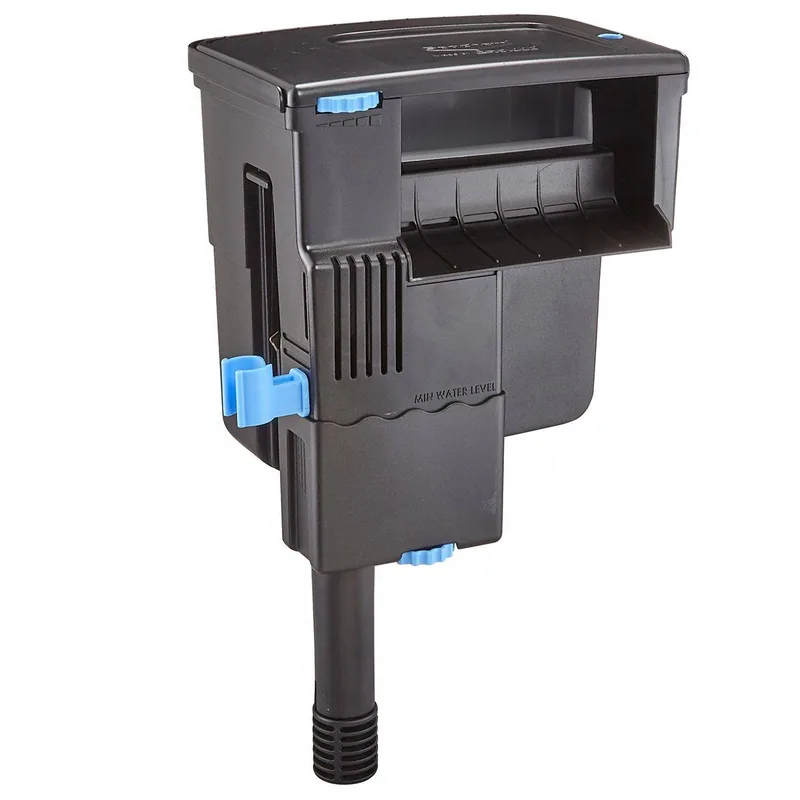
Seachem Tidal 55 HOB Filter
Best HOB Premium- ✓ Self-priming pump restarts automatically after power outages
- ✓ Dual intake with surface skimmer removes protein film
- ✓ Adjustable flow and telescoping intake for versatile placement
- ✓ Easy maintenance with accessible filter basket
- ✗ More expensive than basic HOB filters
- ✗ Larger footprint on the tank rim
- ✗ Intake needs sponge prefilter for shrimp safety
The Seachem Tidal 55 addresses two of the biggest frustrations with standard HOB filters: power outages and surface film. The self-priming pump restarts automatically when power is restored, so you never return home to a dead filter after an outage. The dual intake — a standard submerged tube plus a surface skimmer — pulls in water from both mid-column and the surface, removing the oily protein film that forms in most tanks.
The adjustable flow and telescoping intake make installation versatile. Shorter intakes for shallow tanks, longer for deeper setups, and you can reduce flow for shrimp tanks or fish sensitive to strong current — features the basic AquaClear lacks. The large customizable media basket accommodates sponge, ceramic rings, and activated carbon in any configuration you choose.
At $55, it costs more than the AquaClear but delivers meaningfully better features. For a planted tank or shrimp setup where surface film management matters, the dual intake alone justifies the price difference.
Best for: Planted tanks, shrimp setups, and anyone who wants a premium HOB with surface skimming and automatic restart.
Comparison Table
| Fluval 207 Canister Filter Best Canister | AquaClear 50 HOB Filter Best HOB | Seachem Tidal 55 HOB Filter Best HOB Premium | |
|---|---|---|---|
| Rating | 9.1/10 | 9/10 | 8.7/10 |
| Price | $149.89as of Sep 27, 2026 | $55.79-$61.99as of Sep 27, 2026 | $59.99as of Sep 27, 2026 |
| Flow Rate | 206 GPH | 200 GPH | 250 GPH |
| Tank Size | Up to 45 gallons | 20-50 gallons | Up to 55 gallons |
| Media Capacity | 3.1L total chamber | Customizable basket | Large customizable basket |
| Type | External canister | Hang-on-back | Hang-on-back |
| Check Price → | Check Price → | Check Price → |
Prices change daily — tap Check Price for the current Amazon price. Numbers shown were verified on the "as of" date.
Decision Framework
Choose a Canister If:
- Your tank is 40 gallons or larger
- Noise is a concern (bedroom, living room)
- You want maximum biological filtration capacity
- You run a heavily planted tank with CO2 injection
- You do not mind less frequent but more involved maintenance
- Your tank is near a cabinet or stand with space below
Choose a HOB If:
- Your tank is under 40 gallons
- You want easy, quick maintenance access
- Budget is a primary consideration
- You are a beginner who wants simple operation
- Your tank does not have cabinet space for a canister
- You do not mind some waterfall noise
Choose a Sponge Filter If:
- You keep shrimp (safest option for baby shrimp)
- You are running multiple small breeding tanks
- Simplicity is your top priority
- Budget is extremely limited
- You want backup filtration alongside a primary filter
Shrimp Safety Considerations
Both canisters and HOBs pose risks to baby shrimp through their intake systems. Shrimp-safe filtration requires one of:
- Prefilter sponge on the intake tube (works for both canisters and HOBs)
- Sponge filter as the primary filtration (safest option)
- Fine mesh intake cover that blocks anything larger than bacteria
For breeding colonies where fry and juvenile shrimp are present, a sponge filter is the safest primary filtration. If you prefer the superior performance of a canister or HOB, always add a prefilter sponge to the intake.
Maintenance Schedules
Canister Filters
- Monthly: Rinse mechanical media (sponges) in old tank water. Check impeller for debris.
- Every 3 months: Replace activated carbon. Inspect bio media for excessive buildup (rinse gently if clogged, never replace entirely).
- Every 6 months: Replace fine polishing pads. Check hose condition and O-rings.
- Annually: Replace intake and output tubing if discolored or stiff.
HOB Filters
- Every 2 weeks: Rinse sponge/foam in old tank water. Check water flow.
- Monthly: Replace activated carbon. Check impeller.
- Every 3-6 months: Replace foam block if deteriorating. Never replace bio media unless completely disintegrated.
Frequently Asked Questions
Can I run a canister and a HOB together?
Yes, and some hobbyists do for redundancy. The canister provides the bulk of biological and mechanical filtration, while the HOB serves as backup and a convenient location for chemical media (carbon, Purigen) that you change frequently.
Which filter type is quieter?
Canisters are significantly quieter than HOBs. A properly primed canister is nearly inaudible. HOBs produce constant waterfall noise that varies by water level and flow setting.
Do canister filters leak?
They can if O-rings are dry or damaged, if connections are not sealed properly, or if hoses crack with age. Inspect O-rings with every maintenance session and apply silicone grease. A well-maintained canister should not leak.
How often should I clean my filter?
Canisters: monthly mechanical cleaning, quarterly deep clean. HOBs: biweekly rinse, monthly media swap. The biological media in both types should never be replaced entirely at once — you will crash your cycle.