Solar aerators come in two tiers: high-capacity sealed-battery models built for reliable overnight runtime, and compact budget models with a smaller built-in battery and a lower price. The choice between them affects runtime, long-term cost, and how much margin you have on cloudy days.
This comparison breaks down when each type makes sense and when it does not.
The Core Difference
High-Capacity Battery Solar Aerators (like the Biling) use a sealed high-capacity lithium battery pack. The large capacity provides reliable 4-8 hour nighttime runtime and consistent output, but when the battery degrades after a few years, the unit must be replaced entirely.
Compact Battery Solar Aerators (like the Sunsbell) use a smaller built-in lithium battery paired with a DC charging port as a backup. The solar panel — or a wall adapter on cloudy stretches — tops off the small battery, which then powers the pump overnight. Like the high-capacity models, the battery itself is sealed and not user-replaceable, but the unit costs considerably less upfront.
| Biling 8W Solar Pond Aerator with Battery Backup Best Battery Backup | Sunsbell Solar Powered Pond Oxygenator Air Pump Best Budget Solar | |
|---|---|---|
| Rating | 8.5/10 | 7.8/10 |
| Price | $49.99as of Sep 27, 2026 | $20.39-$23.99as of Sep 27, 2026 |
| Type | Solar with rechargeable battery | Solar with compact built-in battery |
| Runtime | Up to 72 hours on full charge | Up to 20 hours on a full charge |
| Output | 2 built-in air pumps | 1 air stone |
| Battery | 4400mAh built-in | Built-in lithium (non-replaceable), plus DC charging backup |
| Check Price → | Check Price → |
Prices change daily — tap Check Price for the current Amazon price. Numbers shown were verified on the "as of" date.
Detailed Comparison
Battery Backup: Biling 8W Solar Pond Aerator
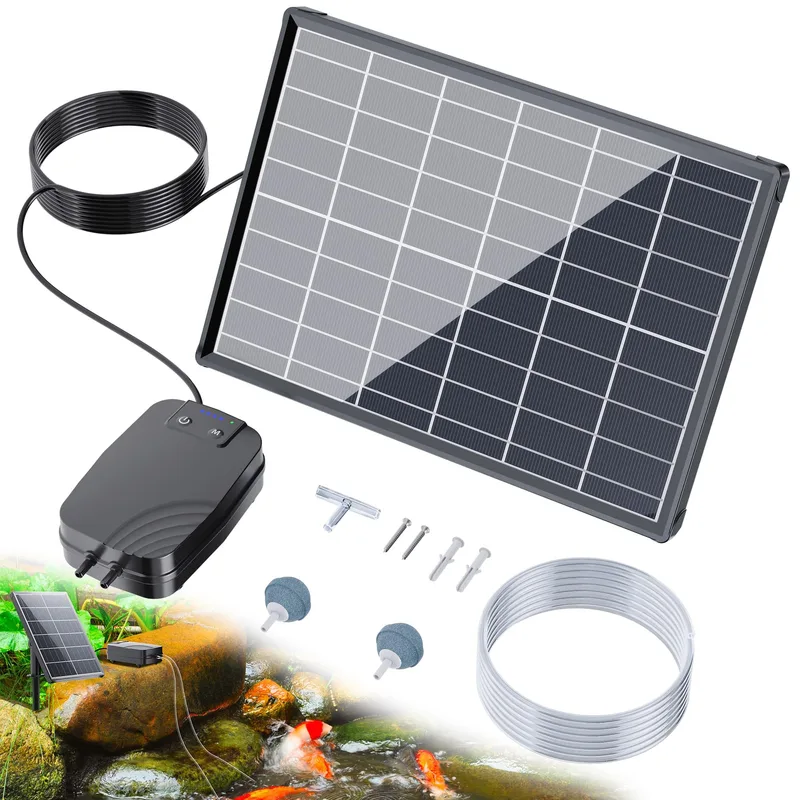
Biling 8W Solar Pond Aerator with Battery Backup
Best Battery Backup- ✓ 4400mAh battery stores charge for nighttime and cloudy-day aeration
- ✓ 8W panel with dual air pumps for stronger output than basic models
- ✓ 3 working modes: strong, soft, and cycle bubble
- ✓ No electricity needed — fully off-grid operation
- ✗ Battery degrades over time and is not user-replaceable
- ✗ Lower air output than plug-in electric pumps
- ✗ Battery adds cost and complexity vs. direct-power models
The Biling is the standard recommendation for fish ponds because it provides nighttime aeration. Fish consume oxygen 24 hours a day. Plants produce oxygen during daylight but consume it at night. The lowest dissolved oxygen levels in any pond occur in the pre-dawn hours — exactly when a direct-power aerator is not running.
For a stocked fish pond in USDA Zones 7-9 summer heat (water temps 80-85°F), nighttime aeration is not optional. Warm water holds less dissolved oxygen than cool water, and fish metabolisms run faster in heat, demanding more oxygen. A direct-power aerator that shuts off at sunset leaves fish vulnerable during the most dangerous oxygen window of the day.
Battery reality check: The 4400mAh battery can power the pump for up to 72 hours on a full charge, though real-world nighttime runtime in a stocked pond depends on pump mode selected. After two to three years of daily charge/discharge cycles, battery capacity will begin to decline.
Budget Option: Sunsbell Solar Powered Pond Oxygenator Air Pump
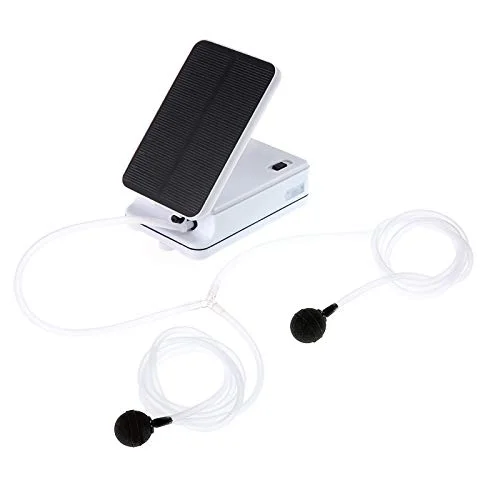
Sunsbell Solar Powered Pond Oxygenator Air Pump
Best Budget Solar- ✓ Dual charging — solar panel or a DC cable for backup during cloudy stretches
- ✓ Cheaper than large battery-backup models
- ✓ Simple design with fewer electronic components
- ✓ Immediate operation as soon as sun hits the panel
- ✗ Smaller battery capacity than dedicated battery-backup models
- ✗ Battery is sealed and not user-replaceable — the whole unit is replaced when it degrades
- ✗ Not suitable as primary aeration for heavily stocked fish ponds
The Sunsbell pairs a small built-in lithium battery with a DC charging port, giving you two ways to keep it topped off — direct sun or a wall adapter during a stretch of overcast days. It makes sense as a budget option in two scenarios:
- Lightly stocked patio ponds — guppies, endlers, or ricefish in small container ponds where lower air output is sufficient
- Supplemental aeration — adding extra aeration to a pond that already has a primary source
The key advantage over the Biling is price, not serviceability — neither unit has a user-replaceable battery, but the Sunsbell’s smaller battery and simpler electronics keep the cost well below the Biling’s.
Cost matters too. At $20-$28 versus $35-$55, the Sunsbell saves meaningful money upfront. The trade-off is lower air output (one air stone versus the Biling’s dual pumps) and a smaller built-in battery than the Biling’s 4400mAh pack.
Head-to-Head Comparison
| Factor | Biling (High-Capacity Battery) | Sunsbell (Compact Battery) |
|---|---|---|
| Nighttime operation | Yes (4-8 hours) | Yes (limited, up to 20h full charge) |
| Cloudy day operation | Yes (from stored charge) | Yes, or plug in DC backup |
| Fish safety at night | Protected | Protected (limited) |
| Battery type | Built-in 4400mAh (sealed) | Built-in compact lithium (sealed) |
| Battery replacement | Must replace whole unit | Must replace whole unit |
| Upfront cost | Higher ($35-$55) | Lower ($20-$28) |
| Output strength | Consistent (battery regulated) | Variable (sun/charge dependent) |
| Air pumps | Dual pumps (stronger) | Single air stone (lighter) |
Which Should You Buy?
Buy Biling (high-capacity battery) if:
- Your pond is moderately to heavily stocked with fish
- The aerator is the primary or only source of oxygen
- You live in an area with frequent cloudy days
- Summer temperatures push water above 80°F regularly
- You keep oxygen-sensitive species (goldfish, koi, heavily stocked ponds)
Buy Sunsbell (compact battery) if:
- Budget is the primary constraint
- You have a nearby outlet and can use the DC charging port as backup during cloudy stretches
- Your pond is lightly stocked with small fish (guppies, endlers, ricefish)
- You already have adequate aeration from another source and want low-cost supplemental aeration
- The pond is heavily planted and lightly stocked (plants provide some oxygen through dissolved reserves)
Shrimp and Small Fish Considerations
For patio ponds stocked with guppies, endlers, or ricefish in USDA Zones 7-9 summer heat:
The Biling is recommended over the Sunsbell for fish ponds. Small fish in warm water are vulnerable to overnight oxygen drops. A patio pond with direct sun can reach 85°F on a July afternoon — at that temperature, dissolved oxygen drops significantly. The Biling’s 4400mAh built-in battery provides more reliable overnight coverage than the Sunsbell’s smaller pack.
Shrimp are even more sensitive to low oxygen than fish. Neocaridina in outdoor containers need continuous aeration during summer months. For lightly stocked patio ponds (10 guppies or fewer), the Sunsbell is workable. For anything more than that, use the Biling or a plug-in electric air pump.
Installation Tips for Both Types
- Position solar panel facing south (in the northern hemisphere) for maximum daily sun exposure
- Keep panel clean — dust, bird droppings, and fallen leaves reduce charging efficiency
- Place air stone at the deepest point of the pond for maximum water column circulation
- Use airline tubing rated for outdoor UV exposure — standard aquarium tubing degrades in sunlight within one season
- Weight the air stone so it stays on the bottom — buoyant stones float up and waste aeration energy at the surface where it is least needed
A properly placed solar aerator turns a stagnant patio pond into an oxygenated, circulating habitat that supports fish through the entire outdoor season. Choose the high-capacity battery unit for stocked ponds, the compact budget unit for light supplemental use, and sleep well knowing your fish have oxygen at 3 AM.