Water changes are the foundation of freshwater aquarium keeping. No amount of filtration, additives, or beneficial bacteria replaces physically removing old water and adding fresh. The question is not whether to do water changes — it is how to make them easy enough that you actually do them consistently.
The right equipment turns a 30-minute chore into a 10-minute task. A faucet-driven system eliminates buckets entirely. A quality gravel vacuum lets you clean substrate while draining. The easier you make water changes, the more often you will do them, and the healthier your tank will be.
Quick Picks
- Best Overall: Python No Spill Clean and Fill — the original bucket-free system, proven for decades
- Best Long Reach: Laifoo 50ft — reaches distant tanks in fish rooms and basements
- Best Budget Faucet System: Hygger Bucket-Free Kit — Python alternative at a lower price
- Best for Small Tanks: Laifoo 5ft Siphon — simple, cheap, perfect for nano setups
Detailed Reviews
1. Python No Spill Clean and Fill (25 ft)
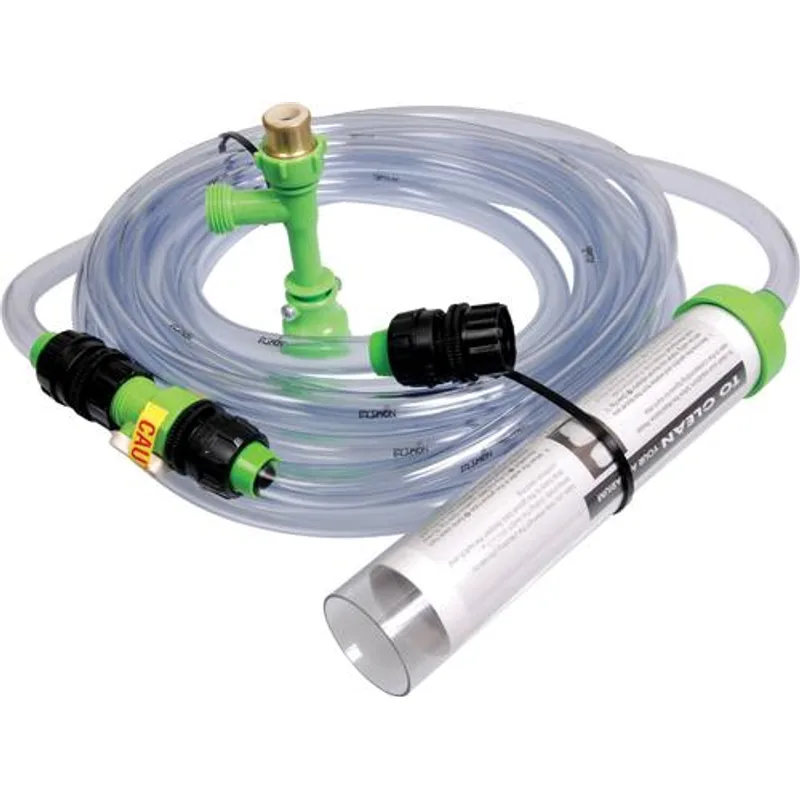
Python No Spill Clean and Fill (25 ft)
Editor's Choice- ✓ No buckets — drain directly to sink and refill from faucet in one system
- ✓ Faucet adapter creates venturi suction — no priming or mouth siphoning
- ✓ 25-foot hose reaches most rooms from the nearest faucet
- ✓ Industry standard for 20+ years with widely available replacement parts
- ✗ Uses more water than bucket method (faucet runs during draining)
- ✗ Gravel tube can catch small shrimp — need a guard for invertebrate tanks
The Python is the standard by which all aquarium water changers are measured. Hook the faucet adapter to your sink, turn on the water, and a venturi effect creates suction that drains your tank through the 25-foot hose. Flip a valve, and the same hose fills the tank with fresh water from the faucet. No buckets, no lifting, no spilling.
For a 20-gallon tank, a 50% water change takes about 8–10 minutes: 4 minutes draining, 4 minutes refilling, plus time for gravel vacuuming. Compare that to carrying four 5-gallon buckets back and forth — the Python pays for itself in time and back-pain savings.
The 25-foot hose reaches most tanks from the nearest bathroom or kitchen faucet. If your fish room is further away, Python sells extension hoses, or you can size up to the 50-foot version.
For shrimp tanks: the standard gravel tube opening can catch shrimplets. Attach a pre-filter sponge or mesh guard over the end, or hold the tube above the substrate and siphon water without disturbing the gravel. Many shrimp keepers skip gravel vacuuming entirely and just siphon water from mid-column.
The only real downside is water waste. Running the faucet to create suction means water going down the drain unused. In areas with expensive water or during droughts, this is a consideration. The bucket method wastes no water but costs time.
Best for: Any tank over 10 gallons where you want the fastest, easiest water changes possible.
2. Laifoo 50ft Aquarium Water Changer
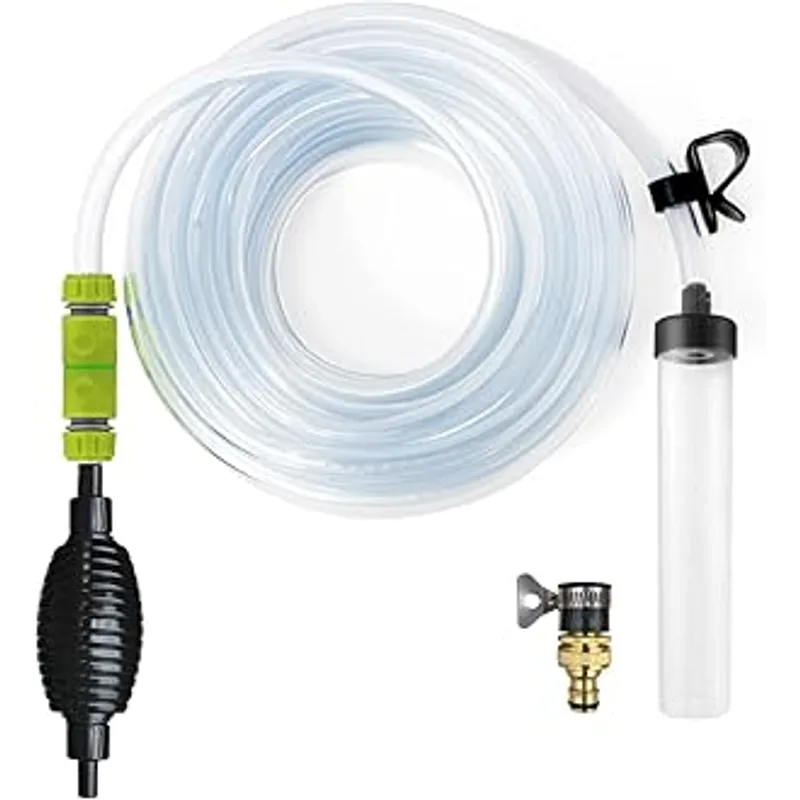
Laifoo 50ft Aquarium Water Changer
Best Long Reach- ✓ 50-foot hose reaches distant tanks — great for fish rooms and basements
- ✓ Same faucet-driven venturi principle as the Python
- ✓ Good build quality at a lower price point than Python
- ✓ Includes faucet adapter and all necessary connectors
- ✗ Longer hose means more water in the line — takes longer to prime
- ✗ Less widely available replacement parts than Python
The Laifoo 50ft works on the same principle as the Python — faucet-driven venturi suction for bucket-free water changes. The 50-foot hose is the key advantage for fish rooms, basement setups, or tanks far from the nearest faucet.
Build quality is good. The faucet adapter is metal, the connections are solid, and the hose is flexible enough to route around corners without kinking. It is not quite as polished as the Python’s components, but for most users the difference is negligible.
The longer hose does mean more water sitting in the line between the tank and the faucet. Starting a siphon takes a few extra seconds, and draining is slightly slower because gravity has to pull water through more tubing. In practice, this adds maybe 1–2 minutes to a water change — not a significant issue.
Replacement parts are the one area where the Python has an advantage. Python parts are available at virtually every pet store and on Amazon. Laifoo parts are less universally available, though the standard hose diameter means generic fittings often work.
Best for: Fish rooms, basements, or any setup where the tank is more than 20 feet from the nearest faucet.
3. Hygger Bucket-Free Aquarium Water Change Kit (25 ft)
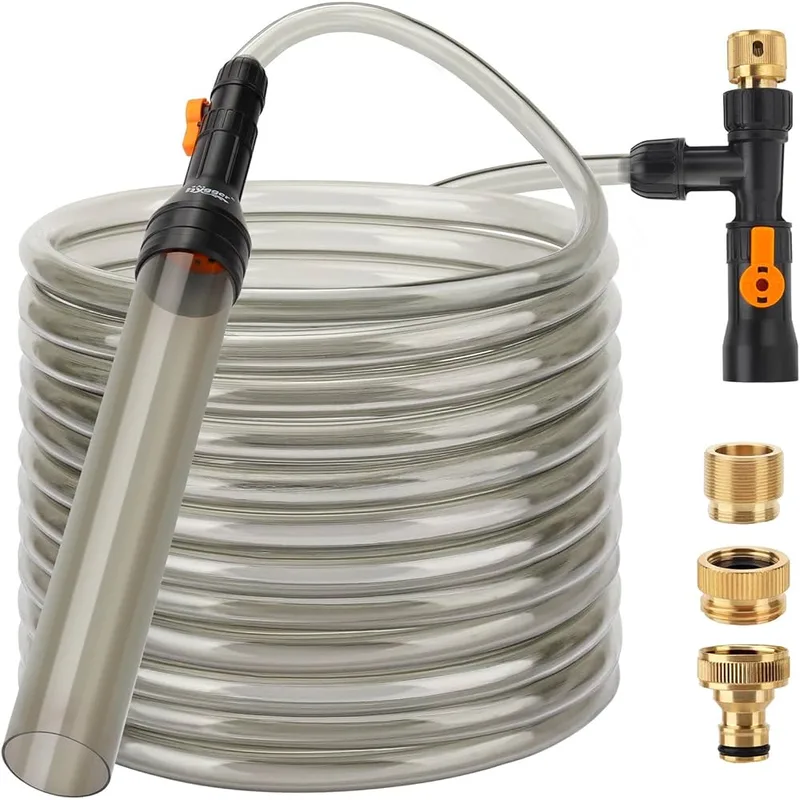
Hygger Bucket-Free Aquarium Water Change Kit (25 ft)
Best Budget Faucet System- ✓ Includes a debris vacuum head for targeted cleaning around plants
- ✓ Three faucet adapters included — fits most standard faucets
- ✓ Budget-friendly alternative to the Python at comparable quality
- ✓ Transparent gravel tube makes it easy to see what you are siphoning
- ✗ Plastic fittings can feel less durable than Python's
- ✗ Instructions could be clearer for first-time users
The Hygger kit is a budget-friendly alternative to the Python that includes a few extras. You get the standard faucet adapter, 25 feet of hose, and a gravel tube, plus a debris vacuum head for targeted cleaning around plants and decorations.
The debris vacuum head is a nice touch. Instead of the wide gravel tube that vacuums a large area, the debris head lets you spot-clean specific areas — behind driftwood, around plant roots, in corners where detritus accumulates. It is a small addition that makes substrate cleaning more precise.
Three faucet adapters are included, which improves the odds of fitting your specific faucet without a trip to the hardware store. The Python ships with one adapter and hopes for the best.
The tradeoff is that the plastic fittings feel slightly less substantial than the Python’s. They work fine, but if you are rough with equipment or plan to use the system for years of weekly service, the Python’s build quality has a slight edge.
Best for: Budget-conscious keepers who want a faucet water change system without paying Python’s premium.
4. Laifoo 5ft Aquarium Siphon Vacuum
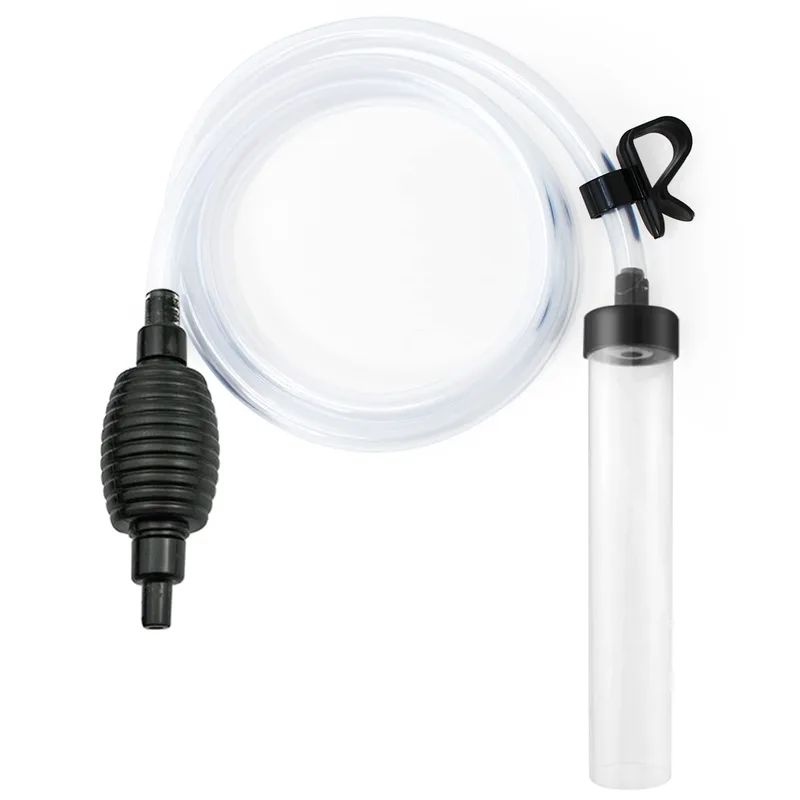
Laifoo 5ft Aquarium Siphon Vacuum
Best for Small Tanks- ✓ Perfect for nano tanks and small setups where a faucet system is overkill
- ✓ Self-priming squeeze ball — no mouth siphoning
- ✓ Narrow gravel tube fits between plants and decor in tight spaces
- ✓ Under $10 — cheapest effective option
- ✗ Requires a bucket — not hands-free like faucet systems
- ✗ Only 5 feet of hose — bucket must be close and below tank
Not every tank needs a faucet-driven system. For nano tanks (5–10 gallons), a desk tank, or a shrimp colony that only needs small water changes, a simple gravity siphon into a bucket is faster and simpler than hooking up hoses to a faucet.
The Laifoo 5ft siphon has a self-priming squeeze ball — a few pumps and water starts flowing. The narrow gravel tube fits between plants and decorations in tight nano tank spaces where a full-size Python gravel tube would be unwieldy.
For a 5-gallon shrimp tank, a 25% water change is about 1.25 gallons. Start the siphon, fill a small bucket, done in 2 minutes. No faucet adapter, no routing 25 feet of hose, no overkill. Sometimes simple is better.
The 5-foot hose length means the bucket must be on the floor directly below or beside the tank. If your tank is on a high shelf, you might need a longer siphon or to use a step stool. But for standard desk-height or stand-mounted tanks, 5 feet is plenty.
Best for: Nano tanks, shrimp colonies, and small setups where a faucet system is overkill.
Comparison Table
| Python No Spill Clean and Fill (25 ft) Editor's Choice | Laifoo 50ft Aquarium Water Changer Best Long Reach | Hygger Bucket-Free Aquarium Water Change Kit (25 ft) Best Budget Faucet System | Laifoo 5ft Aquarium Siphon Vacuum Best for Small Tanks | |
|---|---|---|---|---|
| Rating | 9.4/10 | 8.7/10 | 8.5/10 | 8.3/10 |
| Price | Unavailable | $42.99as of Sep 27, 2026 | Unavailable | $13.90-$15.90as of Sep 27, 2026 |
| Brand | Python | Laifoo | Hygger | Laifoo |
| Length | 25 feet | 50 feet | 25 feet | 5 feet |
| Power | Faucet-driven (no electricity) | Faucet-driven | Faucet-driven | Gravity siphon (into bucket) |
| Gravel Tube | 10 inch included | Included | Included + debris vacuum head | Included (narrow) |
| Refill Function | Yes — fills and drains | Yes | Yes | No — drain only |
| Shrimp Safe | Use gravel guard for shrimp tanks | Use gravel guard for shrimp tanks | Use gravel guard for shrimp tanks | Narrow tube — less risk to shrimp |
| Check Price → | Check Price → | Check Price → | Check Price → |
Prices change daily — tap Check Price for the current Amazon price. Numbers shown were verified on the "as of" date.
Water Change Buying Guide
Faucet System vs. Bucket Method
Faucet systems (Python, Laifoo, Hygger) connect to your sink and drain/fill without buckets. They are best for:
- Tanks 20 gallons and larger
- Multiple tanks (drain one, start filling, move to the next)
- Anyone with back problems or physical limitations
- Fish rooms with many tanks
Bucket method (siphon into a bucket, carry bucket to sink, carry fresh water back) is better for:
- Nano tanks under 10 gallons
- Situations where the nearest faucet is very far away
- Keepers who want to treat water in the bucket before adding to the tank
- Areas where water waste is a concern
Dechlorinating During Refill
When refilling with a faucet system, you are adding untreated tap water directly to the tank. This means you need to add dechlorinator to the tank before or during the refill. Most keepers dose Seachem Prime directly into the tank at the appropriate concentration for the total tank volume, then begin refilling. The Prime neutralizes chlorine and chloramine as the water enters.
With the bucket method, you can treat water in the bucket before adding it to the tank, giving you more control. For shrimp tanks where parameter precision matters, the bucket method with pre-treated, temperature-matched water is gentler.
Shrimp-Safe Water Change Tips
Shrimp are more sensitive to parameter swings than most fish. During water changes in shrimp tanks:
- Change only 10–20% at a time (not 50%)
- Match temperature within 1–2°F
- Pre-treat and match GH/KH if using RO water
- Use a narrow siphon to avoid catching shrimplets
- Add a pre-filter mesh over the siphon inlet
- Refill slowly — drip if possible — to avoid shocking shrimp with rapid parameter changes
How Often and How Much?
- Community fish tanks: 25–50% weekly
- Shrimp tanks: 10–20% weekly
- Heavily planted tanks: 25–50% weekly (plants consume nutrients from fresh water)
- Lightly stocked nano tanks: 15–25% weekly
- Breeding tanks: 25–50% every 3–5 days (fry need pristine water)
Consistency matters more than volume. A reliable 25% weekly change is better than an erratic 50% change every three weeks.
Frequently Asked Questions
Is the Python worth it for a single 10-gallon tank?
Probably not. A simple $10 siphon and a 2-gallon bucket handles a 10-gallon tank quickly. The Python shines when you have a 20-gallon or larger tank, multiple tanks, or physical limitations that make carrying buckets difficult.
Can I use a Python to fill my tank with hot water for temperature matching?
Yes. Adjust your faucet to the approximate tank temperature before switching to fill mode. Most keepers test the water coming out of the hose with their hand — you develop a feel for the right temperature quickly. Exact degree matching is not necessary for most fish; within 2–3 degrees is fine.
Will a gravel vacuum suck up my plants or shrimp?
The standard suction from a gravity siphon or faucet system is not strong enough to pull up rooted plants. Floating plants and small debris will be caught, so push floaters aside before vacuuming. For shrimp, use a narrow tube, add a pre-filter guard, or vacuum above the substrate rather than in it.
How do I vacuum sand substrate without sucking it up?
Hold the gravel tube about an inch above the sand surface. The suction will lift detritus off the sand without pulling the heavier sand into the tube. If sand does enter the tube, it usually drops back out as it loses momentum. Some keepers crimp the hose partially to reduce suction strength over sand.
Do I need to do water changes if I have lots of plants?
Yes. Plants consume nitrate and some waste products, but they do not remove everything. Trace mineral buildup, dissolved organics, and compounds that test kits do not measure all accumulate over time. Even heavily planted tanks benefit from weekly water changes to refresh trace minerals and remove what plants do not consume.
Conclusion
A Python No Spill Clean and Fill transforms water changes from a dreaded chore into a quick routine. If you have been putting off water changes because of the bucket hassle, a faucet system will change your maintenance habits overnight. For nano setups and shrimp tanks, the Laifoo 5ft Siphon at under $10 does the job without overcomplicating things.
The best water change system is the one you actually use consistently. Pick the tool that makes the job easy enough to do weekly, and your fish will show you the difference in color, activity, and health.