If you keep neocaridina or caridina shrimp, GH and KH are not optional parameters. They are the difference between a colony that breeds prolifically and one that suffers failed molts, mysterious deaths, and population crashes.
General hardness (GH) measures dissolved calcium and magnesium — the minerals shrimp need for healthy exoskeleton formation and successful molting. Carbonate hardness (KH) measures the buffering capacity of your water, which prevents dangerous pH swings. Together with TDS, these three readings give you a complete picture of your shrimp water quality.
The problem is that most beginner test kits skip GH and KH entirely. The popular API Freshwater Master Test Kit covers ammonia, nitrite, nitrate, and pH — but not hardness. You need a separate kit for that, and not all options are created equal.
Quick Picks
| Need | Our Pick |
|---|---|
| Best overall GH/KH kit | API GH & KH Test Kit |
| Clearest color change | Nutrafin GH/KH Test Kit |
| KH only (budget) | API KH Carbonate Hardness Test Kit |
| Quick screening | JNW Direct 9-in-1 Test Strips |
| Essential TDS companion | HM Digital TDS-3 Meter |
Why GH and KH Matter for Shrimp
GH (General Hardness)
GH measures the concentration of calcium and magnesium ions in your water, expressed in degrees (dGH). These minerals are critical for shrimp because:
- Molting: Shrimp build their new exoskeleton from dissolved calcium. If GH is too low, the new shell forms thin and soft, leading to failed molts where the shrimp cannot escape its old exoskeleton.
- Egg development: Berried females need adequate mineral content for healthy egg development.
- Overall vitality: Chronically low GH weakens shrimp over time, even if acute symptoms are not visible.
Target ranges:
- Neocaridina (cherry shrimp): 6-8 dGH
- Caridina (crystal shrimp): 4-6 dGH
KH (Carbonate Hardness)
KH measures the buffering capacity of your water — its ability to resist pH changes. This matters because:
- pH stability: Low KH means your pH can crash overnight, especially in tanks with active substrate, CO2 injection, or heavy biological activity.
- Shrimp sensitivity: A sudden pH drop from 7.0 to 6.0 can kill neocaridina. KH above 2 dKH provides enough buffering to prevent this.
- Substrate interaction: Active substrates like Fluval Stratum and ADA Amazonia consume KH over time. If you run active substrate, monitoring KH tells you when the substrate is exhausting its buffering capacity.
Target ranges:
- Neocaridina: 2-5 dKH
- Caridina: 0-1 dKH (with buffering substrate maintaining pH)
TDS (Total Dissolved Solids)
TDS measures everything dissolved in your water — minerals, organics, nitrates, everything. While not as specific as GH or KH, TDS provides a quick health check:
- Neocaridina: 150-250 ppm
- Caridina: 100-150 ppm
Rising TDS between water changes usually indicates accumulating waste. A TDS reading that climbs steadily even with consistent GH/KH suggests organics and nitrates are building up and a water change is due.
Detailed Reviews
1. API GH & KH Test Kit

API GH & KH Test Kit
Best Overall- ✓ Drop-count method provides precise dGH and dKH readings
- ✓ Each drop equals 1 degree — simple math
- ✓ Two separate reagent bottles for independent testing
- ✓ Low cost per test
- ✗ Color change can be subtle in dim lighting
- ✗ No TDS reading included
- ✗ Bottles are small and can be tricky to squeeze accurately
The API GH & KH Test Kit is the standard recommendation for good reason. The drop-count method is straightforward: add one drop of reagent at a time, swirl, and count until the water changes color. Each drop equals 1 degree of hardness. If the water changes color after 6 drops, your reading is 6 dGH (or 6 dKH for the KH test).
This method is more precise than test strips because you get exact integer readings rather than guessing between color pads. For shrimp keeping, where the difference between 4 dGH and 8 dGH matters, this precision is essential.
The GH reagent turns from orange to green at the endpoint. The KH reagent turns from blue to yellow. Both color changes are distinct enough to read accurately, though the GH transition can be subtle in the first few drops — watch carefully. Testing takes about 2 minutes per parameter.
At roughly $12 for approximately 100 tests per parameter, the per-test cost is excellent. This kit will last most hobbyists a full year of weekly testing.
Who it is for: Every shrimp keeper. This is the baseline kit you should own alongside the API Freshwater Master Test Kit.
2. Nutrafin GH/KH Test Kit

Nutrafin GH/KH Test Kit
Best Color Change- ✓ Clear color change endpoint is easier to read than API
- ✓ Works for both freshwater and saltwater
- ✓ Consistent reagent quality
- ✗ Slightly more expensive per test than API
- ✗ Less widely available in local fish stores
- ✗ Instructions could be clearer for beginners
The Nutrafin kit uses a similar drop-count methodology to the API but produces a slightly sharper color change at the endpoint. Some hobbyists find this easier to read, especially in borderline situations where one more drop might or might not have triggered the API color shift.
The reagents are formulated to work in both freshwater and saltwater, which is a minor advantage if you also maintain a reef tank. However, for freshwater shrimp keeping specifically, the Nutrafin offers no meaningful accuracy advantage over the API.
The main reason to choose Nutrafin over API is if you personally find the color change easier to interpret. Both kits are accurate enough for shrimp parameter management.
Who it is for: Hobbyists who want a slightly clearer color change endpoint, or those who also test saltwater tanks.
3. API KH Carbonate Hardness Test Kit

API KH Carbonate Hardness Test Kit
Best KH-Only- ✓ Focused KH testing for precise carbonate hardness monitoring
- ✓ Same reliable drop-count method as the combo kit
- ✓ Very affordable
- ✗ KH only — need a separate kit for GH
- ✗ Better value to buy the combo GH/KH kit
If you already have a way to measure GH (through a combo kit or otherwise), the standalone API KH kit is a cost-effective way to monitor carbonate hardness independently.
This is particularly relevant for tanks running active substrate. As buffering substrate ages, it loses its ability to absorb and lower KH. Monitoring KH over time tells you when the substrate is exhausting — a KH reading that starts rising in a Fluval Stratum or Controsoil tank usually means the substrate is nearing the end of its effective life.
The test method is identical to the KH portion of the combo kit. Same reagent, same drop-count, same color change.
Who it is for: Hobbyists who need KH monitoring specifically, either as a replacement reagent or as a focused purchase.
4. JNW Direct 9-in-1 Test Strips
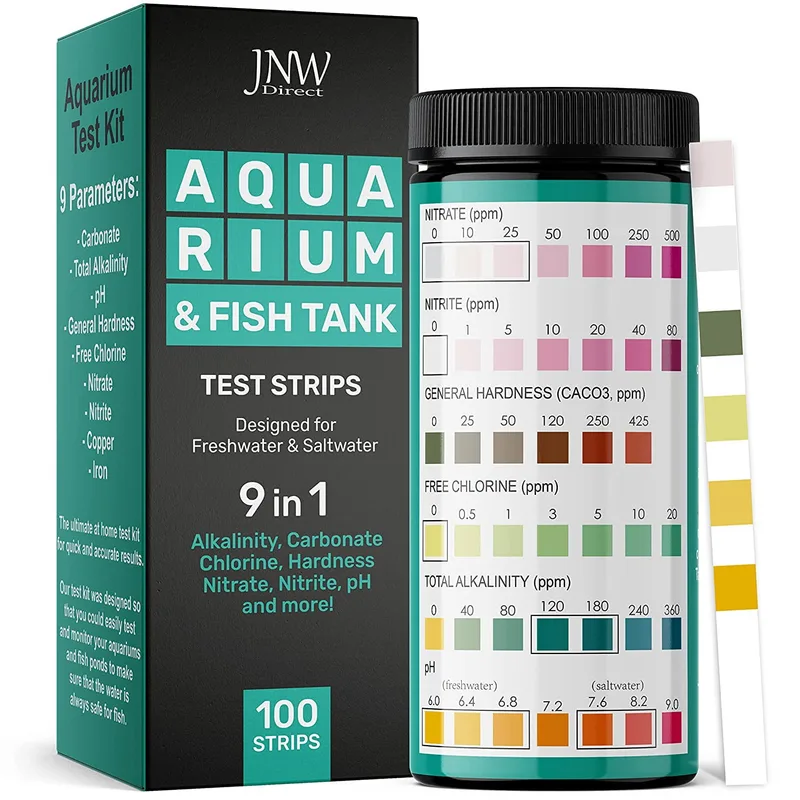
JNW Direct 9-in-1 Test Strips
Best Quick Check- ✓ 9 parameters in 60 seconds including GH and KH
- ✓ Useful for quick daily screening
- ✓ Low cost per test
- ✗ GH and KH readings are rough estimates at best
- ✗ Not accurate enough for shrimp-specific parameter management
- ✗ Color pads can be ambiguous in borderline ranges
The JNW strips include GH and KH pads alongside pH, nitrite, nitrate, and several other parameters. For a quick daily check, they are convenient — dip, wait 60 seconds, and compare.
However, for shrimp keeping, the GH and KH readings from dip strips are too imprecise. The color pads typically show ranges rather than exact values (for example, “0-4 dGH” or “4-8 dGH”). When your neocaridina need 6-8 dGH, knowing you are somewhere between 4 and 8 is not helpful.
Use these strips as a screening tool — if the GH or KH pad looks wildly off, grab your liquid kit for confirmation. Do not make water change or remineralizing decisions based on strip readings alone.
Who it is for: Quick daily screening, but not precise enough for shrimp-specific GH/KH management.
5. HM Digital TDS-3 Meter

HM Digital TDS-3 Meter
Essential Companion- ✓ Instant TDS reading in 2 seconds
- ✓ Essential companion to GH/KH testing for shrimp keepers
- ✓ Hold function locks reading for easy recording
- ✓ Lasts years on included batteries
- ✗ Does not distinguish between mineral types
- ✗ Requires periodic calibration with reference solution
- ✗ TDS alone does not tell you GH or KH — both are needed
A TDS meter is not a substitute for GH and KH testing, but it is an essential companion. The HM Digital TDS-3 gives you a single number that reflects everything dissolved in your water, and it does so in two seconds.
The primary use for shrimp keepers is checking remineralized RO water before adding it to the tank. Mix your remineralizer, dip the TDS pen, and verify the reading is in range. This takes the guesswork out of water changes and ensures consistency batch to batch.
The TDS-3 is also useful for tracking water quality between changes. A TDS reading that climbs steadily from 180 to 250 ppm over a week tells you waste is accumulating, even if ammonia and nitrite remain at zero.
Who it is for: Every shrimp keeper. At $15, a TDS meter is one of the best investments in the hobby.
Comparison Table
| API GH & KH Test Kit Best Overall | Nutrafin GH/KH Test Kit Best Color Change | API KH Carbonate Hardness Test Kit Best KH-Only | JNW Direct 9-in-1 Test Strips Best Quick Check | HM Digital TDS-3 Meter Essential Companion | |
|---|---|---|---|---|---|
| Rating | 9.1/10 | 8.4/10 | 8.7/10 | 7.2/10 | 8.9/10 |
| Price | Unavailable | Unavailable | $8.98as of Sep 27, 2026 | $7.99as of Sep 27, 2026 | $14.40-$14.50as of Sep 27, 2026 |
| Tests Included | GH and KH (separate bottles) | General hardness and carbonate hardness | KH only | pH, GH, KH, Nitrite, Nitrate, Chlorine, and more | — |
| Test Count | Approximately 100 per parameter | Approximately 80 per parameter | Approximately 100 | 100 strips | — |
| Type | Liquid reagent (drop count) | Liquid reagent | Liquid reagent (drop count) | Dip strips | Digital pen meter |
| Freshwater/Saltwater | Freshwater | Both | Both | Both | — |
| Measurement | — | — | — | — | TDS (0-9990 ppm) |
| Accuracy | — | — | — | — | +/- 2% |
| Battery | — | — | — | — | 2x LR44 (included) |
| Check Price → | Check Price → | Check Price → | Check Price → | Check Price → |
Prices change daily — tap Check Price for the current Amazon price. Numbers shown were verified on the "as of" date.
How to Test GH and KH: Step by Step
GH Test (API Method)
- Fill the test tube to the 5ml line with tank water
- Add one drop of GH reagent
- Cap the tube and invert 3-4 times to mix
- Check the color — if it remains orange, add another drop
- Repeat until the water turns green
- Count the total drops — this is your GH in degrees (dGH)
- Each degree = approximately 17.9 ppm
KH Test (API Method)
- Fill the test tube to the 5ml line with tank water
- Add one drop of KH reagent
- Cap and invert to mix
- Check the color — if it remains blue, add another drop
- Repeat until the water turns yellow
- Count the total drops — this is your KH in degrees (dKH)
- Each degree = approximately 17.9 ppm
Pro Tips
- Test at the same time each day for consistency (GH and KH can shift slightly between morning and evening)
- Rinse test tubes with tank water before testing to avoid contamination
- Hold the reagent bottle vertically for consistent drop size
- Replace reagents annually or if results become inconsistent
Adjusting GH and KH for Shrimp
Raising GH
- Salty Shrimp GH/KH+: The standard remineralizer for neocaridina. Add to RO water before water changes.
- Salty Shrimp GH+: Raises GH without affecting KH. Used for caridina in tanks with buffering substrate.
- Crushed coral in a filter bag: Slow, passive GH and KH increase. Good for maintaining stability in tap water setups.
Lowering GH
- RO water blending: Mix RO (reverse osmosis) water with tap water to dilute mineral content.
- Distilled water: Same approach as RO but more expensive for regular use.
- Peat moss filtration: Softens water and lowers pH naturally, but requires monitoring.
Raising KH
- Baking soda (sodium bicarbonate): 1 teaspoon per 5 gallons raises KH by approximately 2-3 dKH. Dissolve in water before adding to the tank.
- Crushed coral: Gradually raises both KH and GH.
Lowering KH
- Active substrate (Fluval Stratum, ADA Amazonia): Absorbs KH and lowers pH. This is the standard approach for caridina tanks.
- RO water: Reduces KH along with all other dissolved minerals.
- Indian almond leaves and driftwood: Mild KH reduction through tannin release.
Frequently Asked Questions
How often should I test GH and KH?
Weekly for established tanks. Daily when cycling, after water changes, or when adjusting remineralizer doses. Once your tank is stable and your water change routine is consistent, you can reduce to biweekly.
Can I use tap water for shrimp without testing?
You can, but you should not. Tap water GH and KH vary by municipality and can change seasonally. Test your tap water at least monthly to know what your baseline is. If your tap water happens to fall within shrimp parameters, you may be able to use it directly — but only testing will confirm that.
What happens if GH is too high for shrimp?
Excessively high GH (above 10-12 dGH for neocaridina) can cause osmotic stress and breeding slowdowns. It is less immediately dangerous than low GH but still suboptimal. Blend with RO water to bring it into range.
What happens if KH crashes to zero?
With no KH buffering, your pH becomes unstable and can crash rapidly — especially overnight when plants stop photosynthesizing and CO2 levels rise. A pH crash from 7.0 to 5.5 can kill an entire shrimp colony in hours. Always maintain at least 1-2 dKH in neocaridina tanks.
Is a TDS meter enough, or do I need separate GH/KH kits?
You need both. TDS tells you the total dissolved content but cannot distinguish between calcium, magnesium, carbonates, and waste products. A TDS of 200 ppm could mean perfect minerals or it could mean low minerals and high nitrates. GH, KH, and TDS together give you the full picture.