AquaRanked is reader-supported. When you buy through links on our site, we may earn an affiliate commission.
Tap water quality varies wildly. In some areas you can condition tap water with dechlorinator and maintain reliable fish-safe parameters indefinitely. In others — high chloramine levels, high TDS, significant seasonal mineral swings — tap water is simply too unpredictable for sensitive fish and shrimp. A reverse osmosis system solves this by stripping tap water down to near-zero TDS, giving you a blank slate you remineralize precisely for whatever you’re keeping.
For Caridina shrimp like Crystal Reds, Taiwan Bees, and Tiger shrimp, RO water is not optional — it is mandatory. Caridina require pH 5.4-6.2, GH 3-6, KH 0-1, and TDS 100-180. These parameters are nearly impossible to achieve from tap water without starting at 0 TDS and building up with a GH-only remineralizer. Neocaridina shrimp are more forgiving, but they too benefit from RO water when local tap water fluctuates between seasons. For planted tank hobbyists injecting CO2, RO water lets you dial in exact carbonate hardness without fighting high KH from tap.
Running multiple shrimp and guppy breeding tanks means water changes several times a week. A reliable RO system is infrastructure, not an accessory — and buying the wrong one costs time and frustration. Here are the five best units for freshwater aquarium use in 2026, covering every budget from entry-level to high-output breeding operations.
Quick Picks
- Best Budget: Aquatic Life RO Buddie 3-Stage 50 GPD — compact aquarium-dedicated RO, removes up to 98% TDS
- Best Value: Aquatic Life RO Buddie 4-Stage 50 GPD — adds color-changing DI resin for true 0 ppm output
- Best Overall: Aquatic Life Twist-In 4-Stage 75 GPD — faster output, tool-free twist-in cartridges, 0 ppm
- Best for Shrimp Breeders: LiquaGen 5-Stage RODI 75 GPD — dual carbon pre-treatment, portable, NSF-certified membrane
- Best High-Volume: LiquaGen 5-Stage RODI 150 GPD — 150 GPD with dual TDS meter for serious rack operations
| Aquatic Life RO Buddie 3-Stage 50 GPD Best Budget | Aquatic Life RO Buddie 4-Stage RO/DI 50 GPD Best Value | Aquatic Life Twist-In 4-Stage RO/DI 75 GPD Best Overall | LiquaGen 5-Stage RODI System 75 GPD Best for Shrimp Breeders | LiquaGen 5-Stage RODI System 150 GPD Best High-Volume | |
|---|---|---|---|---|---|
| Rating | 8.5/10 | 8.8/10 | 9/10 | 8.7/10 | 8.9/10 |
| Price | $61.99as of Sep 27, 2026 | $66.49-$69.99as of Sep 27, 2026 | $93.29-$98.20as of Sep 27, 2026 | $159.99as of Sep 27, 2026 | $174.49as of Sep 27, 2026 |
| Stages | 3 (sediment, carbon block, RO membrane) | 4 (sediment, carbon block, RO membrane, color-change DI resin) | 4 (sediment, carbon block, 75 GPD RO membrane, color-change DI resin) | 5 (sediment, UDF carbon, carbon block, RO membrane, inline DI) | 5 (sediment, UDF carbon, carbon block, 150 GPD RO membrane, DI resin) |
| Output | 50 GPD | 50 GPD | 75 GPD | 75 GPD | 150 GPD |
| TDS Rejection | Up to 98% | — | — | — | — |
| DI Stage | No | Yes — color-changing resin | Yes — color-changing resin | Yes — inline DI canister | Yes |
| Min. Pressure | 30 PSI | 30 PSI | 30 PSI | — | — |
| Suggested Pressure | 60 PSI | 60 PSI | 65 PSI | — | — |
| Dimensions | 7.2 x 4 x 13.8 in | — | 12 x 4 x 13 in | — | — |
| TDS Output | — | 0 ppm with fresh DI resin | 0 ppm with fresh DI resin | 0 ppm | 0 ppm |
| Cartridge System | — | — | Tool-free twist-in | — | — |
| Membrane | — | — | — | ANSI/NSF Standard 58 spiral-wound polyamide | — |
| Portable | — | — | — | Yes — single-frame, no permanent install | — |
| Includes | — | — | — | — | Dual inline TDS meter + pressure gauge |
| Target Use | — | — | — | — | Multi-tank breeding operations, large tanks |
| Check Price → | Check Price → | Check Price → | Check Price → | Check Price → |
Prices change daily — tap Check Price for the current Amazon price. Numbers shown were verified on the "as of" date.
Buying Guide
RO-Only vs. RO/DI — Which Do You Actually Need?
A basic RO system (reverse osmosis only) removes 95-98% of TDS from tap water. Output TDS depends on incoming water quality — if your tap runs 300 ppm, RO-only output might be 6-15 ppm. That is clean enough for most Neocaridina shrimp and general community tanks.
An RO/DI system adds a deionization (DI) resin stage after the membrane, polishing output to true 0 ppm. This is what Caridina shrimp breeders need. Starting from 0 ppm lets you add exactly the right amount of GH-only remineralizer to hit a target TDS of 100-150 ppm precisely. If the membrane alone delivers 6-15 ppm, adding remineralizer on top of residual ions introduces unpredictability into your parameters.
The rule: Neocaridina can work with RO-only. Caridina breeders need RO/DI.
GPD — How Much Output Do You Need?
GPD ratings are measured at 65 PSI and 77°F. Real-world production is lower at reduced pressure or cold tap temperatures.
Approximate fill times at rated GPD:
- 5-gallon shrimp tank: ~2.5 hours at 50 GPD
- 10-gallon tank: ~5 hours at 50 GPD, ~3 hours at 75 GPD
- 20-gallon tank: ~10 hours at 50 GPD, ~6 hours at 75 GPD
- 40-gallon tank: ~13 hours at 75 GPD, ~7 hours at 150 GPD
For single-tank hobbyists doing weekly water changes, 50 GPD works — fill overnight. For breeding rack operators doing 25% water changes on 8-12 tanks per week, 75-150 GPD saves significant time.
Filter Replacement Schedule
Every RO system has a maintenance schedule. Skipping it degrades water quality gradually — which is worse than no RO because you believe the water is pure when it is not.
| Stage | Replacement Interval | Approximate Cost |
|---|---|---|
| Sediment pre-filter | Every 6 months | $5-10 |
| Carbon pre-filter | Every 6 months | $5-12 |
| RO membrane | Every 1-2 years | $20-40 |
| DI resin cartridge | Every 50-200 gallons (varies by tap TDS) | $10-25 |
A TDS meter is essential for knowing when filters need replacement. Monitor pre-RO and post-RO TDS weekly. When post-membrane TDS rises above 10-15% of incoming TDS, the membrane needs replacing.
Water Pressure Requirements
Most RO systems need 40-65 PSI incoming pressure. Below this, production rate drops and membrane TDS rejection falls. City water typically runs 40-80 PSI — adequate for most units. Well water and some apartment buildings run lower. If your system produces unusually slowly or post-membrane TDS is higher than expected, low incoming pressure is often the cause. A booster pump ($40-80) solves this.
Shrimp Safety
RO and RO/DI systems are shrimp-safe by design — pure physical filtration through membranes and resin beads, no chemical additions whatsoever. No copper, no chlorine treatment agents, no additives.
The critical point: RO water alone should never go directly into a shrimp tank. Pure water with near-zero TDS has no minerals and no buffering capacity — it stresses and kills shrimp. Always remineralize before use:
- Neocaridina: use a GH/KH+ remineralizer to reach GH 6-12, KH 2-8, TDS 150-300
- Caridina: use a GH-only remineralizer (zero KH increase) to reach GH 3-6, KH 0-1, TDS 100-180
Detailed Reviews
1. Aquatic Life RO Buddie 3-Stage 50 GPD
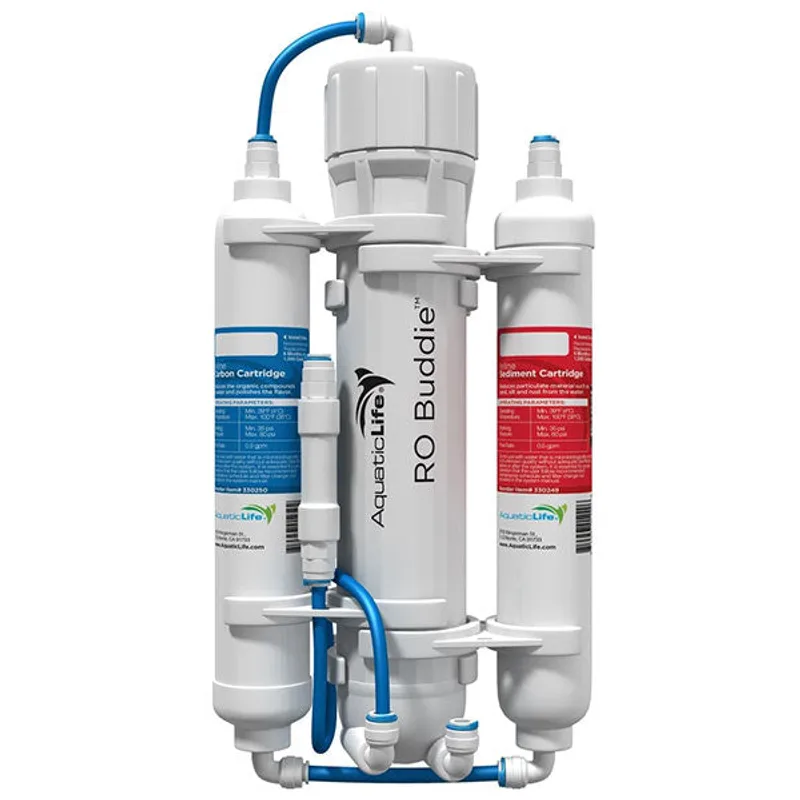
Aquatic Life RO Buddie 3-Stage 50 GPD
Best Budget- ✓ Compact, purpose-built for aquarium use — not a repurposed drinking water unit
- ✓ Removes up to 98% of TDS, suitable for Neocaridina and most community fish
- ✓ Includes 20 feet of tubing and faucet adapter for direct tap hookup
- ✓ Established design with a strong aquarium hobbyist track record
- ✗ No DI stage — output TDS varies with incoming water quality and membrane age
- ✗ 50 GPD throughput means slow fill times on tanks above 20 gallons
The RO Buddie 3-Stage is the entry point for aquarists who want reliable RO water without a large upfront investment. Aquatic Life designed this unit specifically for aquarium hobbyists — not as a repurposed drinking water system — and that specificity shows in the compact form factor and included accessories.
Three filtration stages: a sediment pre-filter catches particulates, a carbon block removes chlorine and chloramines that would otherwise destroy the RO membrane prematurely, and the RO membrane removes up to 98% of remaining TDS. At 60 PSI incoming pressure, this unit delivers approximately 2 gallons per hour — enough to fill a 10-gallon shrimp tank overnight.
The included package is practical: 20 feet of polyethylene tubing, a faucet adapter for direct tap hookup, and a membrane wrench. No permanent plumbing needed — the RO Buddie attaches to a standard kitchen or bathroom faucet with the included adapter. This matters in warm-climate regions where running a line to a garage or outdoor area is simple and the system can be repositioned seasonally.
The limitation is the absent DI stage. Output TDS from this unit depends on incoming water quality and membrane condition. In a high-TDS area (300-500 ppm tap), post-membrane output might run 10-25 ppm — workable for Neocaridina and most community fish, but not precise enough for Caridina breeding where you need a true 0 ppm starting point. If local tap water stays below 200 ppm and is relatively stable, the 3-Stage delivers consistent enough output for most freshwater aquarium applications.
For Neocaridina shrimp keepers managing a couple of tanks and wanting significantly better water than tap without spending $100+, this is the right first RO purchase.
2. Aquatic Life RO Buddie 4-Stage RO/DI 50 GPD
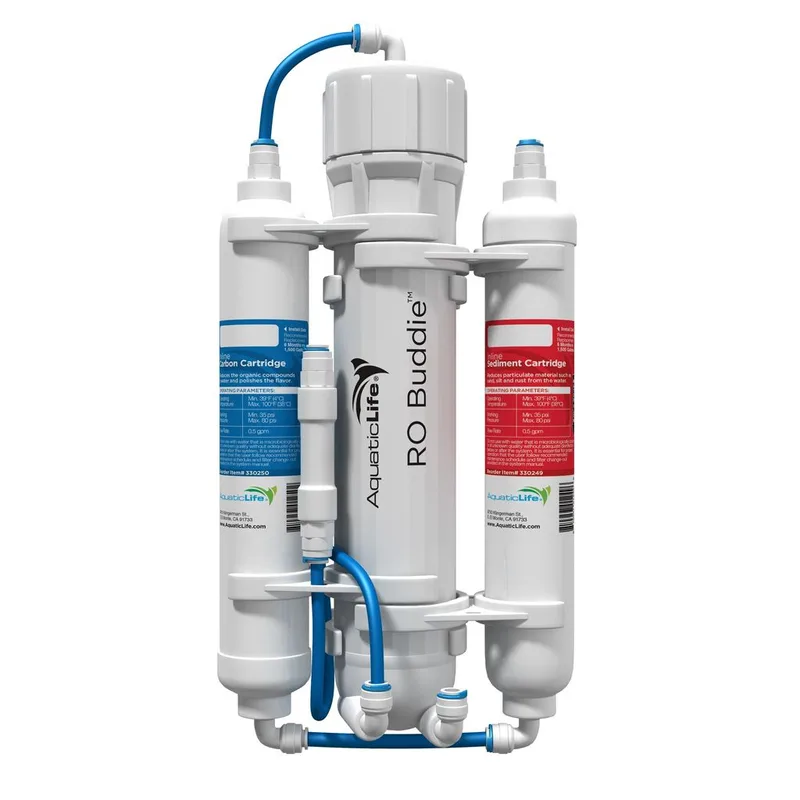
Aquatic Life RO Buddie 4-Stage RO/DI 50 GPD
Best Value- ✓ Color-changing DI resin visually confirms when resin is exhausted — no guessing
- ✓ Achieves 0 ppm TDS output, required for precise Caridina shrimp remineralization
- ✓ Aquarium-dedicated brand with stages designed for fish tank water quality
- ✓ Only ~$25 more than the 3-Stage for a meaningful quality upgrade
- ✗ DI resin cartridge adds ongoing replacement cost every 50-200 gallons depending on source water
- ✗ 50 GPD throughput limits practical use across multiple tanks
The 4-Stage adds what the 3-Stage lacks: a deionization resin cartridge that polishes membrane output to true 0 ppm. For roughly $25 more than the 3-Stage, the DI stage is the most meaningful upgrade in aquarium RO filtration.
The standout feature is the color-changing DI resin. Fresh resin is bright blue-green. As it exhausts, it shifts progressively toward orange-brown. When the cartridge is fully orange, the resin is depleted and needs replacing. No TDS meter required for basic resin monitoring — the cartridge tells you visually. That said, running a separate TDS meter is still worthwhile to catch membrane degradation independently (which the resin color change won’t detect).
With 0 ppm output, this unit makes Caridina breeding achievable. Fill a storage container with RO/DI water, add a GH-only remineralizer like SaltyShrimp Bee GH+ to target parameters (GH 3-6, TDS 100-180), and you have consistent Caridina-ready water for every water change. No seasonal variation, no mineral interference from tap.
DI cartridge replacement cost depends on incoming TDS. In a 400 ppm tap water area, resin exhausts faster than in a 150 ppm area — estimate $10-20 per cartridge and plan replacement every 1-3 months for typical shrimp tank use. This is the version to buy if Caridina keeping is a serious goal. The price difference from the 3-Stage pays for itself in parameter accuracy alone.
3. Aquatic Life Twist-In 4-Stage RO/DI 75 GPD
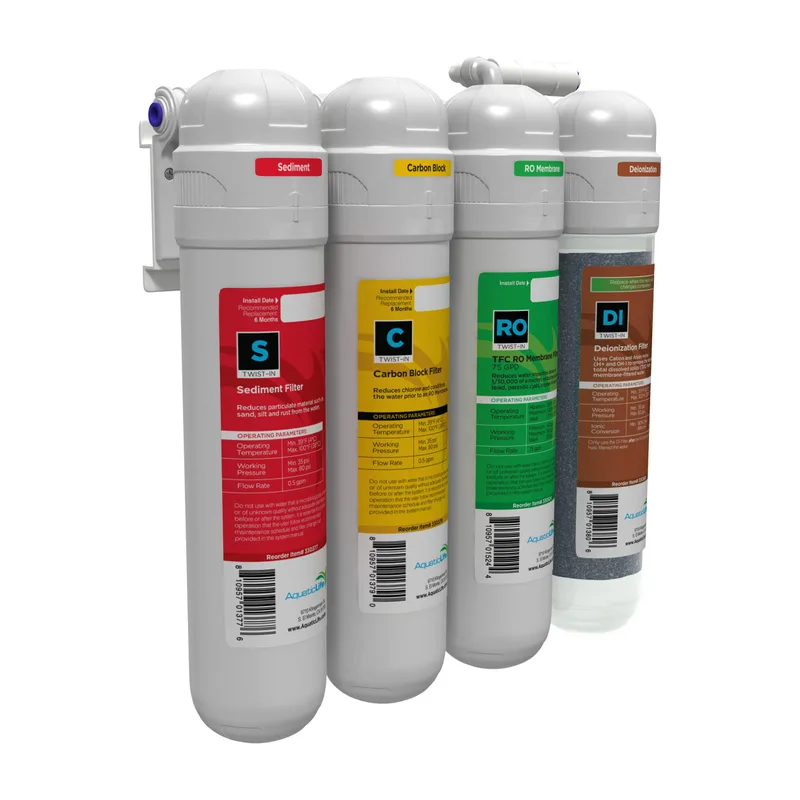
Aquatic Life Twist-In 4-Stage RO/DI 75 GPD
Best Overall- ✓ Twist-in cartridges replace in seconds with no tools — biggest maintenance advantage on this list
- ✓ 75 GPD fills a 10-gallon shrimp tank in under 3 hours
- ✓ Four stages including DI resin deliver 0 ppm output for Caridina breeding
- ✓ Dedicated aquarium brand with consistent quality over multiple generations
- ✗ Proprietary twist-in cartridges cost more than standard inline cartridges
- ✗ Does not include inline TDS meter to monitor membrane vs. DI output separately
Two improvements over the RO Buddie 4-Stage justify the higher price for active aquarists: 75 GPD output and tool-free cartridge replacement.
At 75 GPD, water production runs 50% faster than a 50 GPD unit. That matters when filling a 20-gallon planted tank, doing a 50% water change on a Caridina colony, or running simultaneous changes across multiple tanks. At 50 GPD, a 40-gallon tank takes over 13 hours to fill. At 75 GPD, it takes around 8 hours — the difference between filling before bed versus filling while at work.
The twist-in cartridge design is this system’s biggest practical advantage. Standard RO systems require turning off the supply, depressurizing, unscrewing cartridge housings with a filter wrench, and reconnecting everything. Twist-in cartridges snap in and out in seconds with no tools. Filter changes every 6 months sound minor until you’re standing under a sink with a wrench and a leaking O-ring. The ease of maintenance on the Twist-In means the system actually gets maintained on schedule.
All four stages cover sediment, carbon block, 75 GPD RO membrane, and color-changing DI resin — the same visual monitoring system as the RO Buddie 4-Stage. Output is 0 ppm with fresh resin.
For most active freshwater aquarists managing 1-3 tanks with regular water changes, this is the best all-around unit on this list. If you’re going to invest in an RO system and use it consistently, the tool-free maintenance alone justifies the price over the RO Buddie 4-Stage.
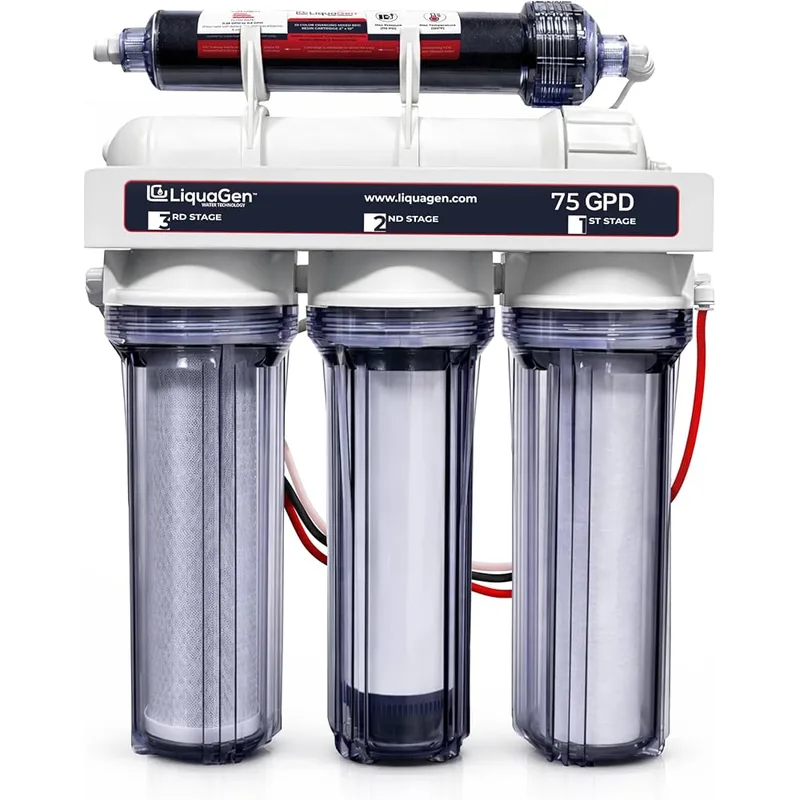
4. LiquaGen 5-Stage RODI System 75 GPD
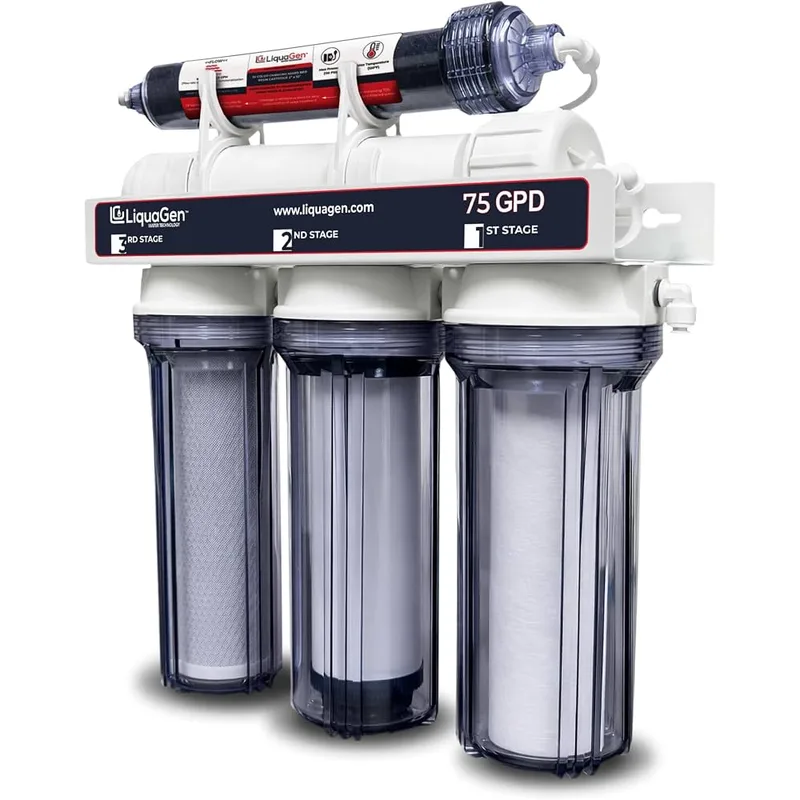
LiquaGen 5-Stage RODI System 75 GPD
Best for Shrimp Breeders- ✓ Dual carbon pre-treatment (UDF granular + solid block) for longer membrane life in chloraminated water
- ✓ Portable single-frame design — no drilling or permanent plumbing required
- ✓ ANSI/NSF 58 certified membrane for verified contaminant rejection
- ✓ Aquarium-specific design and brand, not a rebranded drinking water unit
- ✗ Standard inline cartridges require more effort to replace than twist-in designs
- ✗ DI canister does not color-change — requires a separate TDS meter to know when to replace
LiquaGen builds dedicated aquarium RO/DI systems — no dual-purpose drinking water marketing, no shared parts catalog with under-sink home units. The 5-Stage 75 GPD is their mid-tier aquarium-specific system, and the fifth stage makes a meaningful difference in municipalities using chloramines.
Standard 4-stage systems use a single carbon pre-filter before the membrane. LiquaGen’s 5-Stage uses both a UDF (granular) activated carbon stage and a solid carbon block stage before the membrane reaches water. In areas where municipal water uses chloramines instead of chlorine for disinfection, single-carbon pre-treatment often fails to fully break down chloramine before it contacts the membrane. Chloramines degrade RO membranes faster than chlorine — the dual carbon pre-treatment extends membrane life significantly in these cities. If your area uses chloramines and you’ve burned through RO membranes in under a year on other systems, this is why.
The ANSI/NSF Standard 58 certified spiral-wound polyamide membrane meets standardized performance specifications for contaminant rejection. The inline DI canister takes output to 0 ppm — essential for Caridina breeding. At 75 GPD, fill rates are equivalent to the Aquatic Life Twist-In.
The portable single-frame design stands out for renters or hobbyists who don’t want permanent installations. The unit sits on a countertop or shelf, hooks to a faucet with an included adapter, and moves without disconnecting from fixed plumbing. For a breeding operation running in a climate-controlled indoor room — guppies, shrimp, ricefish — being able to reposition the RO unit without replumbing is a real operational advantage.
The trade-off: standard inline cartridges require more effort to replace than twist-in designs. The DI canister doesn’t color-change, so a separate TDS meter is needed to monitor output. For shrimp breeders monitoring TDS obsessively anyway, that’s a non-issue.
5. LiquaGen 5-Stage RODI System 150 GPD
LiquaGen 5-Stage RODI System 150 GPD
Best High-Volume- ✓ 150 GPD fills a 40-gallon tank in under 7 hours — no waiting overnight for large water changes
- ✓ Included dual TDS meter monitors pre-DI and post-DI output separately to catch membrane failure early
- ✓ Pressure gauge confirms adequate incoming pressure for optimal production
- ✓ Right choice for breeding rack operations doing multiple large water changes weekly
- ✗ Overkill for single-tank hobbyists — 75 GPD handles most freshwater aquarium needs
- ✗ Larger footprint than compact 3-4 stage units
If you’re operating a serious breeding rack — six or more tanks with weekly 25-30% water changes — waiting overnight for RO water becomes a bottleneck. A 75 GPD unit produces roughly 3 gallons per hour. A 150 GPD unit doubles that to 6 gallons per hour. The difference becomes significant when you’re filling a 5-gallon storage container before each water change session.
The included dual inline TDS meter is the standout accessory. Two TDS probes sit on the system — one measures post-membrane TDS, one measures post-DI TDS. Running both lets you identify the exact stage where water quality degrades. If post-membrane TDS rises but post-DI stays at 0 ppm, the membrane is aging but DI resin is compensating. If both rise, the resin is exhausted. Without dual monitoring, you’re identifying problems only after water quality has already compromised your livestock.
The included pressure gauge confirms incoming water pressure is adequate for peak membrane performance. Membrane production rates drop sharply below 50 PSI — knowing your actual pressure prevents troubleshooting sessions that are really just low-pressure problems.
For a single-tank hobbyist or someone keeping one Caridina tank, this unit is unnecessary. The LiquaGen 75 GPD handles that use case. The 150 GPD system pays off when you’re doing 40-50 gallons of water changes per week and RO production speed is a constraint. Running a breeding rack of guppies, shrimp, and ricefish with a 150 GPD system means a full 40-gallon storage reservoir fills in under 7 hours — start it before work, come home to full containers ready for the evening water change round.
Frequently Asked Questions
Do I actually need an RO system for freshwater fish?
For most community fish and Neocaridina shrimp, tap water conditioned with dechlorinator works if local parameters are stable and within range. An RO system becomes essential for Caridina shrimp, which require soft, acidic water nearly impossible to reliably achieve from tap. It also helps significantly when local tap water TDS fluctuates seasonally, when your water supply uses chloramines, or when you want consistent breeding results across multiple tank generations.
What is the difference between RO and RO/DI water?
RO-only systems remove 95-98% of TDS using a membrane. Output is still 6-25 ppm depending on incoming water. RO/DI systems add a deionization resin stage that removes remaining ions to achieve true 0 ppm. For Caridina shrimp, 0 ppm is needed so you can add precise amounts of remineralizer without interference from residual tap minerals. For Neocaridina and most community fish, RO-only is sufficient.
Can I use RO water directly in my aquarium?
No. Pure RO water has near-zero TDS, no minerals, and no buffering capacity. Fish and shrimp placed into pure RO water will experience osmotic stress and can die. Always remineralize before use. Mix in a separate container: for Neocaridina, use a GH/KH+ remineralizer to reach GH 6-12, KH 2-8, TDS 150-300; for Caridina, use GH-only remineralizer to reach GH 3-6, KH 0-1, TDS 100-180.
How often do RO filters need replacing?
Sediment and carbon pre-filters every 6 months. RO membrane every 1-2 years depending on water quality and usage. DI resin when TDS output rises above 5 ppm — this varies widely from every few weeks in high-TDS areas to every several months in lower-TDS areas. A color-changing DI cartridge (like those on the Aquatic Life units) makes resin monitoring easy without a TDS meter.
Is RO water safe for shrimp?
The RO filtration process is completely shrimp-safe — pure physical filtration with no chemical additions. RO output contains no copper, no chlorine agents, no additives. The only risk is using unmineralized RO water directly in the tank, which you should never do. Remineralize to appropriate parameters for your species first.
What GPD is enough for a single 10-gallon shrimp tank?
A 50 GPD unit handles one 10-gallon shrimp tank easily. For a 20-30% weekly water change (2-3 gallons), you need less than 90 minutes of run time. If you have more than 2-3 tanks or do water changes multiple times per week, stepping up to 75 GPD noticeably reduces waiting time.
Does water pressure affect RO performance?
Yes, significantly. Below 40-50 PSI, most RO membranes produce water at a fraction of their rated GPD and with reduced TDS rejection. City water typically runs 40-80 PSI — adequate for most units. If your system runs slow or post-membrane TDS is higher than expected, low incoming pressure is often the cause. A booster pump ($40-80) raises pressure to optimal levels and is worth adding in confirmed low-pressure situations.
How much waste water does an RO system produce?
Standard RO systems produce 3-4 gallons of waste per gallon of purified output. In aquarium practice, you never run the system 24 hours — actual waste is proportional to how much RO water you produce per session. Waste water is concentrated tap water, not hazardous — suitable for watering plants or general household cleaning.
Conclusion
For most active freshwater aquarists, the Aquatic Life Twist-In 4-Stage RO/DI 75 GPD is the clearest recommendation. The combination of 75 GPD output, 4-stage RO/DI filtration reaching 0 ppm, and tool-free twist-in cartridge replacement addresses every practical concern: adequate production speed, Caridina-capable water purity, and maintenance that actually gets done because it takes 30 seconds. If you keep Caridina shrimp or plan to, this is the right buy.
On a tighter budget, the Aquatic Life RO Buddie 4-Stage RO/DI 50 GPD delivers 0 ppm output at a lower price. The color-changing DI resin is the same convenient monitoring system. The trade-off is slower fill rate and standard cartridge changes. For a single Caridina tank or a small Neocaridina breeding setup, the 50 GPD throughput works without issue.
For breeding rack operations — multiple shrimp tanks, guppy lines, ricefish tubs — the LiquaGen 5-Stage RODI 150 GPD eliminates RO production as a scheduling constraint. The dual TDS meter monitors membrane and resin output independently, the pressure gauge confirms optimal conditions, and 150 GPD means storage containers refill fast enough to support aggressive water change schedules. When you’re running water changes across 8-10 tanks every week, the production rate is the difference between a quick evening chore and an all-day project.
Whatever unit you choose, pair it with a standalone TDS meter like the HM Digital TDS-4TMA and a remineralizer matched to your shrimp species — SaltyShrimp GH/KH+ for Neocaridina or SaltyShrimp Bee GH+ for Caridina. The RO system gives you the blank slate — remineralization is how you fill it in.