AquaRanked is reader-supported. When you buy through links on our site, we may earn an affiliate commission.
A pond full of koi, goldfish, or a guppy colony is an open buffet to anything that eats fish. Herons wade the shallows at dawn. Raccoons work the edges at night. Neighborhood cats will sit at the rim for an hour waiting for a fish to surface. If you have lost fish overnight with no other explanation, a predator got them — and the fix is almost always a physical barrier, not a repellent gimmick.
This roundup covers netting kits sized for everything from a half-barrel patio pond to a full backyard koi pond, plus the active deterrents worth pairing with a net when netting alone will not cover the whole picture. In USDA Zones 7-9, outdoor pond season typically runs March through October, and predator pressure does not let up just because the water is warm — herons and raccoons hunt ponds year-round wherever the water stays open.
Here are the five best predator nets for outdoor ponds in 2026, plus the active deterrents that round out a complete defense.
| AlpineReach Koi Pond Netting Kit (15 x 20 ft) Best Overall | Pond Netting Cover, 28 x 30 ft (3/8-inch Mesh) Best for Large Ponds | Pond Netting Cover, 14 x 14 ft (3/8-inch Mesh) Best for Backyard Ponds | Pond Netting Cover, 7 x 10 ft (3/8-inch Mesh) Best for Patio Ponds | Covoeak Pond Protectors, 20-Pack Floating Hexagons Best Low-Profile Option | |
|---|---|---|---|---|---|
| Rating | 9.2/10 | 8.7/10 | 8.6/10 | 8.5/10 | 8.3/10 |
| Price | $25.19-$27.99as of Sep 27, 2026 | $37.99as of Sep 27, 2026 | $17.99as of Sep 27, 2026 | $9.99-$11.99as of Sep 27, 2026 | $21.20as of Sep 27, 2026 |
| Coverage | 15 x 20 ft (300 sq ft) | 28 x 30 ft | 14 x 14 ft | 7 x 10 ft | 20 hexagon panels, connects to fit |
| Mesh | Fine woven, black | 3/8 inch | 3/8 inch | 3/8 inch | — |
| Material | Heavy-duty knitted polyethylene | Durable knitted polyethylene | Woven polyethylene | Woven polyethylene | Rigid plastic web |
| Includes | Ground stakes | 14 ground stakes | 14 ground stakes | 12 ground stakes | — |
| Best For | Medium to large in-ground ponds | Large koi ponds and farm ponds | Backyard ponds under 150 sq ft | Patio ponds and small container ponds | Irregularly shaped ponds or a low-profile look |
| Mounting | — | — | — | — | Floats on the surface, no stakes |
| Check Price → | Check Price → | Check Price → | Check Price → | Check Price → |
Prices change daily — tap Check Price for the current Amazon price. Numbers shown were verified on the "as of" date.
Quick Picks
- Best Overall: AlpineReach 15 x 20 ft Kit — fine black mesh, disappears against water, reusable
- Best for Large Ponds: 28 x 30 ft Netting Cover — biggest coverage for koi and farm ponds
- Best for Backyard Ponds: 14 x 14 ft Netting Cover — sized for a typical backyard pond
- Best for Patio Ponds: 7 x 10 ft Netting Cover — right-sized for container and patio setups
- Best Low-Profile Option: Covoeak Floating Hexagons — no draped mesh, no stakes required
Predator Net Buying Guide
Measure Before You Buy
Measure the longest and widest points of your pond, then add at least 2 feet of overhang on every side. Netting that stops right at the water’s edge leaves a gap a raccoon can reach a paw through, and it will not stay taut if it is cut to the exact pond dimensions. Oversized is always safer than undersized — you can trim excess mesh, but you cannot stretch a net that is too small.
Mesh Size Matters More Than Most Buyers Realize
Fine mesh (under 1/4 inch) blocks nearly everything but clogs with leaves and needs clearing every few days in fall. A 3/8-inch mesh sheds debris better and still stops herons and raccoons, but gives small, determined predators like mink slightly more to grip. For most backyard ponds, 3/8-inch mesh is the practical middle ground; fine mesh makes sense for ponds under heavy tree cover where leaf litter is not the main concern.
Draped Netting vs. Floating Panels
Draped mesh over stakes is the cheapest and most effective option per square foot, but it needs a soil or mulch border to anchor the stakes and it can sag into the water if not pulled taut. Floating hexagon panels skip the staking step entirely and work on ponds with a hardscape or paver border where stakes are not an option, but the gaps between panels are wider and offer less protection against a persistent predator.
Pair Netting with an Active Deterrent
Netting is a physical barrier, but it is not the only layer worth having. Motion-activated sprinklers startle herons and raccoons before they commit to the pond, and a heron decoy exploits the fact that herons are territorial and avoid ponds that look already claimed. Neither replaces netting on its own, but combined with a net, they cut down on the number of visits a predator makes before giving up.
Shrimp and Small Fish Need Netting Too
If you keep Neocaridina shrimp or small livebearers in an outdoor pond alongside guppies or ricefish, predator netting matters even more. Shrimp have no defense against a heron or raccoon beyond hiding, and a single overnight visit can wipe out a colony that took months to build. A fine-mesh net over a shrimp-only or mixed pond is worth the extra maintenance of clearing leaf litter more often.
Detailed Reviews
1. AlpineReach Koi Pond Netting Kit (15 x 20 ft)
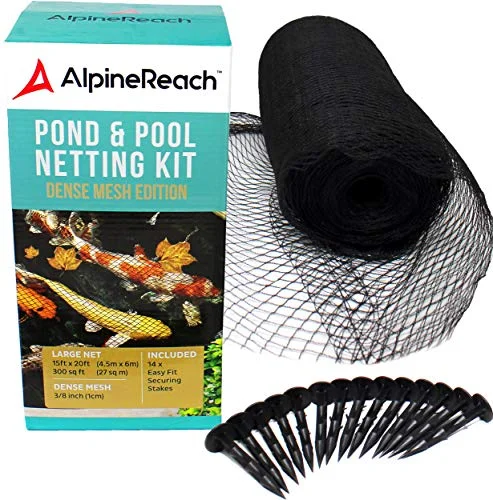
AlpineReach Koi Pond Netting Kit (15 x 20 ft)
Best Overall- ✓ Fine mesh stops herons, raccoons, and cats without gaps large enough for paws or beaks
- ✓ Black color nearly disappears against water once installed
- ✓ Reusable season to season — stores flat when the pond goes dormant
- ✓ Stakes included for a taut, secure perimeter install
- ✗ 300 sq ft of coverage is more material than small ponds need, requiring trimming
- ✗ Fine mesh clogs with falling leaves faster than wider-gauge nets and needs regular clearing
This is the netting kit to buy if you want one product that handles most backyard pond sizes without cutting corners on mesh quality. The fine black weave is dense enough to stop herons, raccoons, and cats, and the black color all but disappears once it is stretched over the water — a real advantage over the bright green mesh some competitors sell.
At 300 square feet of coverage, this kit fits most ponds in the 10 x 15 to 15 x 20 ft range with overhang to spare for staking down the edges. Smaller ponds will need to trim the excess, which is a minor tradeoff for not having to size up mid-season.
The fine mesh does clog with leaves faster than a wider-gauge net, so plan on clearing it every few days once trees start dropping in fall. The material is reusable, though — fold it up, store it over winter, and it holds up for multiple seasons without replacing.
Best for: Backyard koi or goldfish ponds in the 10 x 15 to 15 x 20 ft range that want maximum predator protection.
2. Pond Netting Cover, 28 x 30 ft (3/8-inch Mesh)
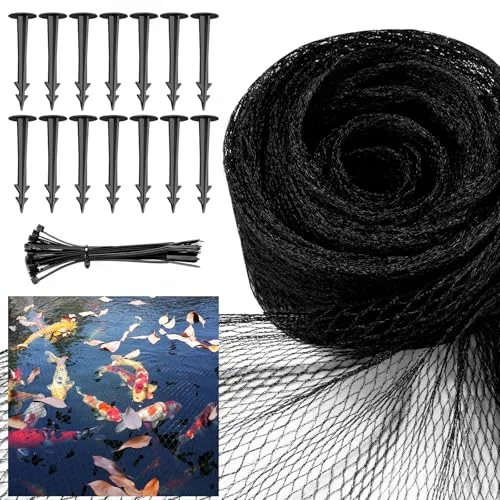
Pond Netting Cover, 28 x 30 ft (3/8-inch Mesh)
Best for Large Ponds- ✓ Largest coverage on this list for big in-ground koi or farm ponds
- ✓ 3/8-inch mesh blocks herons and raccoons while shedding leaves better than fine mesh
- ✓ 14 stakes anchor the full perimeter without sagging into the water
- ✓ Doubles as a leaf-litter cover through fall cleanup
- ✗ Bulky to fold and store during the off-season
- ✗ 3/8-inch gaps give small, determined predators more grip than a finer weave
Large in-ground koi ponds and farm ponds need coverage most kits do not offer, and this 28 x 30 ft net is sized for exactly that. The 3/8-inch mesh sheds falling leaves noticeably better than the fine-weave AlpineReach kit, which matters on a net this size — clearing 840 square feet of clogged fine mesh every few days is not realistic.
Fourteen ground stakes anchor the full perimeter, which is necessary at this scale to keep the net from sagging into the water under its own weight or pooling rainwater. Installation takes two people for a pond this size; stretching and staking 28 x 30 ft of netting solo is possible but slow.
The 3/8-inch gaps are the one compromise. They stop herons and raccoons without issue, but a small, agile predator like mink can get more purchase on the wider weave than on fine mesh. For most backyard and farm pond situations, that tradeoff is worth the leaf-shedding benefit.
Best for: Large koi ponds, farm ponds, and any water feature too big for a standard backyard netting kit.
3. Pond Netting Cover, 14 x 14 ft (3/8-inch Mesh)
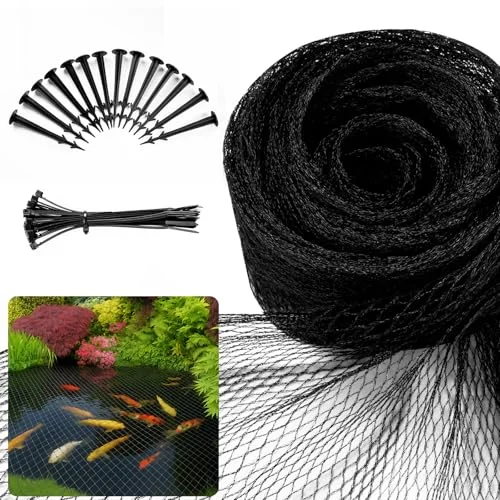
Pond Netting Cover, 14 x 14 ft (3/8-inch Mesh)
Best for Backyard Ponds- ✓ Sized right for the average backyard koi or goldfish pond without excess trim work
- ✓ 3/8-inch mesh sheds falling leaves better than fine-mesh options
- ✓ Stakes included for perimeter anchoring on soil or mulch borders
- ✓ Affordable middle ground between the smallest and largest kits on this list
- ✗ Not large enough for irregularly shaped ponds over 14 feet in any direction
- ✗ 3/8-inch gaps are wide enough for a determined small predator to reach through at the edges
Most backyard ponds fall somewhere in the 8 x 10 to 14 x 14 ft range, and this kit is sized for that middle ground without forcing you to trim down a larger net. The 3/8-inch mesh strikes the same practical balance as the 28 x 30 ft option — good leaf-shedding, solid predator protection, slightly more give at the edges than fine mesh.
Fourteen stakes come included, enough to secure the full perimeter on a soil or mulch border. Installation is a one-person job at this size, and the netting stores compactly over winter.
The main limitation is size. If your pond runs longer than 14 feet in any direction, or has an irregular shape that eats into the overhang, size up to the 28 x 30 ft kit rather than trying to stretch this one past its coverage.
Best for: Standard backyard koi or goldfish ponds under 150 square feet.
4. Pond Netting Cover, 7 x 10 ft (3/8-inch Mesh)
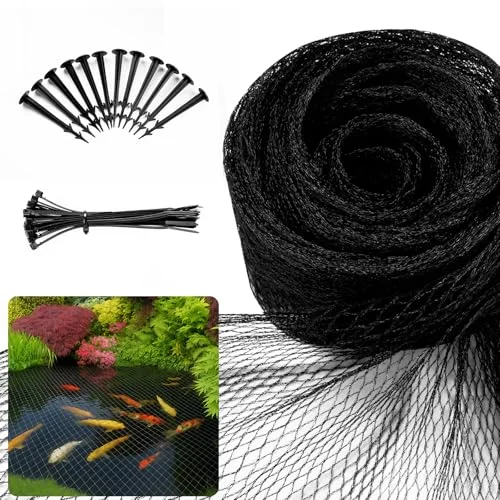
Pond Netting Cover, 7 x 10 ft (3/8-inch Mesh)
Best for Patio Ponds- ✓ Right-sized for patio and container ponds instead of cutting down a larger net
- ✓ Included stakes work in soil beds around raised patio ponds
- ✓ Lowest price on this list for a full stake-and-net kit
- ✓ Easy for one person to install and remove solo
- ✗ Too small for anything beyond a patio or half-barrel pond
- ✗ Rigid stakes do not anchor well in gravel or paved surfaces without added clips
Patio ponds and container water gardens need predator protection just as much as a full in-ground pond, but most netting kits are oversized and wasteful for a barrel or a 30-gallon container setup. This 7 x 10 ft kit is sized correctly, with 12 stakes included for anchoring in the soil bed around a raised or in-ground patio pond.
At this scale, one person can install or remove the net in a couple of minutes — useful if you want to pull it off during the day to enjoy the pond and put it back on at dusk when herons and raccoons are most active.
The included stakes assume a soil or mulch border. If your patio pond sits on pavers, gravel, or a deck, the stakes will not hold and you will need binder clips or weighted edges instead — factor that into your setup before buying.
Best for: Patio ponds, half-barrel ponds, and container water gardens under 100 square feet.
5. Covoeak Pond Protectors, 20-Pack Floating Hexagons
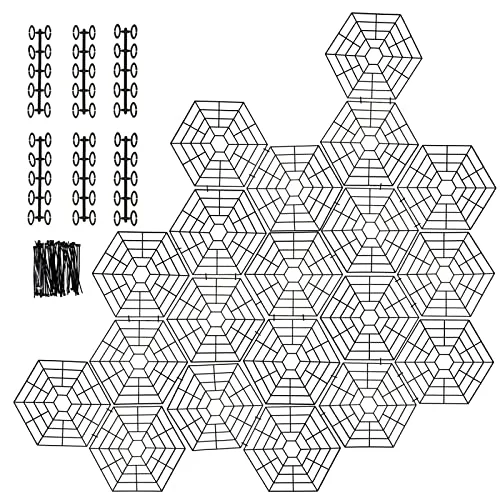
Covoeak Pond Protectors, 20-Pack Floating Hexagons
Best Low-Profile Option- ✓ Floating panels connect into any pond shape without measuring or cutting
- ✓ No stakes or ground anchoring needed — works on ponds with a hardscape border
- ✓ Rigid hexagons sit on the surface instead of sagging into the water like draped mesh
- ✓ Fish can still surface to feed through the gaps between panels
- ✗ Gaps between hexagons are larger than woven mesh, offering less protection against small, determined predators
- ✗ Panels can drift out of position in wind or waterfall current if connectors are not fully clipped
Every net above relies on ground stakes, which assumes your pond has a soil or mulch border to anchor into. Ponds edged in pavers, stone, or a raised concrete rim do not have that option, and that is where floating hexagon panels earn their spot on this list. The 20 rigid panels connect edge to edge and float directly on the water surface, fitting any pond shape without measuring, cutting, or staking.
Because the panels rest on the surface instead of draping over it, they do not sag into the water the way a loose net can after a heavy rain. Fish can still surface to feed through the gaps between hexagons, which some owners prefer over a fully enclosed net for daily viewing and feeding.
The tradeoff is protection level. The gaps between hexagons are wider than a woven mesh, so a small, persistent predator has an easier time working through them than through draped netting. Wind and waterfall current can also push panels out of alignment if the connectors are not fully clipped down. This is the right choice for hardscape-bordered ponds or owners who find draped netting visually unappealing, not for maximum-security predator protection.
Best for: Ponds with paver or stone borders where stakes are not an option, or owners who want a lower-profile look than draped mesh.
Beyond Netting: Active Deterrents Worth Pairing With a Net
Netting is the most reliable single layer of predator protection, but it is not the only tool worth having. These three products complement a net rather than replace one.
Orbit Yard Enforcer Motion-Activated Sprinkler
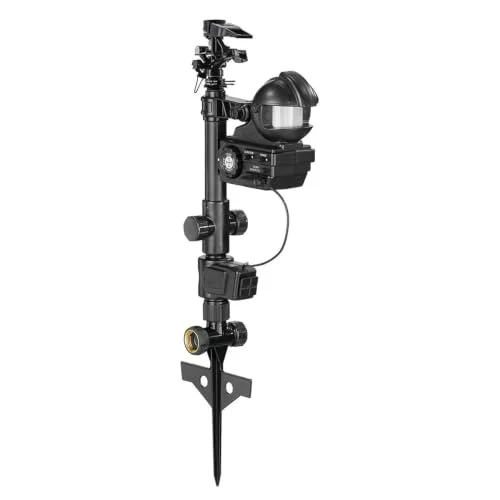
Orbit Yard Enforcer Motion-Activated Sprinkler
- ✓ Motion-activated burst startles herons and raccoons before they reach the water's edge
- ✓ 120-degree field of view covers a wide approach angle from a single unit
- ✓ Metal spike mount is more stable than plastic-stake competitors
- ✓ No netting means the pond stays fully visible for viewing
- ✗ Batteries need regular changes if the sensor triggers often
- ✗ Does not physically stop a predator that pushes through the spray zone
Motion-activated sprinklers detect body heat and movement up to 40 feet away and release a burst of water with startling noise, covering a 120-degree field of view from a single ground-mounted unit. Positioned near the pond’s approach, it startles herons and raccoons before they reach the water’s edge — useful for open ponds where full netting is not practical, or as a second layer alongside a net. The unit runs on batteries, which need regular changes if the sensor triggers often from wind-blown plants nearby, and the metal ground spike holds position better than lighter plastic-stake competitors.
GARDIGO Water Jet Animal Repellent
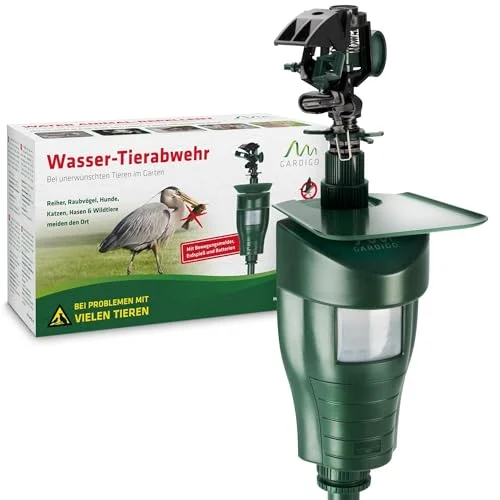
GARDIGO Water Jet Animal Repellent
Budget Sprinkler- ✓ Batteries included out of the box, ready to install
- ✓ Deters herons, raccoons, and cats with the same water-jet mechanism
- ✓ Lower price than the Havahart while covering a similar range
- ✓ Compact enough to tuck into landscaping near the pond edge
- ✗ Shorter track record and fewer long-term reviews than the Havahart
- ✗ Narrower coverage footprint than a dedicated pond-sized sprinkler
A lower-cost motion-activated sprinkler with roughly 33 feet of detection range and batteries included out of the box. It deters herons, raccoons, and cats with the same water-jet mechanism as the Orbit unit at a lower price point, though it has a shorter track record and a narrower coverage footprint. A reasonable budget pick for smaller ponds or as a second unit covering an approach angle the primary sprinkler misses.
PondH2o Blue Heron Decoy (30 inches)
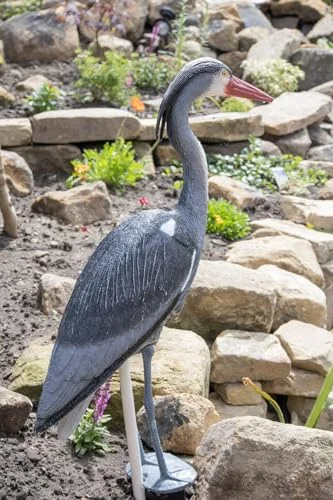
PondH2o Blue Heron Decoy (30 inches)
- ✓ Territorial herons tend to avoid ponds that appear already claimed
- ✓ No power or batteries — installs with a single ground stake
- ✓ Inexpensive add-on to an existing netting or sprinkler setup
- ✓ Weather-resistant finish holds up outdoors March through October
- ✗ Effectiveness drops fast if left in the same spot for more than a few days
- ✗ Should never be the only line of defense — smart herons habituate to it
A weather-resistant resin heron statue that exploits heron territoriality — herons are largely solitary hunters and tend to avoid ponds that already appear claimed by another heron. No power or installation beyond a single ground stake is required, and it holds up outdoors through the March-to-October season. The catch is that a stationary decoy loses effectiveness within days as herons habituate to it; moving it to a new spot every few days keeps it working. Treat it as a cheap add-on to a net or sprinkler, never as a standalone defense.
Frequently Asked Questions
Will netting hurt my fish if they swim into it?
Properly installed netting stays above the waterline, either draped taut over stakes or floating on the surface, so fish never make contact with it. Problems only happen when netting sags into the water — check tension after heavy rain and re-stake as needed.
Do I need netting if I already have a heron decoy?
Yes. A decoy alone is a weak deterrent that herons habituate to within days, especially if it never moves. Netting is the layer that actually stops a determined predator; a decoy or motion sprinkler is a supplement, not a substitute.
What mesh size actually stops raccoons?
A 3/8-inch mesh stops raccoons reliably — their paws cannot fit through gaps that small, and they will not tear the material with claws alone. Fine mesh under 1/4 inch adds a small margin against smaller predators like mink but clogs with debris much faster.
Can I leave predator netting on year-round?
Yes, and in USDA Zones 7-9 there is no reason to take it down outside the active fish season. If you bring fish indoors for winter and leave the pond as a water feature only, removing the net until spring reduces leaf-clearing maintenance, but it offers no benefit if fish or shrimp stay outdoors year-round.
Are floating panels as effective as draped mesh?
Floating hexagon panels are effective against most predators but leave larger gaps than a fine or 3/8-inch woven mesh. They are the right call when your pond’s hardscape border rules out stakes, not a strict upgrade over draped netting where staking is possible.
Do motion-activated sprinklers work on cats as well as herons?
Yes. The sudden water burst and noise startle cats the same way it startles herons and raccoons, though persistent neighborhood cats sometimes learn to avoid the sensor’s trigger zone rather than staying away from the pond entirely. Netting remains the more reliable long-term barrier against cats reaching into shallow water.
How much overhang should I add when sizing a net?
Add at least 2 feet of overhang beyond the pond’s edge on every side. This gives enough slack to stake the net taut without pulling it tight against the water’s edge, where gaps are most likely to open up under wind or settling.
Conclusion
For most backyard ponds, the AlpineReach 15 x 20 ft Kit is the strongest all-around choice — fine mesh, a color that disappears against water, and enough coverage for the majority of standard pond sizes. If your pond runs larger, size up to the 28 x 30 ft kit; if it is patio-sized, the 7 x 10 ft kit avoids paying for coverage you do not need. For ponds with a paver or stone border where stakes are not an option, the Covoeak Floating Hexagons are the practical alternative, even with a slightly lower protection ceiling. Whichever net you choose, pair it with a motion-activated sprinkler or heron decoy for an extra layer — netting stops predators that reach the pond, but a deterrent that keeps them from approaching in the first place means less wear on the net itself.