Every outdoor pond accumulates organic waste. Fish produce ammonia. Uneaten food sinks. Leaves fall in. Algae dies and decomposes. Without intervention, this organic load turns pond water murky, smelly, and unhealthy for fish. Beneficial bacteria products accelerate the natural breakdown of this waste, and the best ones produce noticeably clearer water within a few weeks of consistent use.
These are not magic potions. They are concentrated doses of the same bacteria that naturally colonize pond surfaces — just in higher numbers than nature provides on its own. Think of it as giving your pond’s biological filtration system a massive workforce boost.
Here in the warm southern US (USDA Zones 7-9), I dose beneficial bacteria from the first warm week in March through the end of October. This coincides with the outdoor guppy and ricefish season, when fish are active, eating, and producing waste at their highest rates.
Quick Picks
- Best Overall: Aquascape Beneficial Bacteria — eight targeted strains in a concentrated dry formula
- Best Liquid: Airmax PondClear — ready-to-pour liquid with 20+ years of field testing
- Easiest to Use: The Pond Guy Nature’s Defense — pre-measured toss-in packets
- Best Concentrate: PondValue Ultimate — highly concentrated live bacteria
- Best Cold-Weather: Webb’s All-Season with Barley — works down to 35°F with added algae inhibitor
| Aquascape Beneficial Bacteria Concentrate Best Overall | Airmax PondClear Liquid Bacteria Best Liquid | The Pond Guy Nature's Defense (12 Packets) Easiest to Use | PondValue Ultimate Pond Bacteria Best Concentrate | Webb's All-Season Pond Bacteria with Barley Best Cold-Weather | |
|---|---|---|---|---|---|
| Rating | 9/10 | 8.8/10 | 8.5/10 | 8.2/10 | 8/10 |
| Price | $31.92as of Sep 27, 2026 | $49.99as of Sep 27, 2026 | $34.99as of Sep 27, 2026 | $29.99as of Sep 27, 2026 | $32.28-$37.98as of Sep 27, 2026 |
| Form | Dry concentrate powder | Liquid concentrate | Water-soluble packets | Liquid concentrate | Water-soluble packets with barley |
| Size | 1.1 lb | 1 gallon | — | 1 gallon | — |
| Coverage | Treats up to 4,000 gallons (monthly) | Treats up to 1 acre | 1 packet per 1,000 gallons | Varies by concentration | 1 packet per 1,000 gallons |
| Type | 8 strains of beneficial bacteria | Natural bio clarifier | Bacteria and enzyme blend | Live natural bacteria | Bacteria + barley straw extract |
| Count | — | — | 12 packets | — | 24 packets |
| Check Price → | Check Price → | Check Price → | Check Price → | Check Price → |
Prices change daily — tap Check Price for the current Amazon price. Numbers shown were verified on the "as of" date.
Detailed Reviews
1. Aquascape Beneficial Bacteria Concentrate
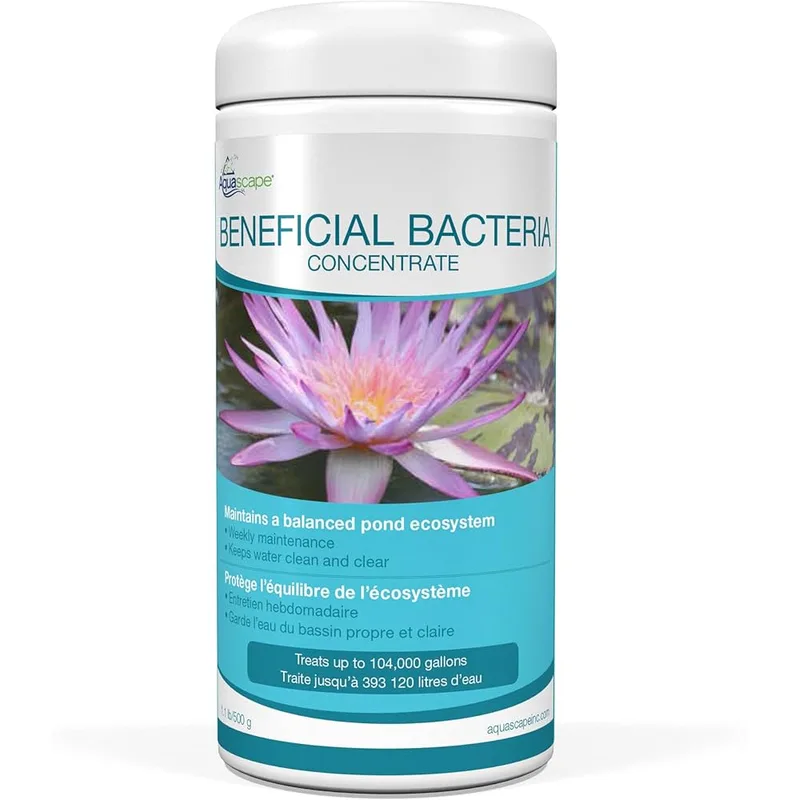
Aquascape Beneficial Bacteria Concentrate
Best Overall- ✓ Eight targeted bacterial strains for comprehensive organic breakdown
- ✓ Dry formula has a long shelf life — does not expire quickly
- ✓ Concentrated formula means a small amount treats a large pond
- ✓ Made by Aquascape, a company that builds professional ponds
- ✗ Requires warm water (above 50°F) to activate effectively
- ✗ Takes 2-4 weeks to see visible water clarity improvement
- ✗ Dry powder needs to be dissolved before application
Aquascape is a company that designs and builds professional pond installations, so their water treatment products are formulated by people who actually maintain ponds for a living. This beneficial bacteria concentrate contains eight targeted bacterial strains selected for their ability to break down different types of organic waste — fish waste, dead plant material, excess nutrients, and bottom sludge.
The dry concentrate format is the key advantage. Liquid bacteria products lose potency over time and are sensitive to temperature during storage and shipping. Dry bacteria are shelf-stable for years and activate upon contact with warm water. You are getting viable, living bacteria every time you dose.
How I use it: Monthly application from March through October. I dissolve the measured dose in a bucket of pond water, let it activate for 15 minutes, then distribute it evenly around the pond perimeter. Within 3-4 weeks of the first spring dose, water clarity improves noticeably.
For small patio ponds: The 1.1-pound container treats up to 4,000 gallons monthly, which means a 200-gallon patio pond gets over a year of treatment from one container. Cost-effective.
2. Airmax PondClear Liquid Bacteria
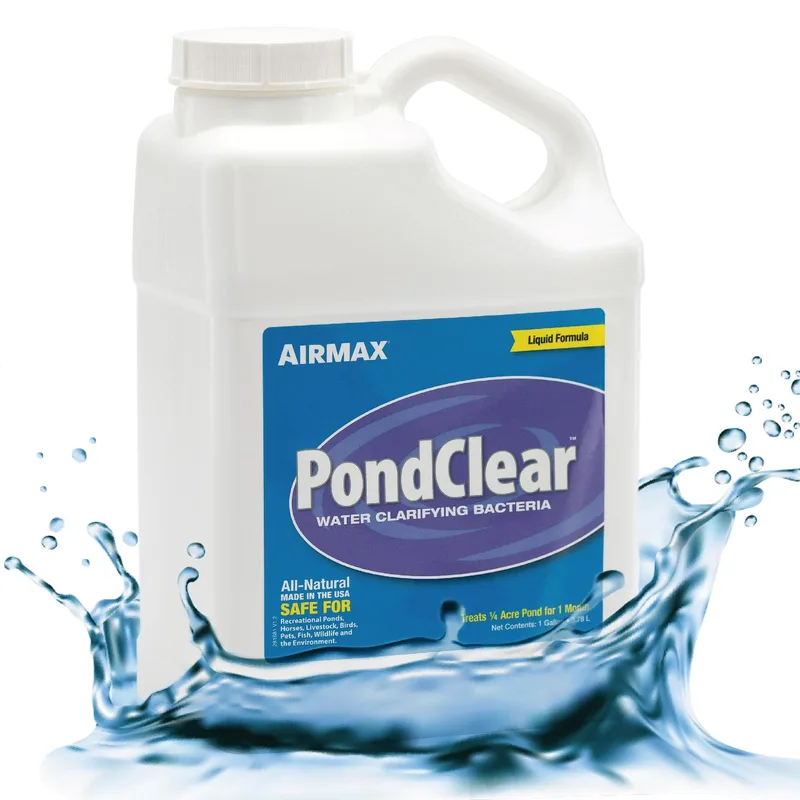
Airmax PondClear Liquid Bacteria
Best Liquid- ✓ Liquid formula is ready to use — just pour directly into the pond
- ✓ Over 20 years of field-tested formulation
- ✓ Handles large pond volumes up to 1 acre
- ✓ Fish, plant, and pet safe with no chemical additives
- ✗ 1-gallon size is overkill for small patio ponds
- ✗ More expensive than dry concentrate options
- ✗ Must be stored properly — liquid bacteria can lose potency in heat
Airmax PondClear is designed for larger ponds and has over two decades of field use backing up its formulation. The liquid format is the most convenient for large-volume dosing — just measure and pour, no dissolving or mixing required.
The formulation focuses specifically on consuming the suspended organic particles that cause green, murky water. It does not kill algae directly (that is what algaecides do, and they create more problems than they solve). Instead, it out-competes algae for nutrients by breaking down the organic matter that feeds algae growth. Remove the food source, and the algae starves.
Who this is for: Pond keepers with 500+ gallon ponds who want a pour-and-forget solution. The 1-gallon size is overkill for a 50-gallon patio tub — go with the Aquascape concentrate for small setups.
3. The Pond Guy Nature’s Defense (12 Packets)
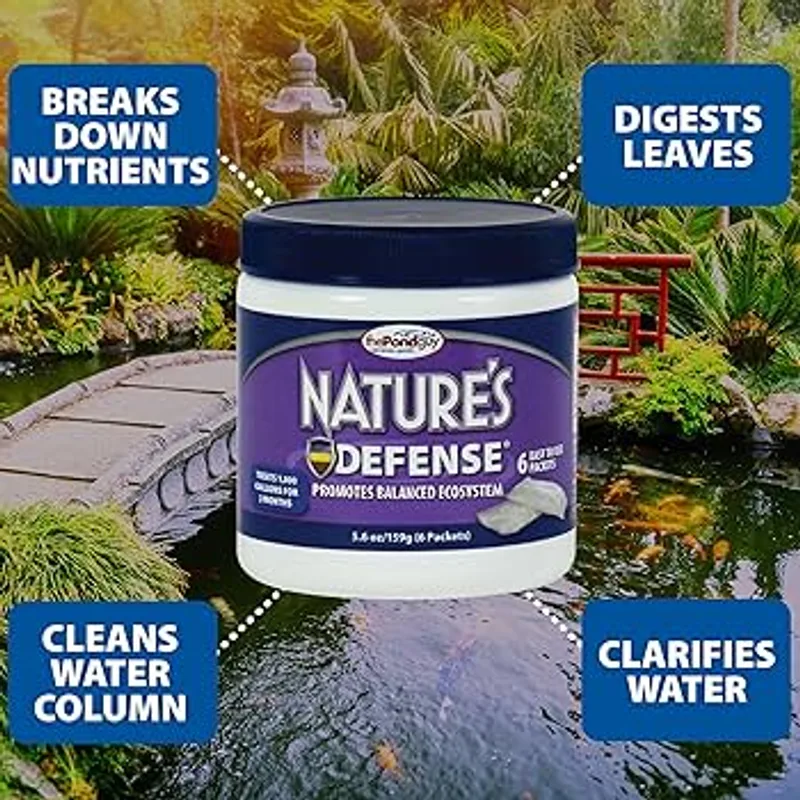
The Pond Guy Nature's Defense (12 Packets)
Easiest to Use- ✓ Pre-measured packets eliminate dosing guesswork
- ✓ Water-soluble — just toss the packet in, no mixing needed
- ✓ Combined bacteria and enzyme formula for dual-action cleaning
- ✓ Activates immediately on contact with water
- ✗ 12 packets only covers one season for a 1,000-gallon pond
- ✗ Packet packaging creates more waste than bulk liquid
- ✗ Less cost-effective per treatment than concentrate options
If you hate measuring, mixing, and dosing, these pre-measured packets are the answer. Each water-soluble packet treats up to 1,000 gallons. You literally toss the packet into the pond — the casing dissolves and the bacteria/enzyme blend disperses on its own.
The combined bacteria and enzyme formula is a nice touch. Bacteria break down waste biologically, while enzymes accelerate chemical decomposition of proteins and fats. Together, they attack organic buildup from two directions.
The honest math: 12 packets at biweekly dosing lasts 24 weeks — roughly one full pond season. For a 1,000-gallon pond, that is reasonable. For a 200-gallon patio pond, you can cut the dose (use half a packet) and stretch the box across two seasons.
4. PondValue Ultimate Pond Bacteria
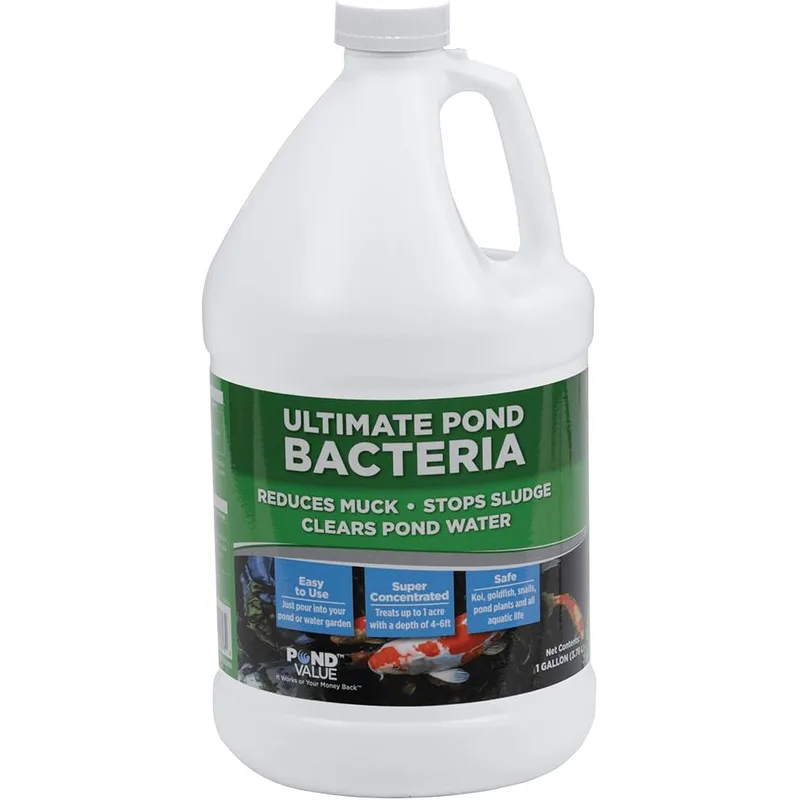
PondValue Ultimate Pond Bacteria
Best Concentrate- ✓ Highly concentrated live bacteria — active immediately upon dosing
- ✓ Reduces sludge, fish waste, and organic debris
- ✓ Safe for fish, plants, and livestock
- ✓ Easy dosing with measuring cap
- ✗ Requires consistent dosing schedule for best results
- ✗ Live bacteria formula is temperature-sensitive during shipping
- ✗ Results vary by pond conditions and organic load
PondValue delivers a highly concentrated live bacteria formula that begins working immediately upon application. The measuring cap makes dosing straightforward, and the gallon size provides plenty of treatments for the season.
The emphasis on sludge digestion makes this particularly useful for ponds with accumulated bottom muck. If you can see a layer of brown organic debris on the pond floor — decomposed leaves, fish waste, uneaten food — this product targets that layer specifically.
Application tip: Dose in the morning when water is warming up. Bacteria activate and reproduce faster in warm water. Dosing in cool evening water slows the activation significantly.
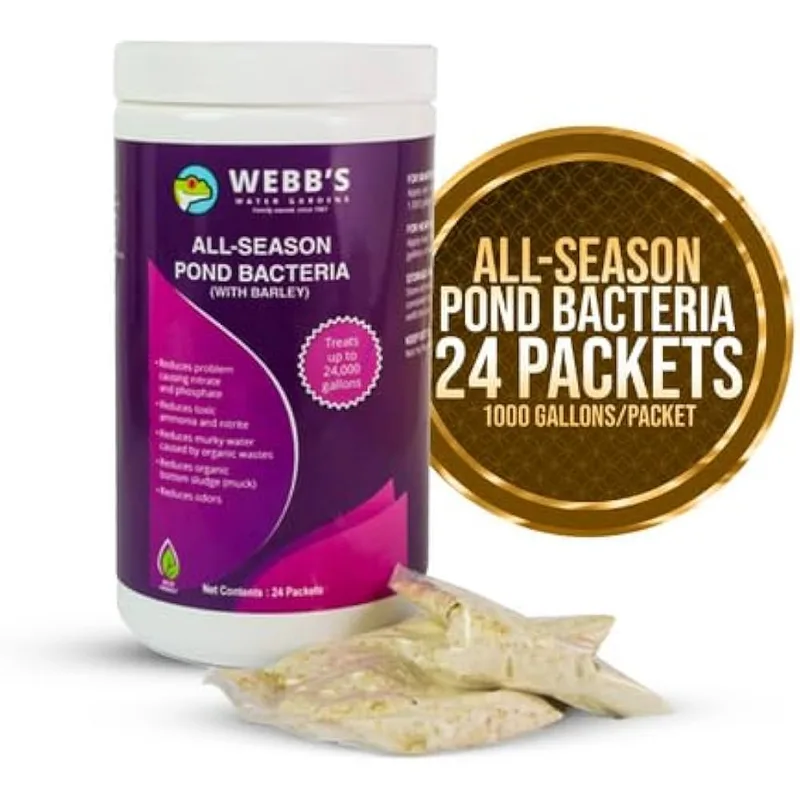
5. Webb’s All-Season Pond Bacteria with Barley
Webb's All-Season Pond Bacteria with Barley
Best Cold-Weather- ✓ Works down to 35°F — the only option here for cold-weather dosing
- ✓ Barley straw extract adds a natural algae inhibitor
- ✓ 24 packets last an entire season with biweekly dosing
- ✓ Pre-measured packets for consistent, easy application
- ✗ Cold-weather effectiveness is slower than warm-weather results
- ✗ Barley extract can slightly tint water amber initially
- ✗ Packets dissolve slowly in cold water
The standout feature is cold-weather functionality. Most beneficial bacteria products require water above 50°F to activate. Webb’s formula works down to 35°F, which means you can start dosing in late winter before the main algae bloom season begins. Getting bacteria established before spring warmth triggers algae growth gives you a head start on water clarity.
The barley straw extract is the other differentiator. Barley straw has been used by European pond keepers for decades as a natural algae inhibitor. As barley straw decomposes, it releases compounds that inhibit new algae growth without harming fish or plants. Combining bacterial treatment with barley extract addresses both existing organic waste and future algae prevention.
For USDA Zones 7-9 ponds: Start dosing in February when water temps are still in the 40s–50s. By the time March arrives and you add fish back to the pond, the bacteria are already established and the barley extract is actively inhibiting early algae blooms.
How Beneficial Bacteria Actually Work in Ponds
Understanding the mechanism helps you use these products effectively:
- Bacteria consume organic waste — fish poop, dead plant matter, excess food, and algae detritus
- Bacteria compete with algae for nutrients — particularly nitrogen and phosphorus
- As organic matter is broken down, the water becomes clearer because suspended particles are consumed
- Sludge on the pond bottom decreases as bacteria digest the accumulated muck
- The nitrogen cycle strengthens — beneficial bacteria process ammonia and nitrite, making water safer for fish
This process is not instant. Expect 2-4 weeks before you see visible improvement, and 6-8 weeks before the pond reaches its clearest state. Consistency matters more than dose size — regular biweekly applications outperform occasional heavy doses.
Dosing Schedule for USDA Zones 7-9 Outdoor Ponds
| Month | Water Temp | Action |
|---|---|---|
| February | 40-50°F | Start cold-weather bacteria (Webb’s) if available |
| March | 55-65°F | Begin standard bacteria dosing; add fish when stable above 65°F |
| April-September | 70-85°F | Biweekly dosing; bacteria most active in warm water |
| October | 60-70°F | Final dose of the season; reduce feeding as temps drop |
| November-January | Below 50°F | No dosing needed; fish are dormant or indoors |
Will Bacteria Harm Fish or Shrimp?
No. Every product on this list is explicitly fish-safe. Beneficial bacteria are the same organisms that naturally colonize your filter media, pond surfaces, and substrate. Adding more of them does not create any toxicity risk.
For shrimp-safe considerations in patio ponds containing neocaridina or other freshwater shrimp: these bacteria products do not affect shrimp. The bacteria consume organic waste, not living organisms. Shrimp and beneficial bacteria coexist naturally in every aquatic environment.
The only caution: do not dose bacteria products simultaneously with algaecides, UV sterilizers running at full power, or heavy doses of water conditioner. These can kill the bacteria you just added. Dose bacteria, then wait 48 hours before running a UV sterilizer. And never use copper-based algaecides in any pond containing shrimp — copper is lethal to invertebrates at concentrations that are safe for fish.