Pond water testing is different from aquarium testing, and most pond keepers do not test enough. In an outdoor pond — especially one stocked with guppies, ricefish, or goldfish — water parameters shift faster and more unpredictably than in a climate-controlled indoor tank. Rain dilutes hardness, sun drives algae blooms that spike pH, and decaying leaves dump ammonia. You need a test kit that covers the right parameters, and you need to actually use it.
Here in the warm southern US (USDA Zones 7-9), our outdoor pond season runs March through October. We recommend testing weekly during the active season and biweekly during the shoulder months. That cadence catches problems early more times than I can count — a sudden ammonia spike after a heavy rain, a KH crash from acidic runoff, a phosphate surge feeding string algae.
Here are the five pond test kits worth owning in 2026, from comprehensive liquid kits to fast screening strips.
Quick Picks
- Best Overall: API Pond Master Test Kit — liquid reagent accuracy for pH, ammonia, nitrite, and phosphate with 500+ tests per kit
- Best Quick Check: API Pond 5-in-1 Strips — 60-second results for routine weekly screening
- Best Compact Kit: NT Labs Pond Water Mini Test — liquid drop accuracy in a portable format covering the three critical parameters
- Best Value Strips: 7-in-1 Pond Test Strips (100ct) — budget-friendly bulk strips covering seven parameters
- Best KH-Specific: Aquascape KH Alkalinity Test Kit — precise titration testing for the parameter most pond keepers forget
| API Pond Master Test Kit Best Overall | API Pond 5-in-1 Test Strips Best Quick Check | NT Labs Pond Water Mini Test Kit Best Compact Kit | 7-in-1 Pond Test Strips (100 Count) Best Value Strips | Aquascape KH Alkalinity Test Kit Best KH-Specific | |
|---|---|---|---|---|---|
| Rating | 9.3/10 | 8.2/10 | 8.5/10 | 7.8/10 | 8/10 |
| Price | Unavailable | $8.17-$14.98as of Sep 27, 2026 | Unavailable | $7.99as of Sep 27, 2026 | $27.99as of Sep 27, 2026 |
| Tests Included | pH, Ammonia, Nitrite, Phosphate | pH, KH, GH, Nitrite, Nitrate | pH, Nitrite, Ammonia | pH, KH, GH, Chlorine, Free Chlorine, Nitrite, Nitrate | KH (Alkalinity) |
| Test Count | 500+ | 25 | 30+ per parameter | 100 | 60 |
| Type | Liquid reagent | Dip strips | Liquid drop | Dip strips | Liquid drop (titration) |
| For | Freshwater ponds | Freshwater ponds | Freshwater ponds | Freshwater ponds and aquariums | Ponds and water features |
| Check Price → | Check Price → | Check Price → | Check Price → | Check Price → |
Prices change daily — tap Check Price for the current Amazon price. Numbers shown were verified on the "as of" date.
Detailed Reviews
1. API Pond Master Test Kit
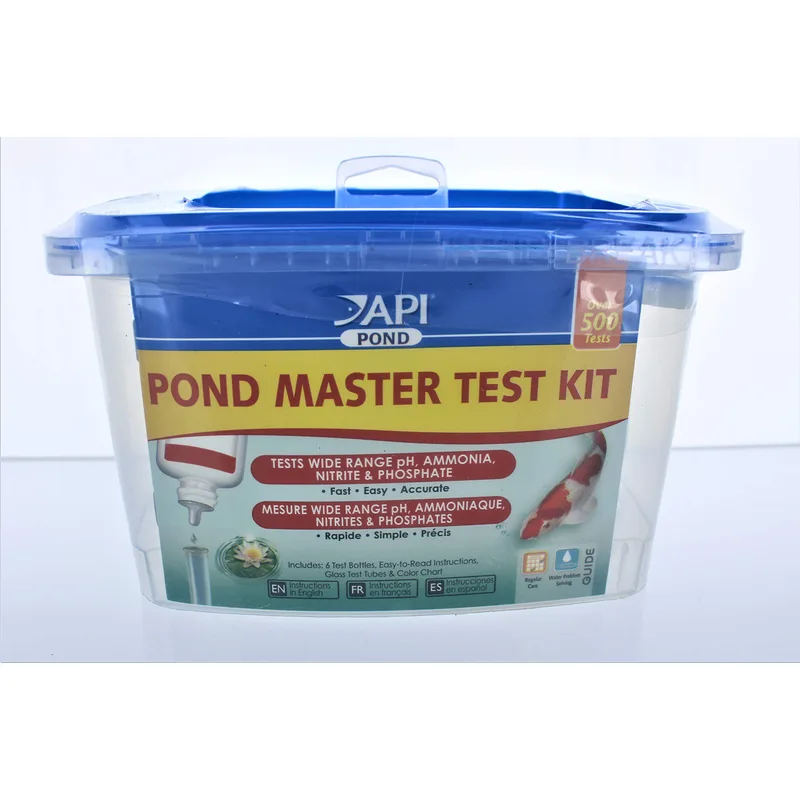
API Pond Master Test Kit
Best Overall- ✓ Liquid reagent accuracy — far superior to test strips for critical parameters
- ✓ Includes phosphate testing, which most aquarium kits skip
- ✓ Over 500 total tests per kit makes cost per test extremely low
- ✓ Clear color charts designed for outdoor lighting conditions
- ✗ No nitrate test included — you need a separate kit for that
- ✗ No GH or KH testing
- ✗ Takes 5-10 minutes per full round of tests
The API Pond Master Test Kit is the standard for a reason. Liquid reagent tests are significantly more accurate than strips, and this kit covers the four parameters that cause the most fish deaths in outdoor ponds: pH, ammonia, nitrite, and phosphate.
The phosphate inclusion is what separates this from the regular freshwater aquarium master kit. Phosphate fuels algae growth in ponds, and if you have been fighting green water or string algae all summer, knowing your phosphate level is the first step toward solving it. Most aquarium kits do not test phosphate because it rarely matters indoors, but in a sunlit pond, it is the difference between clear water and pea soup.
How I use it: Full panel every Monday morning during pond season. I test ammonia separately mid-week if I have added new fish or done a large water change. At 500+ total tests, this kit lasts me over two full seasons.
The one weakness: No nitrate test. API sells a separate nitrate kit, or you can supplement with strips for nitrate screening. It is an odd omission, but the phosphate test more than compensates for pond-specific use.
2. API Pond 5-in-1 Test Strips
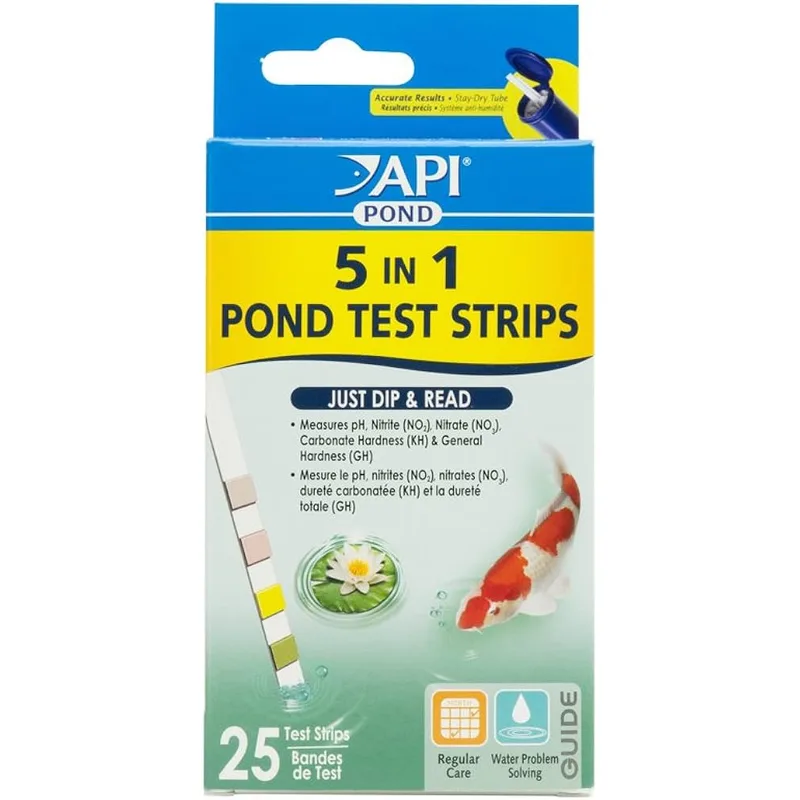
API Pond 5-in-1 Test Strips
Best Quick Check- ✓ Results in 60 seconds — perfect for routine weekly checks
- ✓ Covers KH and GH which the liquid master kit misses
- ✓ Cheap enough to test frequently without worrying about cost
- ✓ No mixing, no tubes, no waiting — just dip and read
- ✗ Less accurate than liquid reagent tests, especially for ammonia
- ✗ Only 25 strips per box — runs out fast with weekly testing
- ✗ Color matching can be ambiguous in certain ranges
Strips get a bad reputation in the aquarium hobby, and for good reason — they are less precise than liquid tests. But for pond use, strips serve an important role: fast weekly screening that tells you if something has changed enough to warrant a full liquid test.
These 5-in-1 strips cover pH, KH, GH, nitrite, and nitrate. The KH and GH readings are particularly valuable for pond keepers because outdoor water hardness fluctuates with rain and evaporation. A sudden KH drop means your pH is about to become unstable, and that is dangerous for fish.
How I use them: Quick dip every time I walk past the pond during season. If anything looks off on the strip, I follow up with the API liquid kit for confirmation. Strips are not reliable enough to make treatment decisions on their own, but they are excellent early warning systems.
Worth noting: 25 strips per box is not many if you test weekly. At one strip per week, you get about six months. Buy two boxes at the start of the season.
3. NT Labs Pond Water Mini Test Kit
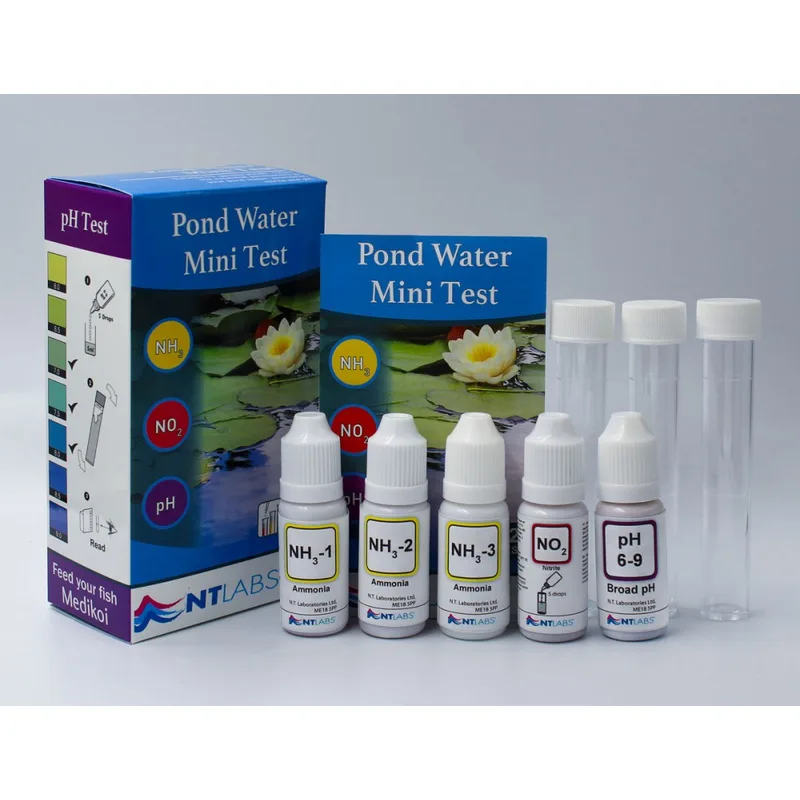
NT Labs Pond Water Mini Test Kit
Best Compact Kit- ✓ Liquid drop accuracy in a compact, portable kit
- ✓ Covers the three most critical parameters for fish health
- ✓ Clear instructions designed for pond keepers, not lab techs
- ✓ Small enough to keep in your pond supply bin
- ✗ Only three parameters — no nitrate, phosphate, or hardness
- ✗ Smaller test count than the API master kit
- ✗ UK brand — sometimes harder to find in US stores
NT Labs is a UK-based company that specializes in pond products, and their mini test kit is a great option if you want liquid reagent accuracy without the bulk of the full API kit. It covers pH, nitrite, and ammonia — the three parameters that are most immediately dangerous to fish.
The kit is compact enough to keep in a toolbox or pond supply bin, and the instructions are written for pond keepers rather than chemistry students. Each test takes about two minutes, and the color charts are clear and easy to read outdoors.
Why I like it: When I am doing a quick health check on a pond that seems fine, I do not need to test phosphate or pull out a full master kit. pH, ammonia, and nitrite tell me whether the biological cycle is running correctly. If all three are good, the pond is good.
The trade-off: Only three parameters means you still need strips or another kit for GH, KH, and nitrate. But for targeted diagnostic testing, this is efficient.
4. 7-in-1 Pond Test Strips (100 Count)
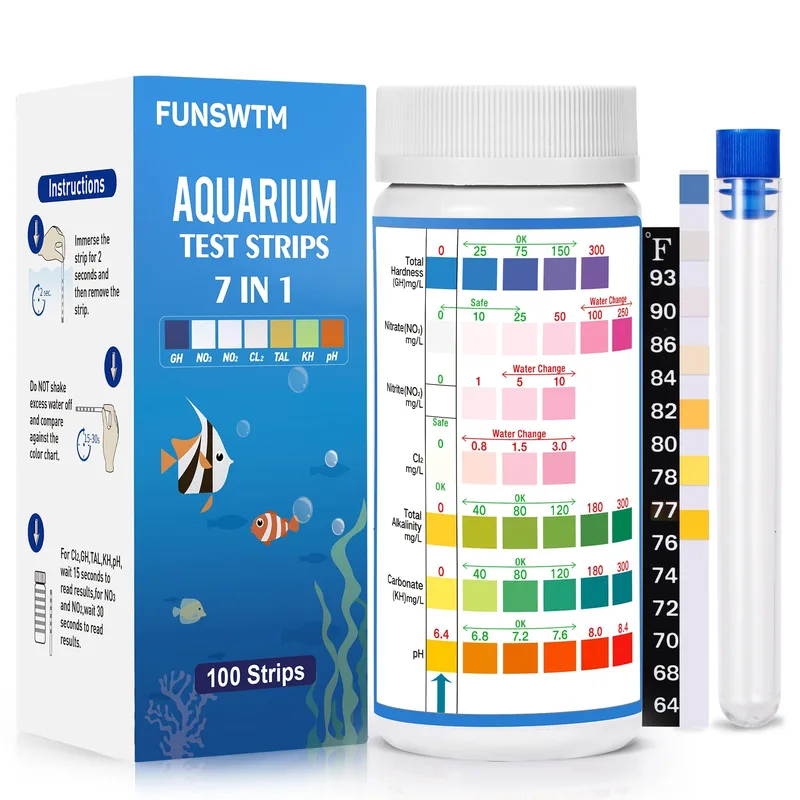
7-in-1 Pond Test Strips (100 Count)
Best Value Strips- ✓ 100 strips per box — lasts months of weekly testing
- ✓ Seven parameters covered on a single strip
- ✓ Includes chlorine testing, useful after water changes with tap water
- ✓ 30-second results for quick screening
- ✗ No ammonia test on the strip — the one parameter you need most
- ✗ Generic brand — quality control is inconsistent batch to batch
- ✗ Strip accuracy is inherently lower than liquid reagent tests
If you want the most tests for the least money, these 100-count 7-in-1 strips are the move. Seven parameters per strip — pH, KH, GH, chlorine, free chlorine, nitrite, and nitrate — at roughly $0.12–$0.16 per strip. You can test every few days without thinking about cost.
The chlorine testing is a nice bonus if you top off your pond with tap water. Chlorine and chloramine are invisible killers in ponds, and a quick strip check after adding water gives peace of mind.
The major problem: No ammonia on the strip. Ammonia is the single most important parameter for fish health, and a 7-in-1 strip without ammonia is like a car dashboard without a fuel gauge. You absolutely must supplement these with a separate ammonia test — either the API liquid test or dedicated ammonia strips.
Who these are for: Pond keepers who already own a liquid ammonia test and want cheap, frequent screening for everything else.
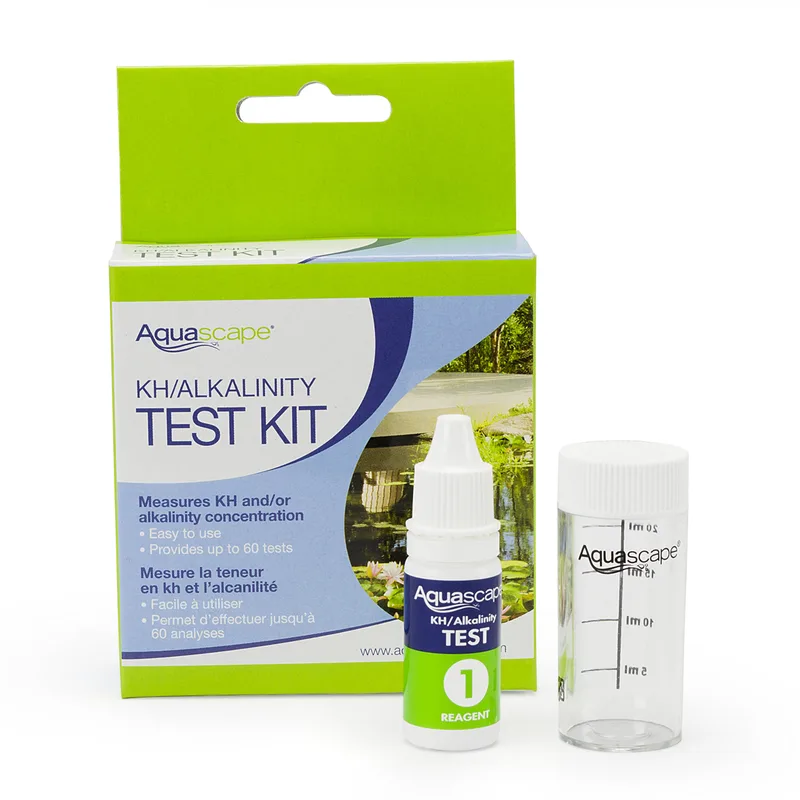
5. Aquascape KH Alkalinity Test Kit
Aquascape KH Alkalinity Test Kit
Best KH-Specific- ✓ Titration method gives precise KH readings, not vague color ranges
- ✓ 60 tests per kit — excellent value for a single-parameter kit
- ✓ Made by Aquascape, a company that actually builds ponds
- ✓ Essential for monitoring pH stability in outdoor ponds
- ✗ Only tests KH — you still need other kits for the full picture
- ✗ Requires counting drops, which some people find tedious
- ✗ Not widely stocked in local pet stores
KH (carbonate hardness) is the parameter most pond keepers forget about until something goes wrong. KH buffers your pH — it prevents the dangerous pH swings that kill fish overnight. In outdoor ponds, KH gets consumed by biological processes and diluted by rain. If it drops too low, your pH can crash from 7.5 to 6.0 in a single night.
The Aquascape KH test uses titration — you add drops of reagent to a water sample until it changes color, then count the drops. Each drop equals one degree of KH. This method gives you a precise number, not a vague color range like strips provide.
Why pond keepers need this: Indoor aquariums have stable KH because tap water is consistent. Outdoor ponds lose KH constantly to rain, biological activity, and acidic substrate. We recommend testing KH every two weeks during pond season and add baking soda or crushed coral if it drops below 4 dKH. This single habit has prevented more fish deaths than any medication I own.
What Parameters to Test in Your Pond (and How Often)
| Parameter | Why It Matters | Test Frequency |
|---|---|---|
| Ammonia | Directly toxic to fish at any level above 0 | Weekly, or after adding fish |
| Nitrite | Toxic — indicates incomplete nitrogen cycle | Weekly |
| pH | Swings kill faster than stable wrong values | Weekly |
| KH | Buffers pH — low KH means unstable pH | Every 2 weeks |
| Nitrate | High levels feed algae, stress fish above 40 ppm | Every 2 weeks |
| GH | Affects osmoregulation; guppies prefer 8-12 dGH | Monthly |
| Phosphate | Primary algae fuel in sunlit ponds | Monthly |
Pond Testing for Guppies and Ricefish
If you keep guppies or ricefish in an outdoor pond here in USDA Zones 7-9, pay special attention to:
- Temperature: Guppies need water above 65°F. A floating thermometer is cheaper and more important than any test kit. Check it in the morning when water is coolest.
- pH: Guppies prefer 7.0–8.0. Ricefish are more flexible (6.5–8.0). If your pond runs acidic from tannins or rain, add crushed coral to the filter.
- GH: Guppies are livebearers and need minerals for fry development. Keep GH above 6 dGH. Ricefish are less demanding but appreciate moderate hardness.
- Ammonia/Nitrite: Zero tolerance. Both species are sensitive to ammonia, especially in warm summer water where ammonia toxicity increases with temperature and pH.
The Testing Strategy That Actually Works
Do not buy a single kit and call it done. The most effective setup for pond keepers is a two-tier approach:
- Primary kit: API Pond Master Test Kit (liquid, accurate, covers the critical parameters)
- Screening strips: Any 5-in-1 or 7-in-1 strip (fast, cheap, catches trends between full tests)
- Optional add-on: Aquascape KH test (if your pond has KH stability issues, which most do)
Test liquid every week during active season. Dip a strip every time you are near the pond. Keep a simple log — even just a notes app on your phone — so you can spot trends before they become emergencies. A slow upward creep in nitrate is easy to fix with a water change. A sudden ammonia spike at 2 ppm is a crisis.
The kits on this list cost between $9 and $28. A single dead fish costs more than all of them combined — in money, in time spent diagnosing the problem, and in the frustration of losing an animal you were responsible for. Test your water.