AquaRanked is reader-supported. When you buy through links on our site, we may earn an affiliate commission.
Hang-on-back filters are the workhorses of freshwater fishkeeping. They mount on the tank rim, require no plumbing, and provide mechanical and biological filtration for tanks from 5 to 30 gallons without the cost or complexity of a canister setup. For breeding racks, shrimp tanks, grow-out setups, or any small aquarium that needs reliable filtration without overthinking it, a HOB is usually the right call.
The problem is that the market is full of bad ones. Cheap HOBs with weak impellers, proprietary cartridges designed to lock you into replacements, and filters that throttle to a trickle the moment algae hits the intake. Running multiple tanks on a breeding rack means equipment failures cost you fry — and that makes filter selection worth getting right.
This roundup covers five HOB filters with real-world trust across the freshwater hobby. Each is currently in stock on Amazon and specced out on what actually matters: flow rate, media customization, noise level, and shrimp safety.
| AquaClear 20 Power Filter Best Overall | Seachem Tidal 35 Power Filter Best Features | Tetra Whisper IQ 20 Power Filter Best Budget | Fluval C2 Power Filter Best Multi-Stage | Marineland Penguin 150 Power Filter Best Bio-Wheel | |
|---|---|---|---|---|---|
| Rating | 9.4/10 | 9.1/10 | 8.6/10 | 8.8/10 | 8.3/10 |
| Price | $41.99as of Sep 27, 2026 | $46.37as of Sep 27, 2026 | $18.66-$23.17as of Sep 27, 2026 | $59.99as of Sep 27, 2026 | $42.75as of Sep 27, 2026 |
| Brand | Fluval (AquaClear) | Seachem / Sicce | Tetra | Fluval | Marineland |
| Tank Size | 5–20 gal | Up to 35 gal | Up to 20 gal | Up to 30 gal | 20–30 gal |
| Flow Rate | 100 GPH | 130 GPH (adjustable) | 130 GPH | 119 GPH | 150 GPH |
| Adjustable Flow | Yes | — | — | — | — |
| Stages | 3 (sponge, carbon, BioMax) | — | — | 5 (poly foam, C-nodes, carbon, Zeo-Carb, bio-screen) | 3 |
| Media | Customizable open basket | Large open basket | — | Refillable chambers | — |
| Self-Priming | — | Yes | — | — | — |
| Surface Skimmer | — | Yes | — | — | — |
| Noise | — | — | <40 dB | — | — |
| Motor | — | — | Submerged (self-priming) | — | — |
| Cartridge | — | — | Bio-Bag (proprietary) | — | Rite-Size (proprietary) |
| Pause Button | — | — | — | Yes | — |
| Bio-Wheel | — | — | — | — | Yes (wet/dry nitrification) |
| Check Price → | Check Price → | Check Price → | Check Price → | Check Price → |
Prices change daily — tap Check Price for the current Amazon price. Numbers shown were verified on the "as of" date.
Quick Picks
- Best Overall: AquaClear 20 — gold standard for customizable media and adjustable flow in tanks up to 20 gallons
- Best Features: Seachem Tidal 35 — self-priming, surface skimmer, maintenance monitor, and large open media basket
- Best Budget: Tetra Whisper IQ 20 — sub-$25, quiet, and reliable enough to stock multiples for a breeding rack
- Best Multi-Stage: Fluval C2 — five discrete filtration stages and a pause button for feeding time
- Best Bio-Wheel: Marineland Penguin 150 — wet/dry Bio-Wheel technology for higher bioloads in 20–30 gallon tanks
Shrimp Safety: Required Reading for HOB Filters
This section is mandatory before running any HOB filter on a shrimp or fry tank.
HOB filter intakes create strong suction. Young shrimp, shrimp larvae, and fish fry can be pulled directly into the impeller. The fix is a prefilter sponge — a coarse sponge sleeve that slips over the intake tube and blocks animals from reaching the impeller. Every filter on this list should have one installed if you keep shrimp or spawn fry. Prefilter sponges cost $2–5 on Amazon and add biological surface area on top of shrimp protection.
For media safety: none of the filters on this list use copper-containing media, and none include medications in their cartridges. Activated carbon included with most filters is shrimp-safe as long as you rinse it before first use. If you ever dose medications in a copper-sensitive invertebrate tank — remove the carbon first (it strips medication), and pull shrimp out before any copper-containing treatment.
Shrimp-safe designations on this list:
- AquaClear 20 — open media basket lets you remove carbon entirely and run on inert bio media only. Shrimp-safe with intake prefilter. ✓
- Seachem Tidal 35 — adjustable flow, large media basket for inert media. Shrimp-safe with intake prefilter on both intake ports. ✓
- Tetra Whisper IQ 20 — shrimp-safe with intake prefilter. Proprietary cartridges contain no copper or medications. ✓
- Fluval C2 — open refillable chambers. Remove Zeo-Carb and carbon for shrimp-only builds. Shrimp-safe with intake prefilter. ✓
- Marineland Penguin 150 — shrimp-safe with intake prefilter. Bio-Wheel does not affect shrimp water chemistry. ✓
Buying Guide: What Matters in a Small Tank HOB Filter
Flow Rate and Tank Turnover
Standard guidance is 4–6x tank volume per hour. A 10-gallon tank needs 40–60 GPH minimum; a 20-gallon tank needs 80–120 GPH. Every filter on this list meets that threshold for its rated tank size.
For shrimp tanks, target the lower end of the range. High flow stresses shrimp and tumbles lightweight animals around the tank. The AquaClear 20 and Seachem Tidal 35 both have adjustable flow dials — you can reduce output to 30–40% without losing biological filtration efficiency, because the media stays colonized regardless of exact flow rate.
For heavily stocked community tanks or grow-out setups where juveniles are eating heavily and producing waste, push to the high end or run a sponge filter alongside the HOB for additional biological capacity.
Media Customization
Proprietary cartridges are a recurring expense trap. Filters that require brand-specific cartridges (Tetra Bio-Bag, Marineland Rite-Size) force ongoing purchases at $6–10 per cartridge every few weeks. For a rack of ten tanks, that cost is significant over a year.
The AquaClear 20 and Seachem Tidal 35 use open media baskets where you can load bulk Seachem Matrix, lava rock, Purigen, or any commercial bio media. Initial cost is higher, but you rinse and reuse rather than replace. For breeding operations where margins matter, this distinction is real.
Noise
HOBs are louder than sponge filters. The question is whether they are loud enough to disrupt a bedroom or living room. All five filters on this list are quiet enough for residential use, but there are differences:
- Tetra Whisper IQ 20: engineered for under 40 dB — among the quietest HOBs sold
- AquaClear 20: low hum at full flow, near-silent at reduced flow
- Seachem Tidal 35: quiet once running; the initial fill is briefly louder
- Fluval C2: slightly louder at full flow due to multi-chamber design
- Marineland Penguin 150: noise-dampened motor, but the Bio-Wheel can produce faint ticking if flow slows
All five run quieter when mounted level. Vibration from an unlevel filter transfers through the aquarium frame and amplifies inside the glass.
Intake Tube Length
Most HOBs ship with intake tubes sized for 12–15 inch tank depths. For shallow tubs, plastic grow-out totes, or patio pond setups, check that the intake reaches below the water surface. The Seachem Tidal 35 has an adjustable intake length that handles a wider range of depths.
Detailed Reviews
1. AquaClear 20 Power Filter
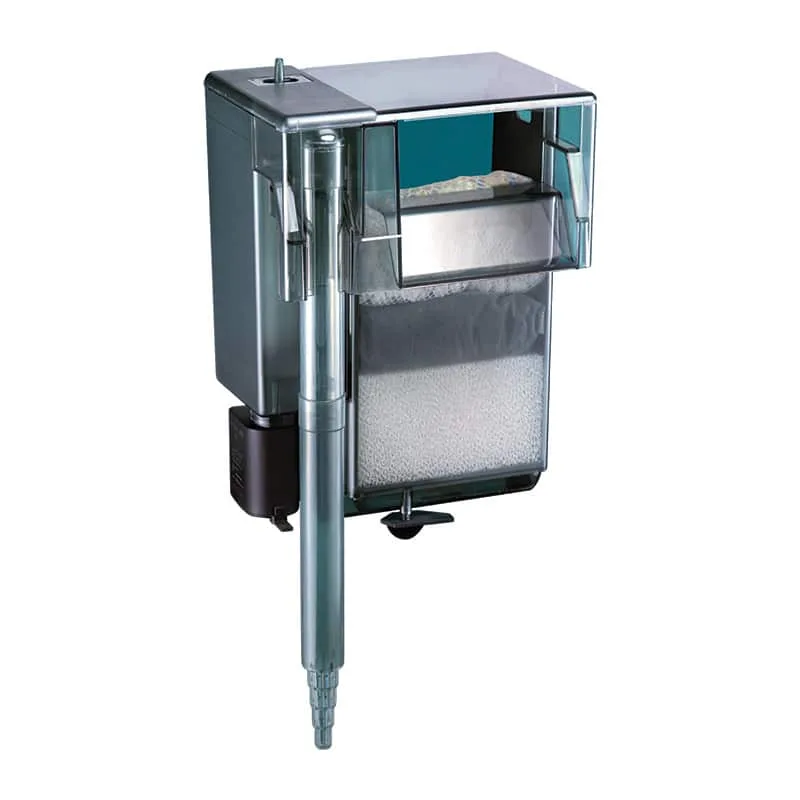
AquaClear 20 Power Filter
Best Overall- ✓ Large open media chamber accepts any third-party bio media
- ✓ Adjustable flow dial — reduce to 30% for nano or shrimp tanks
- ✓ Foam sponge intake pre-filter protects shrimp and fry
- ✓ Decades of proven reliability across breeding rooms
- ✗ Included carbon insert is low-grade — most hobbyists remove it
- ✗ Can trickle quietly if flow is set very low and water level drops
The AquaClear 20 has been the default hobbyist recommendation for 20-gallon-and-under tanks for decades. The reason it has not been displaced: the open media chamber is genuinely useful, and no other filter in this price range gives you the same level of control over what is filtering your water.
The chamber holds three layers by default — foam sponge on the bottom for mechanical filtration, activated carbon in the middle, and BioMax ceramic rings on top for biological filtration. In practice, most experienced hobbyists pull the carbon insert out entirely. Carbon needs replacing every 3–4 weeks or it starts leaching back what it absorbed, and it takes up space that could hold more bio media. Replace it with a second layer of BioMax or a block of lava rock and you have more biological surface area with no ongoing chemical media expense.
The adjustable flow rate dial is the other standout feature. Turn it all the way up for a community tank stocked with active fish. Dial it down to 30–40% for a shrimp colony or a tank with delicate finnage species that get battered by high current. The biological filtration keeps working at lower flow rates — the bacteria live on the media regardless of speed.
Running a breeding rack with AquaClear 20s is common in the serious livebearer hobby. They are reliable enough to run unattended for weeks, and when media does need rinsing, each layer pulls out separately. You can clean the foam without disturbing the BioMax, maintaining your bacterial colony through maintenance.
Shrimp safe: Yes, with a prefilter sponge on the intake. The open media chamber makes it easy to remove carbon entirely and run on purely inert bio media — ideal for keeping shrimp tank parameters stable.
Best for: Breeding tanks, shrimp tanks, community tanks up to 20 gallons where media customization matters.
2. Seachem Tidal 35 Power Filter
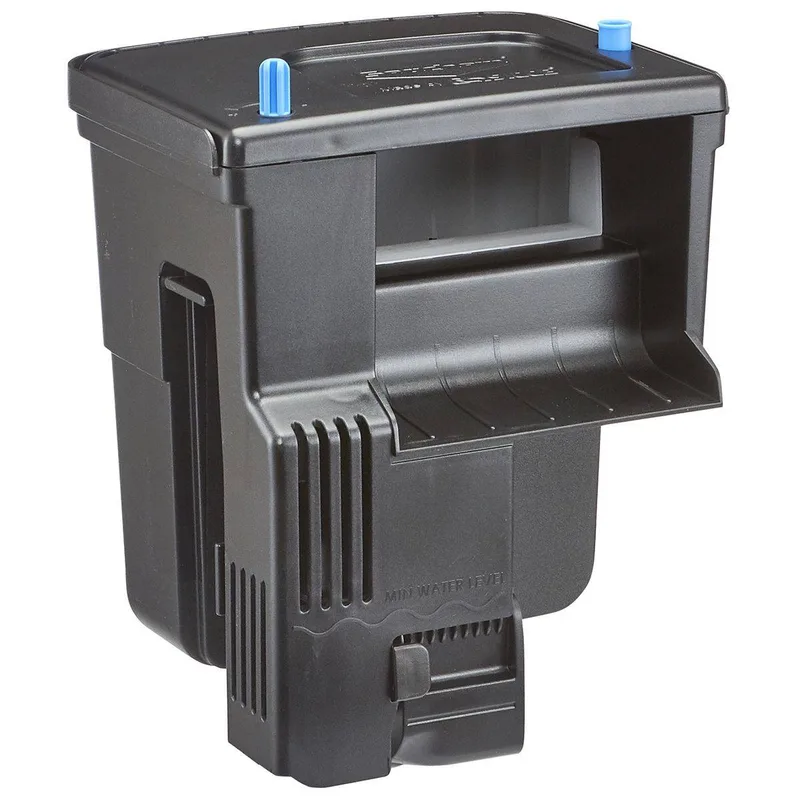
Seachem Tidal 35 Power Filter
Best Features- ✓ Self-priming startup — no manual siphoning needed after power outages
- ✓ Built-in surface skimmer removes protein film automatically
- ✓ Maintenance monitor tells you exactly when to clean
- ✓ Large media basket fits custom media in any configuration
- ✗ Higher price than comparably sized AquaClear
- ✗ Dual intake needs a prefilter sponge for shrimp tanks
The Seachem Tidal entered the HOB market positioned against the AquaClear, and it earned that comparison on a few specific points. The self-priming startup is the one hobbyists mention most — fill the tank, hang the filter, plug it in. The pump fills automatically. No manual siphoning, no pouring water into the filter box to prime the impeller, no waiting. After power outages, the Tidal restarts itself without intervention. That matters on a rack with a dozen tanks.
The surface skimmer is a feature no other filter on this list offers. The dual intake pulls water from both mid-column and the surface, which removes the protein film that builds on still water. That film reduces gas exchange and is visually unappealing. The Tidal eliminates it passively without a separate surface skimmer accessory.
The maintenance monitor is a float indicator inside the filter body. As media clogs and flow slows, the float drops to signal cleaning time. Simple and it works — no guessing whether your filter is still running at full efficiency.
The media basket is large and open. You can run Seachem Matrix, Purigen, activated carbon, or any combination. The basket holds significantly more volume than the AquaClear 20’s chamber, which means more biological surface area for the same tank size. On a densely stocked 25- or 30-gallon community tank, that additional capacity matters for ammonia processing.
The price premium over the AquaClear is real, but the self-priming, surface skimming, and maintenance monitor justify it for tanks where you want a more hands-off maintenance experience.
Shrimp safe: Add a prefilter sponge on both intakes. The adjustable flow dial lets you reduce output significantly for shrimp colonies.
Best for: Planted tanks, community tanks up to 35 gallons, and anyone who wants more automation in their filtration maintenance routine.
3. Tetra Whisper IQ 20 Power Filter
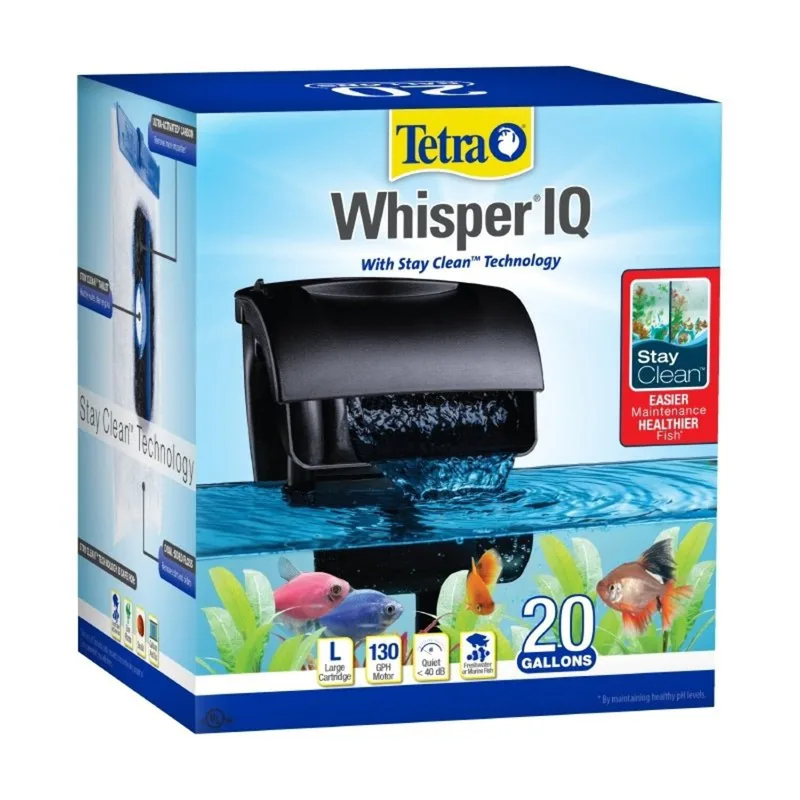
Tetra Whisper IQ 20 Power Filter
Best Budget- ✓ Submerged motor self-primes — no manual priming after power outages
- ✓ Sound shield keeps noise under 40 dB — quiet enough for a bedroom
- ✓ Cartridge slides out cleanly without disturbing the tank
- ✓ Sub-$25 price makes it easy to stock multiples for a rack
- ✗ Proprietary Bio-Bag cartridges limit media customization
- ✗ No adjustable flow — pair with an inline valve if current is too strong
The Whisper IQ 20 is the filter to buy when you need reliable, quiet HOB filtration and you are not willing to spend $35+ per unit. At sub-$25, it is cheap enough to stock multiples — run one on every 10–20 gallon tank on a rack and you are still spending less than a single canister filter.
The submerged motor means the impeller sits fully underwater. This eliminates noise from a motor running outside the water column, and it means the filter self-primes automatically when you plug it in, the same as the Seachem Tidal. The sound shield technology further dampens motor noise. The Whisper IQ 20 runs quietly enough for a bedroom setup without acoustic isolation.
The Stay Clean cartridge system is designed for easy replacement without reaching into the tank. The cartridge slots in from the top and pulls straight out. The downside is that these are proprietary Bio-Bag cartridges — you cannot substitute bulk bio media without DIY modifications. For a breeding rack running 10+ tanks where simplicity matters more than media customization, that tradeoff is acceptable.
For a shrimp tank or a high-value planted display tank where media customization matters, the AquaClear 20 or Seachem Tidal 35 are better choices. For utility breeding tanks and entry-level setups, the Whisper IQ 20 delivers solid performance at the lowest cost of any filter on this list.
Shrimp safe: Slip a prefilter sponge over the intake tube. The Bio-Bag cartridge contains no copper or medications.
Best for: Budget breeding racks, beginner setups, anyone who wants quiet and low-maintenance without paying a premium.
4. Fluval C2 Power Filter
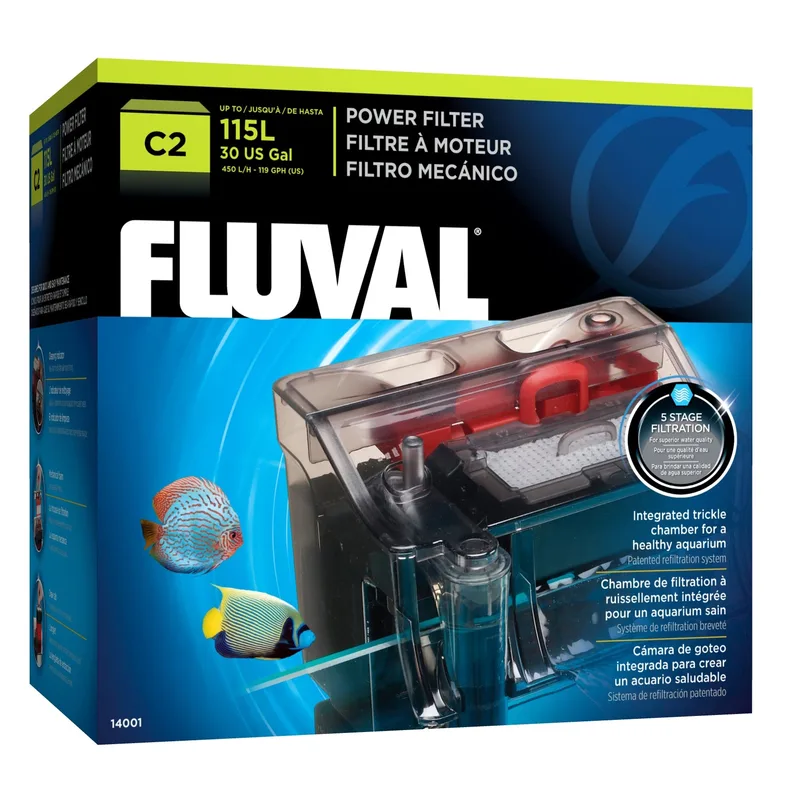
Fluval C2 Power Filter
Best Multi-Stage- ✓ 5-stage filtration is the most thorough in any hang-on-back at this price
- ✓ Pause button stops flow during feeding without full power-down
- ✓ Refillable media chambers accept bulk or specialty media
- ✓ Rinsing indicator makes maintenance timing obvious
- ✗ More chambers mean more to clean at maintenance time
- ✗ 119 GPH is lower than competitors at similar price
The Fluval C2 is the overachiever of this roundup. Its five-stage filtration sequence — poly/foam mechanical, C-nodes biological, activated carbon chemical, Zeo-Carb ammonia control, and bio-screen wet/dry — is the most thorough filtration progression available in a hang-on-back unit at this price point.
Each stage serves a distinct purpose. The mechanical poly foam traps particulate before it clogs biological media. The C-nodes are Fluval’s proprietary biological media with high surface area. The carbon and Zeo-Carb handle chemical filtration and ammonia spikes — useful during new tank cycling or when stocking goes up temporarily. The bio-screen at the top provides a wet/dry oxygenation pass that adds biological capacity without reducing flow rate through the main chamber.
The pause button is a practical feature HOB filters almost never include. Press it during feeding and the impeller stops — no current blowing food away from fish, no uneaten flakes getting sucked into the intake. The filter resumes automatically. For surface-feeding fish or tanks with slow eaters, this is a real quality-of-life improvement.
The refillable media chambers mean you are not locked into proprietary cartridges. Load bulk carbon, Matrix, or Purigen in the chemical stage. Fill the bio-screen with ceramic rings or lava rock. Initial media cost is higher, but you rinse and reuse rather than replace every few weeks.
The 119 GPH flow rate is adequate for 20-30 gallon tanks but slightly lower than comparable filters at this price point. For tanks with heavy feeding schedules or dense stocking, combine it with a sponge filter for additional biological capacity.
Shrimp safe: Yes, with intake prefilter sponge. Remove the Zeo-Carb and carbon stages for shrimp-only builds with stable remineralized water.
Best for: Hobbyists who want maximum filtration stages in a HOB format and are willing to invest slightly more upfront to avoid ongoing cartridge costs.
5. Marineland Penguin 150 Power Filter
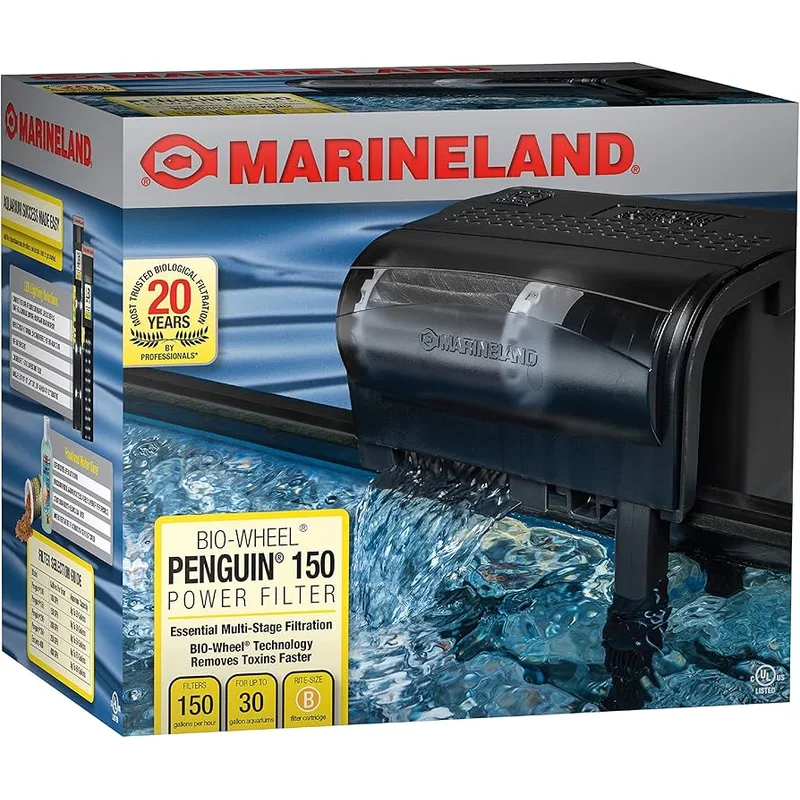
Marineland Penguin 150 Power Filter
Best Bio-Wheel- ✓ Bio-Wheel wet/dry cycling accelerates ammonia processing
- ✓ 150 GPH handles heavier bioloads in 20–30 gallon tanks
- ✓ Affordable price for the flow rate and biological performance
- ✓ Ultra-quiet motor with noise-dampening design
- ✗ Rite-Size cartridges are proprietary — ongoing replacement cost adds up
- ✗ Bio-Wheel can stop spinning if the cartridge clogs and restricts flow
The Marineland Penguin is the Bio-Wheel filter, and the Bio-Wheel is worth understanding before dismissing it as a gimmick. Standard submerged bio media colonizes nitrifying bacteria but does not oxygenate them optimally. The Bio-Wheel spins at the water surface — half-submerged, half-exposed to air. This wet/dry cycling provides bacteria with both moisture and direct atmospheric oxygen, which accelerates nitrification rates compared to purely submerged media.
In practice, a tank with a Bio-Wheel filter cycles faster and handles ammonia spikes better than a tank running comparable flow through a sponge-only system. For a 20–30 gallon community tank stocked with livebearers or cichlids producing significant waste, the Bio-Wheel’s accelerated nitrification is a genuine advantage.
At $24.99, the Penguin 150 is one of the most affordable filters on this list for a 20–30 gallon tank. The 150 GPH flow rate is appropriate for the size range, and the motor is quiet enough for residential use.
The downside is the Rite-Size cartridge system. Marineland’s proprietary cartridges run $6–8 for two and need replacing every 3–4 weeks. Over a year, that is $40–60 per filter in replacement costs. For multiple-tank setups, that adds up faster than open-media alternatives. The Bio-Wheel itself is reusable indefinitely — never replace it, just rinse gently in old tank water if it stops spinning.
The other vulnerability: if the Bio-Wheel slows or stops (usually from a clogged cartridge backing up flow), it can produce a faint ticking noise. This resolves immediately when you replace the cartridge and restore flow. It is not a malfunction — it is the Bio-Wheel signaling that cartridge maintenance is overdue.
Shrimp safe: Cover the intake with a prefilter sponge before adding invertebrates. Never dose copper-based treatments in a tank with shrimp — always remove them first, regardless of which filter you are running.
Best for: Community tanks in the 20–30 gallon range with moderate-to-heavy bioloads where biological performance matters more than media customization.
FAQ
Do I need a prefilter sponge on a HOB filter for a shrimp tank?
Yes, without exception. HOB filter intakes create enough suction to pull in juvenile shrimp, shrimp larvae, and fish fry. A prefilter sponge sleeve slips over the intake tube and blocks animals from reaching the impeller while adding biological surface area. They cost $2–5 on Amazon and are non-negotiable for any shrimp colony or breeding tank.
Can I run a HOB filter on a heavily planted CO2 tank?
Yes, and a HOB often works well here because the surface agitation improves gas exchange. CO2 injection users sometimes dial back HOB flow to reduce CO2 off-gassing — both the AquaClear 20 and Seachem Tidal 35 let you reduce flow significantly. The Tidal 35’s surface skimmer is also useful for clearing surface film that blocks light penetration in high-light planted tanks.
How often should I clean a HOB filter?
Mechanical media (foam sponge or poly pad) typically needs rinsing every 2–4 weeks depending on bioload. Always rinse in old tank water — chlorine in tap water kills beneficial bacteria. Bio media (BioMax, ceramic rings, Matrix) only needs rinsing every 3–6 months. Activated carbon needs full replacement every 3–4 weeks, which is why many hobbyists remove it entirely and replace it with additional bio media.
What flow rate do I need for a 10-gallon tank?
A minimum of 40 GPH, ideally 60–80 GPH for 6–8x turnover per hour. Every filter on this list provides more than enough flow for a 10-gallon tank. Use the flow adjustment dials on the AquaClear 20 or Seachem Tidal 35 to reduce current if it is too strong for your fish or shrimp species.
Is a HOB filter better than a sponge filter for breeding tanks?
Depends on the goal. Sponge filters are safer for fry without modification (no intake suction risk) and provide gentler flow. HOB filters provide stronger mechanical filtration and keep water clearer — important in grow-out tanks where heavy feeding produces waste quickly. The optimal setup for a serious breeding rack is often a sponge filter for biological filtration combined with a small HOB for mechanical filtration and water polishing. Both handle the filtration; the HOB handles the particulate.
Can I run a HOB filter on a shallow tub or plastic tote?
Yes, but check the intake tube length first. Most HOB filters ship with tubes sized for aquariums 12–15 inches deep. A shallow grow-out tote may require trimming the intake tube or finding an extension. The Seachem Tidal 35 has an adjustable intake depth, making it more versatile for non-standard tank heights. This is useful for outdoor barrel pond setups where water depth varies seasonally.
Do any of these filters work with shrimp tanks running RO/remineralized water?
All five filters work fine with RO-based water. The concern is not the filter — it is the media. Remove activated carbon if you want maximum parameter stability, since carbon can theoretically affect remineralized mineral balance over time. Run the filter on inert bio media (BioMax, Matrix, lava rock) with a mechanical sponge. The AquaClear 20 and Fluval C2 are easiest to configure this way because of their open media chambers. Both Neocaridina (pH 6.5–8.0, GH 6–12, TDS 150–300) and Caridina (pH 5.4–6.2, GH 3–6, KH 0–1) shrimp benefit from stable parameters that inert-media HOBs support.
Conclusion
For most small freshwater tanks — shrimp colonies, livebearer breeding setups, community tanks in the 10–20 gallon range — the AquaClear 20 is the answer. The open media chamber, adjustable flow, and decades of proven reliability make it the default choice when you want a filter you can configure for any application and trust to keep running. At $32.99, it is not the cheapest option on this list, but it is the filter hobbyists routinely run for five or more years without replacing.
If your tank is in the 20–35 gallon range and you want more features — particularly self-priming startup, surface skimming, and a maintenance monitor — the Seachem Tidal 35 is worth the premium. It handles planted tanks, community tanks, and shrimp setups equally well, and the large open media basket provides the same customization flexibility as the AquaClear.
For breeding racks where cost per unit matters, the Tetra Whisper IQ 20 at $23.17 is hard to argue with. Buy one for every tank on the rack, add a prefilter sponge, and get back to breeding.
Whichever filter you choose, add a prefilter sponge to the intake before adding any shrimp or fry. It costs almost nothing, protects your animals, and adds biological surface area. There is no reason to skip it.