AquaRanked is reader-supported. When you buy through links on our site, we may earn an affiliate commission.
Every time you add tap water to your aquarium — whether for a water change, topping off evaporation, or filling a new tank — you need a dechlorinator. Tap water contains chlorine or chloramine (often both) that kills beneficial bacteria and damages fish gills. Without a dechlorinator, a simple water change can crash your nitrogen cycle and harm your livestock.
For shrimp tanks, dechlorination is even more critical. Shrimp are extremely sensitive to chlorine and chloramine, and even brief exposure can cause deaths in a colony. Every product on this list is shrimp-safe when used at the recommended dose.
Here are the five best dechlorinators worth buying in 2026, plus the gear that rounds out a solid water-change routine.
| Seachem Prime Editor's Choice | Fritz Complete Water Conditioner Best Alternative | API Tap Water Conditioner Best Value | Seachem Safe Best Powder | Aquarium Co-Op Dechlorinator Best Simple Option | |
|---|---|---|---|---|---|
| Rating | 9.5/10 | 9.1/10 | 8.7/10 | 8.5/10 | 8.3/10 |
| Price | $16.62as of Sep 27, 2026 | $18.99-$19.99as of Sep 27, 2026 | $8.06-$8.48as of Sep 27, 2026 | $14.69as of Sep 27, 2026 | $6-$9 |
| Brand | Seachem | Fritz Aquatics | API | Seachem | Aquarium Co-Op |
| Size | 500ml | 16 oz | 16 oz | 250g (powder) | 4 oz |
| Treats | Chlorine, chloramine, ammonia, nitrite, heavy metals | Chlorine, chloramine, ammonia, nitrite, nitrate, heavy metals | Chlorine, chloramine, heavy metals | Chlorine, chloramine, ammonia, nitrite, heavy metals | Chlorine, chloramine |
| Concentration | 5ml per 50 gallons | 5ml per 50 gallons | 1ml per 20 gallons | Tiny pinch per 50 gallons | 1 pump per 10 gallons |
| Shrimp Safe | Yes | Yes | Yes | Yes | Yes |
| Check Price → | Check Price → | Check Price → | Check Price → | Check Price → |
Prices change daily — tap Check Price for the current Amazon price. Numbers shown were verified on the "as of" date.
Quick Picks
- Best Overall: Seachem Prime — the most trusted conditioner in the hobby, detoxifies ammonia too
- Best Alternative: Fritz Complete — full-spectrum with nitrate detox and less smell
- Best Value: API Tap Water Conditioner — cheapest per gallon, pure dechlorination
- Best Powder: Seachem Safe — insanely concentrated, perfect for fish rooms
- Best Simple Option: Aquarium Co-Op Dechlorinator — one pump per 10 gallons, done
Detailed Reviews
1. Seachem Prime
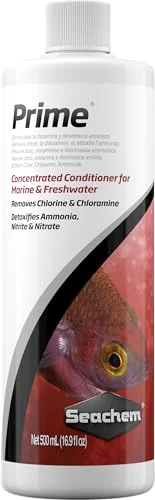
Seachem Prime
Editor's Choice- ✓ The industry standard — more aquarists use Prime than any other conditioner
- ✓ Detoxifies ammonia and nitrite for 24–48 hours in emergencies
- ✓ Extremely concentrated — a 500ml bottle lasts months
- ✓ Safe for all freshwater species including sensitive shrimp
- ✗ Strong sulfur smell that some people find unpleasant
- ✗ Easy to overdose due to the high concentration — measure carefully
Seachem Prime is the dechlorinator that everything else is measured against. It removes chlorine and chloramine instantly, detoxifies heavy metals, and temporarily binds ammonia and nitrite for 24–48 hours. That last feature is what sets it apart — if you have an ammonia spike, a dose of Prime buys you time while the beneficial bacteria catch up.
At 5ml per 50 gallons, a 500ml bottle treats 5,000 gallons of water. For a typical hobbyist doing weekly 25% water changes on a 20-gallon tank, one bottle lasts well over a year. The concentration is excellent value despite the higher upfront cost compared to budget dechlorinators.
The sulfur smell is real. Prime smells like rotten eggs when you open the cap, and sensitive noses may find it unpleasant during water changes. The smell dissipates quickly once mixed into tank water, but it is the number one complaint about the product.
Dosing accuracy matters with Prime because it is so concentrated. The included cap has measurement lines, but they are hard to read. I recommend using a small syringe or pipette for precise dosing, especially on nano tanks where a double dose could temporarily affect water chemistry.
For shrimp tanks, Prime is the safest choice because the ammonia-binding feature protects sensitive shrimp during water changes when small ammonia fluctuations are most likely.
Best for: Anyone who wants the most reliable, versatile water conditioner available.
2. Fritz Complete Water Conditioner
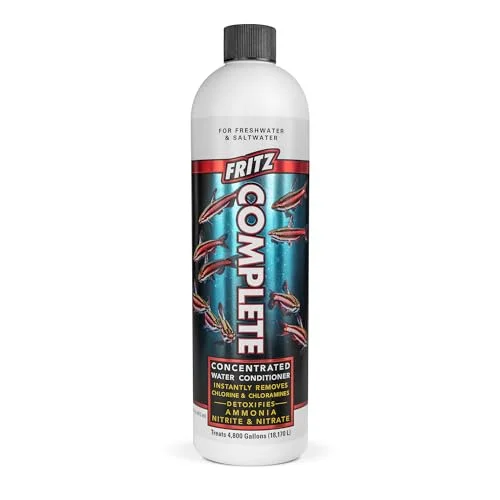
Fritz Complete Water Conditioner
Best Alternative- ✓ Full-spectrum conditioner that also detoxifies nitrate
- ✓ Same concentration as Seachem Prime at a competitive price
- ✓ Made in the USA by a well-known aquatics company
- ✓ Less sulfur smell than Prime
- ✗ Less widely available in local fish stores than Seachem
- ✗ Some users report inconsistent dosing caps between bottles
Fritz Complete is the closest competitor to Seachem Prime and arguably matches it in capability. It removes chlorine and chloramine, detoxifies ammonia, nitrite, and heavy metals — and it adds nitrate detoxification that Prime does not explicitly claim.
The concentration is identical to Prime: 5ml per 50 gallons. The price is usually comparable or slightly lower. Fritz Aquatics has built a strong reputation in the hobby, particularly among fish store owners and professional breeders who use Fritz products across their operations.
The smell is less offensive than Prime. Fritz Complete still has a chemical odor, but it is milder and does not hit you in the face the way Prime does. If sulfur smell is a dealbreaker, Fritz Complete is the upgrade.
One minor complaint: the dosing cap varies between bottles. Some Fritz Complete bottles have well-marked measurement lines on the cap, while others have faint or poorly printed markings. Using a syringe solves this, but it is an inconsistency that Seachem handles better.
For shrimp keepers, Fritz Complete is equally safe as Prime. The full-spectrum detoxification provides the same protection during water changes.
Best for: Hobbyists who want Prime-level performance with a less offensive smell.
3. API Tap Water Conditioner
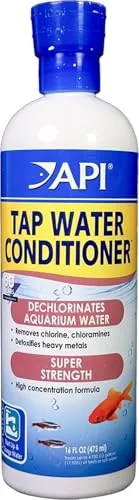
API Tap Water Conditioner
Best Value- ✓ Extremely affordable — the cheapest per-gallon dechlorinator on this list
- ✓ Super concentrated — one ounce treats 600 gallons
- ✓ Simple formula that does one job well
- ✓ Widely available at every pet store and online
- ✗ Does not detoxify ammonia or nitrite like Prime and Fritz Complete
- ✗ Requires a separate product for ammonia emergencies
If you just want to remove chlorine and chloramine without the bells and whistles, API Tap Water Conditioner is the most cost-effective option. One ounce treats 600 gallons, making it one of the most concentrated dechlorinators per dollar.
The formula is simple: it neutralizes chlorine and chloramine and detoxifies heavy metals. It does not bind ammonia or nitrite like Prime and Fritz Complete. For most hobbyists with a properly cycled tank, that is fine — you only need ammonia detoxification during emergencies, not routine water changes.
The price is where API wins. A 16-ounce bottle costs $5-$10 and treats thousands of gallons. If you are on a tight budget or running a fish room where you burn through conditioner fast, API is the financially smart choice.
For shrimp tanks, API Tap Water Conditioner is safe when used at the recommended dose. The lack of ammonia-binding capability is not a concern if your tank is properly cycled and you follow normal water change procedures.
Best for: Budget-conscious hobbyists with cycled tanks who need reliable, no-frills dechlorination.
4. Seachem Safe
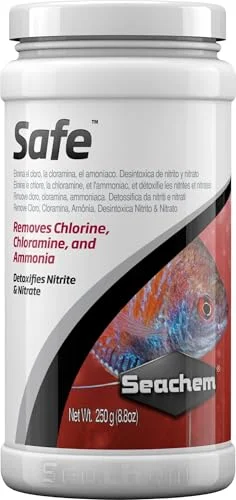
Seachem Safe
Best Powder- ✓ Powder form is the most concentrated water conditioner available
- ✓ Same chemistry as Seachem Prime in a fraction of the volume
- ✓ A 250g container treats roughly 60,000 gallons at Seachem's standard dosing rate
- ✓ Ideal for fish rooms and breeders doing massive water changes
- ✗ Extremely difficult to dose accurately for small tanks
- ✗ Needs a precision scale for consistent dosing
- ✗ No liquid dropper — measuring tiny amounts of powder is fiddly
Seachem Safe is Prime in powder form — literally the same active chemistry, dehydrated into a powder that is astronomically concentrated. A 250g container treats roughly 60,000 gallons at Seachem’s standard chlorine/chloramine dosing rate. If you run a fish room with 20+ tanks and do massive water changes weekly, Safe is the economical choice.
The problem is dosing. A tiny pinch treats 50 gallons, and getting that pinch consistent without a precision scale is nearly impossible. For a single tank, Safe is impractical — you are trying to measure milligrams of powder accurately, which is frustrating and error-prone.
For fish rooms and serious breeders, the solution is to pre-mix a stock solution. Dissolve a measured amount of Safe in a bottle of RO water, and then dose the liquid. This gives you the cost savings of Safe with the dosing convenience of a liquid product.
Safe is shrimp-safe at the correct dose, but the difficulty of accurate dosing makes it a riskier choice for nano shrimp tanks where precision matters.
Best for: Fish rooms and breeding operations that need industrial-scale dechlorination at the lowest possible cost.
5. Aquarium Co-Op Dechlorinator
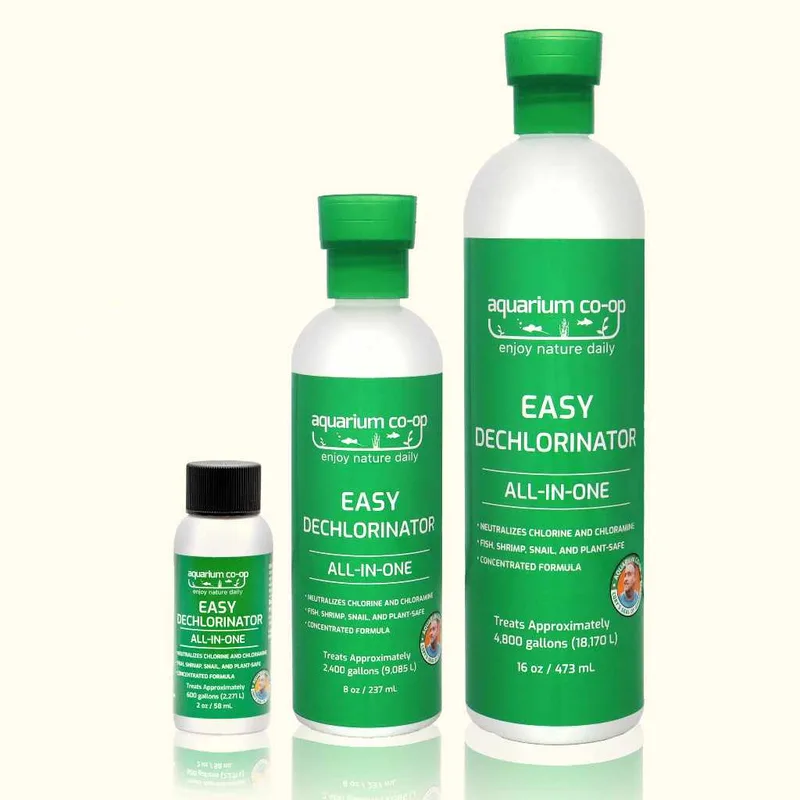
Aquarium Co-Op Dechlorinator
Best Simple Option- ✓ Dead-simple pump dosing — one pump per 10 gallons
- ✓ No unnecessary additives — just dechlorination
- ✓ Affordable price point for casual hobbyists
- ✓ Trusted hobbyist brand
- ✗ Only available direct from Aquarium Co-Op
- ✗ Does not detoxify ammonia or nitrite
- ✗ Small bottle runs out faster than concentrated products
The Aquarium Co-Op Dechlorinator takes the opposite approach from the concentrated products. Instead of measuring drops or milliliters, you get a pump bottle: one pump per 10 gallons. No math, no measuring, no fuss.
The formula is straightforward — sodium thiosulfate in a simple delivery system. It removes chlorine and chloramine. It does not detoxify ammonia or nitrite. For most hobbyists with cycled tanks, that is all you need.
The pump bottle design is the real selling point. During a water change, you pump the bottle a few times into the bucket, fill the bucket, and pour it in. There is something appealing about the simplicity when every other product on this list requires a cap, a syringe, or a scale.
The downside is value: the 4-ounce bottle treats fewer gallons per dollar than Prime, Fritz Complete, or API. You are paying a convenience premium. For someone with one or two tanks who does not want to think about dosing, that premium is worth it. For a fish room, the cost adds up.
Available only from Aquarium Co-Op’s website, not Amazon. Factor in shipping unless you are combining it with another order.
Best for: Casual hobbyists who want foolproof dosing without measuring.
Complementary Gear for Water Change Day
A dechlorinator handles the chlorine and chloramine, but a full water-change routine benefits from a few other tools — especially on a breeding rack where you’re doing this weekly across multiple tanks.
Seachem Stability
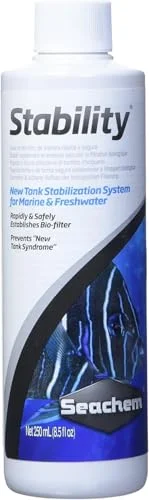
Seachem Stability
Best Cycle Support- ✓ Speeds up cycling on new tanks and after big water changes
- ✓ Pairs naturally with a dechlorinator during setup or a cycle reset
- ✓ No copper or harsh chemicals — safe alongside shrimp colonies
- ✗ Does not replace patience — a cycle still takes time to mature
- ✗ Needs consistent dosing for the first week to work as intended
If you’ve just set up a new tank or done a large emergency water change that disrupted the biofilter, Stability helps re-establish the beneficial bacteria colony faster than waiting it out alone. Dose it alongside your dechlorinator during setup week.
API Stress Coat
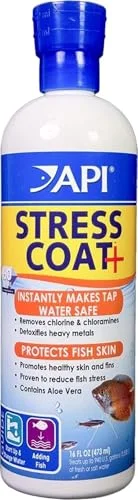
API Stress Coat
Best Slime Coat Protector- ✓ Aloe vera formula rebuilds the fish's protective slime coat after netting or shipping stress
- ✓ Doubles as a basic dechlorinator, not just an additive
- ✓ Useful for new fish acclimation and after fin-nipping incidents
- ✗ Not as concentrated as Prime or Fritz Complete for pure dechlorination
- ✗ Does not detoxify ammonia or nitrite
Stress Coat’s aloe vera formula rebuilds a fish’s slime coat after netting, shipping, or a fin-nipping incident — useful on top of your primary dechlorinator whenever you’re adding new stock or dealing with an aggressive tank mate.
Python No Spill Clean and Fill (50 ft)
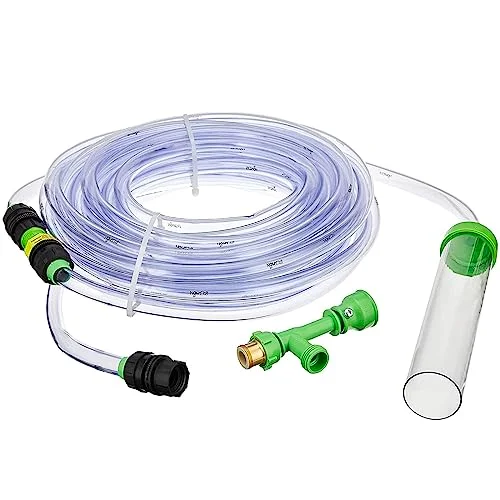
Python No Spill Clean and Fill (50 ft)
Best Water Change System- ✓ Drains and refills straight from the sink — no hauling buckets on breeding racks
- ✓ Vacuums gravel while draining, cutting water-change time significantly
- ✓ Pays for itself fast if you run more than a couple of tanks
- ✗ Upfront cost is steep for a single small tank
- ✗ Still need to dose dechlorinator as the tank refills
Once you’re running more than a couple of tanks, hauling buckets stops making sense. The Python hooks straight to a sink faucet, vacuums gravel while draining, and refills without a bucket in sight. You still dose your dechlorinator as the tank fills — this just removes the bucket-hauling part of the job.
Buying Guide
Chlorine vs. Chloramine
Most US water utilities now use chloramine instead of (or in addition to) chlorine. Chloramine is a more stable disinfectant that does not off-gas as easily as chlorine. This matters because:
- Chlorine can be removed by letting water sit for 24 hours (it evaporates). Chloramine cannot.
- All dechlorinators on this list handle both chlorine and chloramine. You do not need to know which one your utility uses.
- If you use RO water, you do not need a dechlorinator — the RO membrane removes chlorine and chloramine.
Why Ammonia Detoxification Matters
Seachem Prime and Fritz Complete temporarily bind ammonia and nitrite, making them non-toxic to fish for 24–48 hours. This feature is useful in two scenarios:
- During water changes: Tap water may contain small amounts of ammonia (from chloramine breakdown). Prime/Fritz neutralize it instantly.
- Ammonia emergencies: If your cycle crashes or you overstock, a double dose of Prime buys you 24–48 hours to fix the problem.
For routine use in a cycled tank, this feature is nice but not critical. The standard dechlorinators (API, Aquarium Co-Op) work fine.
Shrimp-Safe Dosing
All five products on this list are shrimp-safe at the recommended dose. The key word is “recommended dose.” Overdosing any water conditioner can temporarily reduce dissolved oxygen, which stresses shrimp. Stick to the label and do not assume more is better.
For sensitive Caridina shrimp, add the dechlorinator to the water change bucket before adding it to the tank. This ensures the conditioner is fully mixed and active before it contacts your shrimp.
Frequently Asked Questions
Can I overdose Seachem Prime?
Seachem states that Prime can be dosed up to 5x the recommended amount in emergencies. However, high doses temporarily reduce dissolved oxygen, which can stress fish and shrimp. Do not exceed 2x the normal dose unless you have an active ammonia emergency, and add an air stone for extra oxygenation if you do.
How quickly do dechlorinators work?
Instantly. Chlorine and chloramine are neutralized within seconds of the conditioner being added to the water. You do not need to wait before adding the treated water to your tank.
Do I need a dechlorinator if I use well water?
Usually not, but test your well water for chlorine just to be safe. Some wells near municipal water sources can pick up trace amounts. Well water may have other issues (high iron, pH extremes, hardness) that a dechlorinator does not address.
Can I use dechlorinator directly in the tank?
Yes. Most hobbyists add the conditioner directly to the tank during water changes. The conditioner neutralizes chlorine and chloramine as the new water mixes in. For sensitive shrimp tanks, pre-treating the water in a bucket is safer but not strictly necessary.
How long does a bottle of Seachem Prime last?
A 500ml bottle of Prime treats 5,000 gallons. For a single 20-gallon tank with weekly 25% water changes (5 gallons per week), one bottle lasts over 19 years. Even for a fish room with 200 gallons of water changes per week, it lasts about 6 months.
Is there a natural alternative to chemical dechlorinators?
Letting water sit in an open container for 24+ hours will off-gas chlorine (not chloramine). Activated carbon also removes chlorine. However, neither method removes chloramine, and most US water supplies now use chloramine. Chemical dechlorinators are more reliable and faster.
Conclusion
Seachem Prime remains the gold standard for water conditioning in 2026. Its ammonia-binding capability, extreme concentration, and decades of proven use make it the default recommendation. If the sulfur smell bothers you, Fritz Complete is the best alternative with identical performance.
For budget-conscious hobbyists with properly cycled tanks, API Tap Water Conditioner does the job for a fraction of the cost. And if you run a fish room, Seachem Safe in powder form is the most economical option by a wide margin — just invest in a precision scale.