AquaRanked is reader-supported. When you buy through links on our site, we may earn an affiliate commission.
The debate between liquid test kits and strips comes down to one question: what are you actually testing for? Strips are convenient and fast, but every popular multi-parameter strip kit on the market skips ammonia. That’s a serious gap — ammonia is the parameter that kills fish during cycling and the one you need most when adding new animals or dealing with a tank crash.
Liquid kits require more steps and 5 minutes of your time, but they give you accurate ammonia readings. For anyone running a breeding rack or keeping shrimp, that accuracy isn’t optional. I run both in my fish room: liquid kits for nitrogen cycle parameters and GH/KH, strips for quick sanity checks between full tests on established tanks.
This roundup covers the best options in both categories, including the specialized kits shrimp keepers need but most general-audience articles ignore.
| API Freshwater Master Test Kit Best Overall | Tetra EasyStrips 6-in-1 Aquarium Test Strips Best Strips | Seachem MultiTest Ammonia Best Ammonia Test | API GH & KH Test Kit Best for Shrimp | Salifert Ammonia Test Kit Most Sensitive | API 5-in-1 Test Strips Best Budget | |
|---|---|---|---|---|---|---|
| Rating | 9.2/10 | 7.5/10 | 8.8/10 | 8.5/10 | 8.3/10 | 7/10 |
| Price | $34.18-$35.98as of Sep 27, 2026 | $31.32-$32.97as of Sep 27, 2026 | $21.03-$22.14as of Sep 27, 2026 | Unavailable | $16.99as of Sep 27, 2026 | $11.98as of Sep 27, 2026 |
| Type | Liquid reagent | Test strips | Liquid reagent | Liquid titration | Liquid reagent | Test strips |
| Tests | pH, High Range pH, Ammonia, Nitrite, Nitrate | GH, KH, Chlorine, Nitrite, Nitrate, pH | Total ammonia and free ammonia (NH3) | General Hardness (GH), Carbonate Hardness (KH) | Total ammonia | Nitrite, Nitrate, Total Hardness (GH), KH, pH |
| Test Count | 800 total | 100 strips | 75 tests | ~300 tests per parameter | ~50 tests | 25 strips |
| Parameters | 5 | 6 | 1 (dual-reading) | 2 | 1 | 5 |
| Ammonia Test | Yes | No | — | No | — | No |
| Sensitivity | — | — | < 0.05 mg/L | — | — | — |
| Freshwater | — | — | — | — | Yes | — |
| Check Price → | Check Price → | Check Price → | Check Price → | Check Price → | Check Price → |
Prices change daily — tap Check Price for the current Amazon price. Numbers shown were verified on the "as of" date.
Quick Picks
Quick Picks
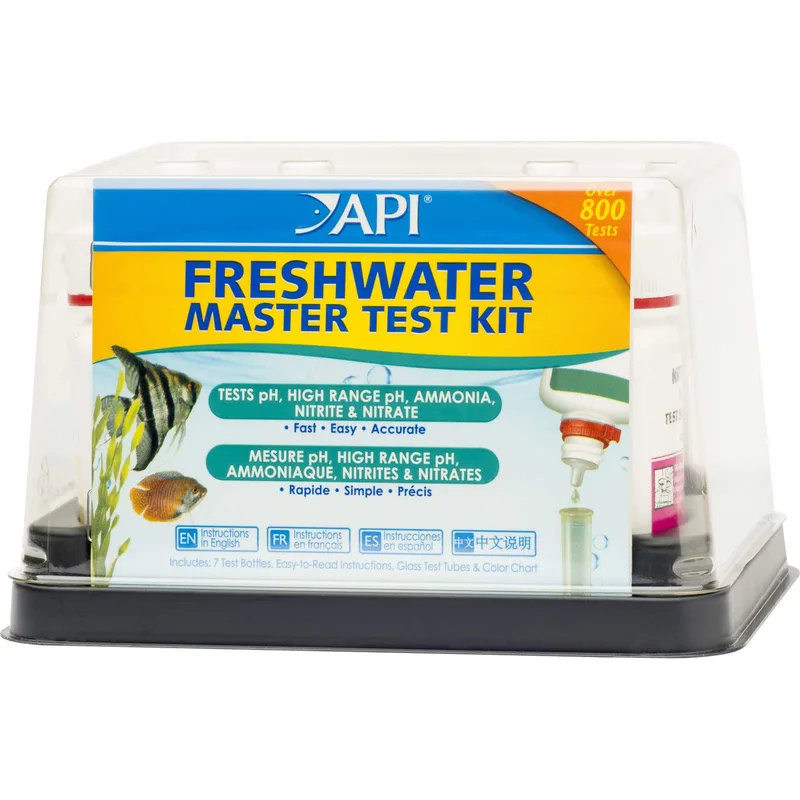
API Freshwater Master Test Kit is the standard for freshwater nitrogen cycle testing. It covers pH, ammonia, nitrite, and nitrate with 800 total tests and a 25-year track record. Nothing else at this price comes close for liquid accuracy.
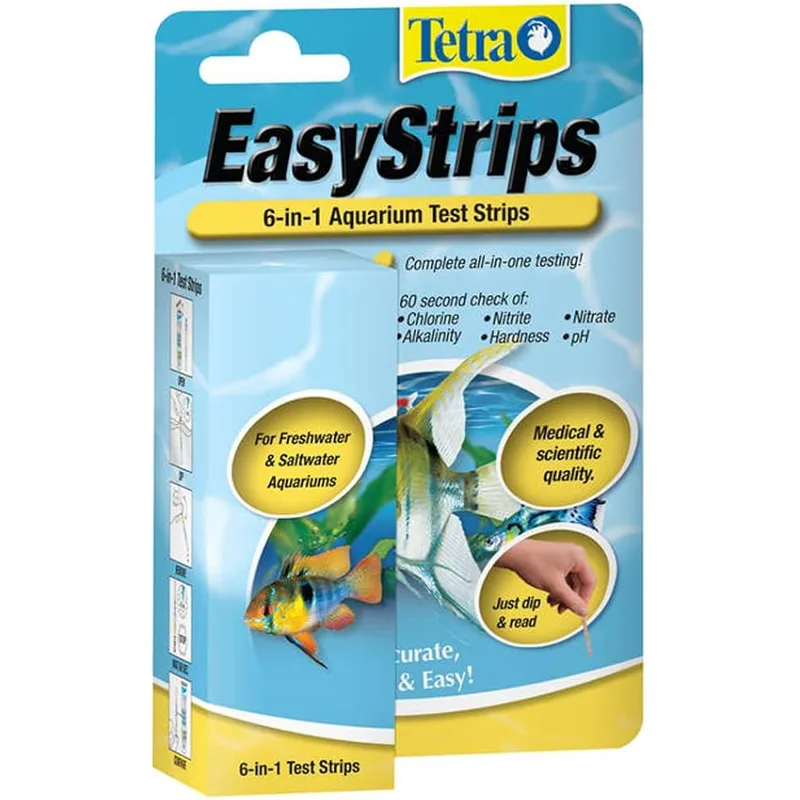
Tetra EasyStrips 6-in-1 is the strip to reach for on established tanks. The 100-count box makes per-test cost reasonable, and including GH and KH in the same strip makes it more useful than most competitors. Don’t mistake it for an ammonia test — it doesn’t have one.
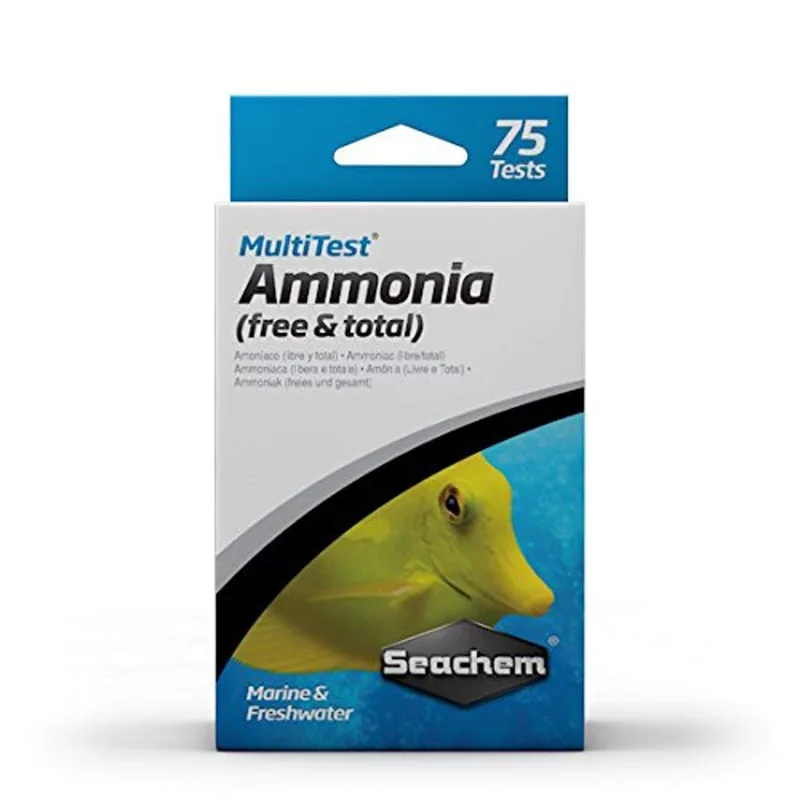
Seachem MultiTest Ammonia is the kit for situations where standard ammonia readings are ambiguous. Its ability to read free NH3 separately from total ammonia matters when you’re using Prime or AmGuard — no other kit at this price makes that distinction.
API GH & KH Test Kit is mandatory for shrimp keepers. Neocaridina need GH 6-8 and KH 2-4. Caridina need GH 3-6 and KH 0-1. You cannot hit those targets without measuring them, and this kit costs under $12.
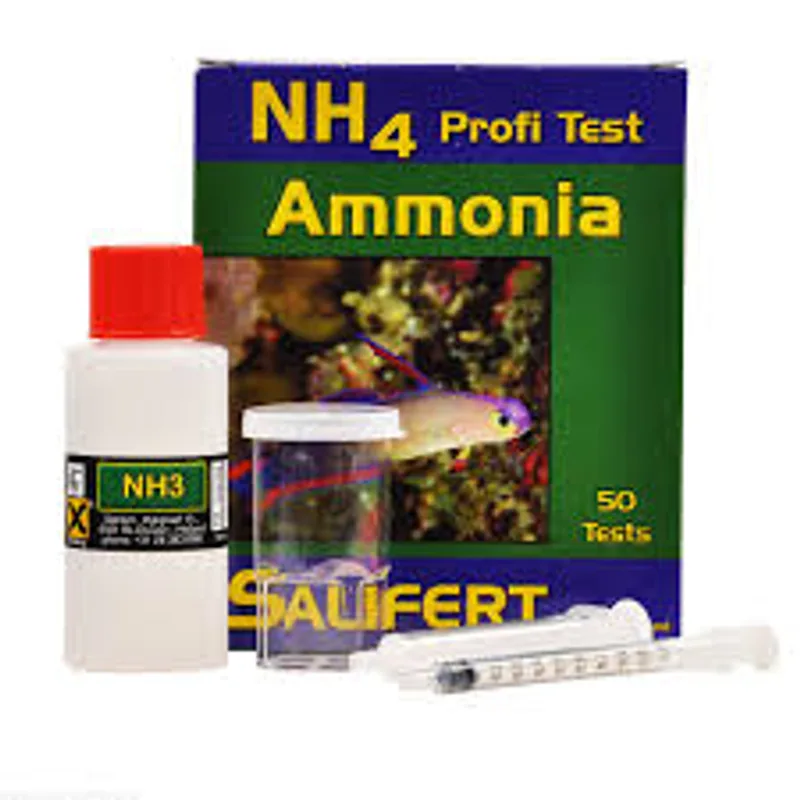
Salifert Ammonia Test Kit suits hobbyists who want cleaner color differentiation at low ammonia concentrations — particularly useful in shrimp rooms where every reading matters.
API 5-in-1 Test Strips are a fine starter option for travel or pond spot-checks, but the 25-strip count and absence of ammonia limit their value as a primary kit.
Buying Guide: What Actually Matters
Liquid vs. Strips: The Real Difference
Strip kits dip into water, reagents diffuse into pads, and you match a color gradient to a chart. Results take 60 seconds with no prep required. The chemistry is convenient but imprecise at borderline values, and ammonia — the most dangerous parameter in a cycling or stressed tank — is absent from every mainstream multi-parameter strip kit on the market.
Liquid kits add reagent drops to a water sample in a test tube. The chemistry is controlled, results are accurate enough to make treatment decisions from, and ammonia testing is possible. Trade-off: most liquid tests take 3-5 minutes per parameter.
For a new tank, active breeding rack, or any tank with livestock concerns, liquid kits are not optional. Strips are supplemental.
The Four Parameters Every Freshwater Tank Needs
- Ammonia (NH3/NH4+) — The primary product of fish waste and uneaten food. Toxic at 0.25 ppm. Requires a liquid kit.
- Nitrite (NO2) — The intermediate in the nitrogen cycle. Acutely toxic. Both liquid and strips cover this, but liquid is more precise.
- Nitrate (NO3) — The end product. Less acutely toxic but accumulates over time. Strips give a rough reading; liquid is more accurate.
- pH — Affects ammonia toxicity and overall fish stress. Strips are adequate for pH tracking once you know your baseline.
GH and KH: The Shrimp-Critical Parameters
General Hardness (GH) measures calcium and magnesium — the minerals shrimp use for shell production. Carbonate Hardness (KH) measures alkalinity — the buffer that stabilizes pH.
Neocaridina shrimp (Cherry, Blue Velvet, etc.) need GH 6-8 and KH 2-4. Caridina shrimp (Crystal Red, Taiwan Bee) need GH 3-6 and KH 0-1, almost always achieved with active substrate and RO water remineralized with a dedicated GH-only mineral like SaltyShrimp Bee Shrimp Mineral GH+.
Neither the API Master Kit nor any popular strip kit tests both GH and KH. The API GH & KH Test Kit fills that gap for about $10.
Test Count and Per-Test Value
When managing 20+ breeding tanks, cost per test matters:
- API Freshwater Master Kit — 800 tests / ~$28 = $0.03/test
- API GH & KH Kit — ~300 tests / ~$10 = $0.03/test
- Tetra EasyStrips 6-in-1 — 100 strips / ~$13 = $0.13/strip
- Seachem MultiTest Ammonia — 75 tests / ~$15 = $0.20/test
- Salifert Ammonia — 50 tests / ~$18 = $0.36/test
- API 5-in-1 Strips — 25 strips / ~$10 = $0.40/strip
The two API liquid kits dominate on value. The Salifert is premium-priced for premium color differentiation.
Shrimp-Safe Note
Test kits are used externally on water samples — nothing enters your tank. No test kit poses a direct risk to shrimp. However, products used in response to test results can be lethal to invertebrates. Copper-based medications, most algaecides, and some fertilizers are toxic to shrimp even at low doses. If tests reveal a problem, confirm any treatment is explicitly labeled invertebrate-safe before dosing a shrimp tank. Seachem Prime and Fritz Complete are both safe for shrimp at standard doses.
Detailed Reviews
API Freshwater Master Test Kit
API Freshwater Master Test Kit
Best Overall- ✓ Tests all four critical nitrogen cycle parameters plus pH
- ✓ 800 tests — under $0.04 per test at current pricing
- ✓ Industry standard accuracy across 25+ years
- ✓ Includes test tubes, laminated color charts, and instructions
- ✗ No GH or KH — shrimp keepers need a separate kit
- ✗ Full test round takes 5-10 minutes
The API Freshwater Master Test Kit has been the default recommendation for freshwater nitrogen cycle testing for over two decades, and the reasoning is straightforward: it tests everything that matters during a cycle (pH, ammonia, nitrite, nitrate), the liquid reagent method produces accurate results, and 800 total tests at under $30 makes the per-test cost lower than anything that competes with it.
The nitrate test requires one extra step that trips up beginners — Bottle #2 contains reagent that settles to the bottom. Shake it vigorously for 30 seconds before adding it, then shake the test tube vigorously for another 60 seconds after both reagents are added. Skip either shake and you’ll get falsely low nitrate readings every time.
The High Range pH test is included for tanks running above pH 7.6, where the standard pH test tops out. Useful for hard water setups or tanks with calcareous substrate.
The only gap is hardness: no GH, no KH. For shrimp breeders or anyone adjusting hardness parameters, pair this with the API GH & KH Test Kit. Together they cover every critical freshwater parameter in liquid form for under $40 combined.
Tetra EasyStrips 6-in-1
Tetra EasyStrips 6-in-1 Aquarium Test Strips
Best Strips- ✓ 100 strips per box — excellent per-test cost for strips
- ✓ Includes GH and KH alongside nitrogen parameters
- ✓ Results in 60 seconds, no reagents to mix
- ✓ Chlorine pad useful for tap water pre-treatment checks
- ✗ Does NOT test ammonia — the most critical cycling parameter
- ✗ Color matching can be ambiguous at borderline readings
- ✗ Less accurate than liquid for nitrate above 20 ppm
The best multi-parameter strip kit for freshwater, primarily because of the 100-count box and the unusual inclusion of both GH and KH alongside the standard nitrogen and pH parameters. Most strip kits test only nitrite, nitrate, and pH. The Tetra 6-in-1 adds GH, KH, and chlorine — making each strip useful for a broader picture of tank conditions.
The chlorine pad earns its keep for anyone doing tap water checks before water changes. If municipal chloramine levels change seasonally (common in warm-climate regions during summer), a quick strip test of tap water confirms your dechlorinator is dosed correctly.
The core limitation is universal to strips: no ammonia. If you’re cycling a tank or troubleshooting a crash, this strip won’t tell you the most important number. Keep the API Master Kit for those situations and use the Tetra strips for weekly nitrate checks on established tanks.
Color matching requires decent lighting. Under warm incandescent light, the nitrate pad in the 20-40 ppm range is genuinely difficult to distinguish. Use natural light or a white LED for best results. Strips degrade quickly if humidity gets into the container — keep the cap sealed between uses.
Seachem MultiTest Ammonia
Seachem MultiTest Ammonia
Best Ammonia Test- ✓ Reads free NH3 separately from total — critical with Prime or AmGuard dosed
- ✓ Multi-cavity plate runs 6 samples simultaneously
- ✓ Includes reference sample for result validation
- ✓ Accurate below 0.05 mg/L — finer than API's practical detection range
- ✗ Ammonia-only kit — must pair with other tests for full picture
- ✗ More steps than standard single-reagent kits
Standard ammonia tests measure total ammonia — the sum of ionic ammonium (NH4+, relatively harmless) and free ammonia (NH3, toxic). Seachem’s MultiTest Ammonia reads both separately, which matters in two specific situations.
The first is when using Prime, AmGuard, or any ammonia-detoxifying conditioner. These products bind ammonia into a temporarily non-toxic form, but standard ammonia tests still read bound ammonia as active. The MultiTest distinguishes the two — you can confirm whether your conditioner is protecting your fish or whether you have a genuine ammonia problem requiring other action.
The second situation is low-pH shrimp tanks. At pH below 7.0, a higher proportion of total ammonia shifts into the NH3 form. Caridina tanks running pH 5.8-6.2 with any ammonia present have a higher fraction in the toxic free form than the same total would represent at neutral pH. The MultiTest quantifies that fraction directly.
The six-cavity test plate lets you run multiple samples simultaneously — useful on a rack system where you’re pulling tests from six tanks in one session. The included reference sample lets you confirm the kit is reading accurately.
For routine cycling of a standard community tank, the API Master Kit is more efficient and cheaper per test. The MultiTest fills a specific role that the API kit cannot cover.
API GH & KH Test Kit

API GH & KH Test Kit
Best for Shrimp- ✓ GH and KH data is mandatory for shrimp and breeding tanks
- ✓ Drop-count titration is precise — one drop equals one degree
- ✓ Excellent value — lasts years in most home setups
- ✓ Works for both Neocaridina and Caridina parameter targets
- ✗ Tests GH and KH only — pair with the Master Kit for nitrogen cycle
- ✗ Titration method requires careful drop counting
No other single test kit purchase delivers more value for shrimp keepers. The API GH & KH kit uses drop-count titration: add reagent drops to a water sample one at a time, swirl between drops, and count until the color changes permanently. One drop equals one degree of hardness. The reading is the drop count.
For a Neocaridina colony, target GH 6-8 — you’re counting 6-8 drops. For Caridina on remineralized RO water, you’re targeting GH 3-6, which requires precision because too-high GH prevents proper molting and too-low GH means mineral deficiency. You cannot hit either target without measuring.
KH testing follows the same process. KH 0-1 for Caridina tanks is essentially undetectable on strips — the liquid titration can catch it reliably at that level. For Neocaridina, KH 2-4 confirms you have adequate buffering to prevent pH swings.
At roughly $10 and lasting years in a home setup, there’s no reason not to own this kit. The Master Kit handles nitrogen cycle parameters; this handles hardness. Together, they’re comprehensive freshwater coverage for under $40.
Salifert Ammonia Test Kit
Salifert Ammonia Test Kit
Most Sensitive- ✓ Clean, well-spaced color range — easier to read at low concentrations
- ✓ Trusted for consistent results by shrimp breeders
- ✓ Works in freshwater and saltwater
- ✓ Compact form factor
- ✗ Only ~50 tests — higher cost per test than API
- ✗ Does not distinguish free NH3 from total ammonia
Salifert built its reputation in reef aquariums, where precision at low concentrations is non-negotiable, and that precision transfers to freshwater ammonia testing. The color range is cleaner and better-spaced than the API Master Kit at low ammonia concentrations — hobbyists who use both frequently report more confident readings in the 0.1-0.5 ppm range where treatment decisions are made.
The practical use case is as a secondary ammonia kit. The API Master Kit handles routine cycle monitoring at lower per-test cost. Salifert earns its shelf space when API results are ambiguous or when you want the highest available confidence in an ammonia reading before making a decision about a shrimp tank.
For a Caridina breeding setup or a coral-grown shrimp room where every animal has breeding value, Salifert’s accuracy premium is worth the higher per-test cost. For a general community tank or a livebearer rack, the API Master Kit’s efficiency wins.
API 5-in-1 Test Strips
API 5-in-1 Test Strips
Best Budget- ✓ Lowest entry cost for multi-parameter strip testing
- ✓ Covers nitrite and nitrate for post-cycle monitoring
- ✓ Quick dip-and-read in under 60 seconds
- ✗ Only 25 strips — burns through fast on a weekly testing schedule
- ✗ No ammonia pad — cannot confirm nitrogen cycle completion
- ✗ Poor value per strip compared to the 100-count Tetra EasyStrips
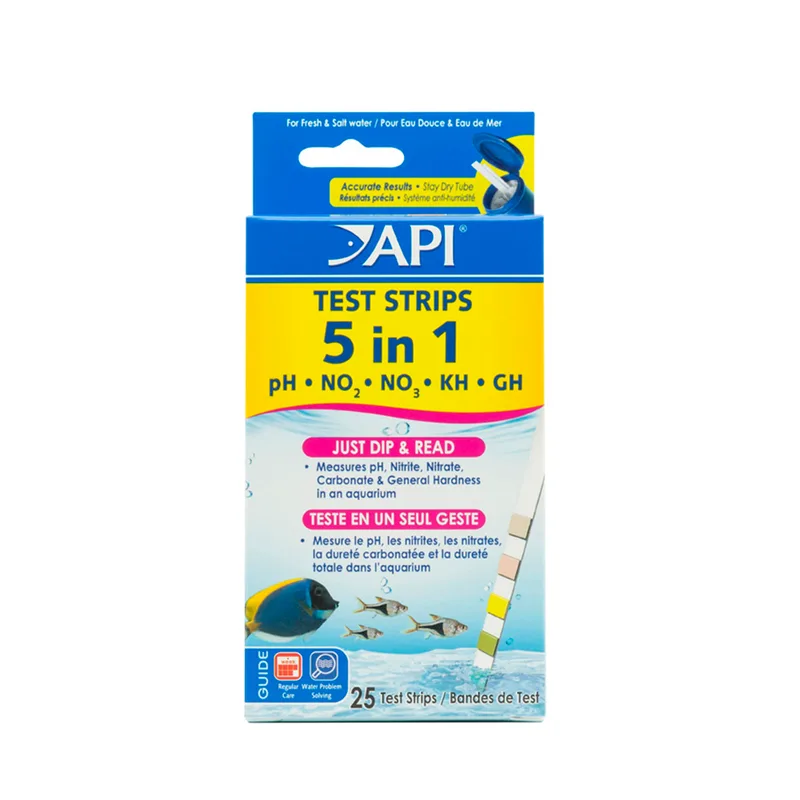
The API 5-in-1 covers nitrite, nitrate, total hardness, KH, and pH in a single dip. Like all mainstream strip kits, ammonia is not included. The 25-strip count is the main practical limitation — anyone testing weekly burns through a box in six months, and the per-strip cost at 25 strips is nearly double the per-strip cost of the 100-count Tetra EasyStrips box.
Where the 5-in-1 makes sense: travel kit for a second location, pond spot-checks, or a quarantine setup where you want quick confirmation that parameters are in range before transferring fish. The Tetra EasyStrips 6-in-1 is a better primary strip choice at similar pricing for the 100-count box.
If you already have the API Master Kit for liquid testing and want an inexpensive backup strip for a second location, the 5-in-1 fills that role. As a standalone testing solution, it leaves too many gaps.
Frequently Asked Questions
Do test strips test ammonia?
No mainstream multi-parameter strip kit tests ammonia. The Tetra EasyStrips 6-in-1, API 5-in-1, and similar products all skip it. Tetra sells standalone ammonia strips separately, but ammonia strips are notoriously unreliable — the reagent chemistry that makes liquid ammonia tests accurate doesn’t transfer well to strip format. Use a liquid kit for ammonia without exception.
How often should I test my aquarium water?
During cycling: test ammonia, nitrite, and nitrate every 2-3 days. Once cycled and established: weekly nitrate checks and monthly full parameter confirms are sufficient for stable tanks with regular water changes. Add more frequent testing after adding new livestock, after medication, or after any symptom of a tank crash.
Can I use strips for shrimp tanks?
Strips can provide a rough GH/KH estimate for Neocaridina tanks where you’re already in the right general range. For Caridina tanks — where GH 3-6 and KH 0-1 require precision — strips aren’t reliable enough. Use the API GH & KH liquid kit for any shrimp-critical hardness targeting. For ammonia, use liquid regardless of what livestock you’re keeping.
What’s the difference between total ammonia and free ammonia?
Total ammonia is the sum of NH4+ (ionized ammonium, relatively harmless) and NH3 (free ammonia, toxic). Most kits measure the total. Seachem MultiTest Ammonia measures each separately. At pH above 7.5, a higher proportion of total ammonia is in the toxic NH3 form, making the distinction more important in alkaline freshwater setups and any tank where detoxifying conditioners are in use.
Do liquid reagent kits expire?
Yes. API reagents last approximately 3-5 years unopened and 1-2 years after opening when stored properly — cool, dark location with caps sealed tight. If results seem inconsistent or colors look off compared to expectations, replace the reagents. Salifert includes expiration dates on the kit. Test strips degrade faster: humidity, heat, and air exposure all accelerate pad failure. Keep strips sealed with the original desiccant.
Why does my API nitrate test always read zero?
You’re not shaking enough. Bottle #2 of the API nitrate test contains reagent that settles to the bottom. Shake it vigorously for at least 30 seconds, then shake the test tube vigorously for another 60 seconds after adding both reagents. Insufficient shaking produces falsely low nitrate readings — a very common source of confusion for beginners.
Is the API Freshwater Master Kit enough for a shrimp tank?
No. The API Master Kit covers pH, ammonia, nitrite, and nitrate — the nitrogen cycle parameters. It does not test GH or KH. For shrimp tanks, add the API GH & KH Test Kit. Neocaridina need GH 6-8 and KH 2-4; Caridina need GH 3-6 and KH 0-1. You cannot safely keep shrimp without measuring those parameters.
Conclusion
Our Top Pick
For freshwater testing, the foundation is the API Freshwater Master Test Kit. It covers the nitrogen cycle parameters that matter most, costs about $0.03 per test, and has earned its reputation over 25 years. If you’re running a shrimp tank, add the API GH & KH Test Kit — at around $10, it’s the most critical second purchase a shrimp keeper can make.
For strip convenience on established tanks, the Tetra EasyStrips 6-in-1 outperform the competition. The 100-strip count makes per-test cost reasonable, and the addition of GH, KH, and chlorine parameters makes each strip more informative than most competitors. Use them for weekly nitrate checks on stable tanks, not as a substitute for liquid testing during cycling or troubleshooting.
For maximum confidence in ammonia readings — particularly when using ammonia-binding conditioners or keeping sensitive Caridina — the Seachem MultiTest Ammonia fills a gap no other kit at this price point covers.
My fish room runs all three liquid kits: the API Master Kit for cycle monitoring, the GH & KH kit for shrimp water, and Seachem MultiTest for ammonia verification when something looks off. The Tetra EasyStrips sit on the shelf for fast weekly checks. Total investment is under $60 and covers everything a freshwater breeding or shrimp operation needs.