Livebearers — guppies, platies, mollies, endlers, and swordtails — are among the hardiest aquarium fish, but they are not immune to disease. Their prolific breeding and often overcrowded conditions in pet stores mean many arrive home already carrying pathogens. Once in your tank, stress from poor water quality, temperature swings, or aggressive tank mates weakens their immune system and allows disease to take hold.
The good news is that most livebearer diseases are treatable when caught early. The bad news is that by the time symptoms are obvious, the disease has often been progressing for days. Learning to spot early warning signs gives your fish the best chance of recovery.
Early Warning Signs
Before specific diseases appear, stressed livebearers show general symptoms that indicate something is wrong:
- Clamped fins: Fins held tight against the body instead of extended
- Lethargy: Fish sitting on the bottom or hiding instead of active swimming
- Loss of appetite: Refusing food for more than 1-2 days
- Rapid breathing: Gill movement noticeably faster than normal
- Color fading: Dulling of body color, especially in males
- Flashing: Rubbing against surfaces (indicates skin/gill irritation)
- Isolation: A social fish separating itself from the group
Any of these symptoms should trigger immediate water testing. Ammonia and nitrite exposure cause many of the same symptoms as disease, and the treatment is a water change — not medication. Always rule out water quality before medicating.
Ich (White Spot Disease)
Symptoms
Small white dots (like grains of salt) on fins, body, and gills. Fish may flash against surfaces and breathe rapidly. In advanced cases, dozens of spots cover the entire body.
Cause
The protozoan parasite Ichthyophthirius multifiliis. Almost always introduced by new fish or plants that carry the parasite in its free-swimming stage. Temperature drops commonly trigger outbreaks because they stress fish while the parasite thrives in cooler water.
Treatment
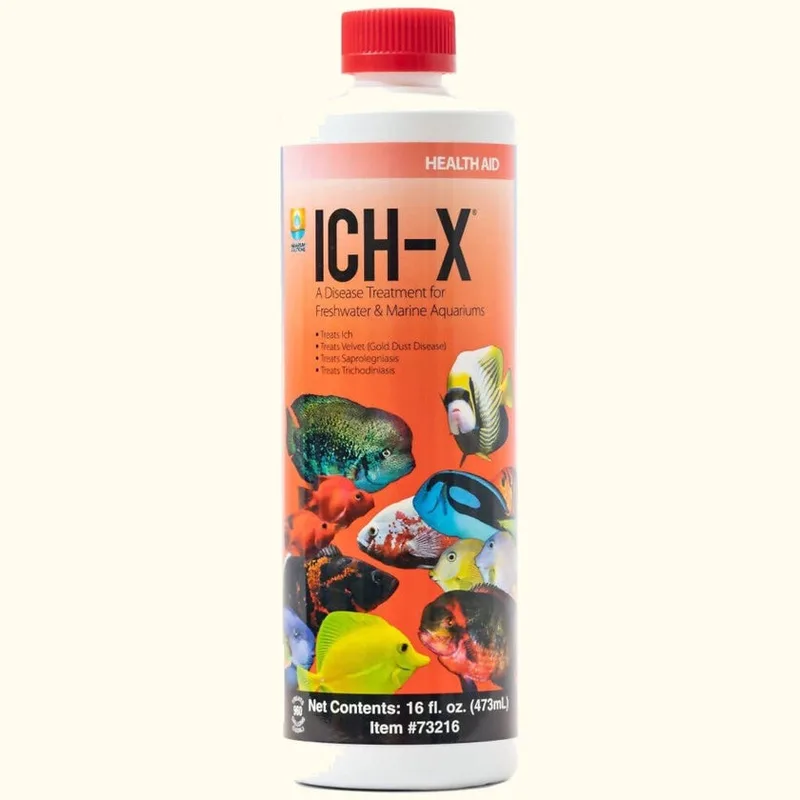
Hikari Ich-X
Best for Ich/Parasites- ✓ Fast-acting against ich and external parasites
- ✓ Does not stain silicone like older malachite green formulas
- ✓ Can be used at half-dose with shrimp present
- ✓ Clear dosing instructions
- ✗ Remove carbon filtration during treatment
- ✗ Can stress scaleless fish at full dose
- ✗ Multiple treatments usually needed (every 24-48 hours)
Raise temperature to 82-84degF to speed up the parasite’s life cycle (it can only be killed during the free-swimming stage, not while attached to the fish). Dose Ich-X or similar malachite green/formaldehyde medication every 24-48 hours until spots disappear, then continue treatment for 3 additional days.
Important for shrimp tanks: Ich-X can be used at half dose in shrimp tanks. Malachite green is the active ingredient that poses risk to invertebrates, so the reduced dose provides treatment while minimizing shrimp stress. Remove any carbon filtration during treatment.
Prevention
Quarantine all new fish for 2-3 weeks before adding to your display tank. Maintain stable temperatures and avoid sudden drops.
Columnaris (Cotton Mouth / Saddleback)
Symptoms
White or grayish-white patches that look like cotton or fungus, typically appearing around the mouth, on the body (often as a saddle-shaped patch behind the dorsal fin), or on fins. Lesions can progress rapidly over 24-48 hours. Fins may erode. In severe cases, the mouth becomes entirely covered and the fish cannot eat.
Cause
The gram-positive bacterium Flavobacterium columnare. Common in tanks with fluctuating temperatures, overcrowding, or poor water quality. Highly contagious — once one fish shows symptoms, others in the tank are likely already exposed.
Treatment
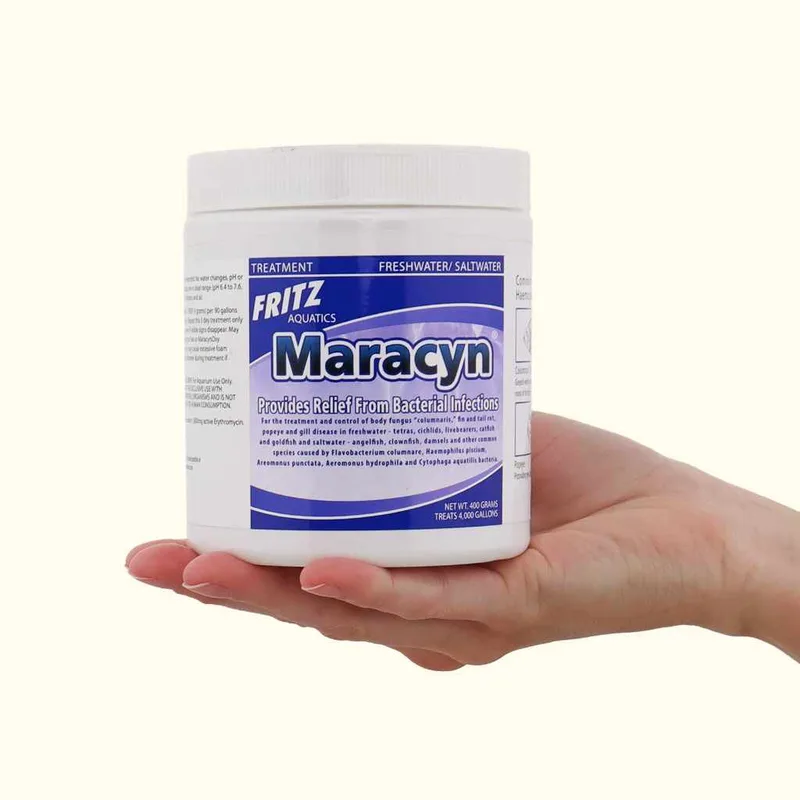
Fritz Maracyn (Erythromycin)
Best for Bacterial- ✓ Effective against columnaris and fin rot
- ✓ Pre-measured packets are easy to dose
- ✓ Does not discolor water
- ✗ Only effective against gram-positive bacteria
- ✗ Can disrupt biological filtration
- ✗ Not safe for invertebrates in high doses
Lower the temperature to 75degF (columnaris thrives in warmer water — the opposite of ich). Treat with erythromycin (Fritz Maracyn) or a combination of nitrofurazone and kanamycin for resistant strains. Daily 30% water changes during treatment help reduce bacterial load in the water.
Columnaris moves fast. If you notice lesions, begin treatment immediately — waiting even 24 hours can mean the difference between recovery and losing the fish.
Prevention
Maintain stable temperatures, avoid overcrowding, and quarantine new arrivals. Columnaris bacteria exist in most tanks at low levels — disease only develops when fish are stressed.
Fin Rot
Symptoms
Fins appear ragged, frayed, or shorter than normal. Edges may look white or red (indicating infection). In guppies with elaborate fins, early fin rot can be mistaken for nipping — but fin rot produces uneven, jagged edges while nipping produces clean tears.
Cause
Bacterial infection, usually Aeromonas or Pseudomonas species. Almost always secondary to stress, poor water quality, or physical damage (fin nipping by aggressive tank mates). Clean water with zero ammonia and nitrite prevents most cases.
Treatment
Mild cases: Improve water quality with daily 20-30% water changes. Keep ammonia and nitrite at zero. This alone resolves early fin rot in most cases.
Moderate to severe cases: Add aquarium salt (1 tablespoon per 5 gallons) and continue water changes. If the condition worsens after 3-4 days, treat with Fritz Maracyn or Seachem ParaGuard.
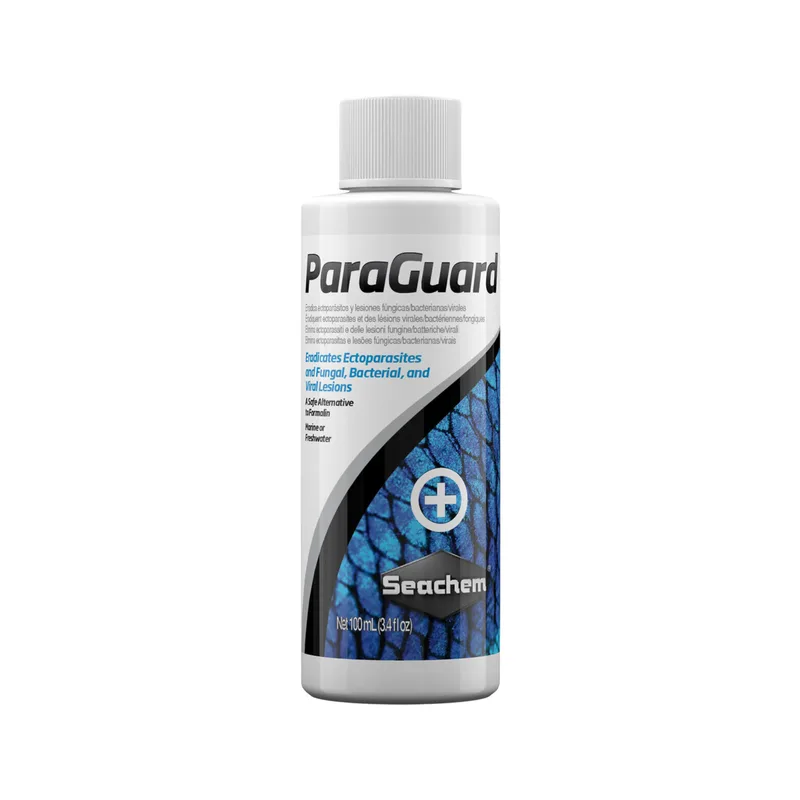
Seachem ParaGuard
Best Broad Spectrum- ✓ Broad-spectrum against multiple infection types
- ✓ Relatively mild on biological filtration
- ✓ Effective quarantine treatment
- ✗ Requires daily dosing for full treatment course
- ✗ Less potent than targeted medications
- ✗ Not effective against internal parasites
Prevention
Maintain pristine water quality. Remove aggressive tank mates that nip fins. Avoid overcrowding. Guppies with large, flowing fins are particularly susceptible because their fins present more surface area for bacterial colonization.
Velvet (Gold Dust Disease)
Symptoms
A fine, gold or rust-colored dusting on the body, often easier to see with a flashlight shined at an angle. Fish scratch against surfaces, breathe rapidly, and may have clamped fins. Velvet is often mistaken for ich, but the spots are much finer and give a “dusted” appearance rather than distinct white dots.
Cause
The dinoflagellate parasite Piscinoodinium (freshwater velvet). Introduced by new fish and triggered by stress. The parasite attacks gill tissue, which is why breathing difficulties are an early symptom even before visible dusting appears.
Treatment
Treat the same as ich — raise temperature to 82-84degF and dose Ich-X. Some hobbyists also darken the tank completely (the parasite has a photosynthetic stage), but medication alone is usually effective.
Copper-based medications are also effective against velvet but are lethal to shrimp and snails. Do not use copper in any tank containing invertebrates.
Prevention
Quarantine new arrivals. Maintain stable, clean conditions.
Camallanus Worms
Symptoms
Red, thread-like worms protruding from the anus of the fish. Fish may become thin despite eating, show bloating, or produce white, stringy feces. By the time worms are visible, internal infestation is advanced.
Cause
Internal parasitic nematodes. Extremely common in livebearers, especially fish from large-scale breeding operations and pet stores. Can spread through feces contaminating the substrate.
Treatment
Levamisole or fenbendazole are the treatments of choice. Dose the tank per instructions (typically a single dose repeated after 2-3 weeks to catch hatching larvae). Remove carbon filtration during treatment.
Treat the entire tank — if one fish shows worms, all fish in the tank are likely infested. Vacuum the substrate thoroughly after treatment to remove expelled worms and larvae.
Prevention
Quarantine and prophylactically treat new livebearers, especially pet store fish. Many experienced breeders treat all new arrivals with a round of levamisole regardless of whether symptoms are visible.
Dropsy (Pinecone Disease)
Symptoms
Body appears bloated and scales protrude outward, creating a pinecone-like appearance when viewed from above. Eyes may bulge (popeye). The fish often stops eating and becomes lethargic.
Cause
Dropsy is not a disease itself — it is a symptom of organ failure, usually kidney failure from bacterial infection. By the time scales are raised, internal damage is typically severe and often irreversible.
Treatment
Honestly? The prognosis is poor. Isolate the affected fish in a hospital tank. Treat with a broad-spectrum antibiotic (kanamycin or combination therapy) and add Epsom salt (1 tablespoon per 5 gallons) to reduce fluid retention. Some fish recover, but many do not.
Prevention
Maintain excellent water quality. Dropsy is almost always a consequence of chronic stress and poor conditions over time.
Shimmying (Livebearing Shimmy)
Symptoms
Fish rocks back and forth in place without making forward progress. Body may appear stiff. Most common in mollies but can affect all livebearers.
Cause
Osmotic stress from water that is too soft or has inadequate mineral content. Mollies and platies evolved in brackish or hard water environments and suffer when kept in very soft, acidic conditions. Low GH is usually the culprit.
Treatment
Raise GH to 10-15 dGH using a remineralizer or crushed coral. Add 1 tablespoon of aquarium salt per 5 gallons. Symptoms typically resolve within 24-48 hours once mineral content improves.
Note for shrimp keepers: If you keep livebearers with shrimp, the GH requirements may conflict. Neocaridina shrimp prefer 6-8 dGH while mollies prefer 10-15+. This incompatibility is one reason mollies and shrimp are not ideal tank mates.
Prevention
Research the hardness requirements of your specific livebearer species. Most livebearers prefer moderate to hard water (GH 8-15 dGH, KH 4-10 dKH). Do not keep them in soft, acidic setups intended for blackwater species.
When to Euthanize
Sometimes treatment fails and a fish is suffering. Signs that euthanasia may be the humane choice:
- Inability to swim or stay upright for more than 48 hours
- Refusal to eat for more than 7 days with visible wasting
- Advanced dropsy with no improvement after 5 days of treatment
- Severe columnaris that has eroded most of the mouth or body
The most humane method is clove oil overdose: dissolve 5-10 drops of pure clove oil in warm water, add to a small container with the fish, and the fish will gradually fall asleep permanently.
Frequently Asked Questions
Should I medicate the whole tank or just the sick fish?
For contagious diseases (ich, velvet, columnaris), treat the entire tank — other fish are already exposed. For injuries or isolated infections (a single fish with fin rot), you can treat in a hospital tank to avoid stressing healthy fish and disrupting biological filtration.
Can disease spread from guppies to shrimp?
Most fish diseases do not infect invertebrates. However, medications used to treat fish can harm or kill shrimp. If medicating a tank with shrimp, research the medication’s safety for invertebrates and use reduced doses where appropriate.
How do I prevent disease in new fish?
Quarantine everything for 2-3 weeks in a separate tank. Observe for symptoms. Many breeders prophylactically treat with a round of Seachem ParaGuard and levamisole during quarantine regardless of apparent health.
Why do my guppies keep dying even with good water parameters?
If water parameters are truly clean (0 ammonia, 0 nitrite, low nitrate), look for internal parasites (especially camallanus worms), genetic weakness from inbreeding (common in mass-bred pet store guppies), or disease introduced by new additions. Quarantine and prophylactic deworming of all new arrivals often resolves mysterious ongoing deaths.