AquaRanked is reader-supported. When you buy through links on our site, we may earn an affiliate commission.
Guppies (Poecilia reticulata) are the fish that got most of us into this hobby. They are colorful, cheap, easy to breed, and available at every fish store in the country. They are also the fish that teaches hard lessons when things go wrong — because guppies that look fine can crash fast if water quality slips or temperatures swing.
Running a guppy breeding operation changes how you think about these fish. You stop thinking about “a guppy” and start thinking about colony management, gender ratios, fry survival rates, and line quality. The basics still apply, but the margin for error shrinks when you have 200 fish across a dozen tanks depending on stable conditions.
This guide covers everything you need to keep guppies successfully — from first tank setup through breeding colonies and raising fry.
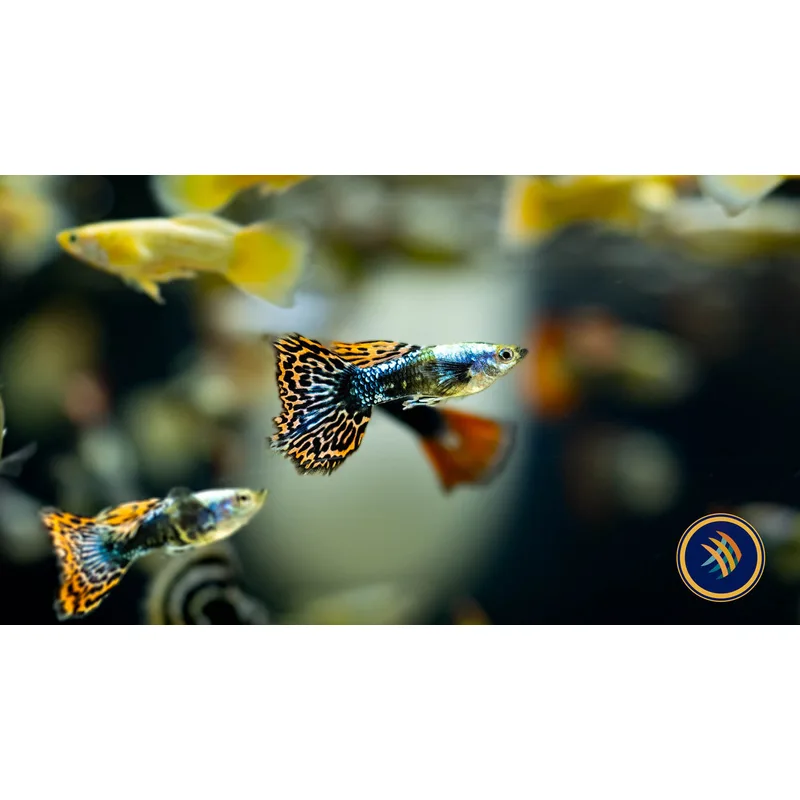
Tank Setup
Tank Size
A 10-gallon tank is the practical starting point for guppies. You can keep guppies in 5-gallon tanks, but smaller water volumes make stable conditions harder to maintain. A 10-gallon gives you enough water mass that a missed water change or a slightly warmer room does not immediately stress the fish.
For breeding colonies, a 20-gallon long is the gold standard. The larger footprint gives females room to evade male harassment, and the extra water volume means your parameters hold steadier between maintenance sessions. If you ever set up a breeding rack, 10- and 20-gallon tanks are the workhorses — they are inexpensive, stack efficiently on wire shelving, and sized right for single-strain colonies.
Do not go smaller than 5 gallons for an established colony. The combination of high bioload (guppies breed fast) and the ammonia sensitivity of newborn fry makes tiny tanks a maintenance nightmare.
Starter Kits
For beginners, an all-in-one starter kit removes the guesswork. The Aqueon 10-gallon kit includes a glass tank, LED hood, power filter, preset heater, and basic accessories. The one modification worth making immediately: fit the filter intake with a sponge prefilter before adding any fish. The bare plastic intake will pull in newborn fry and kill them.
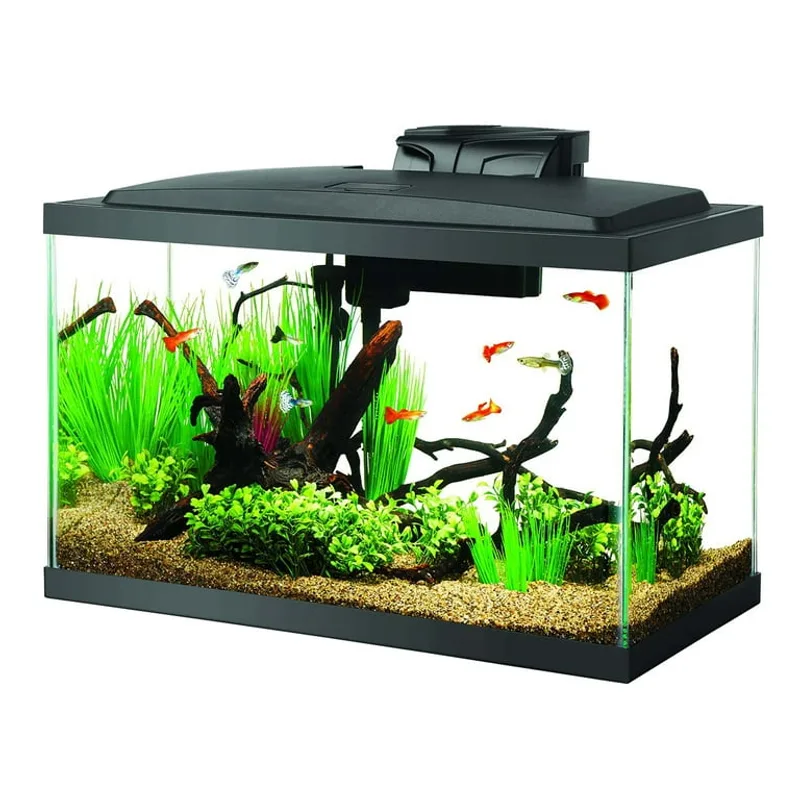
Aqueon 10 Gallon Aquarium Starter Kit
Best Starter Tank- ✓ Everything needed to start in one box — no separate purchases required
- ✓ USA-made glass aquarium is durable and optically clear
- ✓ LED hood provides solid illumination without high energy use
- ✓ 50W preset heater maintains guppy-safe temperature automatically
- ✗ Filter intake needs a sponge prefilter to protect newborn fry
- ✗ Preset heater is not adjustable — cannot dial in a specific temperature
Substrate
Guppies are not fussy about substrate. Fine-grain sand or smooth gravel both work. Dark substrate makes guppy colors appear more vivid — the fish visually contrast better against darker backgrounds.
Planted tanks benefit from root tab-supplemented gravel or a thin layer of nutrient-rich soil capped with sand. Java fern, vallisneria, and guppy grass (Najas guadalupensis) grow readily in guppy water chemistry and provide essential cover for fry.
For breeding tanks where you are cleaning regularly, bare-bottom or thin sand speeds up maintenance. Siphoning detritus from gravel in 10 tanks takes time you do not have.
Filtration
Sponge filters are the standard for any tank that will have fry. The sponge prevents newborns from reaching the intake, and the biofilm that colonizes the sponge surface gives fry a constant food source. Pair a medium sponge filter with an air pump rated for your tank size.
The Tetra Whisper (up to 40 gallon) air pump is slightly oversized for a 10-gallon setup, but that is by design — a strong pump with an inline valve gives you more control than a weak pump running at full output. Adjust the flow down until the sponge filter produces a steady, gentle bubbling rather than turbulent churn.
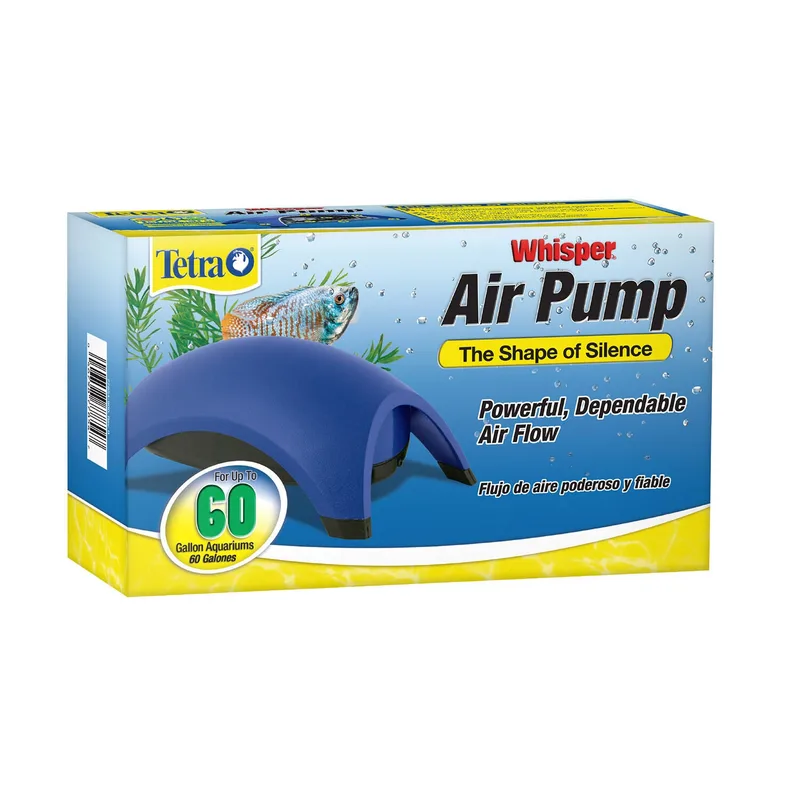
Tetra Whisper Air Pump (Up to 40 Gallon)
Best Air Pump- ✓ Dome shape and suspended motor reduce operating noise significantly
- ✓ Reliable performance for sponge filters and air stones
- ✓ Slightly oversized for a 10-gallon tank — adjust flow with an air valve
- ✓ Widely available and affordable to replace
- ✗ Not adjustable — fixed output requires an inline valve to reduce flow
- ✗ Rubber feet can slip on smooth surfaces over time
If you prefer a hang-on-back filter, cover the intake with a pre-filter sponge. This protects fry and extends impeller life by preventing debris from entering. Without a prefilter, you will find dead fry in the filter media within days of a drop.
Plants and Hardscape
Dense planting is the most practical way to improve fry survival without a dedicated fry tank. Java moss, guppy grass, and hornwort provide instinctive hiding spots that newborn guppies seek out. Floating plants like water sprite and frogbit add another layer at the surface, where fry spend their first days.
In a breeding setup where fry survival matters, aim to cover at least one-third of the tank footprint with moss or fine-leafed plants. A tank with good moss coverage will produce far higher natural fry survival than a bare tank.
Water Parameters
Guppies tolerate a fairly wide parameter range compared to more sensitive species, but stability matters more than hitting any specific number. A tank that holds steady at pH 7.4 consistently is better than one that swings between 7.0 and 7.8 throughout the week.
| Parameter | Target Range |
|---|---|
| Temperature | 72-82°F (22-28°C) |
| pH | 7.0-8.0 |
| GH | 8-12 dGH |
| KH | 4-8 dKH |
| Ammonia | 0 ppm |
| Nitrite | 0 ppm |
| Nitrate | <30 ppm |
Temperature
Guppies are tropical fish. Below 68°F, immune function drops, disease susceptibility rises, and breeding stops. Above 84°F, oxygen levels fall and lifespan shortens. The breeding sweet spot is 76-80°F — active reproduction without burning through the fish too fast.
A reliable adjustable heater is non-negotiable for indoor tanks, even in warm climates. Overnight temperature drops in an unheated room can swing water temperatures 5-8°F, which weakens immune function over time.
If you keep outdoor patio ponds in USDA Zones 7-9, guppies thrive from April through October when water temperatures consistently stay above 72°F. In warm southern climates, outdoor pond season typically runs mid-March through late October. Summer heat above 90°F is manageable with shade coverage and surface aeration — without both, oxygen levels drop and fish will gasp at the surface. Bring guppies indoors before nighttime temperatures drop below 65°F consistently.
pH and Hardness
Guppies prefer slightly alkaline water. A pH of 7.2-7.8 is the practical target. They tolerate up to 8.5, but above 8.0 you will notice reduced breeding frequency and occasional stress coloration in males.
GH (general hardness) matters more for livebearers than many hobbyists realize. Guppies need calcium and magnesium for proper development and sustained reproduction. A GH of 8-12 dGH supports healthy females that can produce multiple broods without depleting their mineral reserves.
If your tap water is very soft (GH below 6), add crushed coral to the filter or use a remineralizer to raise hardness. Guppies kept long-term in soft water often show reduced color quality and smaller broods across generations.
Feeding
Feeding Schedule
Feed adult guppies 2-3 times daily, offering only as much as they can consume in 2-3 minutes. Overfeeding is the most common water quality problem in guppy tanks — uneaten food breaks down quickly in warm water and causes ammonia spikes.
For fry under four weeks old, feed 4-5 times daily in small amounts. Fry grow fastest with frequent, small feedings. Once they reach 0.5 inches (roughly four weeks at 78°F), reduce feeding frequency and transition to the adult schedule.
What to Feed
A staple micro pellet covers nutritional needs for most meals. Supplement with variety 2-3 times per week:
- Micro pellets: Hikari Fancy Guppy, Xtreme Nano — correctly sized for guppy mouths
- Crushed flakes: Good for young fry; crush between fingers before feeding
- Baby brine shrimp: Best growth food for fry; adults eat them eagerly too
- Daphnia: Natural digestive aid, good for conditioning breeding females before drops
- Micro worms: Easy to culture at home; excellent first food for newborn fry
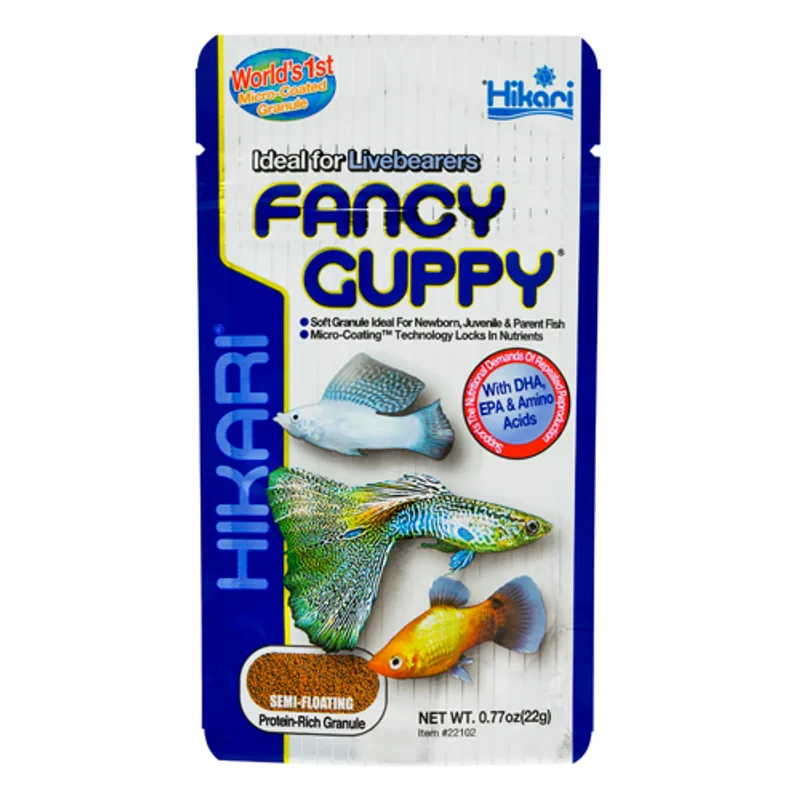
Hikari Fancy Guppy
Best Staple Food- ✓ Micro pellet size sized perfectly for guppy mouths — adults and juveniles alike
- ✓ 50% protein supports growth, breeding, and color development
- ✓ Spirulina content enhances reds and blues naturally over weeks of feeding
- ✓ Low-waste formula keeps water cleaner than flake foods
- ✗ Small container runs out fast with larger colonies
- ✗ Buy the multi-pack for better value if running multiple tanks
Avoid foods where wheat flour, soy, or corn is listed as the primary ingredient. These are filler ingredients that pass through fish without providing meaningful nutrition. Look for fish meal, krill, or whole shrimp as the first listed protein source.
Breeding
Gender Ratio
Maintain a ratio of at least 2 females per male, and 3:1 is better in community setups. Male guppies harass females constantly, and a single female with two or three males will be stressed, show reduced color, and may stop eating. With more females, the male’s attention is distributed and no single female bears the full burden.
In a breeding colony focused on production, a 4:1 or 5:1 female-to-male ratio gives females more recovery time between births and results in larger, healthier broods.
Sexing
Males and females are distinguishable by 4-6 weeks of age:
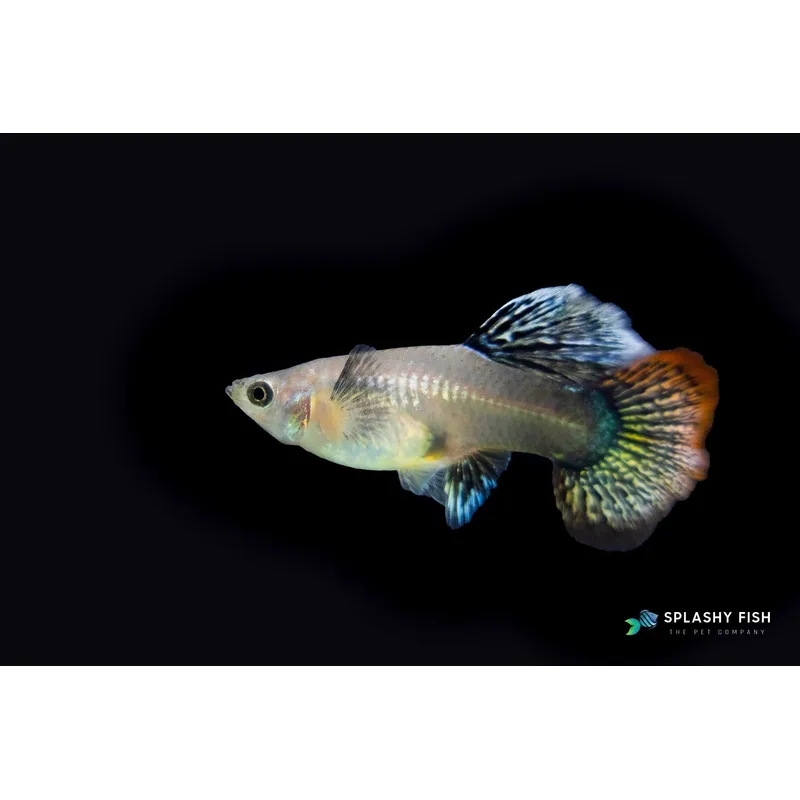
- Males: Smaller body, bright coloration, elongated tail fin, pointed anal fin (the gonopodium — modified for fertilization)
- Females: Larger body, rounder belly, plainer coloration, rounded anal fin, visible gravid spot (dark area near the anal fin that darkens as pregnancy progresses)
At birth, all fry look identical. Male color appears around 3-4 weeks, and the gonopodium is visible by week 5-6.
The Breeding Cycle
Guppies are livebearers. Females give birth to fully developed fry. The cycle:
- A male fertilizes a female through repeated attempts (females often evade)
- Gestation lasts 28-35 days at 76-80°F — warmer water accelerates development
- The gravid spot darkens and the female’s belly becomes noticeably squared-off near birth
- She delivers 10-50 fry per drop, depending on age and condition
- A single fertilization can produce multiple broods — females store sperm for months
Females can begin breeding at 3 months old. They reach peak reproductive output at 6-12 months and slow down after 18 months. Track this if you are managing quality lines — a female past her prime produces smaller, less vigorous fry.
Fry Survival
The critical decision is whether to separate fry from adults. In a heavily planted tank, roughly 20-30% of fry survive naturally. For serious breeding, intervention is required.
Option 1 — Breeding box: Move a visibly pregnant female into a hanging breeder box. After she drops, remove her and raise fry in the box for 2-3 weeks. Survival rates approach 95%, but females stressed by confinement sometimes abort or produce smaller broods. Use the breeder box sparingly.
Option 2 — Dedicated fry tank: The best method for active breeders. Set up a separate 5-10 gallon tank with a mature sponge filter and dense plant coverage. Move a gravid female in a few days before her estimated drop date, let her birth in the dedicated tank, then return her to the colony. Lower stress than a breeder box and consistently produces the best results.
Option 3 — Heavy plants only: For hobbyists who are not tracking numbers, a heavily planted community tank will produce enough surviving fry to maintain or grow the colony without active intervention.
In warm-climate breeding setups, outdoor tubs and patio ponds during summer months produce explosive breeding activity — natural light cycles, live food availability, and warm temperatures push females to drop large broods frequently.
Tank Mates
Guppies are peaceful community fish. Compatible options:
- Corydoras catfish: Bottom feeders that do not compete with guppies and stay out of trouble. Pygmy corys and emerald corys are excellent choices.
- Otocinclus: Algae eaters too small to threaten adult guppies. They completely ignore fry in planted tanks.
- Small tetras: Ember tetras, neon tetras, and cardinal tetras coexist in larger tanks with adequate space. All small tetras will eat newborn fry.
- Nerite snails and mystery snails: Clean up uneaten food and algae without interacting negatively with guppies.
- Cherry shrimp: Adult shrimp and adult guppies generally coexist. Guppies will eat shrimplets, so if breeding both species, keep them in separate tanks.
Avoid: bettas (will attack guppies with flowing fins), tiger barbs (notorious fin nippers), larger cichlids (will eat guppies), and goldfish (wrong temperature range and will eat smaller fish).
Common Health Issues
Wasting Disease (Fish TB)
The most serious disease in guppy colonies. Symptoms: progressive weight loss, curved spine, clamped fins, faded color, recessed belly. Caused by Mycobacterium species. No reliable treatment exists — infected fish should be humanely euthanized and the tank disinfected with a diluted bleach solution before reuse.
This disease spreads through feces, dead fish, and shared water. Never share nets or equipment between tanks without disinfecting with a diluted bleach or potassium permanganate solution.
Fin Rot
Bacterial infection causing frayed, ragged fins with white or black margins. Almost always caused by water quality problems — elevated ammonia or nitrate, low pH, or temperature swings. Fix water parameters first. In persistent cases, kanamycin or API Fin and Body Cure addresses bacterial fin rot. Avoid copper-containing medications if snails or shrimp share the system.
Ich (White Spot Disease)
White pinhead-sized spots across the body and fins, rubbing against decor, clamped fins. Ich is treatable: raise temperature to 86°F for 10-14 days combined with aquarium salt (1 tablespoon per 5 gallons), or use Ich-X. Remove shrimp and snails before using any medication.
Velvet (Oodinium)
Gold or rust-colored dust on the body, most visible with a flashlight held at a low angle. More aggressive than ich and spreads faster. Treat with copper-based medication (remove invertebrates first) or methylene blue. Raise temperature to 82-84°F to accelerate the parasite life cycle during treatment.
Frequently Asked Questions
How many guppies can I keep in a 10-gallon tank?
A reasonable starting population is 6-8 guppies (2 males, 4-6 females). A 10-gallon will not support more than 12-15 long-term without excellent filtration and frequent water changes. Remember that a single trio of guppies becomes 20-30 fish within two months — plan your colony management before you start, not after.
Do guppies need a heater?
Yes, for indoor tanks in most climates. Guppies need stable water temperatures between 72-82°F. Most homes run cooler than this, especially overnight or during winter. An adjustable 25-75 watt heater prevents the temperature drops that weaken immune function over time.
How often do guppies give birth?
Under good conditions, a female delivers every 28-35 days. Warmer temperatures (78-80°F) produce shorter gestation periods. A healthy female produces 10-50 fry per drop. Peak output comes from well-fed females in their prime breeding period (6-12 months old).
Can guppies live in an outdoor pond?
Yes, with conditions. Guppies need water above 65°F at minimum and breed most actively above 72°F. In USDA Zones 7-9, outdoor pond season runs approximately April through October. Summer heat above 90°F is manageable with shade and surface aeration. Bring guppies indoors before nighttime temperatures approach 60°F consistently.
Why are my guppies dying?
The most common causes: uncycled tank (ammonia poisoning), temperature shock from water changes, copper contamination from medications or fertilizers, overcrowding without adequate filtration, and wasting disease in established colonies. Check ammonia, nitrite, nitrate, and pH first — water quality problems account for the majority of unexplained guppy deaths.
How do I improve guppy color?
Color depends on genetics, diet, water quality, and background color. Feed foods containing spirulina, krill, and carotenoid-rich shrimp. Use dark substrate. Maintain clean water — stressed guppies show washed-out color regardless of diet. For breeding projects, selectively pair the most intensely colored males over multiple generations.
Can I keep only male guppies?
Yes. Male-only tanks are common for hobbyists who want the color display without managing fry. Males may display some chasing behavior toward each other, but without females present, it is typically less intense. A 10-gallon planted tank with 6-8 males makes an excellent display setup.
Conclusion
Guppies are as rewarding as they are forgiving. Get the fundamentals right — cycled tank, stable temperature (74-80°F), appropriate gender ratio, fry-safe filtration — and they breed reliably without much intervention.
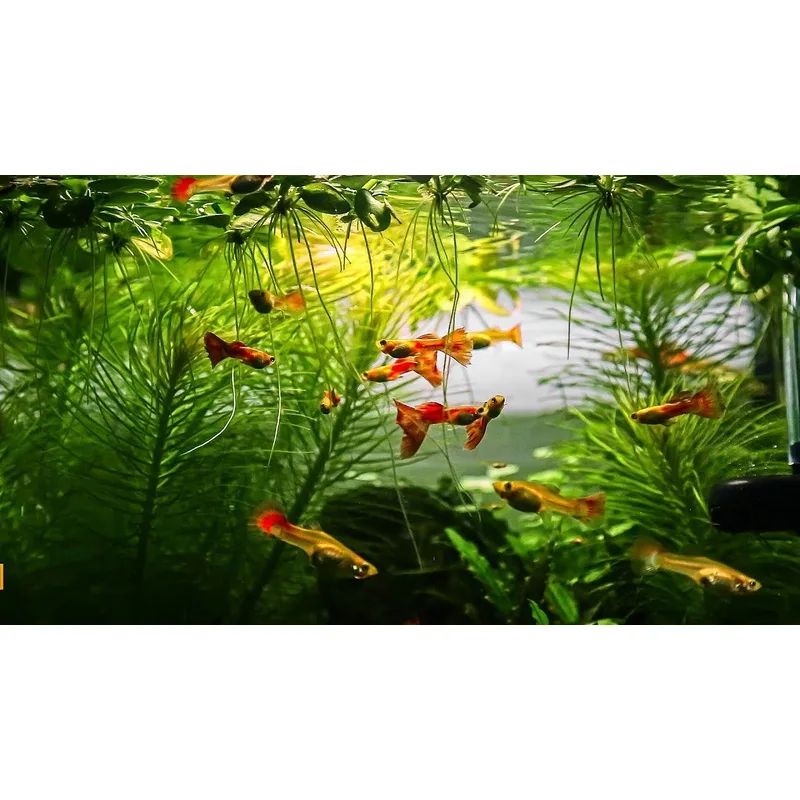
The starting recommendation for a beginner: a 10-gallon starter kit modified with a sponge prefilter on the intake, a trio of guppies (one male, two females) from a local breeder, and Hikari Fancy Guppy fed twice daily. Do weekly 25% water changes, keep temperature at 76-78°F, and let the colony establish itself before adding more fish.
Once you have a stable colony running, the next step is selective breeding — isolating your best-colored males, setting up dedicated drop tanks, and tracking line quality across generations. That is where guppy keeping gets genuinely interesting, and where this hobby holds serious hobbyists for years.