Temperature might be the most important parameter nobody pays enough attention to. We obsess over pH, ammonia, and nitrate — and then forget that a heater malfunction or a summer heat wave can kill an entire tank in hours.
A reliable thermometer is cheap insurance. At $5-17, there is no excuse for guessing whether your tank is at 76degF or 82degF. That six-degree difference matters enormously for tropical fish metabolism, shrimp breeding triggers, and plant growth rates.
This roundup covers the best options in 2026, from app-connected digital probes to old-school glass tubes.
Quick Picks
| Need | Our Pick |
|---|---|
| Best overall | Inkbird IBS-TH2 Bluetooth |
| Best value | VIVOSUN LCD Digital Thermometer |
| Best budget | Marina Floating Thermometer |
| Best stick-on | LCR Hallcrest Liquid Crystal |
| Best compact | Zacro Digital Aquarium Thermometer |
Why Accurate Temperature Matters
For Fish
Tropical freshwater fish have evolved in stable thermal environments. A sudden 5-degree swing stresses immune systems and triggers disease outbreaks — ich in particular is strongly correlated with temperature drops. Most community fish thrive at 74-78degF, with species-specific preferences within that range.
For Shrimp
Shrimp are even more temperature-sensitive. Neocaridina breed most actively at 72-76degF and become stressed above 80degF. Caridina shrimp prefer even cooler conditions, 68-74degF. Temperature fluctuations are a common trigger for failed molts — the shrimp starts the molting process but cannot complete it because the temperature shifted during the vulnerable period.
For Breeding
Temperature is a breeding trigger for many species. Guppies breed faster at warmer temperatures (78-80degF). Corydoras spawn after a cold water change that simulates rainy season conditions. Medaka ricefish breed when water exceeds 75degF and days are long. Without a thermometer, you are guessing at these triggers.
Detailed Reviews
1. Inkbird IBS-TH2 Bluetooth Thermometer
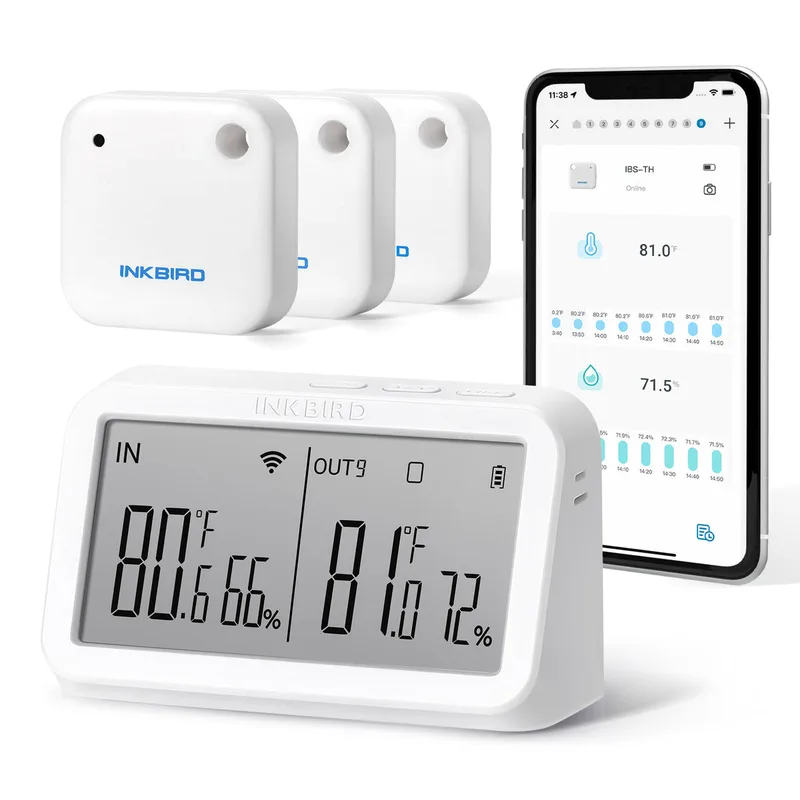
Inkbird IBS-TH2 Bluetooth Thermometer
Best Overall- ✓ Bluetooth app logs temperature history and sends alerts
- ✓ High accuracy with waterproof external probe
- ✓ Compact unit mounts anywhere on the tank
- ✓ Temperature alarms for high and low thresholds
- ✗ Bluetooth range limits monitoring to nearby rooms
- ✗ App requires initial setup
- ✗ Battery life is 6-12 months
The Inkbird IBS-TH2 is the most feature-rich option for hobbyists who want more than just a number on a screen. The Bluetooth app logs temperature history as a graph, which lets you spot gradual heater drift, daily temperature swings, and seasonal patterns that a single-point reading misses.
The killer feature is high/low temperature alerts. Set thresholds — say, an alarm if the tank drops below 72degF or exceeds 82degF — and your phone notifies you when something is wrong. This is particularly valuable for shrimp keepers and breeders where a heater malfunction can devastate a colony before you notice.
Accuracy is excellent at +/- 0.5degF (±0.3degC), and the waterproof probe reads actual water temperature rather than glass surface temperature. The main limitation is Bluetooth range — you need to be within about 30 feet of the unit for the app to connect and update. This is fine for a tank in your living room or fish room but will not work for monitoring from another floor of the house.
Who it is for: Serious hobbyists, shrimp keepers, and breeders who want temperature logging and alerts.
2. VIVOSUN LCD Digital Aquarium Thermometer
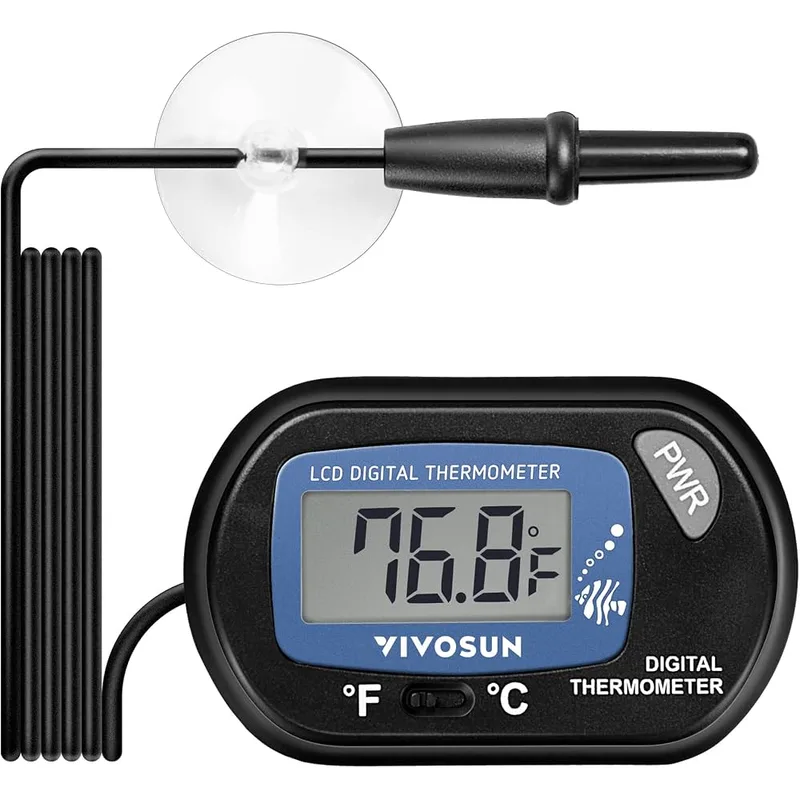
VIVOSUN LCD Digital Aquarium Thermometer
Best Value- ✓ Under $10 and widely available
- ✓ Suction cup attaches probe inside the tank
- ✓ Large, easy-to-read LCD display
- ✓ Accurate enough for routine monitoring
- ✗ Suction cup can lose grip over time
- ✗ No temperature logging or alerts
- ✗ Reads in whole degrees — less precise than premium options
The VIVOSUN is the practical workhorse thermometer for most hobbyists. At under $10, it provides a clear digital readout with a suction-cupped probe that sits inside the tank. The large LCD is readable from several feet away, which means you can check the temperature at a glance during feeding.
Accuracy at +/- 1 degree is adequate for most freshwater tanks. You will know the difference between 74degF and 78degF, which is what matters for routine monitoring. It will not catch a 0.5-degree drift the way the Inkbird will, but for everyday use, it is more than sufficient.
The most common complaint is the suction cup. After a few months in water, suction cups lose their grip and the probe falls to the substrate. Replacements are cheap, but it is an annoyance. Some hobbyists use a dab of aquarium-safe silicone to permanently attach the probe to the glass instead.
Who it is for: Most hobbyists who want a reliable, affordable digital thermometer without bells and whistles.
3. Marina Floating Thermometer with Suction Cup
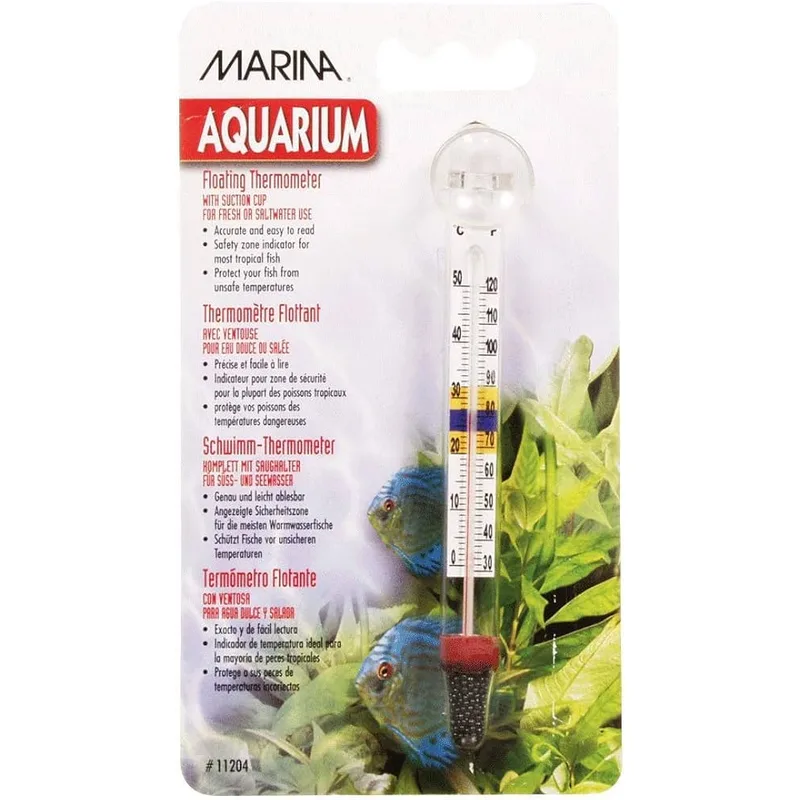
Marina Floating Thermometer with Suction Cup
Best Budget- ✓ No batteries or electronics to fail
- ✓ Visible from across the room
- ✓ Costs almost nothing
- ✓ Suction cup keeps it at a fixed depth
- ✗ Less accurate than digital options
- ✗ Glass tube can break if knocked
- ✗ Suction cup degrades and needs replacement
The Marina floating thermometer is the simplest option available. It is a glass tube with colored liquid that rises and falls with temperature, attached to the inside glass with a suction cup. No batteries, no electronics, no apps — just physics.
At around $4, it costs less than a bag of fish food. The readout is visible from across the room, and because it sits inside the water, it reads actual water temperature. Glass tube thermometers have been used in the hobby for decades and they work.
The downsides are precision and fragility. The analog markings are spaced about 2degF apart, so you are reading between lines and estimating. The glass tube can crack if a large fish bumps it or if it falls during a water change. Keep a backup if you rely on this as your primary thermometer.
Who it is for: Budget-conscious hobbyists and anyone who wants a no-maintenance backup thermometer.
4. LCR Hallcrest Liquid Crystal Stick-On Thermometer
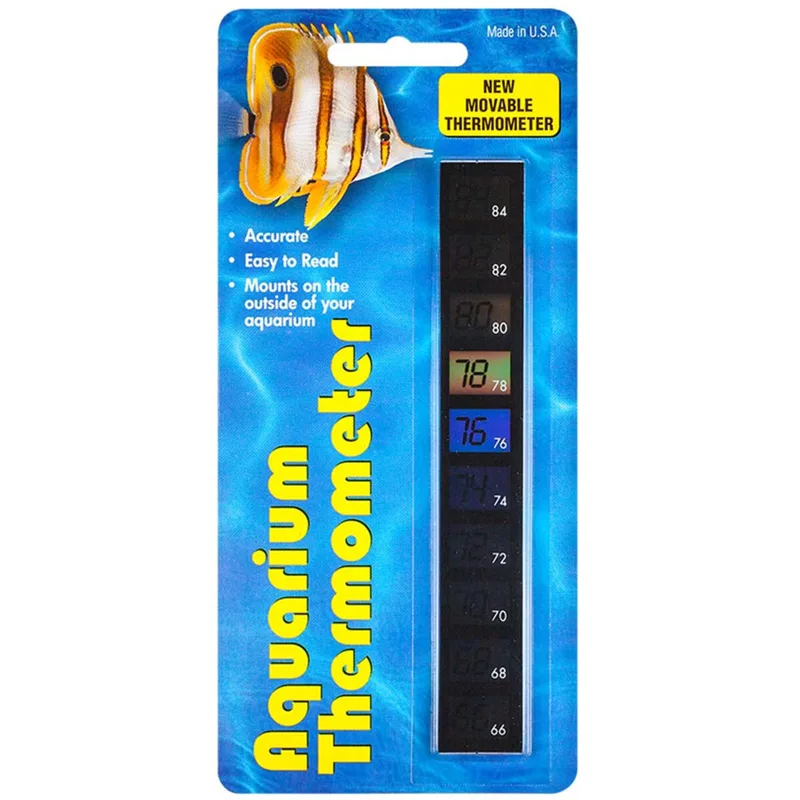
LCR Hallcrest Liquid Crystal Stick-On Thermometer
Best Stick-On- ✓ Sticks to outside of glass — no internal components
- ✓ No batteries, no maintenance
- ✓ Always visible
- ✓ Inexpensive and simple
- ✗ Reads ambient glass temperature, not water temperature
- ✗ Accuracy decreases in cold or drafty rooms
- ✗ Cannot be repositioned once stuck
- ✗ Less precise than internal probe thermometers
Stick-on liquid crystal thermometers are the easiest option to install — peel the backing, press onto the outside glass, done. The color-changing strip shows the approximate temperature by highlighting the relevant number in green or blue.
The appeal is simplicity and permanence. No batteries die, no suction cups fail, no probes to route. It sits on the glass and reads temperature forever.
The catch is accuracy. Stick-on strips read the glass surface temperature, not the water temperature. In a temperature-stable room, the glass surface is close to the water temperature. In a drafty room, near a window with direct sunlight, or near heating/cooling vents, the glass temperature can differ from the water by 3-5degF. This makes stick-on strips unreliable as your sole thermometer.
Best use: A quick visual reference alongside an internal digital probe. If the stick-on strip shows 76degF and your digital probe reads 77degF, you know things are stable without checking the digital display.
Who it is for: Hobbyists who want a permanent visual temperature reference as a supplement to a more accurate thermometer.
5. Zacro Digital Aquarium Thermometer
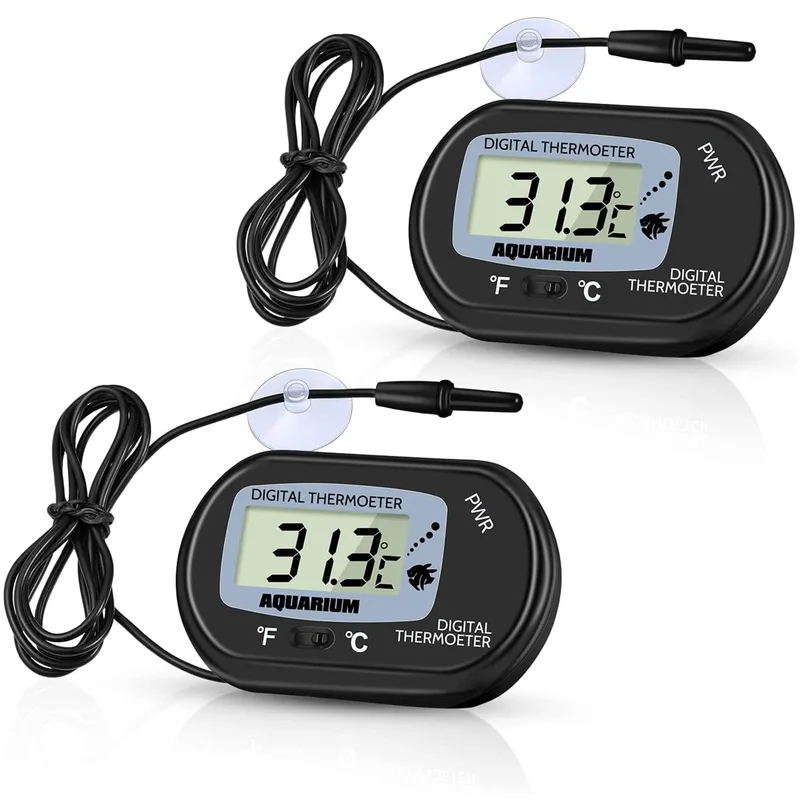
Zacro Digital Aquarium Thermometer
Best Compact- ✓ 2-pack provides one for each tank
- ✓ Compact probe attaches inside tank with suction cup
- ✓ High accuracy at +/- 0.1°C
- ✓ Very affordable price point
- ✗ Small display can be hard to read from a distance
- ✗ No temperature alerts
- ✗ Suction cup can lose grip over time
The Zacro stands out in this category for one simple reason: it comes as a 2-pack. For hobbyists running multiple tanks — a main display plus a breeding tank, or two shrimp setups — getting two accurate thermometers for the price of one is genuinely useful.
Accuracy is excellent at +/- 0.1degC, placing it on par with more expensive digital options. The compact probe attaches inside the tank with a suction cup, and the LCD display unit clips to the glass rim or sits on the stand. The display is on the small side and harder to read from across the room, but for close-range daily checks it is perfectly readable.
Like all probe thermometers in this price range, the suction cup can lose its grip over time. Replace it with a fresh suction cup or a small dab of aquarium-safe silicone if it becomes a recurring problem.
Who it is for: Hobbyists with two tanks who want accurate digital thermometers at a strong value.
Comparison Table
| Inkbird IBS-TH2 Bluetooth Thermometer Best Overall | VIVOSUN LCD Digital Aquarium Thermometer Best Value | Marina Floating Thermometer with Suction Cup Best Budget | LCR Hallcrest Liquid Crystal Stick-On Thermometer Best Stick-On | Zacro Digital Aquarium Thermometer Best Compact | |
|---|---|---|---|---|---|
| Rating | 9.1/10 | 8.7/10 | 8/10 | 7.5/10 | 8.3/10 |
| Price | Check price | $7.99as of Sep 27, 2026 | Check price | $5.18as of Sep 27, 2026 | $9.99as of Sep 27, 2026 |
| Type | Digital with external probe | Digital with suction cup probe | Glass tube with suction cup | Liquid crystal strip | Digital with submersible probe |
| Accuracy | +/- 0.5°F (+/- 0.3°C) | +/- 1°C | +/- 2°F | +/- 2°F | +/- 0.1°C |
| Display | LCD with Bluetooth app | LCD | Analog (liquid in glass) | Color-changing strip | LCD |
| Power | 2x AAA batteries | LR44 battery | None needed | None needed | LR44 battery |
| Check Price → | Check Price → | Check Price → | Check Price → | Check Price → |
Prices change daily — tap Check Price for the current Amazon price. Numbers shown were verified on the "as of" date.
Thermometer Placement Tips
- Mid-tank depth. Place the probe or thermometer at the middle depth of your tank, away from the heater. Temperature stratifies — the bottom can be 2-3degF cooler than the top in a deep tank without good circulation.
- Away from the heater. A thermometer next to the heater will read artificially high. Place it on the opposite end of the tank for a more representative reading.
- Away from filters and returns. Outflow jets create local circulation patterns that may not reflect the overall tank temperature.
- Inside the tank, not on the glass outside. External readings (including stick-on strips) are always less accurate than internal probes.
Frequently Asked Questions
What temperature should a freshwater aquarium be?
Most tropical freshwater fish thrive at 74-78degF. Shrimp prefer the lower end of this range (72-76degF for neocaridina). Cold-water species like white clouds and goldfish prefer 65-72degF. Always research the specific requirements of your species.
How often should I check my aquarium temperature?
A glance at the thermometer during daily feeding is sufficient for established tanks. During cycling, after adding a new heater, or during seasonal temperature extremes, check twice daily (morning and evening) to catch swings.
Can aquarium thermometers be wrong?
Yes. Cheap thermometers can be off by 2-5degF out of the box. Digital probes are generally more accurate than analog glass tubes or stick-on strips. If you suspect your thermometer is inaccurate, compare it against a known-accurate thermometer (even a kitchen meat thermometer works for a quick calibration check).
Do I need a thermometer if I have a heater with a built-in thermostat?
Absolutely. Heater thermostats fail, drift, and are often inaccurate from the factory. An independent thermometer is the only way to verify your heater is actually maintaining the temperature it claims to be set at. Heater failures are among the most common causes of fish death — an independent thermometer is your early warning system.