Chasing a moving pH target is one of the fastest ways to stress fish. A pH that drifts half a point between water changes puts your livestock under constant osmotic pressure, and the weaker ones — fry, shrimp, sensitive species — show it first. A good pH buffer locks your water at a stable target and keeps it there until the next water change.
The problem is that not every buffer works the same way, and picking the wrong one can create more problems than it solves. Phosphate-based buffers feed algae. Crushed coral only raises pH. Some products soften water as a side effect, great for discus and terrible for African cichlids. And dosing any buffer without checking GH, KH, and pH first is guesswork — you’ll overshoot before you realize it.
Here is what actually works, who each buffer is best for, and the test kits worth owning alongside them.
| Seachem Neutral Regulator Best Overall | Seachem Alkaline Buffer Best Phosphate-Free | API Proper pH 7.0 Best Budget Option | Seachem Discus Buffer Best for Low pH | Dacwiko Crushed Coral Best Natural Option | Seachem Acid Buffer Best Buffer Pairing | API GH & KH Test Kit Essential Add-On | API Freshwater Master Test Kit Essential Add-On | |
|---|---|---|---|---|---|---|---|---|
| Rating | 9.3/10 | 9/10 | 8.5/10 | 8.7/10 | 8.3/10 | 8.4/10 | 8.9/10 | 9/10 |
| Price | $12.99as of Sep 27, 2026 | $12.14as of Sep 27, 2026 | $10.00as of Sep 27, 2026 | $12.79as of Sep 27, 2026 | $14.66as of Sep 27, 2026 | $10.63as of Sep 27, 2026 | Unavailable | Unavailable |
| Brand | Seachem | Seachem | API | Seachem | Dacwiko | Seachem | API | API |
| Target pH | 7.0 | 7.2–8.5 (adjustable) | 7.0 | 5.8–6.8 (adjustable) | Raises gradually (no fixed target) | 5.0–8.0 (paired with Alkaline Buffer) | — | — |
| Size | 250g | 300g | 8.8 oz (250g) | 250g | 2.2 lb (1000g) | 300g | 2.5 oz, roughly 90 combined tests | Approximately 800 tests |
| Phosphate-Free | No (phosphate-based) | Yes | No | Yes | Yes | Yes | — | — |
| Dechlorinates | Yes | No | Yes | No | No | No | — | — |
| Shrimp Safe | Yes | Yes (with gradual dosing) | Yes | Yes (Caridina) | Yes (Neocaridina) | Yes (gradual dosing) | — | — |
| Tests | — | — | — | — | — | — | General Hardness (GH) and Carbonate Hardness (KH) | Ammonia, nitrite, nitrate, pH |
| Format | — | — | — | — | — | — | Liquid drop titration | Liquid reagent drops with color chart |
| Check Price → | Check Price → | Check Price → | Check Price → | Check Price → | Check Price → | Check Price → | Check Price → |
Prices change daily — tap Check Price for the current Amazon price. Numbers shown were verified on the "as of" date.
Quick Picks
pH Buffer Buying Guide
Phosphate-Based vs. Phosphate-Free
This is the single most important distinction when choosing a pH buffer. Phosphate-based buffers (Neutral Regulator, API Proper pH) work well and are easy to use, but they add phosphates to your water. In a well-maintained tank with moderate lighting, this usually does not cause problems. But in tanks with strong lighting, CO2 injection, or an existing algae problem, those extra phosphates can feed algae growth.
Phosphate-free buffers (Alkaline Buffer, Acid Buffer, Discus Buffer, crushed coral) avoid this issue entirely. The tradeoff is that they are often less convenient — they may not dechlorinate, require more precise dosing, or only work in one direction.
Chemical Buffers vs. Natural Substrates
Chemical buffers (powders, liquids) give you precise control and fast results. Crushed coral and other natural substrates work gradually and are lower maintenance. For tanks where you do frequent water changes and need consistent parameters, chemical buffers make more sense. For set-it-and-forget-it tanks, natural substrates are easier.
Test Before You Buffer
Dosing a pH buffer without knowing your starting GH, KH, and pH is how overshoot happens. Tap water KH varies enormously by region, and a dose calibrated for one household’s water can swing another tank’s pH far past the target. A GH/KH kit and a pH-capable master kit take a few minutes and tell you how much buffering capacity you’re starting with — the difference between a controlled adjustment and a stressed tank.
Matching Buffer to Species
- Community tropicals (tetras, barbs, rasboras): Neutral Regulator or API Proper pH 7.0
- African cichlids: Alkaline Buffer targeting 7.8–8.2, paired with Acid Buffer for fine control
- Livebearers (guppies, platies, mollies): Alkaline Buffer or crushed coral, target 7.2–7.6
- Discus and cardinal tetras: Discus Buffer targeting 6.0–6.8
- Neocaridina shrimp: Crushed coral or Alkaline Buffer (gradual dosing), target 7.0–7.6
- Caridina shrimp: Discus Buffer or active buffering substrate, target 5.8–6.5
How Much Buffer to Use
Start with half the recommended dose and test after 24 hours. pH buffers need time to fully react with your water chemistry, and overshoot is worse than undershoot. You can always add more — you cannot easily remove excess buffer.
For crushed coral, start with about one cup per 20 gallons in a mesh bag in your filter. Test pH and KH weekly and add more coral if pH is not reaching your target.
Shrimp-Safe Water Care
Every buffer in this roundup is shrimp-safe when dosed correctly, but “safe product” and “safe dosing” are different things. Cap any buffer-driven pH change at 0.2 per day, and go slower for Caridina than the more tolerant Neocaridina. None of these buffers contain copper, but that’s worth checking on any other treatment before it goes in a shrimp tank — copper-based medications and some algaecides are lethal to shrimp at doses fish shrug off.
Detailed Reviews
1. Seachem Neutral Regulator
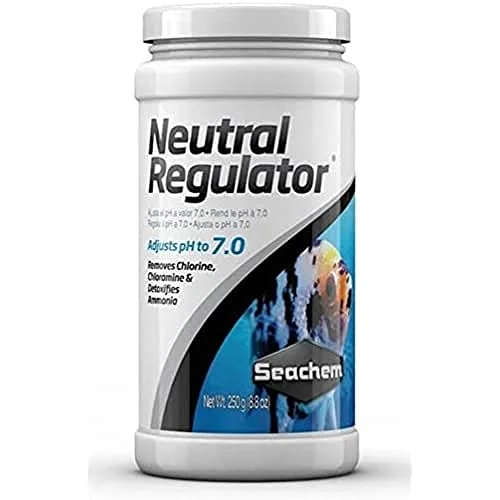
Seachem Neutral Regulator
Best Overall- ✓ Locks pH precisely at 7.0 — works from either direction
- ✓ Also removes chlorine, chloramine, and detoxifies ammonia
- ✓ Extremely well-established product with decades of proven use
- ✓ Works quickly and holds pH stable between water changes
- ✗ Phosphate-based formula can feed algae in high-light tanks
- ✗ Softens water by precipitating calcium — not ideal for hard-water species
Seachem Neutral Regulator is the default recommendation for a reason. It adjusts pH to 7.0 from either direction — too high and it brings it down, too low and it brings it up — and holds it there. For community tanks with a mix of species that all do fine around neutral, this is the easiest solution.
What sets Neutral Regulator apart from simpler buffers is that it also removes chlorine, chloramine, and detoxifies ammonia. That means you can use it as part of your water change routine and skip a separate dechlorinator. One product, two jobs.
The catch is that Neutral Regulator is phosphate-based. In a low-tech tank with moderate lighting, this usually is not an issue. But in a high-light planted tank or a tank already dealing with algae, those added phosphates can make things worse. If algae is a concern, look at the Alkaline Buffer instead.
The other thing to know: Neutral Regulator softens water by precipitating calcium and magnesium. For most tropical community fish, softer water is fine or even preferred. For African cichlids, livebearers that want hard water, or snails that need calcium, this is a drawback. Know your species before committing.
Best for: General community tanks with mixed tropical species that thrive around pH 7.0.
2. Seachem Alkaline Buffer
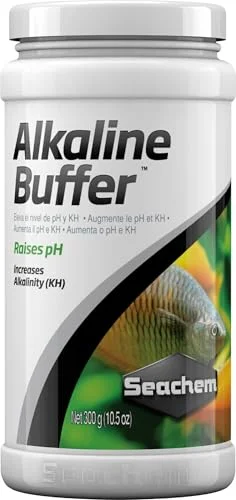
Seachem Alkaline Buffer
Best Phosphate-Free- ✓ Non-phosphate formula will not fuel algae growth
- ✓ Raises and maintains pH anywhere between 7.2 and 8.5
- ✓ Pairs with Seachem Acid Buffer for precise pH targeting
- ✓ Excellent for African cichlid and livebearer tanks
- ✗ Does not dechlorinate — still need a separate water conditioner
- ✗ Requires some trial and error to dial in your target pH
If you need to raise pH without adding phosphates to your water, Seachem Alkaline Buffer is the cleanest option available. It uses a non-phosphate formula to raise and stabilize pH anywhere between 7.2 and 8.5, depending on how much you dose.
The adjustable range is the real selling point. African cichlid keepers can push pH up toward 8.0–8.2. Livebearer tanks (guppies, platies, mollies) do well in the 7.4–7.6 range. You control the target by adjusting the dose, and Seachem provides a chart to help you dial it in.
For maximum precision, pair Alkaline Buffer with Seachem Acid Buffer, reviewed below. By adjusting the ratio of the two, you can lock pH at almost any target from 5.0 to 8.5. This is the approach serious planted tank keepers and breeders use when they need exact water parameters.
The downside is that Alkaline Buffer does not dechlorinate, so you still need a separate water conditioner like Seachem Prime for water changes. It is also a bit more manual than Neutral Regulator — you need to experiment with dosing to find the right amount for your water.
Shrimp keepers: this buffer is safe for Neocaridina when dosed gradually. Avoid large single doses that swing pH more than 0.2 in a day. Shrimp tolerate stable pH at various levels much better than they tolerate rapid changes.
Best for: African cichlid and livebearer tanks, or any setup where phosphate-free buffering matters.
3. API Proper pH 7.0
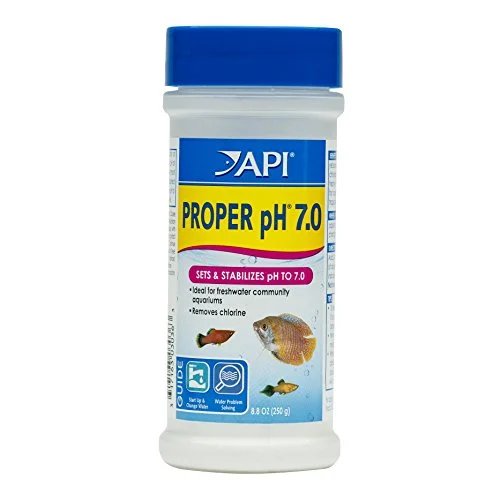
API Proper pH 7.0
Best Budget Option- ✓ Pre-measured powder packets make dosing foolproof
- ✓ Removes chlorine and detoxifies heavy metals
- ✓ Available in multiple target pH versions (6.5, 7.0, 7.5, 8.2)
- ✓ Affordable and widely available
- ✗ Phosphate-based — can contribute to algae in planted tanks
- ✗ Packets can overshoot in very soft water if you are not careful
API Proper pH 7.0 takes the guesswork out of buffering. It comes in pre-measured powder packets — you dissolve one packet per 10 gallons of water, and pH locks at 7.0. No measuring, no math, no fiddling with ratios.
This is the buffer to reach for as a beginner or anyone who just wants a simple answer to pH instability. The packets also remove chlorine and detoxify heavy metals, so like Neutral Regulator, it doubles as a water conditioner during water changes.
API makes Proper pH in multiple target versions: 6.5, 7.0, 7.5, and 8.2. If your fish need something other than neutral, grab the version that matches. The 8.2 version is popular with African cichlid keepers, and the 6.5 version works for soft-water species like tetras and rasboras.
The limitation is the same as Neutral Regulator — it is phosphate-based. And because the packets are pre-measured for a fixed dose, there is less flexibility to fine-tune your pH target. In very soft water with low KH, a single packet can overshoot and swing pH more aggressively than expected. Always test after dosing.
Best for: Beginners who want a simple, pre-measured buffer that also conditions tap water.
4. Seachem Discus Buffer
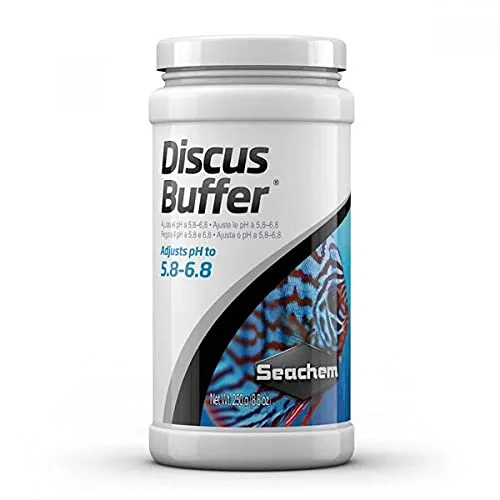
Seachem Discus Buffer
Best for Low pH- ✓ Phosphate-free formula targets the acidic range discus and Caridina shrimp need
- ✓ Adjustable target between 5.8 and 6.8 based on dose
- ✓ Softens water while lowering pH — perfect for blackwater setups
- ✓ Will not promote algae growth
- ✗ Only useful if you need low pH — not a general-purpose buffer
- ✗ Can crash KH if overdosed in already soft water
Most pH buffers are designed to raise pH or hold it at neutral. Seachem Discus Buffer goes the other direction — it targets the acidic range between 5.8 and 6.8, which is exactly what discus, cardinal tetras, Caridina shrimp, and other soft-water species need.
The formula is phosphate-free, which matters because low-pH tanks with phosphates tend to grow algae aggressively. Discus Buffer also softens water, which is a feature rather than a bug for the species it is designed for. Discus and Caridina shrimp both come from soft, acidic water in the wild.
Dosing is adjustable — use less for a target around 6.8, more for 5.8. For most discus and shrimp tanks, Discus Buffer alone holds pH steady enough between water changes.
One caution: if your tap water already has very low KH (under 2 dKH), Discus Buffer can crash your KH to zero and cause pH to become unstable. Test your KH regularly when using this product, and consider adding a small amount of Alkaline Buffer if KH drops too low.
Best for: Discus tanks, blackwater setups, and Caridina shrimp colonies that need acidic, soft water.
5. Dacwiko Crushed Coral
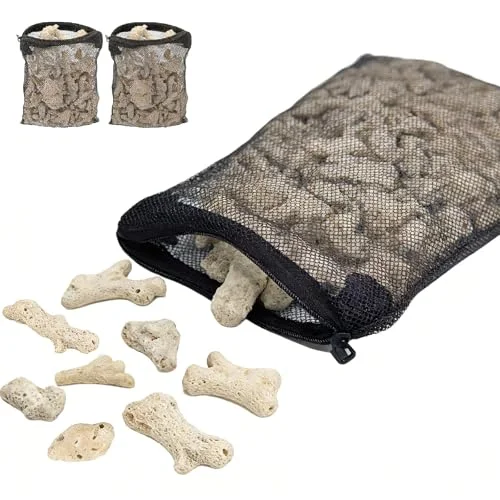
Dacwiko Crushed Coral
Best Natural Option- ✓ Completely natural — dissolves slowly to raise pH and KH over time
- ✓ Includes reusable mesh bag for filter or substrate use
- ✓ No risk of sudden pH swings — works gradually
- ✓ Provides calcium for snails and Neocaridina shrimp
- ✗ Cannot lower pH — only raises it
- ✗ No precise pH targeting — results depend on water chemistry
Crushed coral is the low-tech, low-effort approach to pH buffering. Drop a mesh bag of it in your filter or scatter it across the substrate, and it slowly dissolves to raise pH and KH over time. No measuring, no dosing schedule, no chemicals.
The appeal is simplicity and safety. Crushed coral cannot cause a sudden pH crash or spike — it dissolves at a rate determined by your water’s acidity. The lower your pH, the faster it dissolves. As pH rises, dissolution slows down. It is a self-regulating system that rarely causes problems.
For Neocaridina shrimp keepers, crushed coral is an excellent choice. It raises KH and GH while providing calcium that shrimp need for molting. A bag of crushed coral in the filter of a cherry shrimp tank keeps parameters stable with zero ongoing effort.
The limitation is that crushed coral only raises pH — it cannot lower it. And you cannot target a specific pH the way chemical buffers can. If you need pH at exactly 7.0 or 6.5, crushed coral is not precise enough. But if you just need to prevent pH from crashing below 7.0 in soft tap water, it works reliably.
The Dacwiko bag comes with a reusable mesh bag and enough coral for a 20- to 40-gallon tank. Replace it every 6–12 months as the coral dissolves and loses buffering capacity.
Best for: Low-maintenance tanks with soft tap water that need a gentle, ongoing pH boost.
Essential Add-Ons: Testing Before You Buffer
6. Seachem Acid Buffer
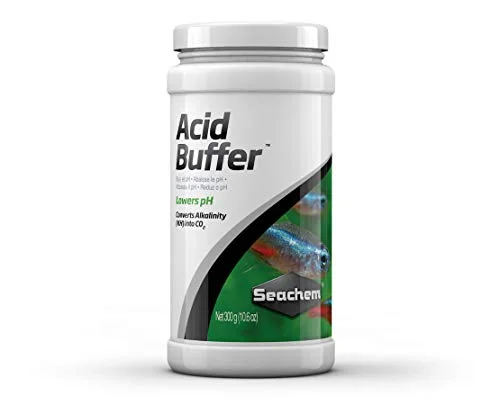
Seachem Acid Buffer
Best Buffer Pairing- ✓ Paired with Alkaline Buffer, dials pH to almost any target between 5.0 and 8.0
- ✓ Converts carbonate hardness into usable CO2, which planted tanks can put to work
- ✓ Phosphate-free — won't feed algae the way phosphate buffers can
- ✗ Not useful on its own — needs Alkaline Buffer to hit a specific target
- ✗ Lowers KH as it lowers pH, so soft-water tanks can crash KH if overdosed
Acid Buffer is not a standalone product for most tanks — it earns its spot as the partner to Alkaline Buffer. Used together, the ratio of Acid to Alkaline Buffer locks pH at almost any target between 5.0 and 8.0, the level of control breeders and planted tank keepers need when a species has a narrow pH window.
The chemistry works by converting carbonate hardness (KH) into free CO2, a bonus in a CO2-injected planted tank and a liability in an already-soft tank — low starting KH means Acid Buffer can push it toward zero fast, and pH becomes unstable once that happens.
Phosphate-free like Alkaline Buffer, so it won’t feed algae. Dose gradually in shrimp tanks and confirm KH with a test kit before and after — overdosing here has an immediate, visible consequence.
Best for: Fine-tuning pH alongside Alkaline Buffer, or lowering pH in planted CO2 tanks.
7. API GH & KH Test Kit
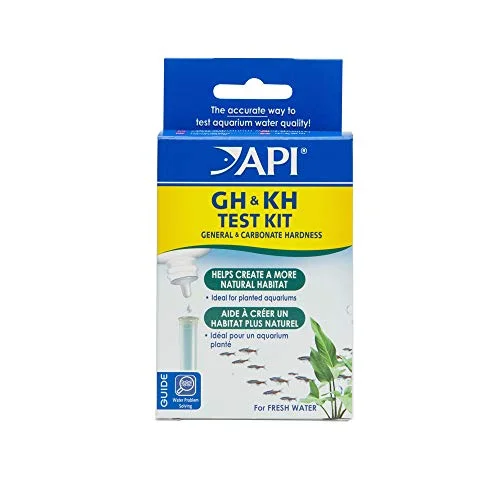
API GH & KH Test Kit
Essential Add-On- ✓ The only reliable way to confirm crushed coral or a chemical buffer is holding KH
- ✓ Drop-count titration is more accurate than paper strips for tracking small changes
- ✓ Knowing baseline KH before dosing prevents the most common buffer overshoot mistakes
- ✗ Counting color-change drops takes practice compared to a digital meter
- ✗ Doesn't test pH directly — pair with a pH kit or digital meter
Every recommendation in this roundup assumes you know your water’s starting GH and KH, and this is the kit that tells you — a liquid drop-count titration test, counting drops until the water changes color, where each drop represents a fixed amount of hardness.
KH is the buffering capacity of your water, the reserve that resists pH swings. Low KH means pH can crash overnight even without a buffer involved; high KH means a buffer needs a bigger dose to move the needle. Without this number, dosing any of the chemical buffers above is a guess — and drop-count tests are meaningfully more accurate than paper strips for tracking small week-to-week changes across a breeding rack.
Best for: Confirming crushed coral is actually holding KH, or dialing in Acid/Alkaline Buffer ratios precisely.
8. API Freshwater Master Test Kit
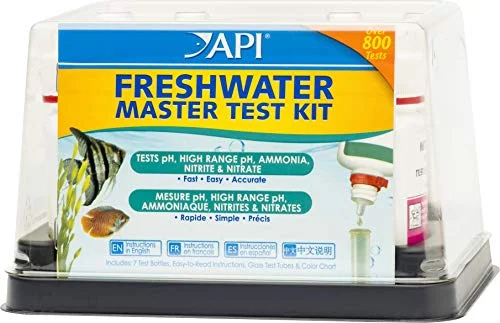
API Freshwater Master Test Kit
Essential Add-On- ✓ Confirms pH is actually the problem before buying a buffer at all
- ✓ Covers ammonia and nitrite too, so a slow cycle isn't mistaken for a pH swing
- ✓ Refills sold separately, so the up-front kit lasts for years
- ✗ The included pH test only reads accurately up to about 7.6 — African cichlid keepers need a high-range kit too
Before buying any buffer, confirm pH is actually the problem. This kit covers pH alongside ammonia, nitrite, and nitrate — the four readings that matter most in any freshwater tank — so a pH swing doesn’t get chased with a buffer when the real issue is an unfinished nitrogen cycle or an overstocked tank outpacing the biofilter.
The included pH reagent reads accurately up to about 7.6, covering every buffer here except the high end of Alkaline Buffer’s range — African cichlid keepers pushing toward 8.2 will want a high-range pH kit too. Refills are sold separately, so the upfront cost is the only real expense; the same bottle set lasts most home aquariums well over a year of weekly testing.
Best for: Ruling out ammonia, nitrite, or nitrate as the real cause before assuming a buffer is needed.
Frequently Asked Questions
Is it better to buffer pH or leave it alone?
If your pH is stable — even if it is not “ideal” — leaving it alone is usually better than chasing a number. Most freshwater fish adapt to a range of pH values as long as the level stays consistent. Buffer only if your pH swings significantly between water changes (more than 0.3–0.4 points) or if your tap water pH is genuinely incompatible with your fish.
Can pH buffers harm shrimp?
pH buffers themselves are safe for shrimp, but rapid pH changes are dangerous. Shrimp are more sensitive to pH swings than most fish. When adding any buffer to a shrimp tank, dose gradually — no more than 0.2 pH change per day. Crushed coral is the safest option for shrimp because it raises pH slowly and provides beneficial calcium.
How often do I need to re-dose pH buffer?
Most chemical buffers need to be re-dosed with each water change, since you are replacing buffered water with unbuffered tap water. Between water changes, a good buffer should hold pH stable for at least a week. If pH drifts significantly between water changes, your KH may be too low to maintain the buffer — test KH and consider increasing it.
Can I use pH buffer with CO2 injection?
Yes, but CO2 naturally lowers pH, so you need a buffer that can hold pH against that downward pressure. Seachem Alkaline Buffer works well in CO2-injected tanks because it raises KH, which resists pH drops from CO2. Avoid phosphate-based buffers in planted CO2 tanks — the combination of phosphates and CO2-driven growth often triggers algae blooms.
Does crushed coral work in a canister filter?
Yes — putting crushed coral in a media bag inside your canister filter is one of the most effective ways to use it. The constant water flow through the canister dissolves the coral more evenly than a bag sitting in a hang-on-back filter. Place the coral after your mechanical filtration media so it does not get clogged with debris.
What happens if I overdose pH buffer?
Chemical buffers can cause a rapid pH swing if overdosed, which stresses fish and can be lethal to shrimp. If you overdose, perform a 50% water change immediately with dechlorinated water to dilute the buffer. Then re-dose at the correct amount. This is another reason to start with half doses and work up.
Do I really need a GH/KH test kit, or is a pH test enough?
pH alone doesn’t tell the whole story. Two tanks can read the same pH while one has plenty of buffering capacity (high KH) and the other is one water change away from a crash (near-zero KH). A GH/KH kit shows the reserve behind the number, which is what actually predicts whether a buffer dose will hold or blow through.
Conclusion
Our Top Pick
For most freshwater community tanks, Seachem Neutral Regulator is the simplest and most reliable pH buffer — it locks pH at 7.0 and handles dechlorination in one step. If you are in a planted tank dealing with algae or need a phosphate-free option, Seachem Alkaline Buffer paired with Acid Buffer gives you adjustable targeting without feeding algae. And for low-maintenance setups where you just want stable pH with zero effort, a bag of crushed coral in your filter is the easiest long-term solution.
Whichever buffer fits your tank, don’t dose blind. A GH/KH test kit and a pH-capable master kit cost less than a single fish and tell you exactly how much buffering capacity you’re starting with — that’s what separates a controlled pH adjustment from a stressed tank. Pick a buffer, confirm your baseline, and re-dose predictably with every water change.