Shrimp need minerals. Every molt requires calcium and magnesium to build a new exoskeleton, and a shrimp that runs low on minerals either fails to molt or molts with a soft, deformed shell. In established tanks with mineral-rich tap water, the water itself provides enough. But if you run RO water, have soft tap water, or keep a dense colony, supplemental minerals make the difference between a colony that limps along and one that thrives.
Mineral stones and remineralizers come in several forms — clay stones that sit in the tank, powders you dissolve in water, and ceramic balls that release trace elements slowly. Each approach has tradeoffs, and the right choice depends on your shrimp species, water source, and how involved you want to be.
| Shirakura Mineral Stone (200g) Best Overall | SaltyShrimp Bee Shrimp Mineral GH+ (110g) Best for Caridina | SaltyShrimp Shrimp Mineral GH/KH+ (200g) Best for Neocaridina | Awesome Industries Tourmaline Mineral Balls (10-Pack) Best Budget Option | Mironekuton Deep Sea Mineral (150g) Best for Planted Shrimp Tanks | HM Digital COM-100 Waterproof EC/TDS/Temp Combo Meter Best TDS Meter | API GH & KH Test Kit Best GH/KH Test Kit | GlasGarten Mineral Junkie Bites Best Mineral Food | |
|---|---|---|---|---|---|---|---|---|
| Rating | 9.2/10 | 9/10 | 8.8/10 | 8/10 | 8.5/10 | 9/10 | 8.9/10 | 9/10 |
| Price | $22.99as of Sep 27, 2026 | $20.48as of Sep 27, 2026 | $32.99as of Sep 27, 2026 | $5.69-$5.99as of Sep 27, 2026 | $22.99as of Sep 27, 2026 | $68.13as of Sep 27, 2026 | Unavailable | $17.88as of Sep 27, 2026 |
| Brand | Shirakura | SaltyShrimp | SaltyShrimp | Awesome Industries | Mironekuton | — | API | GlasGarten |
| Type | Montmorillonite clay stone | Remineralizer powder | Remineralizer powder | Tourmaline ceramic balls | Mineral substrate additive | — | — | Mineral-fortified feeding stick |
| Size | 200g | 110g | 200g | 10 pieces | 150g | — | 2.5 oz (approximately 90 tests) | — |
| Duration | 3–6 months | Treats ~550 gallons | Treats ~1000 gallons | 1–2 years | Ongoing (mixed into substrate) | — | — | — |
| Shrimp Safe | Yes — all species | Yes — designed for Caridina | Yes — designed for Neocaridina | Yes | Yes | N/A — testing tool | N/A — testing tool | Yes — all species |
| Function | Minerals, toxin binding, grazing surface | Raises GH without KH for active substrate setups | Raises both GH and KH | Trace minerals, calcium for molting | Substrate enrichment, plant and shrimp vitality | — | — | Combines calcium/mineral supplementation with a food source |
| Reads | — | — | — | — | — | EC, TDS, Temperature | — | — |
| TDS Range | — | — | — | — | — | 0-8,560 ppm (0.86 conversion factor) | — | — |
| Accuracy | — | — | — | — | — | +/-2% full scale | — | — |
| Waterproof | — | — | — | — | — | IP-67 | — | — |
| Tests | — | — | — | — | — | — | General Hardness (GH), Carbonate Hardness (KH) | — |
| Format | — | — | — | — | — | — | Liquid reagent drops with color chart | — |
| Check Price → | Check Price → | Check Price → | Check Price → | Check Price → | Check Price → | Check Price → | Check Price → |
Prices change daily — tap Check Price for the current Amazon price. Numbers shown were verified on the "as of" date.
Quick Picks
Mineral Stone Buying Guide
Why Shrimp Need Supplemental Minerals
Shrimp molt every 3–6 weeks, building an entirely new exoskeleton each time. This process requires significant amounts of calcium and magnesium, plus trace elements like iron, manganese, and potassium. In the wild, these minerals come from the substrate, decaying plant matter, and mineral-rich water sources.
In an aquarium — especially one using RO water — those natural mineral sources are absent. Without supplementation, shrimp develop molting problems: incomplete molts, soft shells, the white ring of death (a gap between head and body plates during a failed molt), and eventually death.
Mineral Stones vs. Remineralizers
- Mineral stones (Shirakura, tourmaline balls) sit in the tank and release minerals passively. They are low maintenance but provide modest, hard-to-control mineral levels. Best as supplements, not primary sources.
- Remineralizers (SaltyShrimp GH+, GH/KH+) dissolve in water before you add it to the tank. They provide precise, measurable mineral content. Best as your primary mineral source when using RO water.
Most serious shrimp keepers use both: a remineralizer to set base parameters, plus a mineral stone for trace elements and grazing enrichment.
Caridina vs. Neocaridina Mineral Needs
- Caridina (crystal red, crystal black, Taiwan bee): Need soft, acidic water with GH 4–6, KH 0–1, pH 5.8–6.5. Use GH+ only (no KH).
- Neocaridina (cherry, blue dream, orange sakura): Tolerate harder water with GH 6–8, KH 3–5, pH 7.0–7.6. Use GH/KH+ for balanced hardness.
Using the wrong remineralizer for your species causes parameter mismatches that stress shrimp and reduce breeding success.
How to Tell If Your Shrimp Need More Minerals
- Frequent molting deaths — shrimp die during or immediately after molting
- White ring of death — visible white line between head and body plates
- Soft or thin shells — shells feel flimsy or transparent after molting
- Low breeding rates — berried females drop eggs or produce fewer shrimplets
- Dull coloration — shrimp appear washed out despite good genetics
If you see any of these signs, test your GH and KH immediately and adjust your mineral supplementation.
Detailed Reviews
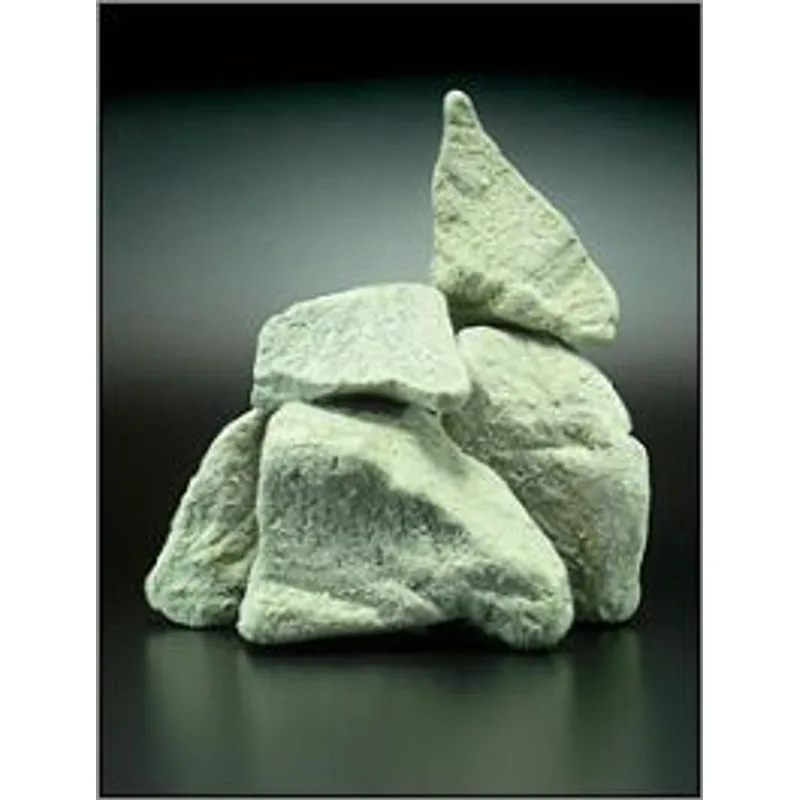
1. Shirakura Mineral Stone (200g)
Shirakura Mineral Stone (200g)
Best Overall- ✓ Montmorillonite clay releases minerals slowly and binds toxins like ammonia and heavy metals
- ✓ Shrimp graze the surface constantly — doubles as biofilm food source
- ✓ Trusted Japanese brand used by serious shrimp breeders worldwide
- ✓ Lasts 3–6 months before needing replacement
- ✗ Premium price compared to generic alternatives
- ✗ Crumbles over time and can create sediment in the tank
The Shirakura Mineral Stone is a compressed montmorillonite clay disc that sits in your tank and does two jobs at once. First, it slowly releases minerals — calcium, magnesium, potassium, and dozens of trace elements — into the water column. Second, it binds toxins like ammonia, heavy metals, and organic waste through ion exchange. Montmorillonite has been used in aquaculture for decades precisely because of this dual function.
But the real reason shrimp keepers love these stones is behavioral. Shrimp flock to the Shirakura stone and graze it constantly. The surface develops a layer of biofilm that shrimp feed on, making the stone both a mineral source and a feeding station. In a colony tank, you will see shrimp covering the stone at all hours.
The stone swells when wet and gradually crumbles over 3–6 months. This is normal — it means the minerals are releasing. Once the stone has dissolved to crumbs, replace it. Some keepers leave the crumbs in the substrate where they continue releasing minerals slowly.
One note: the Shirakura stone will not significantly change your GH or KH readings. It is a trace mineral supplement, not a primary remineralizer. If you are using RO water, you still need a product like SaltyShrimp to set your base parameters. Think of the mineral stone as the multivitamin, not the main course.
Best for: Any shrimp tank where you want ongoing trace mineral supplementation and a natural grazing surface.
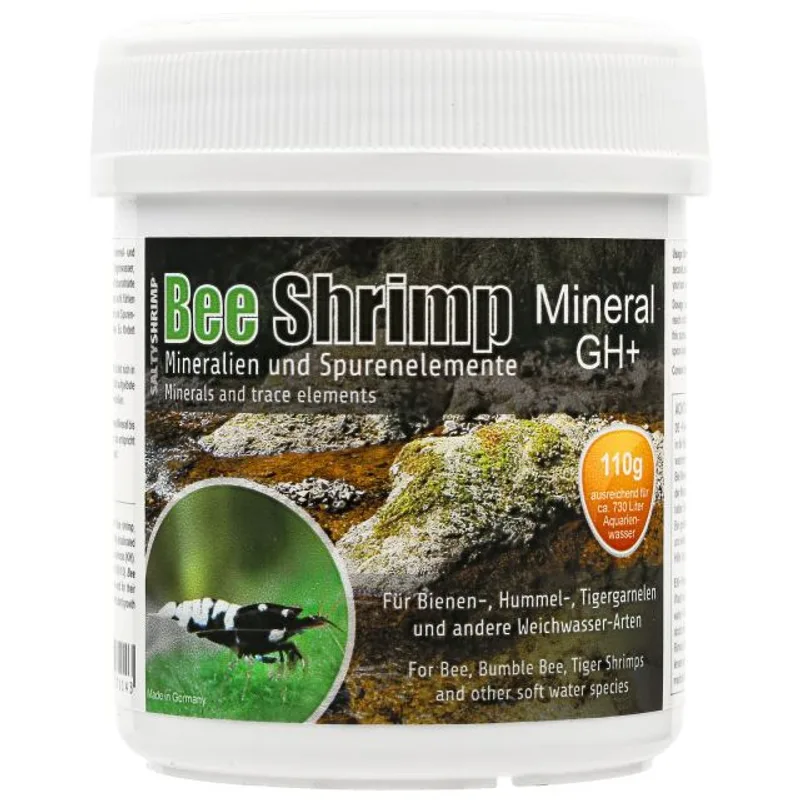
2. SaltyShrimp Bee Shrimp Mineral GH+ (110g)
SaltyShrimp Bee Shrimp Mineral GH+ (110g)
Best for Caridina- ✓ Raises GH without increasing KH — perfect for Caridina with buffering substrates
- ✓ Precise dosing with included scoop for consistent parameters
- ✓ German-made with pharmaceutical-grade ingredients
- ✓ The standard remineralizer among competitive shrimp breeders
- ✗ Not a stone — must be dissolved in water before adding to tank
- ✗ Only raises GH — need separate KH source if not using active substrate
If you keep Caridina shrimp (crystal reds, crystal blacks, Taiwan bees) on active buffering substrate, SaltyShrimp Bee Shrimp Mineral GH+ is the remineralizer you want. It raises GH without touching KH, which is exactly what Caridina need — their active substrates buffer pH to the low 6.0 range, and adding KH would fight the substrate.
The dosing is straightforward: add GH+ to your RO water until your TDS meter reads your target (usually 130–150 TDS for most Caridina). One scoop per roughly 5 gallons gets you in the right range, and you can fine-tune from there. Once you find your dose, water changes become a predictable, repeatable process.
This is the remineralizer that serious Caridina breeders standardize on. The consistency batch to batch is excellent — you get the same TDS reading with the same dose every time. That predictability matters when high-grade shrimp are worth real money and parameter swings cost you animals.
The limitation is that GH+ only makes sense for Caridina setups with active substrate. For Neocaridina, you need the GH/KH+ version that raises both hardness parameters.
Best for: Caridina breeders using RO water and active buffering substrates like ADA Amazonia or SL-Aqua.
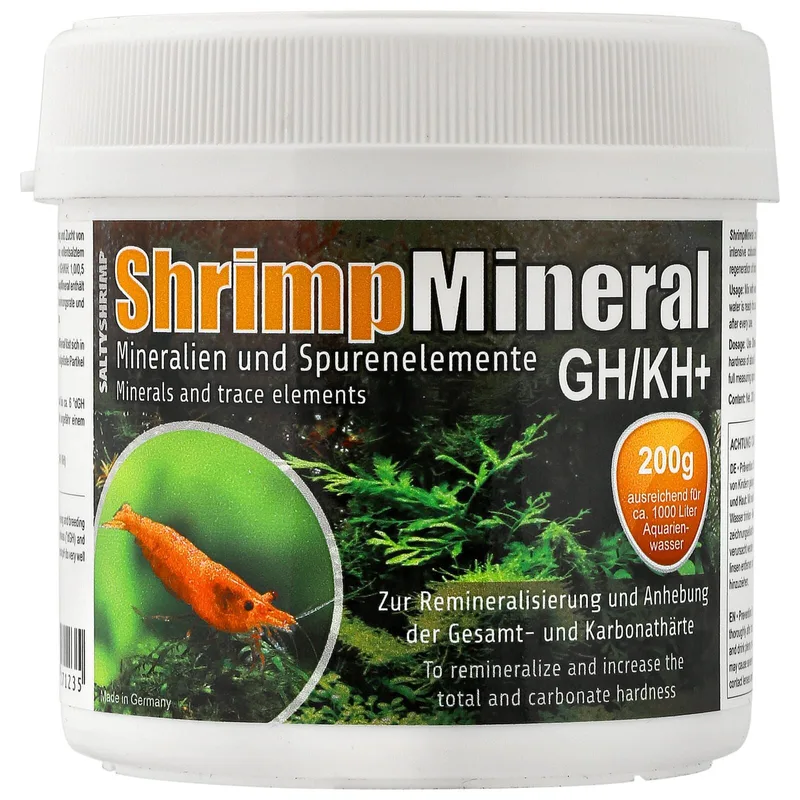
3. SaltyShrimp Shrimp Mineral GH/KH+ (200g)
SaltyShrimp Shrimp Mineral GH/KH+ (200g)
Best for Neocaridina- ✓ Raises both GH and KH at a balanced ratio — ideal for Neocaridina
- ✓ Consistent results every time you remineralize RO or distilled water
- ✓ Lasts a long time — 200g treats around 1000 gallons
- ✓ Industry standard for Neocaridina breeders using RO water
- ✗ Not suitable for Caridina setups where you want low KH
- ✗ Requires RO water for best results — adds a step to water changes
The GH/KH+ version is what Neocaridina keepers (cherry shrimp, blue dreams, orange sakura) need. It raises both GH and KH at a balanced ratio, targeting the slightly alkaline, moderately hard water that Neocaridina thrive in.
Mixing is simple: dissolve the powder in a bucket of RO or distilled water, measure with a TDS meter, and adjust until you hit your target (usually 200–250 TDS for Neocaridina). Pour that into the tank during water changes, and your parameters stay consistent week after week.
The 200g container treats approximately 1000 gallons of water, which lasts months even with weekly water changes on a 10- or 20-gallon colony tank. The value per gallon treated is excellent compared to buying pre-mixed mineral water or relying on tap water that changes seasonally.
If your tap water already has GH of 6–8 and KH of 3–5, you may not need this product at all — your tap water is already in the Neocaridina sweet spot. GH/KH+ is primarily for keepers who use RO water to avoid tap water contaminants or inconsistency.
Best for: Neocaridina breeders using RO water who want consistent, repeatable water parameters.
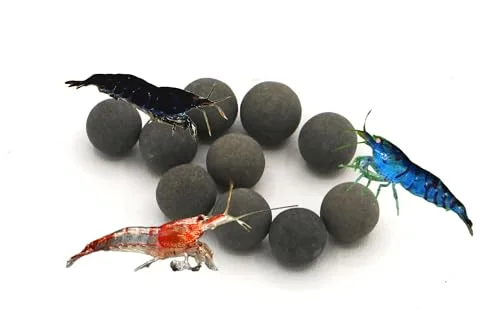
4. Awesome Industries Tourmaline Mineral Balls (10-Pack)
Awesome Industries Tourmaline Mineral Balls (10-Pack)
Best Budget Option- ✓ Affordable mineral supplement — under $6 for a 10-pack
- ✓ Long lasting — tourmaline balls release minerals slowly over 1–2 years
- ✓ Provide calcium and trace elements that support healthy molting
- ✓ Small size lets you scatter them or place in filter compartments
- ✗ Mineral release is minimal — more of a supplement than a primary source
- ✗ Generic brand with less quality control than Shirakura or SaltyShrimp
Tourmaline balls are small ceramic spheres that release calcium and trace minerals slowly into aquarium water. This pack comes with 10 large balls that you can scatter in the substrate, place in a filter compartment, or pile in a dish for shrimp to graze around.
These are a budget-friendly supplement, not a primary mineral source. The mineral release from tourmaline balls is modest — you will not see meaningful changes in GH or KH from adding them. What they do provide is a slow trickle of calcium and trace elements that support healthy molting and shell development over time.
Shrimp do graze on tourmaline balls, though not with the same enthusiasm as a Shirakura stone. The smooth ceramic surface does not develop biofilm as readily as montmorillonite clay. They function more as a passive mineral source than an active feeding station.
The longevity is the selling point. Tourmaline balls last 1–2 years in a tank before they need replacing, and at under $6 for a pack, the cost per month is negligible. For budget shrimp setups or as a supplement alongside a proper remineralizer, they are a solid add-on.
Best for: Budget-conscious shrimp keepers who want a low-cost, low-maintenance mineral supplement.
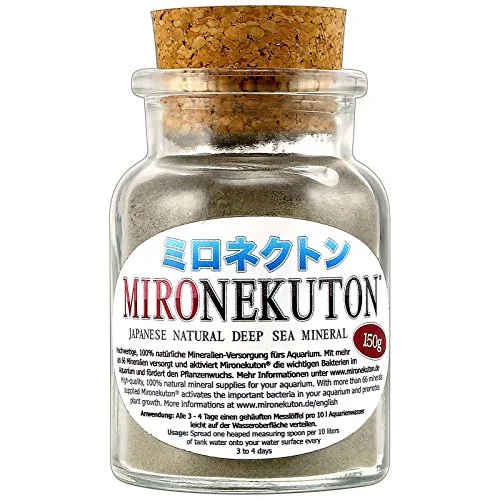
5. Mironekuton Deep Sea Mineral (150g)
Mironekuton Deep Sea Mineral (150g)
Best for Planted Shrimp Tanks- ✓ Designed specifically for planted shrimp tanks — boosts both plant roots and shrimp health
- ✓ Mixed into substrate for long-term mineral release
- ✓ Japanese deep-sea mineral with a strong reputation in the Asian shrimp community
- ✓ Improves overall tank environment rather than just water parameters
- ✗ Harder to find in stock compared to SaltyShrimp products
- ✗ Must be mixed into substrate — cannot add to an established tank easily
Mironekuton takes a different approach — instead of sitting in the water column or dissolving in a bucket, it is mixed directly into the substrate. The powder releases minerals from below, feeding plant roots and enriching the water that passes through the substrate.
This bottom-up approach works well in planted shrimp tanks where the substrate does double duty supporting plant growth and shrimp foraging. Plants grow healthier roots, which in turn provide better biofilm grazing surfaces for shrimp. It is a virtuous cycle.
Mironekuton is a Japanese deep-sea mineral powder with a strong following in the Asian shrimp keeping community, where Caridina breeding is at its most advanced. It is designed for tank setup — you mix it into the substrate before adding water. Adding it to an established tank requires disturbing the substrate, which is disruptive but doable during a rescape.
The limitation is availability. Mironekuton goes in and out of stock on Amazon, and you may need to check specialty shrimp retailers. When it is available, the quality justifies the higher price point.
Best for: New tank setups where you want long-term substrate-level mineral supplementation for both plants and shrimp.
Beyond the Mineral Stone: Testing and Feeding Gear
A mineral stone or remineralizer only helps if you actually know your water parameters and give shrimp a way to take minerals in through feeding too. These three products round out a complete mineral-management setup.
6. HM Digital COM-100 Waterproof EC/TDS/Temp Combo Meter
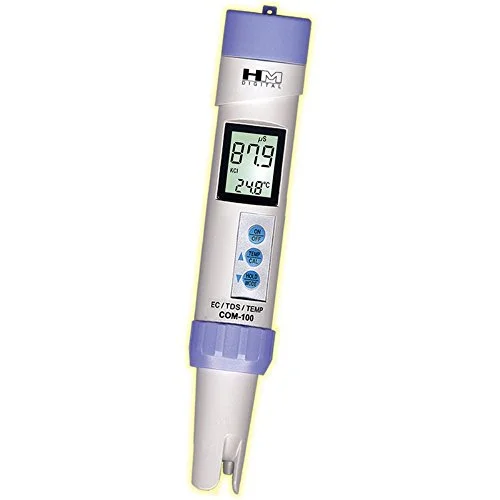
HM Digital COM-100 Waterproof EC/TDS/Temp Combo Meter
Best TDS Meter- ✓ The industry-standard meter in the shrimp-keeping community
- ✓ Reads EC directly, not just TDS, for more precise remineralizing
- ✓ IP-67 waterproof housing survives drops into the tank
- ✓ Tells you exactly when mineral levels have dropped enough to need topping off
- ✗ Pricier than basic pen-style TDS meters
- ✗ Requires periodic calibration for lab-accurate readings
A TDS meter is how you confirm your remineralizer dose actually landed where you wanted it. The COM-100 is the meter most shrimp breeders standardize on — dunk the waterproof probe in your mixing bucket or tank, and it reads TDS in seconds. Without one, dosing a remineralizer is guesswork.
Best for: Anyone dosing SaltyShrimp or a similar remineralizer who needs to confirm the target TDS was hit.
7. API GH & KH Test Kit
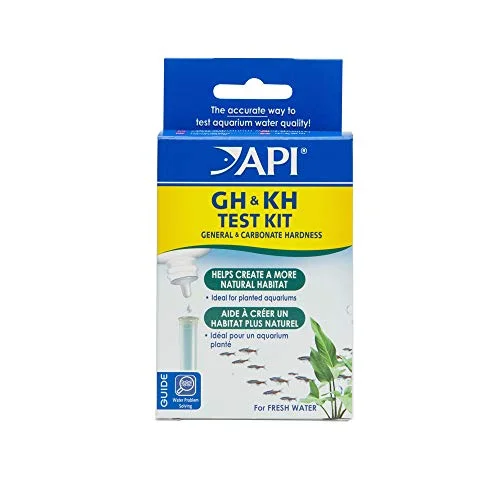
API GH & KH Test Kit
Best GH/KH Test Kit- ✓ Confirms whether GH and KH have actually drifted before you add more minerals
- ✓ Drop-count titration is more precise than color-matching strips
- ✓ Covers both hardness parameters in one kit
- ✗ Slower to run than a digital meter — a few minutes per test
- ✗ Color-matching can be tricky to read under some tank lighting
A TDS meter tells you total dissolved solids, but not the GH/KH split that determines whether your water suits Caridina or Neocaridina. This liquid test kit fills that gap with a simple drop-count titration for both parameters.
Best for: Confirming GH and KH before adding minerals, not just after — the “test before you supplement” habit that prevents overdosing.
8. GlasGarten Mineral Junkie Bites
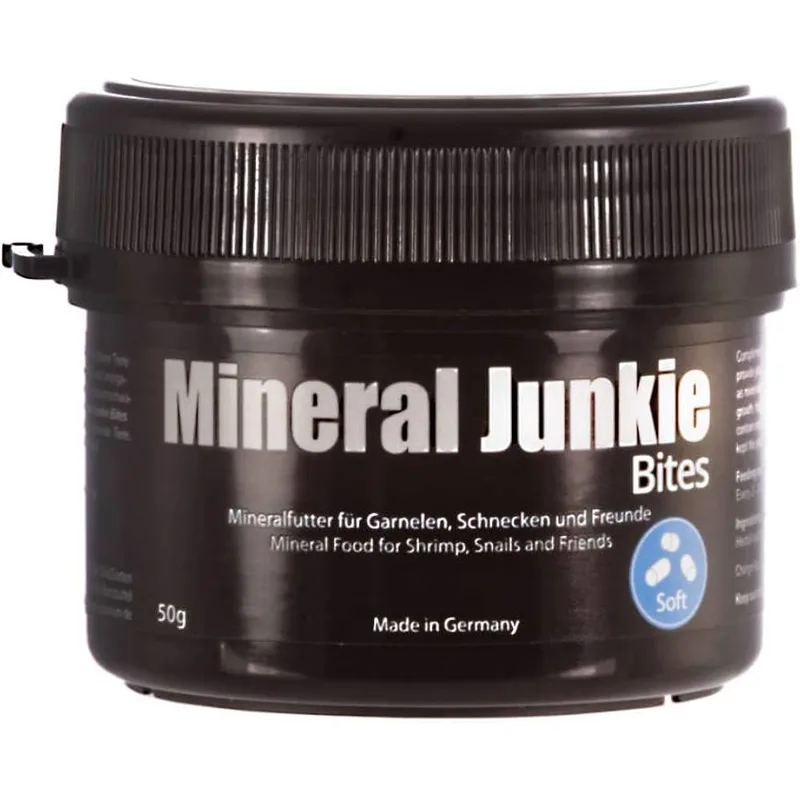
GlasGarten Mineral Junkie Bites
Best Mineral Food- ✓ Delivers minerals directly through feeding instead of the water column
- ✓ Shrimp actively seek it out, unlike passive stones
- ✓ Useful alongside a mineral stone or remineralizer, not a replacement for either
- ✗ More expensive per gram than a mineral stone
- ✗ Needs to be fed regularly rather than set-and-forget
Mineral stones and remineralizers work through the water column or substrate. Mineral Junkie Bites take a third route — minerals delivered directly through feeding, which shrimp seek out actively instead of passively grazing. It pairs well with either a stone or a remineralizer rather than replacing them.
Best for: Colonies already dosing a remineralizer that could use an extra mineral boost around heavy molting periods.
Frequently Asked Questions
Do I need a mineral stone if I use SaltyShrimp remineralizer?
Not strictly, but it helps. SaltyShrimp provides the primary minerals (calcium, magnesium) at precise levels. A mineral stone like Shirakura adds trace elements and gives shrimp a biofilm-covered grazing surface. Think of the remineralizer as the foundation and the mineral stone as the supplement.
How many tourmaline balls do I need per gallon?
A general guideline is 1 ball per 2 gallons, but this is approximate. Tourmaline balls release minerals very slowly, so using a few extra does not cause problems. For a 10-gallon shrimp tank, 5–10 balls scattered in the substrate or filter is a reasonable starting point.
Can mineral stones change my pH?
Montmorillonite stones (like Shirakura) can raise pH very slightly in extremely soft water, but the effect is minimal in most setups. They will not override an active buffering substrate. Tourmaline balls have negligible pH impact. If your pH is where you want it, mineral stones are unlikely to move it meaningfully.
How often do I replace a Shirakura Mineral Stone?
Every 3–6 months, depending on your water chemistry. Softer water dissolves the stone faster. When the stone has crumbled to small pieces and no longer holds its shape, it is time for a new one. You can leave the crumbs in the substrate — they continue releasing trace minerals.
Are mineral stones safe for fish?
Yes. Mineral stones designed for shrimp tanks are safe for all freshwater fish. The minerals released are the same ones found naturally in rivers and streams. Fish generally ignore the stones, though some bottom feeders (corydoras, otocinclus) may graze on the biofilm that develops on the surface.
Can I use tap water instead of RO water with a remineralizer?
You can, but it defeats the purpose. The point of RO water plus remineralizer is precise, consistent mineral content without the unpredictable additives in tap water (chloramine, heavy metals, variable hardness). If your tap water has stable parameters that match your shrimp’s needs, you may not need a remineralizer at all.
Conclusion
For most shrimp keepers, the winning combination is a SaltyShrimp remineralizer matched to your species (GH+ for Caridina, GH/KH+ for Neocaridina) as your primary mineral source, plus a Shirakura Mineral Stone for trace elements and enrichment. The remineralizer handles the measurable parameters, and the stone provides the extras that keep shrimp actively grazing, molting cleanly, and showing their best color.
If you are on a tight budget, Awesome Industries Tourmaline Balls provide basic mineral supplementation for under $6 and last most of a year. They will not replace a proper remineralizer, but they are better than nothing for shrimp in tanks with soft water.
Our Top Pick