AquaRanked is reader-supported. When you buy through links on our site, we may earn an affiliate commission.
Livebearer fry have one enemy that kills more of them than any disease: their own parents. Adult guppies, mollies, platies, and swordtails will eat their own fry within minutes of birth. A fry trap gives newborns a fighting chance by separating them from hungry adults during the critical first hours.
The concept is simple: put the pregnant female in a trap with a partition that lets fry drop through to a safe lower section, or catch fry as they are born and move them to a protected area. The execution varies wildly between products, though. Some traps stress the mother so badly she aborts. Others have such poor water circulation that fry suffocate.
I run a guppy and shrimp breeding operation with multiple racks and have cycled through most of the fry traps on the market. Here are the five that actually work in 2026, plus the gear that makes them work better.
| Fluval Multi-Chamber Holding and Breeding Box (Large) Best Overall | Marina 3-in-1 Floating Breeding Trap Best Value | BaoZqua Dual-Chamber Breeder Box Best Internal Box | Marina 5-Way Convertible Breeding Trap Most Versatile | Finnex External Refugium Breeder Box Best Premium | |
|---|---|---|---|---|---|
| Rating | 9.2/10 | 8.8/10 | 8.6/10 | 8.3/10 | 8/10 |
| Price | $23.99as of Sep 27, 2026 | $8.39as of Sep 27, 2026 | $13.98as of Sep 27, 2026 | $32.96as of Sep 27, 2026 | Unavailable |
| Brand | Fluval | Marina | BaoZqua | Marina | Finnex |
| Type | Hang-on breeder box | Floating internal trap | Internal breeder box | Floating internal trap | External hang-on with pump |
| Chambers | Up to 3 | 2 (with V-partition) | 2 | Configurable (up to 3) | 1 (large) |
| Mounting | Hang-on (external) | Floats inside tank | Suction cups + hook | Floats inside tank | Hang-on with included pump |
| Material | Clear plastic | Clear plastic | Transparent acrylic | Clear plastic with mesh panels | Clear acrylic |
| Water Flow | — | — | — | — | Active (pump-driven) |
| Check Price → | Check Price → | Check Price → | Check Price → | Check Price → |
Prices change daily — tap Check Price for the current Amazon price. Numbers shown were verified on the "as of" date.
Quick Picks
Buying Guide: How to Save More Livebearer Fry
When to Use a Fry Trap
Not every livebearer pregnancy requires a trap. In a heavily planted tank with plenty of hiding spots (floating plants, dense stems, moss), many fry survive without intervention. But if your tank is sparsely decorated or your adult fish are aggressive eaters, a trap significantly improves survival rates.
Watch for signs that a female is about to give birth:
- Squared-off belly (the gravid spot darkens and the belly looks boxy)
- Hiding behavior — she separates from the group and stays near cover
- Reduced appetite in the hours before birth
- Visible contractions or fry visible through the belly wall
Move her to the trap when you see these signs, but do not leave her in the trap for more than 24-48 hours. Extended confinement stresses the mother and can cause health problems.
Trap vs. Planted Tank Method
Many experienced breeders skip traps entirely and use dense floating plants (water sprite, guppy grass, hornwort) as natural fry savers. The plants provide enough cover that a percentage of fry survives each drop. This is the lower-effort approach, but it means accepting that some fry will be eaten.
If you want maximum fry survival from every drop — for line breeding or selling specific strains — a trap gives you near-100% capture of newborns. The tradeoff is the time and stress of catching the pregnant female and monitoring the trap.
Fixing Poor Water Circulation
Stagnant water is the second-biggest killer of trapped fry after the mother herself. Floating traps like the Marina models rely on small slits for passive flow, which is fine in a well-filtered tank but risky during a summer heat wave or in a heavily stocked tank. Running a small airstone off a battery-backed air pump next to the trap keeps oxygen levels up without needing an extra outlet near the tank.
How Long to Keep Fry in the Trap
Move fry out of the breeder trap as soon as possible — ideally within 48 hours. Traps have limited water volume, and fry produce waste that degrades water quality quickly in such a small space. Transfer them to a grow-out tank or a larger breeding net once they are swimming freely and you have counted them.
Feeding Fry in the Trap
Newborn livebearer fry can eat crushed flake food or powdered fry food from birth. Feed tiny amounts 3-4 times per day. In a trap with limited water volume, overfeeding fouls the water fast, so err on the side of less. A single pinch of powder food per feeding is usually enough for a batch of 20-30 fry.
Detailed Reviews
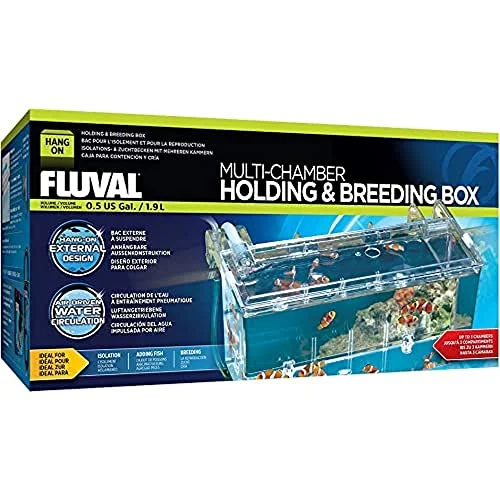
1. Fluval Multi-Chamber Holding and Breeding Box
Fluval Multi-Chamber Holding and Breeding Box (Large)
Best Overall- ✓ Hangs outside the tank — does not take up internal space
- ✓ Up to 3 separate compartments for pregnant females and fry
- ✓ Clear walls let you monitor fish without disturbing them
- ✓ Water circulates from the main tank through the box
- ✗ Requires the tank rim to be thin enough for the mounting bracket
- ✗ Water level in the box drops if tank water level drops
- ✗ Plastic can scratch and cloud over time
The Fluval breeding box hangs on the outside of your tank, which solves the biggest problem with internal traps: space. Hooked up to an air pump (sold separately, roughly 1 L/minute output), your tank water circulates continuously through the box, so fry get the same water quality as the main tank without taking up any internal real estate.
The large version offers up to three separate compartments. The typical setup is: pregnant female in the largest section, newborn fry drop through slots into the second section, and the third section holds slightly older fry that have outgrown the nursery stage. You can also remove partitions to create one large holding area.
Water circulation is the key advantage over floating internal traps. With an air pump attached, the box draws main-tank water through continuously rather than relying on the fish to move it. Fry are never sitting in stagnant water, which means better oxygen levels and less waste buildup. That translates directly to higher survival rates.
The limitation is mounting. The hang-on bracket fits standard aquarium rims, but if your tank has a thick rim, a rimless design with beveled edges, or a lid that interferes with the bracket, you may have fitment issues. Measure your rim before buying.
Best for: Serious livebearer breeders who want maximum fry survival with external convenience.
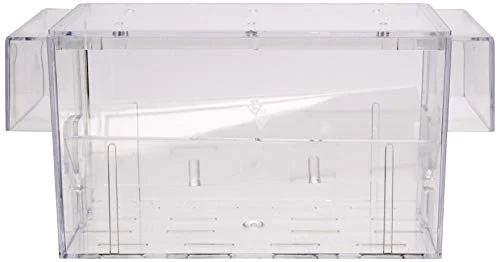
2. Marina 3-in-1 Floating Breeding Trap
Marina 3-in-1 Floating Breeding Trap
Best Value- ✓ Cheapest breeder trap that actually works
- ✓ V-shaped partition lets fry drop safely to the bottom chamber
- ✓ Floats at the water surface — no suction cups to fail
- ✓ Has been the go-to budget trap for decades
- ✗ Small internal volume — stresses larger pregnant females
- ✗ Plastic is thin and cracks if you are not careful
- ✗ Limited water circulation compared to hang-on designs
The Marina 3-in-1 has been the default budget fry trap for at least fifteen years, and it is still the one to recommend when someone asks what the cheapest trap that works is.
The V-shaped partition in the middle is the key feature. When a pregnant guppy or molly gives birth, the fry are small enough to slip through the gap at the bottom of the V and drop into the lower section where the mother cannot reach them. Once the mother is done, remove her and let the fry grow in the protected space.
For the price — often under $10 — it does what it needs to do. The plastic is thin and will crack if dropped, but with basic care it lasts for years. The floating design means it works in any tank regardless of rim style.
The downside is size. A pregnant fancy guppy fits fine, but a large pregnant swordtail or molly will be cramped. Stressed females can delay birth or even reabsorb fry. For larger livebearers, step up to the Fluval or Finnex for more room.
Water circulation is also limited since the trap just floats inside the tank with small slits for flow. In a well-filtered tank this is usually fine, but in a heavily stocked tank or during a heat wave, the reduced flow can stress fry.
Best for: Budget-conscious guppy breeders who need a simple, proven fry saver.
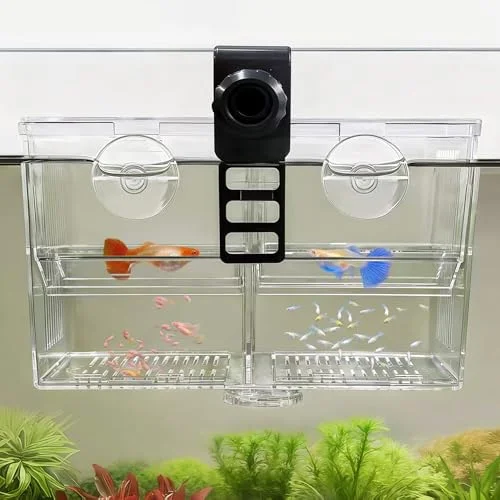
3. BaoZqua Dual-Chamber Breeder Box
BaoZqua Dual-Chamber Breeder Box
Best Internal Box- ✓ Dual mounting options — suction cups or hook over tank rim
- ✓ 0.08-inch birth gaps let fry drop safely while keeping the mother above
- ✓ Mesh vents maintain water flow and prevent stagnation
- ✓ Works for isolation and quarantine too
- ✗ Takes up space inside the tank
- ✗ Suction cups may lose grip in humid conditions
- ✗ Smaller than hang-on options
The BaoZqua is a newer entry that improves on the classic internal breeder box design. The dual-chamber setup uses 0.08-inch birth gaps that let newborn fry drop safely to the lower nursery section while keeping the mother contained above.
The mesh vents on the sides maintain better water flow than solid-wall designs, which reduces the stagnation problem that plagues many internal breeder boxes. The 0.04-inch mesh is fine enough to keep even the smallest fry contained while allowing water and dissolved oxygen to circulate freely.
Mounting flexibility is a nice touch — suction cups for internal placement and a hook for hanging over the tank rim. The suction cups work well on clean glass, but they can lose grip over time as biofilm builds up. The hook mount is the safer bet if your tank rim supports it.
The transparent acrylic construction allows monitoring the mother and fry without disturbing them. You can see when birth has started, count fry, and spot any issues without opening the box.
Best for: Keepers who want an internal breeder box with better water flow than the classic Marina designs.
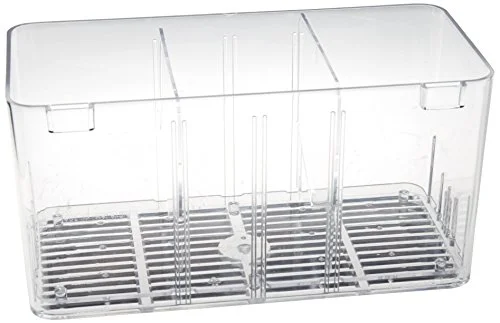
4. Marina 5-Way Convertible Breeding Trap
Marina 5-Way Convertible Breeding Trap
Most Versatile- ✓ Five different configurations for various breeding scenarios
- ✓ Removable mesh panels let you customize airflow and separation
- ✓ Works as a breeder trap, fry saver, or isolation chamber
- ✓ Affordable and widely available
- ✗ Thin plastic panels can warp in warm water
- ✗ Small footprint limits the number of fry you can raise
- ✗ Floating design drifts around the tank
The 5-Way Convertible takes the basic Marina breeding trap concept and adds configurability. Removable mesh panels let you set it up as a simple breeder trap, a divided fry saver with multiple sections, an isolation chamber for sick or aggressive fish, or a combined breeding-and-growing unit.
This flexibility makes it a good choice for one product that handles multiple scenarios. Need to isolate a bullied fish? Reconfigure the panels. Want to separate two batches of fry by age? Create two compartments. The panels snap in and out without tools.
The mesh panels also improve water circulation compared to the solid-wall 3-in-1 model. More flow means better oxygen levels for fry, which is always a good thing.
The catch is the same as any floating internal trap: limited space. The 5-Way Convertible is slightly larger than the 3-in-1, but it is still not big enough for large livebearers or for raising fry past the first week or two. Plan to move fry to a grow-out tank or a larger breeder net once they outgrow the trap.
Best for: Hobbyists who need a multi-purpose trap that handles breeding, isolation, and fry-saving in one product.
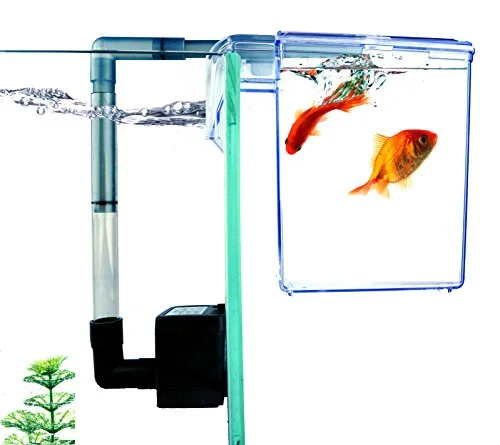
5. Finnex External Refugium Breeder Box
Finnex External Refugium Breeder Box
Best Premium- ✓ Included water pump ensures strong circulation — no stagnant water
- ✓ Largest capacity of any option on this list
- ✓ External placement saves all internal tank space
- ✓ Can double as a refugium for growing plants or pods
- ✗ Most expensive option by a significant margin
- ✗ Pump adds noise and uses an extra power outlet
- ✗ Overkill for casual livebearer breeding
The Finnex is the premium option on this list, and the included water pump is what justifies the higher price. Unlike passive hang-on designs that rely on gravity flow, the Finnex actively pumps water from the main tank through the breeder box, ensuring strong, consistent circulation.
That active flow makes a measurable difference in fry survival. The water in the box stays at the same temperature, oxygen level, and cleanliness as the main tank. There are no dead spots, no temperature gradients, and no waste buildup. For high-value fry (fancy guppy strains, rare livebearers), that reliability is worth the extra cost.
The box itself is clear acrylic and offers the most internal volume of any option on this list. A pregnant swordtail fits comfortably without the cramped stress that smaller traps cause. The box can also double as a refugium — growing java moss inside it to provide natural filtration and infusoria for newborn fry.
The tradeoffs are cost and complexity. The pump uses an extra power outlet and adds a faint hum. The box also takes up space behind the tank. For a single pair of guppies in a 10-gallon tank, the Finnex is overkill. For a dedicated breeding setup with valuable stock, it is the best option available.
Best for: Serious breeders with high-value livebearer strains who want maximum fry survival rates.
Complementary Gear for Fry Trap Success
A trap alone does not guarantee fry survival. These three products solve the problems that come up around the trap itself — feeding, circulation, and where fry go once they graduate.
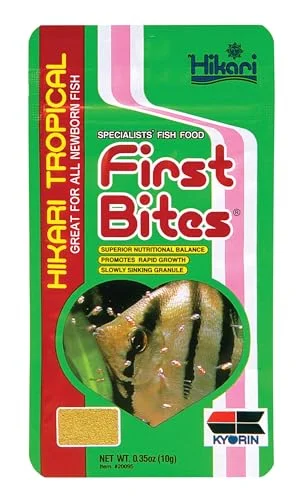
Hikari First Bites (10g)
Hikari First Bites (10g)
- ✓ Semi-floating particles stay in the water column where most fry feed — reduces uneaten food
- ✓ High 48% protein content supports rapid growth during the critical early weeks
- ✓ Works for livebearer fry as well as egg scatterers and mouthbrooders
- ✓ Affordable enough to feed every batch a trap produces
- ✗ Small package (10g) disappears fast when feeding large clutches daily
- ✗ Not fine enough for the very smallest larvae species
Newborn fry sitting in a trap need food they can actually eat and that will not immediately foul the small water volume. First Bites is a semi-floating powder fine enough for livebearer fry from birth, and the 48% protein content supports the fast growth rate that gets fry out of the vulnerable stage quickly.
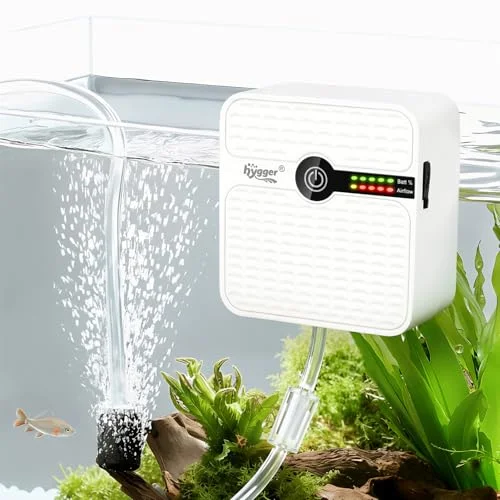
Hygger USB Rechargeable Air Pump
Hygger USB Rechargeable Air Pump
- ✓ Built-in rechargeable battery keeps a floating trap oxygenated even away from an outlet
- ✓ Adjustable airflow with continuous and intermittent modes
- ✓ Up to 22 hours runtime in continuous mode
- ✓ Small enough to run a single airstone next to any trap
- ✗ Louder than plug-in models of similar size
- ✗ Battery capacity decreases over time with repeated charge cycles
Floating traps like the Marina models depend on passive flow through small slits, which struggles in a heavily stocked tank or during a summer heat wave. A small battery-backed air pump running an airstone next to the trap adds real circulation without needing an extra outlet near the tank — useful for breeding racks where outlets are already maxed out.
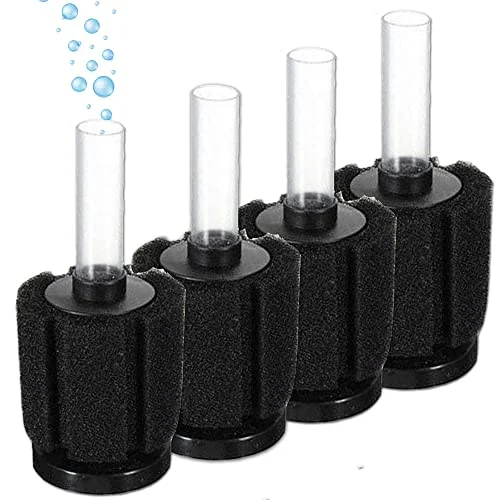
Aquapapa Bio Sponge Filter (4-Pack)
Aquapapa Bio Sponge Filter (4-Pack)
- ✓ Proven design for the grow-out tank fry move to after leaving the trap
- ✓ Good balance of mechanical and biological filtration
- ✓ Weighted base stays planted without suction cups
- ✓ Four-pack covers a standard breeding row of grow-out tanks
- ✗ Slightly bulkier footprint than cylinder-style filters
- ✗ Needs rinsing every 2-3 weeks in active breeding tanks
Fry should not stay in a trap past 48 hours. Once they move to a grow-out tank, they need gentle, fry-safe filtration — a sponge filter is the standard choice because it will not pull fry into an intake. This four-pack covers a full row of grow-out tanks on a breeding rack.
Frequently Asked Questions
Can I leave a pregnant guppy in the breeder trap overnight?
Yes, but no longer than 48 hours total. Prolonged confinement stresses the female and can delay birth or cause her to reabsorb fry. If she has not given birth within 48 hours, return her to the main tank and try again in a few days.
How do I know which fry trap size to buy?
For guppies and endlers, any size works — even the smallest Marina 3-in-1 is adequate. For swordtails and mollies, which are larger fish, choose the Fluval Large or the Finnex to give the mother enough room. A cramped mother is a stressed mother, and stress leads to complications.
Do fry traps work for all livebearers?
Yes. Guppies, endlers, mollies, platies, and swordtails all benefit from fry traps. The V-partition design works for any species where newborns are small enough to drop through the gaps. For species with unusually large fry, the gaps may need to be widened slightly.
Can I use a breeder box for isolating sick fish?
Absolutely. Most breeder boxes work as isolation chambers for sick, injured, or aggressive fish. The Fluval and Finnex are particularly good for this because they hang outside the tank, giving the isolated fish its own space with main-tank water quality.
How many fry can a typical guppy produce?
Female guppies drop 10-60 fry per batch, with 20-30 being average for a healthy adult. Larger, well-fed females produce more fry. With a good trap and proper care, you can save nearly all of them.
Is it better to trap the mother or catch the fry?
Trapping the mother before she gives birth is easier and catches all fry. Catching fry individually after birth in the main tank is tedious and many will be missed. The trap method is faster, more effective, and less stressful for the breeder — though slightly more stressful for the mother.
Conclusion
Best Fry Trap in 2026
For most livebearer breeders, the Fluval Multi-Chamber Breeding Box is the best overall fry trap. Its external design, three-compartment layout, and air-pump-driven water circulation give fry the best survival chances without taking up tank space. If budget is tight, the Marina 3-in-1 Floating Trap under $10 has been saving fry for decades and still works fine for guppies and smaller livebearers.
Whatever trap is chosen, remember: the trap is just step one. Feeding fry properly while they’re in it, keeping the water moving, and getting fry out into a proper grow-out tank within 48 hours is what actually turns saved fry into healthy juvenile fish.