Keeping your freshwater aquarium water in check is the single most important thing you can do for your fish, shrimp, and plants. Ammonia spikes kill. Silent nitrite creep stresses fish into disease. And if you are keeping neocaridina or caridina shrimp, the margin for error on GH, KH, and TDS is even tighter than most beginners realize.
A reliable test kit is not optional — it is the foundation of a healthy tank. But with dozens of options on the market, which ones actually deliver accurate, repeatable results? We break down the five best freshwater aquarium test kits available right now, covering liquid reagents, test strips, and digital photometers.
Quick Picks
| Need | Our Pick |
|---|---|
| Best overall kit | API Freshwater Master Test Kit |
| Most accurate ammonia reading | Salifert Ammonia Test Kit |
| Best for planted & shrimp tanks | Seachem MultiTest Ammonia |
| Best budget option | JNW Direct 9-in-1 Test Strips |
| Best digital precision | Hanna Instruments HI713 Checker |
Why Water Testing Matters
Fish do not show symptoms of poor water quality until damage is already done. Ammonia burns gills before you notice labored breathing. Nitrite inhibits oxygen transport in the blood before a fish stops eating. By the time you see a problem, you are already behind.
Regular testing — weekly at minimum, daily during cycling or after medicating — lets you catch issues before they become emergencies. For shrimp keepers, this is doubly important: invertebrates are far less tolerant of parameter swings than most tropical fish.
A Note for Shrimp Keepers: GH, KH, and TDS
If you keep neocaridina or caridina shrimp, the standard ammonia/nitrite/nitrate tests are necessary but not sufficient. Shrimp are sensitive to mineral content and osmotic pressure, which means you also need to monitor:
- GH (General Hardness): Measures calcium and magnesium. Critical for molting success.
- KH (Carbonate Hardness): Buffers pH stability. Too low and your pH can crash overnight.
- TDS (Total Dissolved Solids): A broad indicator of everything dissolved in the water, including minerals, organics, and waste products.
Neocaridina parameters: pH 6.5–7.5, TDS 150–250 ppm, GH 6–8 dGH, KH 2–4 dKH
Caridina parameters: pH 5.5–6.8, TDS 80–150 ppm, GH 3–5 dGH, KH 0–2 dKH
None of the test kits below measure TDS — you will need a separate TDS meter for that (they run about $10–15 and last for years). For GH and KH, the API GH & KH Test Kit is the go-to add-on and pairs well with any of the kits in this roundup. Keep in mind that caridina shrimp in particular need extremely stable parameters; even small swings in GH or KH during water changes can trigger failed molts or deaths.
Detailed Reviews
1. API Freshwater Master Test Kit
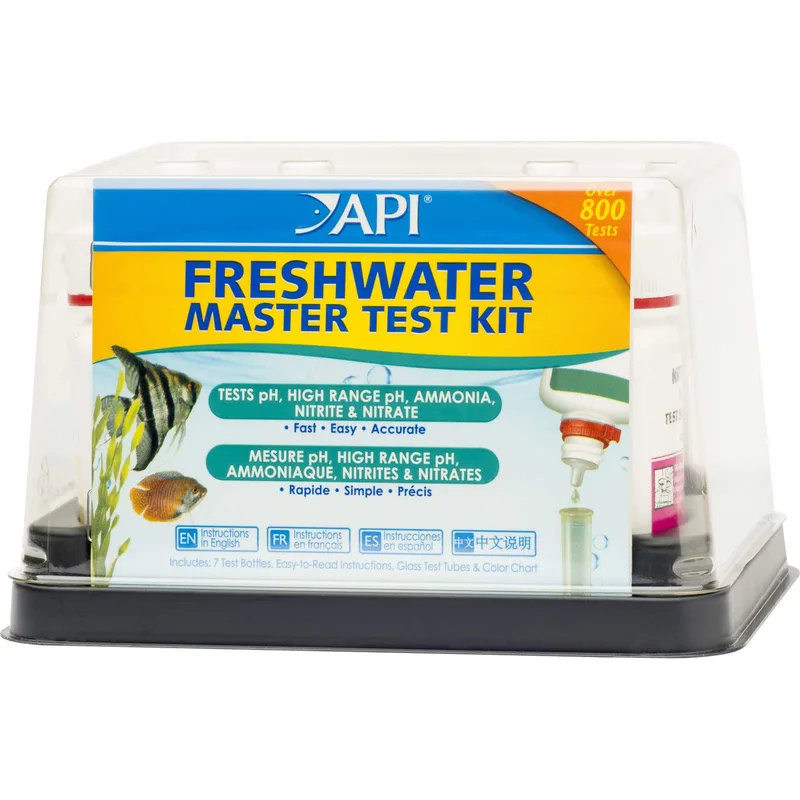
API Freshwater Master Test Kit
Best Overall- ✓ Covers the core nitrogen cycle parameters
- ✓ Liquid reagents are far more accurate than strips
- ✓ Extremely low cost per test
- ✓ Color charts are clear and easy to read
- ✗ No GH, KH, or TDS readings
- ✗ Nitrate test requires vigorous shaking
- ✗ Takes 5-10 minutes per full round of tests
The API Freshwater Master Test Kit is the default recommendation for a reason. It covers the four parameters that matter most during cycling and ongoing maintenance — pH, ammonia, nitrite, and nitrate — with liquid reagents that are meaningfully more accurate than dip strips.
You get over 800 individual tests from a single box, which brings the per-test cost down to a few cents. The color cards are laminated and well-designed, with clear gradations between safe and dangerous levels. The high-range pH test is a nice inclusion for anyone keeping African cichlids or livebearers in harder water.
The main knock is the nitrate test. You need to shake Bottle #2 vigorously for 30 seconds and then shake the test tube for another 60 seconds. Skip that step and you will get falsely low readings. It is a common pitfall that leads new hobbyists to think their nitrates are fine when they are not.
Who it is for: Anyone setting up a new tank, cycling, or maintaining a community freshwater aquarium. This is the kit to start with.
2. Salifert Ammonia Test Kit
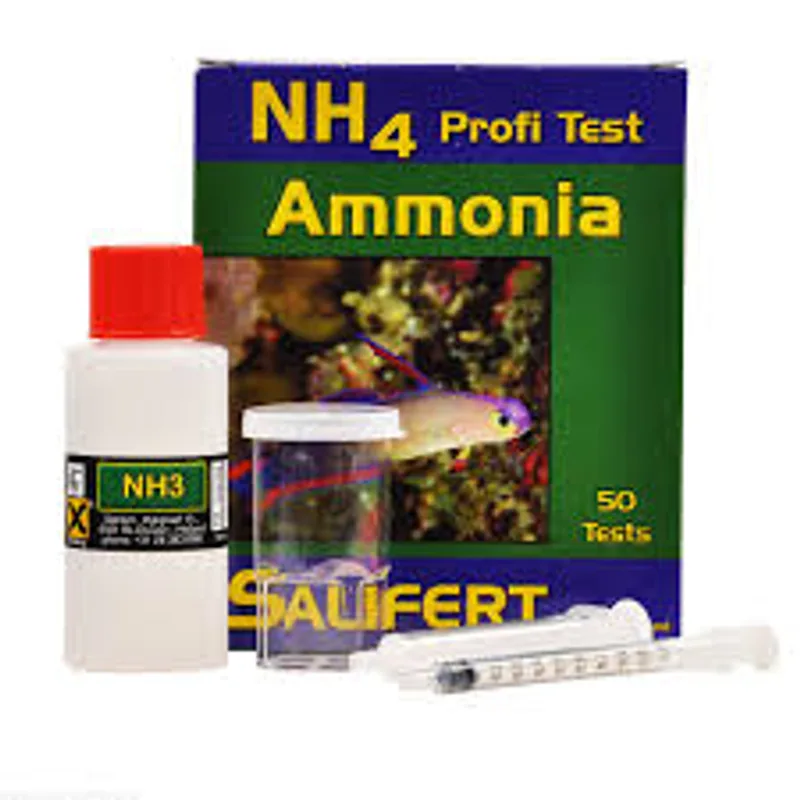
Salifert Ammonia Test Kit
Most Accurate- ✓ Distinguishes free ammonia from total ammonia
- ✓ Extremely precise at low concentrations
- ✓ Trusted by breeders and serious hobbyists
- ✓ Clear color differentiation at critical levels
- ✗ Only covers ammonia — need separate kits for other parameters
- ✗ Slightly more complex procedure than API
- ✗ Higher cost per parameter covered
Salifert kits are made in the Netherlands and have a reputation among reef keepers and serious freshwater breeders for precision at low concentrations. The ammonia kit distinguishes between free ammonia (the toxic form) and total ammonia nitrogen, which is something the API kit does not do.
This distinction matters in tanks with higher pH, where a larger percentage of total ammonia exists in the toxic free form. If you keep shrimp or sensitive species like discus or wild-caught apistos, knowing the free ammonia concentration gives you a clearer picture of actual risk.
The procedure involves a few more steps than API — you are adding reagents in sequence and timing a color development period — but it is straightforward once you have done it twice. The color differentiation at the critical 0–0.5 ppm range is noticeably better than cheaper kits.
Who it is for: Breeders, shrimp keepers, and anyone who needs ammonia precision beyond what the API kit provides.
3. Seachem MultiTest Ammonia
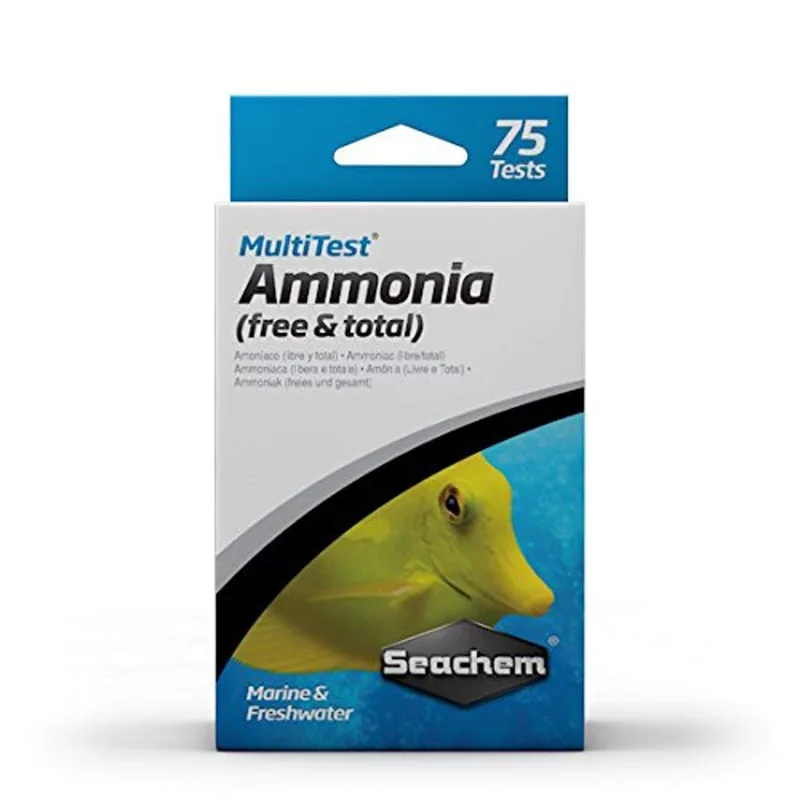
Seachem MultiTest Ammonia
Best for Planted Tanks- ✓ Reads free and total ammonia separately
- ✓ Multi-well plate lets you run several tests at once
- ✓ Reference sample included for calibration
- ✓ Sensitive enough for planted and shrimp tanks
- ✗ Ammonia only — need additional kits for full panel
- ✗ Color interpretation can be tricky in dim lighting
- ✗ Reagents have a shorter shelf life once opened
Seachem’s MultiTest line takes a slightly different approach. Instead of individual test tubes, you get a multi-cavity plastic plate that lets you run several tests side by side. This is useful for comparing readings across multiple tanks or tracking a parameter over time without re-testing.
Like Salifert, the Seachem MultiTest reads both free and total ammonia. It also includes a reference sample so you can verify your reagents are still good — a feature that surprisingly few test kits offer. If your reagents are expired or contaminated, you will know before you waste time on a bad reading.
The kit works well for planted tanks where ammonia from root tabs or aqua soil can leach into the water column during the first few weeks. Being able to distinguish free ammonia from ammonium (which plants actually use) helps you decide whether a water change is urgent or unnecessary.
Who it is for: Planted tank enthusiasts and multi-tank hobbyists who want to batch-test efficiently.
4. JNW Direct 9-in-1 Aquarium Test Strips
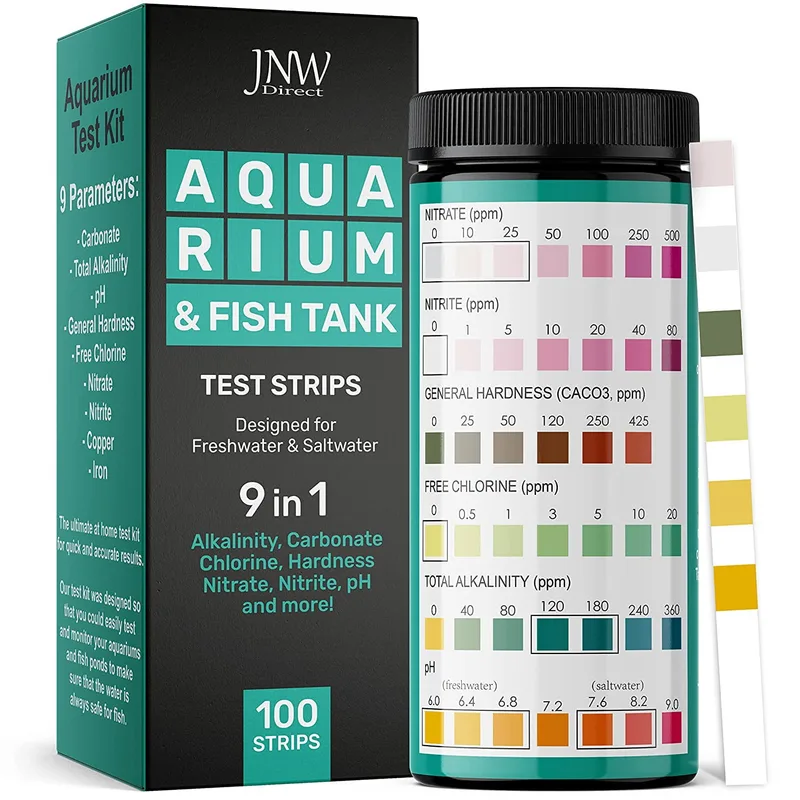
JNW Direct 9-in-1 Aquarium Test Strips
Best Budget- ✓ Results in about 60 seconds
- ✓ Covers 9 parameters in a single dip
- ✓ Includes free eBook with parameter guidance
- ✓ Great for quick daily spot-checks
- ✗ Less precise than liquid reagent kits
- ✗ Color pads can be hard to read in borderline ranges
- ✗ No separate free vs. total ammonia distinction
- ✗ GH and KH readings are rough estimates
Test strips get a bad reputation in the hobby, and some of it is deserved — they are less precise than liquid reagents, especially in borderline ranges. But the JNW Direct strips have a place in your toolkit as a quick daily check.
You dip a strip for two seconds, shake once, wait 60 seconds, and compare against the color chart. In under two minutes you have a rough read on pH, hardness, alkalinity, nitrite, nitrate, and chlorine. When everything looks normal, you save yourself the 10+ minutes a full liquid test takes. When something looks off, you grab the API or Salifert kit for confirmation.
The 100-strip count means each test costs about 16 cents. JNW also includes a free eBook that walks through what each parameter means and what to do when numbers are out of range — helpful for beginners who are still learning what “2 dKH” actually implies for their tank.
Who it is for: Hobbyists who want a fast daily screening tool to complement a more accurate liquid kit.
5. Hanna Instruments HI713 Phosphate Low Range Checker
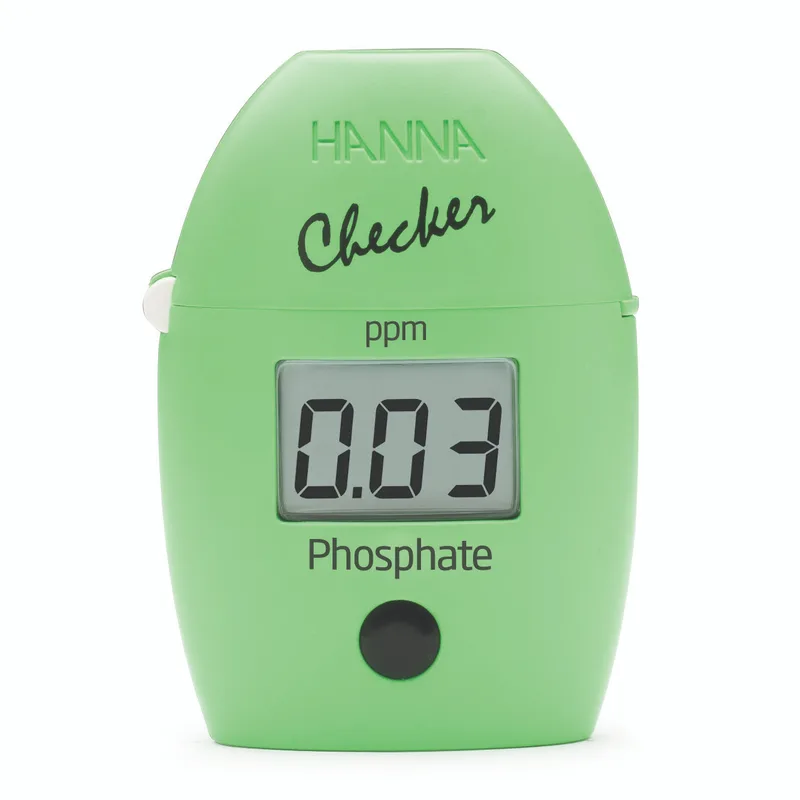
Hanna Instruments HI713 Phosphate Low Range Checker
Best Digital- ✓ Numeric digital readout eliminates color-chart guessing
- ✓ Extremely precise at low phosphate concentrations
- ✓ Compact and portable
- ✓ Reagent refills are affordable
- ✗ Only measures phosphate — not a full test suite
- ✗ Requires purchasing replacement reagents
- ✗ Higher upfront cost than liquid kits
The Hanna Checker line occupies a unique space between hobby-grade kits and lab instruments. The HI713 is a handheld digital photometer that gives you a numeric phosphate reading on a screen — no squinting at color charts, no debating whether that shade is “light blue” or “medium blue.”
Why phosphate? In planted tanks, phosphate is one of the three macronutrients (along with nitrogen and potassium) that drive growth. Too little and plants stall. Too much and you are feeding algae. In non-planted tanks, elevated phosphate often correlates with overfeeding and can contribute to nuisance algae blooms.
The HI713 reads phosphate in the 0.00–2.50 ppm range with a resolution of 0.01 ppm. That level of precision is overkill for a casual community tank, but invaluable if you are dosing EI or lean-dosing a high-tech planted setup. Replacement reagent packs (25 tests each) run about $10, keeping the ongoing cost reasonable.
Who it is for: Planted tank hobbyists and anyone chasing algae problems who needs precise phosphate data.
Comparison Table
| API Freshwater Master Test Kit Best Overall | Salifert Ammonia Test Kit Most Accurate | Seachem MultiTest Ammonia Best for Planted Tanks | JNW Direct 9-in-1 Aquarium Test Strips Best Budget | Hanna Instruments HI713 Phosphate Low Range Checker Best Digital | |
|---|---|---|---|---|---|
| Rating | 9.2/10 | 8.8/10 | 8.5/10 | 7.4/10 | 8.6/10 |
| Price | $34.18-$35.98as of Sep 27, 2026 | $13.99as of Sep 27, 2026 | $21.03-$22.14as of Sep 27, 2026 | $7.99as of Sep 27, 2026 | $86.99as of Sep 27, 2026 |
| Tests Included | pH, High Range pH, Ammonia, Nitrite, Nitrate | Ammonia (free + total) | Free ammonia, Total ammonia | pH, Hardness, Alkalinity, Nitrite, Nitrate, Chlorine, and more | Phosphate (low range) |
| Test Count | 800+ | 50 | 75 | 100 strips | 25 (reagent refills available) |
| Type | Liquid reagent | Liquid reagent | Liquid reagent with multi-cavity plate | Dip strips | Digital photometer |
| Freshwater/Saltwater | Freshwater only | Both | Both | Both | Both |
| Check Price → | Check Price → | Check Price → | Check Price → | Check Price → |
Prices change daily — tap Check Price for the current Amazon price. Numbers shown were verified on the "as of" date.
Buying Guide: How to Choose the Right Test Kit
Liquid Reagents vs. Test Strips vs. Digital
- Liquid reagent kits (API, Salifert, Seachem) offer the best balance of accuracy and cost. They require more time and attention, but the readings are reliable enough to make decisions on.
- Test strips (JNW Direct) are fast and cheap per test. Use them for daily screening, not for diagnosing problems or making water-change decisions.
- Digital photometers (Hanna) remove subjectivity from the equation entirely. They cost more upfront but pay for themselves if you are managing a parameter that requires precision, like phosphate dosing in a planted tank.
What Parameters to Prioritize
- Ammonia and Nitrite — These are the emergency parameters. Any detectable level means something is wrong. Prioritize kits that read these accurately.
- Nitrate — Less immediately dangerous, but chronically high nitrate (above 40 ppm in most freshwater setups) leads to stress, poor coloration, and susceptibility to disease.
- pH — Important for species-specific setups and shrimp keeping. Less critical if you are running a standard community tank with tap water.
- GH and KH — Essential for shrimp keepers. Optional but useful for anyone keeping soft-water species or running CO2 injection.
- Phosphate — Only necessary if you are dosing fertilizers or troubleshooting persistent algae.
Shelf Life and Storage
Liquid reagents expire. Most have a shelf life of 3–5 years sealed, but once opened, exposure to air and light degrades them faster. Store kits in a cool, dark place — not on a shelf above your tank where heat and humidity accelerate degradation. If your results start looking inconsistent, replace the reagents before assuming your tank has a problem.
Frequently Asked Questions
How often should I test my freshwater aquarium water?
During cycling, test daily for ammonia, nitrite, and nitrate. Once established, weekly testing is sufficient for most tanks. If you add new livestock, change your filtration, or medicate, bump back to daily until parameters stabilize.
Are test strips accurate enough for a freshwater tank?
For a quick sanity check, yes. For making decisions about water changes, medication dosing, or diagnosing a sick fish, no. Liquid reagent kits are significantly more reliable in the ranges that matter. Keep strips around for convenience, but confirm any concerning results with a liquid test.
Why does my API nitrate test always read zero?
Almost certainly because Bottle #2 is not being shaken hard enough. The reagent in that bottle settles and crystallizes. Bang it on a table, shake it for a full 30 seconds, then shake the test tube for 60 seconds after adding the drops. Retest — you will likely see a different (and more accurate) result.
Do I need a TDS meter if I keep shrimp?
Yes. TDS gives you a single number that reflects the total mineral and organic content of your water. It is the fastest way to check whether your remineralized RO water is in the right range before adding it to the tank. A basic TDS pen costs $10–15 and takes two seconds to use. For neocaridina, aim for 150–250 ppm. For caridina, 80–150 ppm.
Can I use a saltwater test kit on a freshwater tank?
Technically, ammonia and nitrite chemistry is the same regardless of salinity. But saltwater kits often have different pH ranges and may include parameters you do not need (like calcium and magnesium at reef-level concentrations). Stick with freshwater-specific kits to avoid confusion and unnecessary cost.
How long do liquid test kit reagents last after opening?
Most manufacturers state 3–5 years for unopened bottles. Once opened, expect reliable results for 1–2 years if stored properly. High-range pH and nitrate reagents tend to degrade fastest. If your readings suddenly seem off for no obvious reason, expired reagents are the first thing to rule out.
Conclusion
For most freshwater hobbyists, the API Freshwater Master Test Kit is the right starting point. It covers the critical nitrogen cycle parameters with enough accuracy to keep your tank safe, and the per-test cost is hard to beat.
If you keep shrimp, pair the API kit with a GH/KH test kit and a TDS meter — those three tools together will cover every parameter neocaridina and caridina need. For breeders or anyone keeping sensitive species, upgrading to the Salifert or Seachem ammonia kits gives you the free-ammonia precision that the API kit lacks.
And do not dismiss test strips entirely. The JNW Direct strips are a practical daily screener that takes under two minutes. Use them for routine checks, and pull out the liquid kit when something looks off or when you need numbers you can act on.
Whatever you choose, the important thing is to actually use it. A test kit sitting in a drawer helps no one. Build testing into your weekly maintenance routine, and your tank will be better for it.