AquaRanked is reader-supported. When you buy through links on our site, we may earn an affiliate commission.
An air pump is the heart of any sponge filter setup, and it matters more than most hobbyists expect. A pump that is too weak starves your filter of airflow. One that is too loud ruins a bedroom setup at 2 AM. The right pump delivers consistent, adjustable airflow without constant noise complaints.
The difference between a good pump and a poor one comes down to noise and longevity. Flow rate matters, but even budget pumps move enough air to drive a sponge filter. The question is whether they do it quietly and whether the diaphragm still holds up a year later. Here are the five air pumps worth buying in 2026.
Quick Picks
| Hygger Quietest Aquarium Air Pump Editor's Choice | Tetra Whisper Air Pump Most Trusted | Pawfly Nano Silent Air Pump Best Nano | Hygger USB Rechargeable Air Pump Best Battery Backup | Tetra Whisper AP Deep Water Air Pump Best for Large Tanks | |
|---|---|---|---|---|---|
| Rating | 9.3/10 | 8.9/10 | 8.6/10 | 8.4/10 | 8.2/10 |
| Price | $43.69as of Sep 27, 2026 | Check price | $9.99as of Sep 27, 2026 | $23.99as of Sep 27, 2026 | $25.09-$44.00as of Sep 27, 2026 |
| Brand | Hygger | Tetra | Pawfly | Hygger | Tetra |
| Wattage | 10W | ~3W | 1.3W | 2.5W | 5W+ |
| Flow Rate | 80-255 GPH (3 settings) | Up to 40 GPH | 450 mL/min | 24 GPH | Up to 150 GPH |
| Outlets | 2 | 1 | 1 | 1 | 1 |
| Tank Size | Up to 600 gal | Up to 40 gal | 1-15 gal | Up to 30 gal | Up to 150 gal |
| Noise Level | <30 dB | ~35 dB | <35 dB | <40 dB | ~38 dB |
| Battery | — | — | — | USB rechargeable lithium | — |
| Check Price → | Check Price → | Check Price → | Check Price → | Check Price → |
Prices change daily — tap Check Price for the current Amazon price. Numbers shown were verified on the "as of" date.
Buying Guide
How to Size an Air Pump
Match the pump rating to your tank volume, then go one size up if you plan to run multiple sponge filters or air devices. A pump rated for 20 gallons will comfortably drive one sponge filter in a 20-gallon tank, but it will strain to power two sponge filters or a sponge filter plus an air stone simultaneously.
For shrimp tanks, less airflow is generally better. Shrimp dislike strong currents, and excessive bubble output creates surface turbulence that stresses small shrimp and shrimplets. An adjustable pump or an inline control valve lets you find the right balance without buying a separate unit.
Noise Reduction Tips
- Place the pump on a folded towel, a piece of foam, or a rubber mat — never directly on a hard shelf
- Hang the pump at or above water level to prevent backflow noise through the airline
- Always install a check valve between the pump and the tank
- Replace worn diaphragms — they get progressively louder as they age
- If the pump buzzes against a wall, add adhesive felt pads between the housing and the surface
Shrimp-Safe Considerations
Air pumps are always shrimp-safe — they move air, nothing else. The shrimp-safety question applies to what the pump drives. Sponge filters and air stones are fully safe for shrimp and shrimplets. Air-driven internal filters with open intakes are not. Make sure whatever you attach to the airline is shrimp-appropriate before adding any invertebrates.
All five pumps reviewed here are safe for shrimp tanks. No copper, no chemicals, no exposed intakes.
When to Replace Your Air Pump
Most diaphragm air pumps last 2-4 years with continuous use. Warning signs include reduced airflow (bubbles slow even though the pump sounds normal), increased noise (uneven diaphragm flex), and the pump housing getting warm. Some pumps, including several Tetra models, have replacement diaphragm kits available — worth checking before buying a whole new unit.
Detailed Reviews
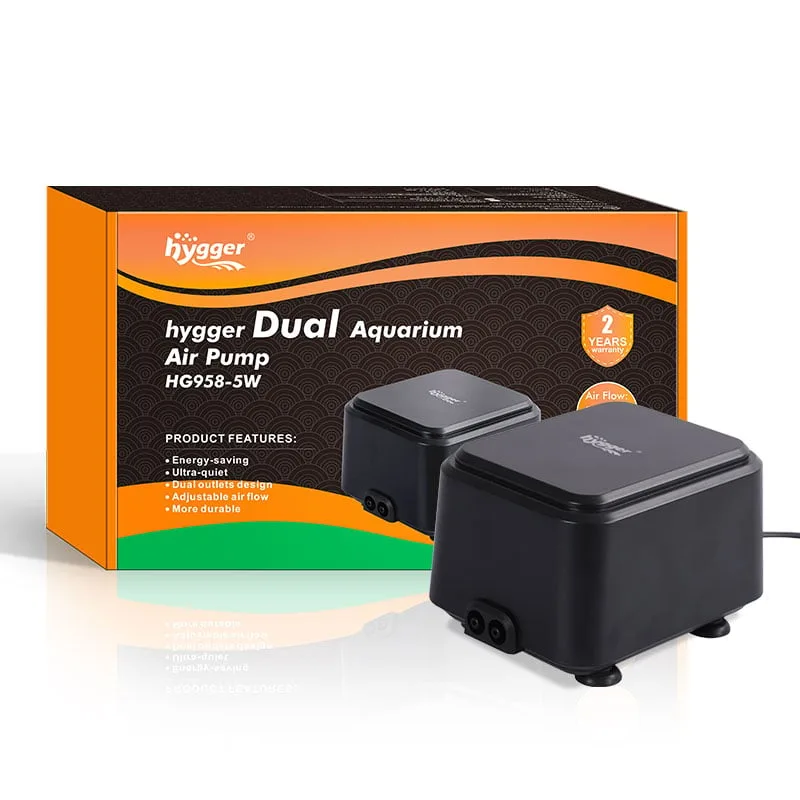
1. Hygger Quietest Aquarium Air Pump
Hygger Quietest Aquarium Air Pump
Editor's Choice- ✓ Genuinely quiet — one of the lowest noise ratings in the category at under 30 dB
- ✓ Adjustable airflow knob lets you dial in exact output without a separate valve
- ✓ Three flow settings (80, 160, and 255 GPH) cover tanks from nano to 600 gallons
- ✓ Rubber feet and vibration-dampened housing reduce desk buzz significantly
- ✗ Diaphragm may weaken after 18-24 months of continuous use
- ✗ Larger model is overkill for a single nano or small tank
Hygger earns the top spot because they actually engineered this pump to be quiet rather than just marketing it that way. The internal design uses a bearingless motor with magnetic suspension, thickened ABS housing to contain motor noise, and rubber feet to absorb vibration. According to the verified specs, the result is a pump that runs under 30 dB — quieter than most rooms at rest. Place it on a folded towel or a piece of foam and it effectively disappears.
The adjustable airflow dial is the other standout. Most air pumps run at full output or not at all, forcing you to buy a separate inline valve to reduce flow. The Hygger lets you dial airflow up or down directly on the unit. For shrimp tanks where gentle, steady flow is critical, that built-in control is a real advantage. Dial down the left outlet for a shrimp colony, open both outlets fully to drive multiple sponge filters across a breeding rack.
At 10W with three output settings (80, 160, and 255 GPH), this single model covers tanks from small community setups to 600 gallons. On a breeding rack running six 10-gallon tanks, one Hygger on full output can drive all six sponge filters simultaneously through an airline splitter.
Best for: Anyone who prioritizes quiet operation and wants adjustable airflow without extra hardware.
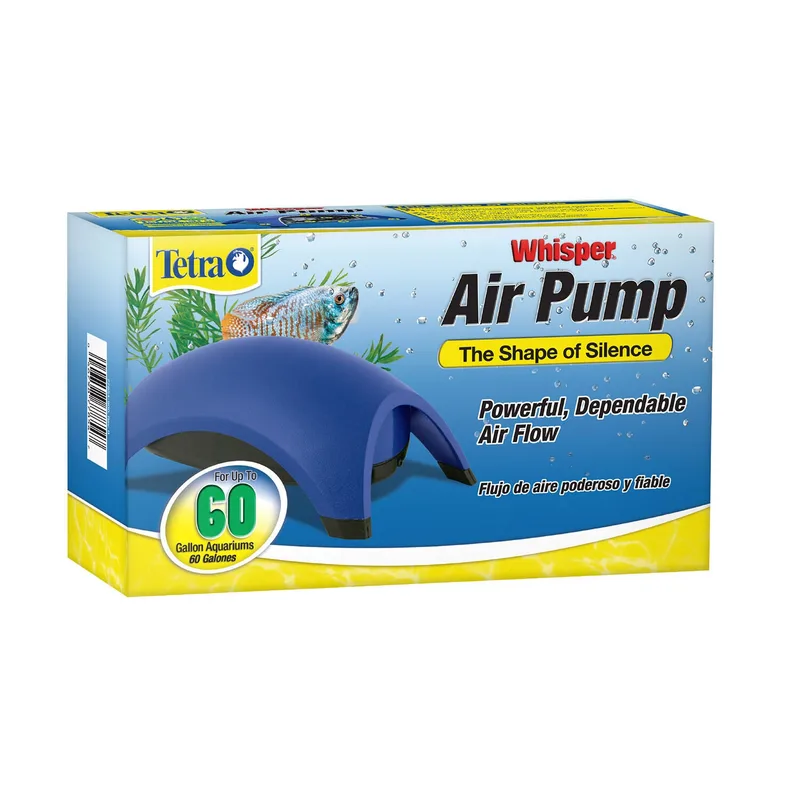
2. Tetra Whisper Air Pump
Tetra Whisper Air Pump
Most Trusted- ✓ The most well-known air pump brand — proven reliability over decades
- ✓ Dome shape with suspended motor minimizes vibration and noise
- ✓ Right-sized for 20 to 40-gallon community tanks
- ✓ Extremely affordable at the smaller sizes
- ✗ Not adjustable — requires a separate inline valve to control flow
- ✗ Can buzz against hard surfaces — place on a foam pad
The Tetra Whisper has been the default air pump recommendation for over twenty years, and that reputation was earned through reliability. User reviews consistently report Whisper pumps running continuously for years without failure. The dome-shaped design is not just aesthetic — it dampens vibration by suspending the diaphragm away from flat surfaces.
It is not the quietest pump on this list (the Hygger beats it), but it is quiet enough for most rooms, especially on a soft surface. The downside is the lack of adjustability. The Whisper runs at one speed. If the airflow is too strong for a sponge filter, you need to add an inline control valve to bleed off excess air — about $3 on Amazon and easy to set up, but an extra piece of hardware.
Pricing is where the Whisper shines. The 40-gallon model typically runs under $15, making it one of the cheapest pumps from a major brand. For a single mid-size community tank with a sponge filter, the value is hard to beat.
Best for: Budget-conscious hobbyists who want proven reliability without adjustable flow.
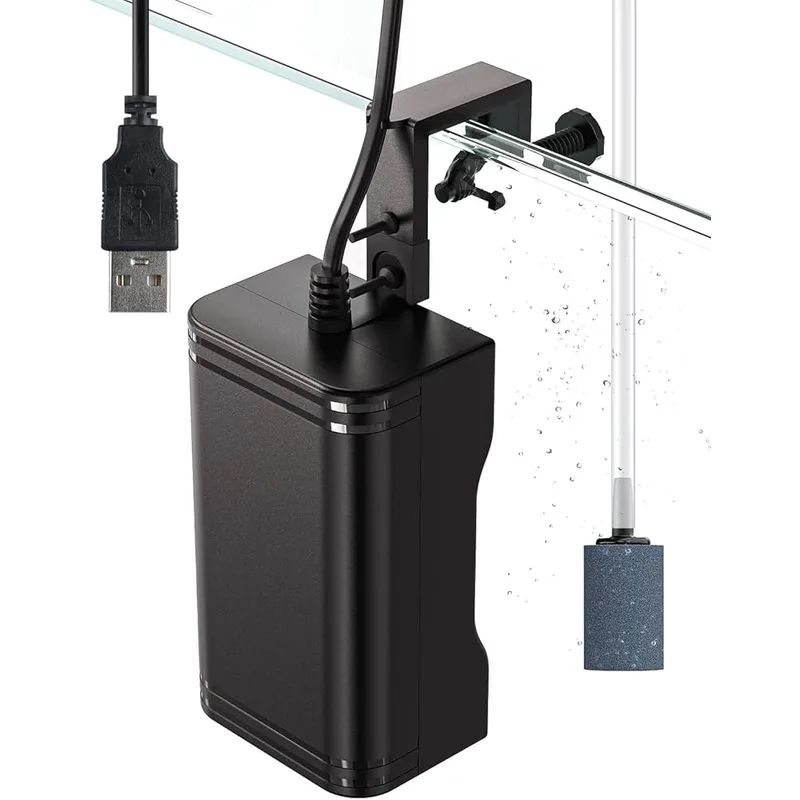
3. Pawfly Nano Silent Air Pump
Pawfly Nano Silent Air Pump
Best Nano- ✓ Extremely compact — smaller than a deck of cards
- ✓ Very quiet for a pump this affordable
- ✓ Comes with air stone, airline tubing, and check valve
- ✓ Perfect for a single sponge filter in a nano shrimp tank
- ✗ Not enough power for tanks over 15 gallons
- ✗ Single outlet only — cannot run multiple filters
The Pawfly Nano is the smallest plug-in air pump worth recommending. At 1.3W, it draws negligible power and takes up almost no space behind a tank. What sells it is the complete kit — pump, air stone, airline tubing, and check valve included. Open the box, connect the pieces, plug it in. No separate shopping for accessories.
For a single nano shrimp tank or a betta tank with a small sponge filter, the Pawfly has sufficient output. The 450 mL/min flow rate drives a nano sponge filter with a steady stream of bubbles. Noise is acceptable in context — a faint hum in a quiet room, but it blends into background noise easily. Placing it on a soft surface reduces vibration noticeably.
The Pawfly will not power anything larger than a 15-gallon tank and cannot run multiple filters. That is not a limitation — it is the design intent.
Best for: Single nano tank setups where space and budget are limited.
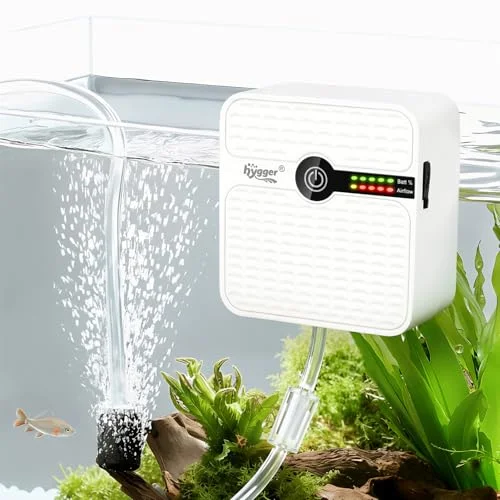
4. Hygger USB Rechargeable Air Pump
Hygger USB Rechargeable Air Pump
Best Battery Backup- ✓ Built-in rechargeable battery keeps running during power outages
- ✓ USB charging works with any phone charger or power bank
- ✓ Adjustable airflow with continuous and intermittent modes
- ✓ Up to 22 hours runtime in continuous mode, up to 37 hours in intermittent mode
- ✗ Louder than plug-in models of similar size
- ✗ Battery capacity decreases over time with repeated charge cycles
Power outages kill fish colonies — not immediately, but without surface agitation, oxygen levels drop fast over several hours. A battery-backed air pump is cheap insurance against that scenario.
The Hygger USB Rechargeable runs on a built-in lithium battery that charges via USB, so any phone charger or power bank works as a charger. On a full charge, it runs for up to 22 hours in continuous mode or up to 37 hours in intermittent mode (10 seconds on, 10 seconds off). That covers most residential power outages and keeps fish and shrimp alive until power is restored.
The four adjustable airflow settings let you balance output against battery life. In an emergency, dial it down to the minimum setting that still creates surface ripple and conserve charge. The tradeoff is noise — battery-powered pumps run louder than plug-in equivalents because the motor compensates for battery voltage drop. This is a backup pump, not a primary daily driver.
Best for: Anyone who wants power-outage insurance, especially shrimp keepers with sensitive colonies.
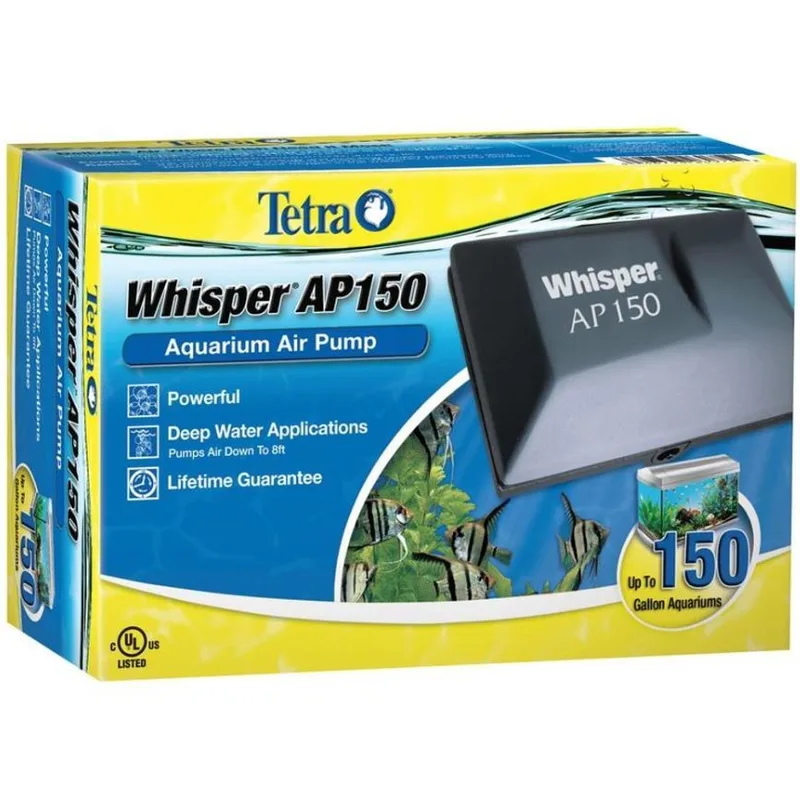
5. Tetra Whisper AP Deep Water Air Pump
Tetra Whisper AP Deep Water Air Pump
Best for Large Tanks- ✓ Enough pressure for deep tanks over 18 inches
- ✓ Can drive multiple sponge filters or air stones simultaneously
- ✓ Tetra reliability in a heavy-duty package
- ✓ Deep water pressure rating handles tall column tanks
- ✗ Noticeably louder than smaller Whisper models
- ✗ Overkill for most nano and mid-size setups
- ✗ No adjustable flow — use airline valves to regulate
Standard air pumps lose performance as water depth increases. Pushing air through a sponge filter at the bottom of an 18-inch tank requires significantly more pressure than a 10-inch tank. The Tetra Whisper AP series is rated for deep water applications — consistent airflow in tanks up to 24 inches deep.
For tall column tanks, large community setups, or breeding rack consolidation, the AP has enough output. The AP 150 model tops out at 150 gallons with enough pressure for multiple sponge filters running off a single pump. In a fish room running multiple 20-gallon grow-out tanks, one AP 150 can replace three or four smaller pumps and free up outlet space.
The noise is the compromise. Deep water pumps need stronger diaphragms and more powerful motors, and that translates to audible operation. A thick foam pad or wall-mounted shelf helps. For bedroom tanks, use a quieter pump — the AP series is a fish room tool.
Best for: Large tanks, deep tanks, and fish room setups where one pump drives multiple filters.
Frequently Asked Questions
Do I need an air pump if I have a hang-on-back filter?
Not necessarily. Hang-on-back filters create surface agitation that oxygenates the water. An air pump adds extra aeration and can drive a sponge filter as a secondary or backup. For shrimp tanks specifically, many keepers run both: the HOB for primary filtration and a sponge filter for shrimp-safe biological filtration with biofilm for shrimp to graze on.
How many sponge filters can one air pump run?
It depends on pump wattage and sponge filter size. A 2W pump comfortably runs one small or medium sponge filter. A 4-6W pump can run two to three sponge filters through an airline splitter. Going beyond that requires a commercial-grade pump or multiple units. The Hygger 10W on full output can drive six or more small sponge filters simultaneously.
Should I run my air pump 24/7?
Yes. Beneficial bacteria in your sponge filter need constant water flow to stay alive. Turning off the pump for extended periods kills bacteria colonies and can crash your cycle. The only acceptable exception is a brief pause during feeding — some keepers stop the pump for 15-30 minutes so food does not get blown around — but keep it short.
Is a more expensive pump always quieter?
Not always, but generally yes. Pumps that use bearingless motors, magnetic suspension, and rubber-dampened housings cost more to manufacture and tend to run quieter. The cheapest budget pumps use basic motors with minimal noise dampening. The Hygger line demonstrates that mid-price pumps can punch well above their weight on noise control at under 30 dB.
Can I use an air pump for CO2 injection?
No. Air pumps push atmospheric air, which is about 0.04% CO2. A dedicated CO2 system uses pressurized gas at much higher concentrations. Running an air pump in a CO2-injected planted tank actively off-gasses the dissolved CO2, reducing its effectiveness. If you run CO2, skip the air pump or run it only at night when CO2 is turned off.
What size air pump do I need for a breeding rack?
For a rack of 10-gallon tanks running one sponge filter each, a Hygger 10W on full output handles six tanks through a six-way airline splitter. For larger racks with 20-gallon tanks or dual sponge filters per tank, use a Tetra AP 150 or add a second Hygger. Always err toward more pump capacity on a breeding rack — fry do not tolerate low-oxygen events.
Conclusion
For most freshwater setups, the Hygger Quietest Air Pump is the clear winner. The under-30-dB noise rating, adjustable airflow dial, and capacity to run up to 600 gallons make it the most versatile pump in the category. If budget is the priority and adjustable flow is not a concern, the Tetra Whisper delivers proven multi-year reliability at bargain prices — add a $3 inline control valve and you have a complete, quiet solution.
For breeding racks and fish rooms, the Tetra Whisper AP 150 consolidates multiple smaller pumps into one unit with enough output for tall tanks and multiple filters simultaneously. Keep a Hygger USB Rechargeable charged as backup insurance — on a breeding rack, a power outage without aeration can cost a month’s worth of fry.
Our Top Pick