Aquascaping is what separates a tank with some plants in it from a tank that actually looks intentional. You do not need to be an artist or spend thousands of dollars. You need a basic understanding of layout principles, the right hardscape materials, and plants matched to your lighting and CO2 setup.
This guide covers the fundamentals: the three dominant layout styles, how to choose and place hardscape, which plants work for beginners, and the tools that make the whole process less frustrating.
The Three Core Layout Styles
Most freshwater aquascapes fall into one of three categories. Understanding these gives you a framework to start from, even if your final tank ends up as a hybrid.
Nature Style
Pioneered by Takashi Amano, nature style aquascaping recreates miniature natural landscapes — forests, mountains, river banks. The hallmarks are:
- Irregular, asymmetric placement of rocks and driftwood
- A mix of plant species at different heights and textures
- Open swimming space balanced against planted areas
- A focal point positioned according to the golden ratio (roughly one-third from either side)
Nature style is the most forgiving for beginners because imperfection is part of the aesthetic. A slightly crooked piece of driftwood or unevenly growing moss adds to the natural feel rather than detracting from it.
Iwagumi
Iwagumi is a Japanese stone-arrangement style that uses rocks as the primary design element with minimal plant species — often just one or two carpeting varieties. The rules are strict:
- Odd number of stones (typically 3, 5, or 7)
- One dominant stone (Oyaishi) that sets the scale and direction
- Supporting stones placed to create visual tension and balance
- Low carpeting plants only — Monte Carlo, dwarf hairgrass, or glossostigma
- Open, minimalist negative space
Iwagumi looks deceptively simple but is one of the hardest styles to execute well. The minimal plant selection means algae has less competition, so lighting, CO2, and nutrient balance must be dialed in precisely. This is not a beginner-friendly style, but understanding it improves your eye for hardscape placement in any layout.
Dutch Style
Dutch aquascaping treats the tank like a terrestrial garden. There is little to no hardscape — the focus is entirely on plants arranged in dense, colorful groupings:
- Multiple plant species organized by height (short front, tall back)
- Strong color contrast between adjacent plant groups
- Manicured, organized rows often following “streets” that create depth
- Regular trimming to maintain defined shapes and boundaries
Dutch tanks are high-maintenance. They require consistent fertilization, strong lighting, and frequent trimming to prevent one species from overtaking another. The payoff is a lush, garden-like display that showcases plant diversity.
Hardscape Fundamentals
Hardscape — rocks and wood — forms the skeleton of your aquascape. Get this right and the rest of the layout falls into place. Get it wrong and no amount of plants will save the design.
Choosing Rocks
Seiryu stone: Blue-gray limestone with dramatic white veining. The most popular aquascaping stone for good reason — it has strong visual presence and natural fracture lines that create interesting shapes. Note: Seiryu stone raises KH and pH, which makes it unsuitable for caridina shrimp tanks or soft-water setups without buffering substrate.
Dragon stone (Ohko stone): Tan/brown stone with deep pits and crevices. Inert — does not affect water chemistry. Lightweight and easy to work with. Excellent for nature-style layouts and safe for shrimp tanks.
Lava rock: Porous and lightweight with a rough texture. Inert and affordable. Great for colonizing beneficial bacteria and attaching moss or anubias. Not as visually dramatic as Seiryu or dragon stone.
Mountain stone: Gray, angular stone with a rough slate-like texture. Creates convincing cliff and mountain faces. Inert and widely available.
Choosing Wood
Spider wood: Branching, spindly pieces that create dramatic tree-like silhouettes. Sinks relatively quickly and provides excellent anchor points for moss and epiphytic plants. Releases tannins — expect some water discoloration initially.
Manzanita wood: Dense, branching hardwood with reddish-brown bark. Creates elegant, tree-like structures. Takes longer to sink than spider wood but lasts years without decomposing.
Malaysian driftwood: Dense, dark wood that sinks immediately. Gnarly shapes with good texture. Releases tannins heavily — pre-soaking for a week or more is recommended unless you want blackwater conditions.
Cholla wood: Hollow cactus skeleton with a lattice pattern. Lightweight and decomposes within 1-2 years. Perfect for shrimp tanks — the hollow interior provides hiding spots and the surface grows biofilm that shrimp graze on.
Placement Rules
- Odd numbers. Use an odd number of rocks and wood pieces. Even numbers create symmetry, which looks artificial in natural layouts.
- Golden ratio focal point. Place your largest or most dramatic piece roughly one-third from the left or right edge — not centered.
- Vary sizes dramatically. A single large rock surrounded by two or three small supporting stones looks more natural than three similarly sized rocks.
- Bury the base. Push rocks and wood partially into the substrate. Pieces sitting on top of the substrate look placed; pieces emerging from it look natural.
- Create depth with elevation. Build up substrate toward the back using support materials (lava rock, plastic mesh) to create sloping terrain. This adds visual depth, especially in smaller tanks.
Essential Aquascaping Tools
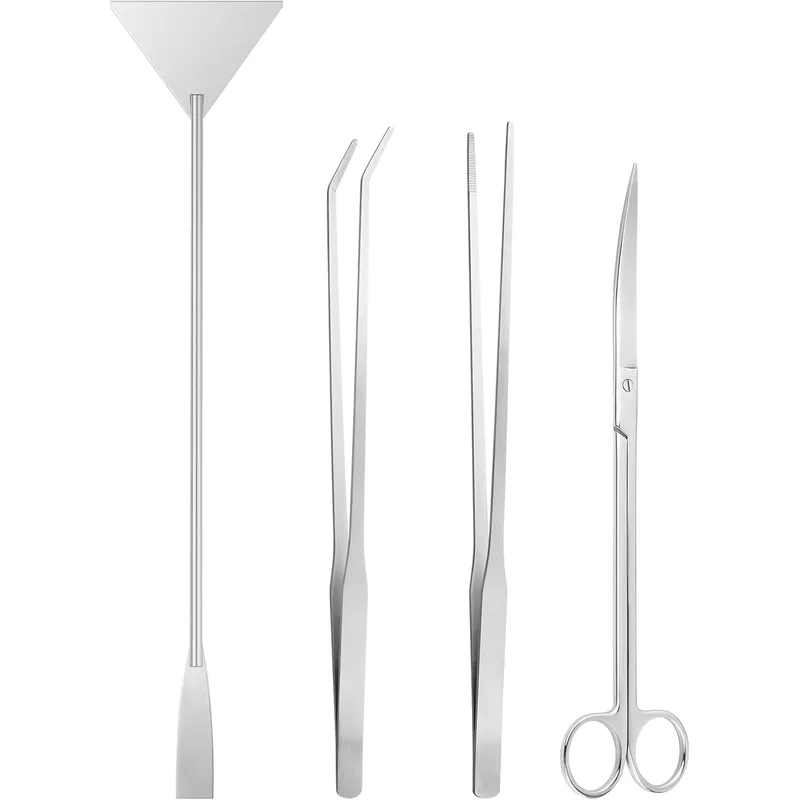
Ohtomber Aquascape Tools Kit
Best Starter Kit- ✓ Covers all basic aquascaping needs in one set
- ✓ Long enough to reach the bottom of most tanks
- ✓ Affordable entry point for beginners
- ✗ Tips are not as precise as premium brands
- ✗ May develop surface rust if not dried after use
A basic aquascaping toolkit makes planting dramatically easier. Long tweezers are essential for pushing stems and root plants into substrate without disturbing neighboring plants. Curved scissors let you trim carpeting plants and stems at the substrate line without reaching into the tank.
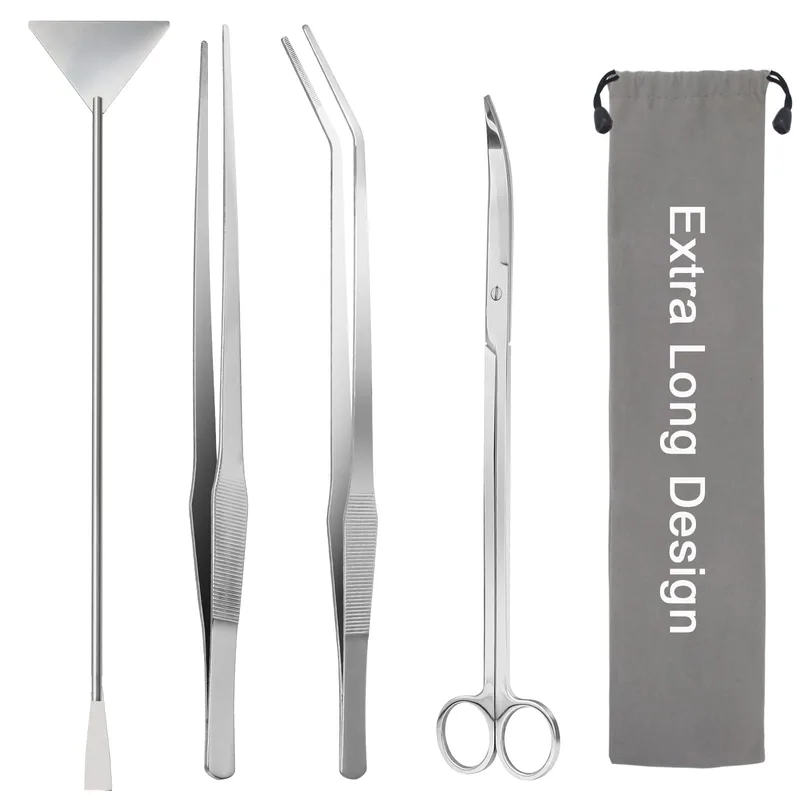
Liveek 4-in-1 Aquascape Tools Set
Best Build Quality- ✓ Anti-rust coating holds up well in wet conditions
- ✓ Curved scissors are ideal for trimming carpeting plants
- ✓ Sand spatula is useful for substrate shaping
- ✗ Tweezers can feel slightly stiff for delicate planting
- ✗ No carrying case included
The Liveek set adds a sand spatula, which is surprisingly useful for leveling and shaping substrate slopes. The anti-rust coating is a practical advantage over cheaper uncoated sets.
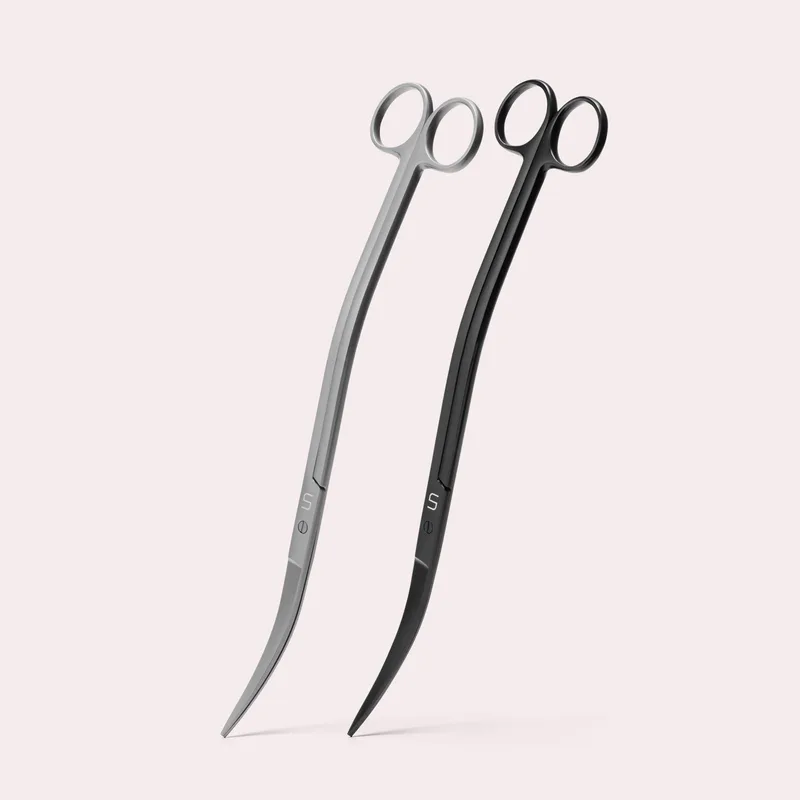
UNS Aquascaping Wave Scissors
Best Scissors- ✓ Wave blade shape follows natural plant contours
- ✓ Sharp enough for clean cuts that reduce plant damage
- ✓ Premium feel and build quality
- ✗ Only scissors — need separate tweezers and tools
- ✗ Higher price for a single tool
For serious trimmers, the UNS wave scissors are a noticeable upgrade. The curved blade follows plant contours and makes clean cuts that heal faster than the torn edges left by dull budget scissors.
Beginner-Friendly Plants by Position
Foreground (Short, Carpet-Like)
- Dwarf sagittaria: Grows in low-to-moderate light, spreads via runners, and tolerates a wide range of water parameters. The easiest carpeting plant for beginners.
- Monte Carlo: Needs moderate light and benefits from CO2, but can carpet without injection in high-light setups. Slower to fill in than hairgrass.
- Marsilea hirsuta: Clover-like leaves that create a low, dense carpet. Grows slowly but reliably in low-tech tanks.
Midground
- Cryptocoryne wendtii: Bronze, green, or red varieties. Slow-growing, tolerant of low light, and virtually indestructible once established. May melt initially but always recovers.
- Anubias nana: Attach to rocks or wood — do not bury the rhizome. Grows in almost any light condition. Very slow-growing but incredibly hardy.
- Bucephalandra: Similar to anubias but with more color variety. Attach to hardscape. Grows slowly and is shrimp-safe.
Background (Tall, Column-Filling)
- Vallisneria: Tall, grass-like leaves that create natural movement in current. Grows fast and spreads aggressively via runners. Easy and forgiving.
- Rotala rotundifolia: Colorful stem plant that turns pink-red under strong light. Grows quickly and responds well to trimming. Needs moderate-to-high light for best color.
- Ludwigia repens: Red-green stem plant that is easy to grow in moderate light. Good color contrast against green plants.
Floating Plants
- Red root floaters: Provide natural shade, absorb excess nutrients, and reduce algae. Roots provide cover for shrimp and fry.
- Dwarf water lettuce: Fast-growing surface cover. Excellent nutrient absorber but can block light to plants below if not thinned regularly.
- Salvinia minima: Small floating fern that multiplies quickly. Easy to manage and provides shelter for surface-dwelling fry.
Substrate Choices
Active substrates (Fluval Stratum, ADA Amazonia, Controsoil) buffer pH downward and provide nutrients. Ideal for planted tanks and required for caridina shrimp. They exhaust after 1-2 years.
Inert substrates (pool filter sand, black diamond blasting sand, gravel) do not affect water chemistry. Cheaper and longer-lasting, but you will need root tabs for rooted plants. Fine for neocaridina shrimp.
Combination approach: Many aquascapers use active substrate under a cap of inert sand or fine gravel. This provides root nutrition while giving a clean visual appearance.
Common Beginner Mistakes
- Starting too complex. A tank with 15 plant species, 6 types of rock, and 3 pieces of driftwood will look chaotic. Start with 3-4 plant species and one type of hardscape.
- Ignoring the rule of thirds. Centering your focal point creates a static, uninteresting composition. Offset it.
- Flat substrate. A level substrate from front to back eliminates depth perception. Slope it up toward the back, even slightly.
- Planting too densely at first. Plants need room to grow and fill in. Planting stems every half-inch looks great on day one and becomes an overgrown mess by week three.
- Skipping the dry start. For carpeting plants, a dry start method (planting in moist substrate before flooding) gives roots 4-6 weeks to establish without algae competition. Worth considering for iwagumi layouts.
Frequently Asked Questions
Do I need CO2 for aquascaping?
No. Many beautiful aquascapes use only low-tech plants without CO2 injection. CO2 expands your plant options and accelerates growth, but it also increases maintenance complexity and cost. Start without it and add later if you want to grow demanding species.
How much does aquascaping cost?
A basic 10-gallon aquascape with inert substrate, a few rocks, and beginner plants can be set up for $50-100 beyond the tank and filter. High-end setups with active substrate, premium hardscape, and CO2 can run $300-500 for a 20-gallon tank.
How long does it take for an aquascape to fill in?
Most planted tanks start looking good at 6-8 weeks and reach their intended design at 3-6 months, depending on plant species and CO2 availability. Patience is the most underrated aquascaping skill.
Can I aquascape a shrimp tank?
Absolutely. Shrimp tanks are some of the best candidates for aquascaping because shrimp are small, stay near the bottom, and do not uproot plants. Use dragon stone (inert) instead of Seiryu stone if keeping caridina, and incorporate cholla wood or moss-covered hardscape for grazing surfaces.